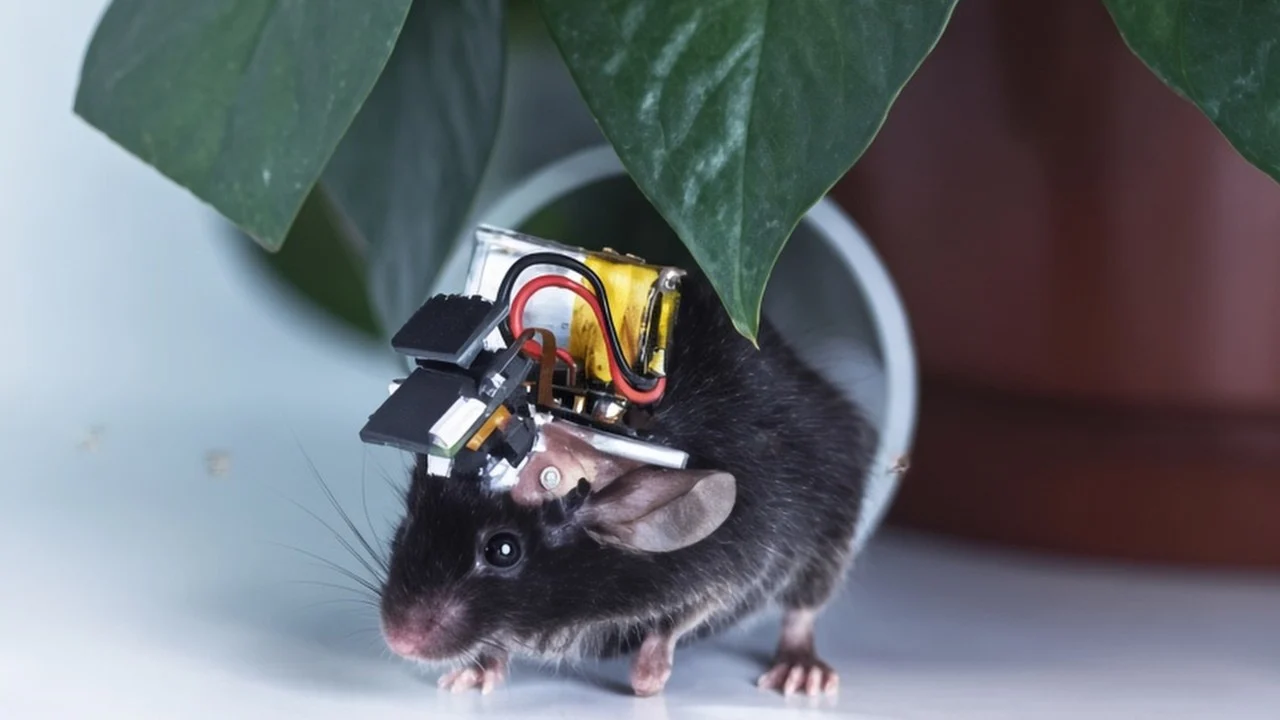
中国科学家研制出了他们所说的世界上最小的可穿戴微型脑监测仪,能够同时追踪数千个神经元的活动。
Chinese scientists have developed what they say is the world’s smallest wearable mini brain monitor that can track the activity of thousands of neurons at the same time.
这款名为“Airscope”(空域镜)的无线设备重仅1克(0.35盎司),是同类设备中最轻的,使研究人员能够在未拴系的实验动物身上追踪更广泛的大脑活动。
Weighing in at one gram (0.35 oz), the wireless “Airscope” is the lightest device of its kind and enables researchers to track a wider range of brain activity in untethered laboratory animals.
该设备由清华大学和中国人民解放军医学院的科学家联合研制,相关成果于周一发表在同行评审期刊《自然》上。
The device was jointly developed by scientists from Tsinghua University and the Chinese PLA Medical School, and detailed in a paper published in the peer-reviewed journal Nature on Monday.
论文通讯作者、清华大学自动化系的戴琼海表示:“这台显微镜将推动光学脑机接口向更精准的神经检测方向发展。”
“This microscope will push optical brain-computer interfaces towards more precise neural detection,” said Dai Qionghai, the paper’s corresponding author from Tsinghua’s automation department.
据清华大学周二在社交媒体上的帖子,戴琼海指出,该技术的潜力远不止于脑研究。
In a social media post by Tsinghua University on Tuesday, Dai noted that the technology’s potential extended far beyond brain research.
他被引述说:“未来,其应用有望从神经科学拓展到免疫学、肿瘤学等领域,实现对疾病发展过程的全程追踪。”
“In the future, its application is expected to expand from neuroscience to fields such as immunology and oncology, enabling the complete tracking of the disease development process,” he was quoted as saying.
“Airscope”是一种中观镜,这是一种高端光学仪器,旨在以“中等”尺度观察生物组织,如皮层神经活动。
The Airscope is a mesoscope, a high-end optical instrument designed to observe biological tissues, such as cortical neural activity, at an “intermediate” level.
它填补了显微镜和宏观镜之间的空白,使研究人员能够在宽视场下观察细胞活动。
It plugs the gap between a microscope and a macroscope, enabling researchers to observe cell activity over a wide field of view.
多年来,科学家们一直在寻求清晰地观察大脑神经元在自然群体互动中如何调控复杂行为——这是理解智能本质的关键一步。
For years, scientists have sought to clearly observe how brain neurons regulate complex behaviours during natural, group interactions – a crucial step in understanding the nature of intelligence.
为此,他们必须在追踪相对大面积动物组织的同时,仍能分辨单个细胞的活动。
To do this, they must track a relatively large area of animal tissue while still distinguishing the activity of individual cells.
此前,能够做到这一点的设备要求固定动物头部或用缆线拴系。而体积足够小、允许自由活动的设备,视场通常受限,往往小于1毫米(0.04英寸)。
Previously, devices that could do this required animals to have their heads fixed in place or be tethered by cables. And, devices small enough to allow free movement typically had a restricted field of view, often less than 1mm (0.04 inches).
戴课题组将设备体积缩减了近五个数量级,与传统台式显微镜相比,记录神经信号的质量“相当”。
Dai’s team shrank the volume of their device by nearly five orders of magnitude compared to conventional benchtop microscopes, with “comparable” quality of recorded neural signals.
他们还采用了一颗两百万像素的图像传感器,该传感器可压缩数据,实现百万像素级图像的无线传输。整个项目意味着要优化光学、照明、电子及无线传输系统。
They also used a two-megapixel image sensor that compresses data, enabling the wireless transmission of megapixel-grade images. The whole project meant optimising optical, illumination, electronic and wireless transmission systems.
团队利用人工智能设计透镜,并开发出一种计算机视觉模型,能够从视频画面中识别并持续追踪个体,防止目标丢失或混淆。
The team used artificial intelligence to design the lenses and developed a computer vision model that can identify and continuously track individual subjects from video footage, preventing target loss or confusion.
利用“Airscope”,团队研究了小鼠在各种行为下的神经信号变化。
Using the Airscope, the team studied neural signal changes across various mouse behaviours.
团队将设备安装在小鼠身上,让它们在一个定制的微型栖息地中自由活动,该栖息地设有坡道、树洞和庇护所。
The team fitted their devices to mice and allowed them to roam a custom-built micro-habitat featuring ramps, tree holes and shelters.
由于整套装置重量轻到不干扰小鼠的自然行为,小鼠能够自由挖掘和攀爬。
The mice were able to burrow and climb freely because the entire set-up was light enough not to interfere with the mice’s natural behaviour.
当小鼠探索周围环境时,研究人员利用超轻量头戴设备,一次性记录了单只小鼠大脑皮层中超过8500个单个神经元的活动。
While the animals explored their surroundings, researchers used the ultra-lightweight headset to record the activity of more than 8,500 individual neurons in a single mouse’s cerebral cortex, all at one time.
他们的发现包括确定背侧脑区皮层活动模式如何影响动物的社会竞争优势。
Their findings include identifying how cortical activity patterns in dorsal brain regions influence an animal’s social competitive advantage.
团队希望利用这项技术进一步探究社会行为和情绪状态的神经机制,有望为抑郁症等疾病的研究提供关键线索。
The team hopes to use this technology to further investigate the neural mechanisms underlying social behaviour and emotional states, potentially providing vital clues for research into conditions such as depression.
据清华大学文章介绍,戴课题组自2013年起一直在研究中观成像技术。
According to the Tsinghua article, Dai’s team has been researching mesoscopic imaging technology since 2013.
2024年,清华大学戴课题组宣布研发出一种超级体内显微镜,能够清晰成像大规模细胞网络的完整三维相互作用。
In 2024, Dai’s team from Tsinghua announced the development of a super intravital microscope that could clearly image the entire three-dimensional interactions of a large network of cells.
这款名为 RUSH3D 系统的显微镜,在厘米级视场范围内实现了亚细胞分辨率。它能够以每秒 20 帧的速度进行高速三维成像,从而实现数小时的连续观测。
The microscope – called the RUSH3D system – features subcellular resolution over a field of view that is centimetres-wide. It is capable of high-speed 3D imaging at 20 frames per second, allowing for many hours of continuous observation.
该成果发表于《细胞》期刊,于当年中旬刊出,并被列为 2024 年中国十大科技进展之一。
The development, published in the journal Cell in mid-September of that year, was listed as one of China’s biggest science advances of 2024.