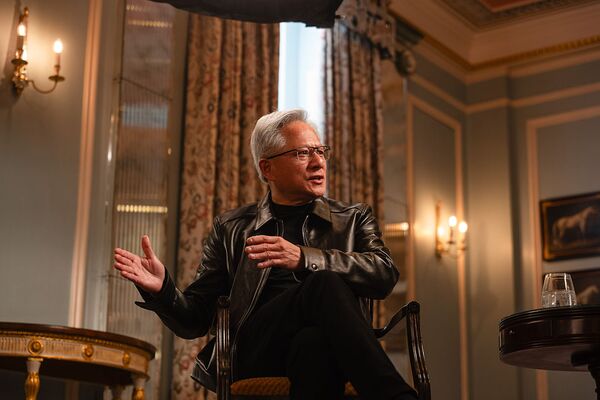
英国没人想同意一个穿皮夹克的美国大亨的观点。但很难反驳黄仁勋对英国出了什么问题的诊断。上周,英伟达公司老板在伦敦一座改建的教堂里对聚集的政客和投资者表示,这个国家有足够的智力,却缺乏足够的企业家精神。他说,面对百万种获胜的途径,英国倾向于找到“那一个不做的理由”。黄仁勋确实认为这座岛屿上有人才,他通过在五家英国初创公司投资数百万英镑予以强调。
Nobody in Britain wants to agree with a leather-jacket-wearing American tycoon. But it’s tough to poke holes in Jensen Huang’s diagnosis of what’s gone wrong with the UK. Last week, the Nvidia Corp. boss told politicians and investors gathered in a converted London church that the country has enough intellect but not enough entrepreneurial spirit. Offered a million ways to win, he says, it tends to find “the one reason not to do it.”Huang does believe there’s talent on this island, a point he underlined by betting millions on five British startups.
但这里既没有金融环境,也没有监管气候,让英国企业家能够大规模思考。正如上议院一个委员会所指出的,“一批又一批有前途的科技公司”正在移居海外。牛津离子被美国的IonQ以10亿美元收购;OrganOx被日本医疗科技集团Terumo以15亿美元收购。Wise将其主要上市地转移到了美国。想要做大的英国公司也必须去别处。
But there’s neither the financial environment nor the regulatory climate to allow UK entrepreneurs to think on a grand scale. As a House of Lords committee has pointed out, “a procession of promising science and technology companies” is moving overseas. Oxford Ionics was bought by US-based IonQ for $1 billion; OrganOx by Japanese medtech group Terumo for $1.5 billion. Wise shifted its primary listing to the US. British companies that want to go big also have to go elsewhere.
英国发生了什么?这个地方曾经充满了精力充沛的业余爱好者、古怪的发明家和帝国建设者。一个开创了从足球到蒸汽机再到股份制公司一切事物的国家,怎么开始寻找不做事的理由了?
What happened to Britain? This place once teemed with energetic amateurs, wacky inventors and empire-builders. How did a country that pioneered everything from football to steam engines to the joint-stock company start searching for reasons to do things?
过去几个月我采访的大多数英国创始人都不约而同地给出了同一个原因:英国害怕冒险。这里的金融业没有胃口支持高风险、高回报的创业,国家也不会做出塑造市场所需的规则或采购合同方面的政治冒险。
Most UK-based founders I’ve spoken with in the past few months offered up the same reason, unprompted: Britain fears risk-taking. Finance here doesn’t have the appetite to support high-risk, high-reward ventures, and the state won’t make the political gambles needed to shape a market through rules or procurement contracts.
这不仅是一个技术问题。事实上,没有什么比对风险的病态回避更能定义当今英国的政治和经济文化了。没人愿意任何事物改变,唯恐可能带来危险。对未来可能发生之事的恐惧,已成为国家意识形态;英国主要政党之间的主要区别,在于他们偏好哪种对1970年代的愿景。
This is a problem beyond tech. In fact, nothing defines the political and economic culture in Britain today so much as a pathological aversion to risk. Nobody ever wants anything to change, on the off chance it could be dangerous. Fear of what the future might hold has become the national ideology; the main difference between the UK’s major political parties is which vision of the 1970s they prefer.
阻碍英国的大部分问题,都可追溯到同样的胆怯心态。例如,为什么英国企业长期缺乏投资资金?一方面,英国养老金资金不再投资股票;2025年,养老金仅将四分之一的资产投于股票,56%投于债券——分别是世界七大养老金市场中最低和最高的比例。2014年,这一比例为股票43%、债券38%。
Much of what holds Britain back can be traced to the same timid mindset. Why, for example, are its businesses chronically short of funds to invest? For one, UK pension money is no longer in equities; in 2025, pensions held just a quarter of their assets in equities and 56% in bonds — the lowest and highest shares, respectively, of the world’s seven largest pension markets. The split was 43%/38% in favor of equities in 2014.
该国过多的财富被房地产所占据。房地产被视为一种价值增值的稳妥投资——部分原因在于地方议会,很少有议会敢于冒险批准新建项目。毕竟,新建项目可能会破坏某人的景观,或吸引“错误类型”的人。任何幸存下来的项目,都会受到数十条出于好意的规则限制。结果不仅是一个停滞不前的国家,也是一个看起来和感觉上都更贫穷的国家。
Too much of the country’s wealth is tied up in property. It’s seen as a safe bet that increases in value — thanks in part to local councils, few of which dare to take a punt on permitting new building. There’s a chance, after all, that it might spoil someone’s view or draw the wrong sort. Any project that survives is constrained by dozens of well-meaning rules. The result isn’t just a stagnant country, but also one that looks and feels poorer.
议会害怕新邻居,企业害怕扩张,政客害怕损失或法律挑战。但恐惧不能成为一个国家的组织原则。
Councils fear new neighbors, businesses fear expansion and politicians fear losses or legal challenges. But fear can’t be a country’s organizing principle.
任何现代自由民主国家都有责任保护其人民免受可能降临的最坏情况。这就是英国这样的福利制度存在的原因。但当各国不断扩大安全网,试图徒劳地让公民免受任何危险时,制度将变得不可持续——尤其是当同样的风险回避阻止国家增长到足以支付其福利完美主义的开支时。
Any modern liberal democracy has the responsibility to protect its people from the worst that might befall them. That’s why welfare systems like the UK’s exist. But when countries keep expanding the safety net in a doomed attempt to insulate their citizens from any hazard, the system becomes unsustainable — especially when that same risk-aversion prevents the nation from growing enough to pay for its welfare perfectionism.
如果英国尚未陷入这种境地,恐怕也快了。《华尔街日报》上周一篇广为流传的报道详述了该体系偏离初衷的程度。残疾津贴最初是为工业事故受害者设计的,如今却有约700万人领取——超过十分之一。自2019年以来,劳动年龄成年人领取人数激增逾60%;没有其他西方国家出现过类似增幅。而当基尔·斯塔默试图从该体系每年1000亿英镑的账单中仅削减50亿英镑(约合67亿美元)时,其后座议员迫使他做出了政策大转弯。
If the UK isn’t there already, it will be soon. A widely read story in the Wall Street Journal last week outlined the degree to which the system has drifted from its original purpose. Disability payments, first designed for victims of industrial accidents, are today claimed by about 7 million people — more than one in ten. That number has risen by more than 60% among working-age adults since 2019; no other Western country has seen a comparable increase. And when Keir Starmer tried to trim just £5 billion ($6.7 billion) off the system’s £100 billion-a-year bill, his backbenchers forced him into a U-turn.
投资者发现即便拥有巨大多数席位的政府也无法修补福利体系,感到沮丧,纷纷抛售英国国债。十年期借贷成本今年已从4.5%升至5.5%,为七国集团(G7)中最高。
Investors, depressed to discover that even a government with a huge majority couldn’t fix welfare, sold gilts. Ten-year borrowing costs have risen from 4.5% to 5.5% this year, the highest in the G7.
试图保护人们免受一切可能风险并不会消除风险;它只是将风险转嫁给另一群公民——而这些人可能会造反。英国人无需远眺,看看他们的法国邻居便知结局如何。
Trying to protect people against every possible peril doesn’t abolish risk; it just shifts it to another set of citizens — who might revolt. Brits need look no further than their French neighbors to see how that turns out.
这个国家发明了板球和珍妮纺纱机。它也是保险制度的发明地。保护人们免受风险本是个好主意。遗憾的是,正是这一主意来定义现代英国。
This is the country that invented cricket and the spinning jenny. It’s also the one that invented insurance. Protecting people against risk was a great idea. Such a pity it’s the one that’s come to define modern Britain.