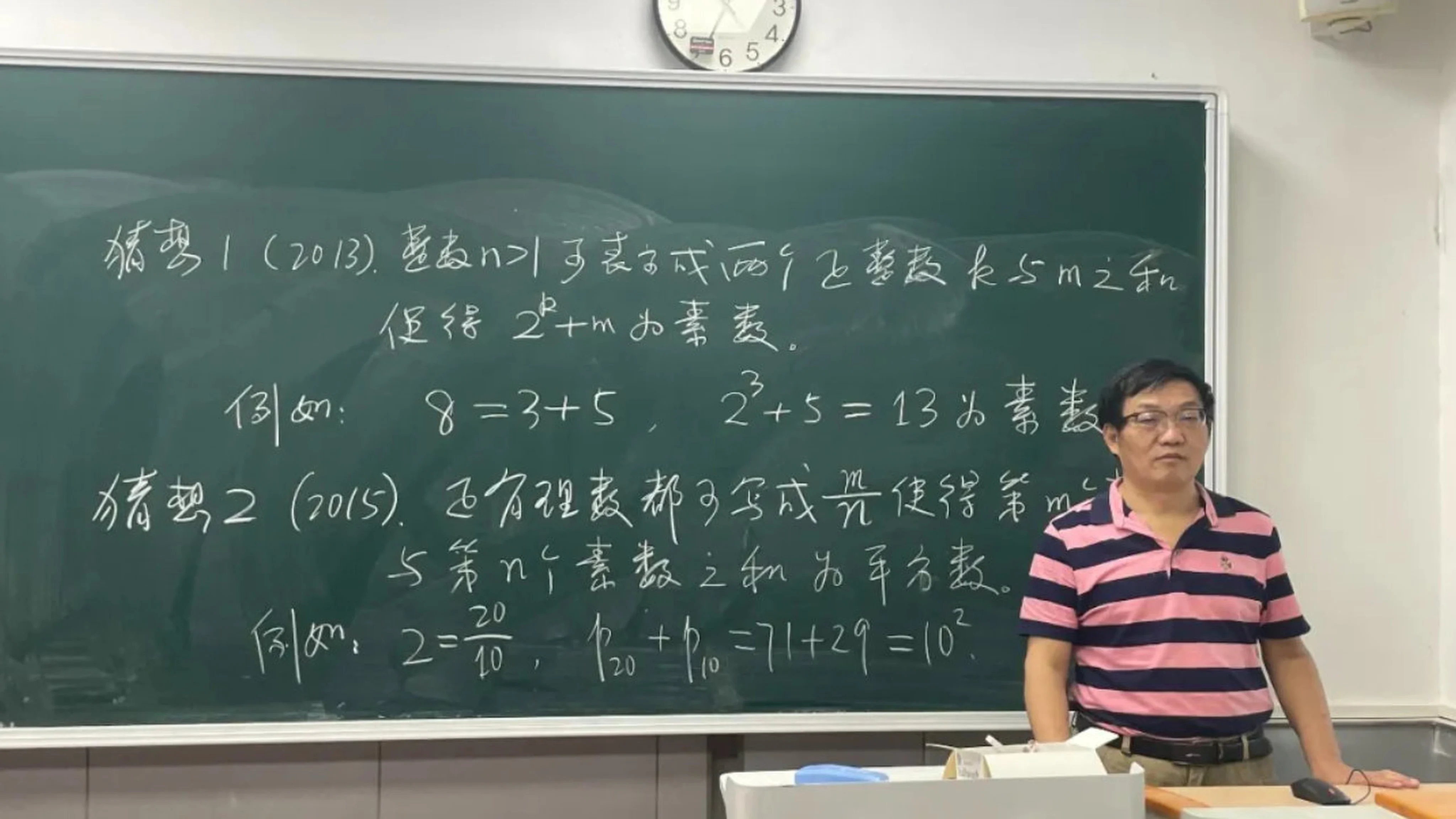
在人工智能为复杂数学问题提供答案的时代,中国数学家孙志伟认为,好奇心和提出好问题的重要性前所未有地重要。
In an age of AI-induced answers to complex mathematical problems, Chinese mathematician Sun Zhiwei maintains that curiosity and asking good questions are more important then ever.
在从事数论研究数十年后,现年61岁的南京大学数学系教授孙志伟,已经构建了一个庞大的问题体系——超过1000个,且仍在持续增长——供全球研究者攻克。
Over a career spent probing the edges of number theory, Sun, a 61-year-old professor at Nanjing University’s department of mathematics, has built a vast landscape of problems – more than 1,000 and counting – for the global research community to tackle.
传统数学训练强调掌握已有公式和证明既定定理,孙志伟表示,真正的进步在于用直觉发现新问题,再用逻辑加以解答。
While traditional mathematical training emphasises mastering existing formulas and proving established theorems, Sun said true progress relied on using intuition to discover new questions and using logic to solve them.
“如果一个学科没有猜想,人们就不知道该做什么,该领域就会停滞不前。”孙志伟对《中国科学报》说。
“If a discipline has no conjectures, people no longer know what to do and the field approaches a standstill,” Sun told China Science Daily.
“人工智能无法解决每一个数学问题。数学家们无需恐慌。相反,他们可以腾出时间专注于人工智能所不及之处的任务,例如开发新方法、建立新理论。”他说,并将把人工智能的互联网搜索权限关闭,使其无法发现该问题尚未解决,从而拒绝继续攻克它。
“[Artificial intelligence] cannot solve every mathematical problem. Mathematicians need not panic. Instead, they can free up time to focus on tasks where AI falls short, such as developing new methods and establishing new theories. “I view AI as a highly knowledgeable, diligent and intelligent graduate student. When setting it to tackle difficult mathematical problems, I provide appropriate guidance and, when necessary, prompt it to adjust its strategy,” he said, adding that he would cut off the AI’s internet search access so it could not discover that the problem remained unsolved and refuse to work on it.
孙志伟表示,在他职业生涯早期,他是一名传统的解题者,在1900年提出的希尔伯特第十问题上取得了关键进展。
Sun said that, in his early career, he was a traditional problem solver and made key advancements on Hilbert’s Tenth Problem posed in 1900.
但2005年在加州大学尔登分校担任访问教授时,他迎来转折点——遇到一位擅长利用数学软件发现规律的美国教授。当时,这种技术对孙志伟来说是全新的。
But a 2005 visiting professorship at the University of California, Irvine, marked a turning point when he met an American professor who was adept at using mathematical software to uncover patterns, a technique that was new to Sun at the time.
在帮助这位教授解决了困扰多年的一项猜想之后,孙志伟表示,他意识到数学工具正在经历一次质的飞跃。
After helping the professor resolve a conjecture that had remained unsolved for years, Sun said he realised mathematical tools were undergoing a qualitative leap forward.
2009年,他开始自学如何使用 Mathematica 这个数学计算软件。借助计算机的帮助,他得以验证成千上万的数学案例;而这项任务在过去需要耗费大量人力,且往往无法通过手工计算完成。
In 2009, he started to teach himself how to use the Mathematica program for technical computing. Using computers enabled him to validate thousands of cases, a task that previously demanded painstaking and often unfeasible manual calculations.
“从那一年起,我突然有了顿悟,各种奇思妙想纷纷涌现出来,”孙(Sun)回忆道。
“From that year on, I suddenly had an epiphany and all sorts of whimsical ideas started coming to me,” Sun recalled.
今年,孙整理出了一本长达400多页的论文集,其中收录了他提出的1000个尚未被证明的数学猜想。
This year, Sun compiled a collection of problems more than 400 pages long, containing 1,000 unsolved conjectures that he had proposed.
他的学术主页上还列出了这些猜想,并为它们的证明提供了奖金;这些奖金全部来自他的工资。
His academic homepage also features a collection of conjectures paired with cash prizes for their proofs, funded using his salary.
他的许多研究课题都超越了传统的数学框架。例如,他对法国数学家拉格朗日(Lagrange)提出的“四平方定理”(该定理指出每个自然数都可以表示为四个整数的平方和)提出了新的限制条件,从而提出了新的猜想。
Many of his problems push beyond classical milestones. For example, Sun introduced new constraints to French mathematician Lagrange’s two-century-old four-square theorem, which states that every natural number can be expressed as the sum of four integer squares, to formulate new conjectures.
“我们只是简单地认为某个定理‘很美’;一旦证明完成,我们就认为这个问题已经解决了。我们从不讨论这个定理是否足够强大,或者它是否存在局限性,”孙说道。
“We simply state that a given theorem is ‘beautiful’, and once the proof is complete, we consider the matter closed. We never discuss whether the theorem is strong enough or it has limitations,” Sun said.
“教科书往往只强调数学定理的‘伟大之处’,而忽视了它们的缺陷。”孙认为,随着人工智能(AI)的发展,我们应该欢迎 AI 在推动数学进步、探索真理方面的作用。
“Textbooks often only talk about greatness, not flaws.”As AI reshapes scientific discovery, Sun said the role of AI should be welcomed in advancing mathematics in the pursuit of truth.
“如果你研究数学只是为了名利,你可能会担心 AI 会抢走你的工作;但如果你追求的是真理,那么你应该欢迎 AI 为数学领域带来的进步。”他说。
“If you pursue mathematics solely for fame and fortune, you might worry about AI taking your job, but if your goal is the pursuit of truth, you should welcome the way AI advances the field,” he said.
他将自己提出的某些最困难的问题称为“‘外星人猜想’”——他认为这些问题“人类绝对无法解决”。
He said he dubbed some of his most difficult problems “alien conjectures” – problems that he said “Earthlings definitely cannot solve.”
当被问及提出这些无法解决的问题的意义时,孙回答道:“我的动机并不在于这些问题是否能够被解决,我只是追求真理。至于现代工具是否足够强大,那是另一个问题。”
When asked about the point of proposing unsolvable problems, Sun said: “My motive is not whether you can solve it or not, I am just pursuing the truth. As for whether modern tools are enough, that is another matter.”