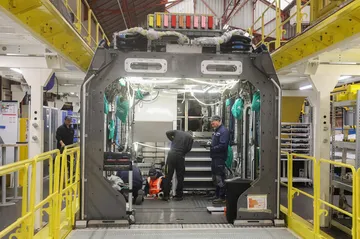
英国曾是铁路技术的先驱。如今,它的电气化率却是世界上最低的国家之一,长途列车严重依赖柴油。电池电动列车是改变这一局面的解决方案。
The UK was once a pioneer of rail technology. Now, it has one of the worst electrification rates in the world and relies heavily on diesel for long-distance trains. Battery-electric trains are a solution to change the game.
本周的《零》节目中,阿克沙特·拉蒂与全球最大列车公司之一阿尔斯通的产品总监詹姆斯·奥沙利文对话,谈论一份价值10亿英镑(13亿美元)的电池电动列车合同,以及这类列车如何实现铁路出行的脱碳。
This week on Zero, Akshat Rathi speaks with James O’Sullivan, product director at Alstom, one of the world's biggest train companies, about a £1 billion ($1.3 billion) contract for battery-electric trains and how they can decarbonize rail travel.
阿克沙特·拉蒂:我们在《零》节目中大量讨论气候解决方案,但做了200集之后,我们还没有谈过火车。这一集要纠正这个历史性的疏漏。
Akshat Rathi We talk a lot about climate solutions on Zero, but after 200 episodes, we still haven't talked about trains. This episode corrects that historical mistake.
火车是最高效的地面交通方式。一加仑柴油可以让一列火车把一吨重量运送500英里,而一辆重型卡车在同样燃料下只能跑这一距离的三分之一。如果用绿色电力驱动火车,你就拥有了一种无与伦比的清洁地面交通方式。对于正在建设新铁路线的国家来说,电动列车如今是显而易见的选择。但许多国家,比如英国,其铁路网是在电气化时代之前建成的。它们现在需要对这些线路进行电气化,而这可能相当昂贵且充满挑战。
Trains are the most efficient form of ground transportation. With one gallon of diesel, a train can move one tonne of weight 500 miles, while a heavy duty truck would go only a third of that distance on the same amount of fuel. Power that train with green electricity, and you've got an unparalleled form of clean ground transportation. For countries that are building out new train lines, electric trains are now a no-brainer. But a lot of countries, like the UK, built their train networks before the age of electrification. They now need to electrify those routes, and that can be quite expensive and challenging.

这里是《零》,我是阿克沙特·拉蒂。本周主题:火车电气化。今天的嘉宾是詹姆斯·奥沙利文,全球最大列车公司之一阿尔斯通的产品总监。詹姆斯一直领导着一款将在英国部署的电池电动列车的相关工作。詹姆斯,欢迎来到《零》。詹姆斯·奥沙利文:感谢你的邀请。
This is Zero, I am Akshat Rathi. This week: the electrification of trains. My guest today is James O'Sullivan, product director at Alstom, one of the world's biggest train companies. James has been leading the work on a battery-electric train that will be deployed in the UK. James, welcome to Zero. James O'Sullivan Thank you for having me.
这是一档大量讨论气候解决方案的节目,但到目前为止我们还没有做过关于火车的节目,已经做了200集,我非常兴奋。我最近刚从中国的一次报道之行回来,中国的铁路网络相当令人印象深刻。非常令人印象深刻。
So this is a show where we talk a lot about climate solutions, but so far we've not had a show about trains, having done 200 episodes, I'm very excited. So I have just recently come back from a reporting trip in China, and the Chinese rail network is pretty impressive. Hugely impressive.
也许这是世界上最好的铁路网之一,全长16万公里,其中75%已实现电气化。我在印度长大,那里的铁路网虽然不如前者先进,但也相当令人印象深刻。它延伸至极远的地方,深入群山,直达海岸。如今它几乎全线电气化,电气化程度甚至高于中国网络。
Perhaps one of the best rail networks in the world, 160,000 kilometers, 75% of it is electrified. I grew up in India, where again, the rail network is not as advanced, but it's pretty impressive. It goes to very far off places, up into the hills, down to the coast. And now it's almost all electrified. It's even more electrified than the Chinese network.
但过去18年,我把这里——英国——当作家。初来乍到,感觉其铁路网仿佛让人穿越回了过去。英国既没有最快的列车,也没有最先进的列车,甚至连足够的电力机车都没有。其网络电气化率仅约40%。那个诞生了火车的国家,究竟哪里出了问题?
But for the last 18 years, this is where I call home, the UK. And coming here for the first time, it really felt like going backwards in time with its rail network. The UK doesn't have either the fastest trains or the most advanced trains, or really even enough electric trains. About 40% of the network is electrified. What went wrong with the country that gave birth to the train?
我不认为哪里“出了问题”,这么说吧。我想说的是,如果我们有一张白纸重新开始,大概率不会走到今天这一步。必须记住,在英国,我们靠的是维多利亚时代铺设的基础设施遗产度日。
I don't think anything went wrong, so to speak. What I would say is that if we had a blank sheet of paper, we probably wouldn't have ended up where we got to today. You have to remember in the UK, we are living off the legacy of the Victorian infrastructure that was installed at the time.
当时他们凭借最好的预期、最大的努力,设计出了适合用途的系统。而如今我们在英国所做的一切,具体来说,都是在优化、榨取最后一滴汁水,以便在引入新车辆时榨取最大效益。
They used their best expectations, their best efforts to design something that was fit for purpose. And everything that we do now, in the UK specifically, is about optimizing, squeezing the last bit out of the lemon to get the best of our rolling stock when we're introducing them into the UK.
相比之下,印度和中国——印度建设时间不算太近,但比英国近;中国的基础设施建设则是非常近期的事。我想说,他们有机会审视英国、从中汲取经验教训。那么,究竟是什么阻碍了英国真正实现铁路网电气化?
Compared to, say, India and China, which India is not that recent, but more recent than the UK. China is very recent in terms of their installation of the infrastructure. They've had the ability to look at the UK and learn from it, I would say. So what is it that has held the UK back from actually electrifying its rail network?
我认为曾有一个时期,特别是柴油列车取代蒸汽列车的时候。柴油机车出现时被视为一次重大突破,因为蒸汽机车效率相当低。我的意思是,如果你周末有空去欣赏那种壮观景象,蒸汽机车看起来很壮丽。但就柴油机车的商业理由而言:只需要一名司机;加油容易得多;可以设计结构简单得多的动车组来载客。它真的非常、非常有效。
So I think there was a point in time where, particularly when diesel trains were taking over from steam trains. When diesel came in, it was seen as a revelation because steam was quite inefficient. I mean, they're glorious to go and look at if you've got time at the weekend to just enjoy the spectacle. But in terms of the business case for diesel: you only need one driver; refueling is much easier; you can design a much simpler multiple unit to be able to carry passengers. It was really, really effective.
现在,随着我们步入21世纪,目前已走过了四分之一历程,我们面临的许多关于为应对全球变暖而实现脱碳的挑战,在柴油机车引入时根本未被理解。一些国家,特别是欧洲国家,决定走电气化路线。在英国,我们更多地选择了柴油路线。当时,这似乎是一个明智的决定。但只有事后诸葛亮,我们现在才意识到,其实最好能尽可能全面实行电气化。
Now, as we move into the 21st century, and we're a quarter of the way through at this point, a lot of the challenges that we have around decarbonization to treat global warming, they just weren't understood at the time that diesel came in. Some countries, particularly in Europe, decided to go down the electrification route. In the UK, we went down the diesel route more-so. And at the time, that seemed like a sensible decision. But only in hindsight do we realize now that actually, it would have been better to go with the full electrification as much as possible.
既然你整天都在思考火车的问题,请告诉我们为什么火车是最好的陆地交通选择。
And given you think about trains day in and day out, give us why trains are the best ground transport option.
我认为很难得出什么是最佳解决方案的结论。不存在放之四海而皆准的方案。汽车在某些方面有优势,飞机在某些方面有优势。铁路的优势主要体现在两个方面,我会说。第一,进入市中心并到达当地区域。特别是上下班通勤时,你会发现铁路,尤其是在伦敦,是每天早上到达办公室距离最近的方式。
I think it's very difficult to come up with what is the best solution. There is no one size fits all. There'll be certain things where the car has its advantages, certain things where the plane has its advantages. Where rail has its advantage is two areas, I'd say. One, getting into the center of a city and accessing local areas. Particularly if you're commuting into work, you tend to find that rail, particularly in London as well, is the closest way of getting to your office every morning.
铁路的另一大优势在于高密度客运。即便是城际出行,一列火车也能承载数百名乘客。而若乘坐汽车,每辆车最多只能载四到六人。现实中真正拼车出行的人有多少,我不得而知。我推测平均每辆车的乘客数大约在一到两人之间。因此,就实现碳中和出行、以高吞吐量将人员从一地输送至另一地而言,铁路恐怕是同类方式中的佼佼者。
The other thing that rail is very good at is high density passenger movement. Even intercity travel, you can get hundreds and hundreds of people on a single train. Whereas if you're traveling by car, you'd be at four, maybe six maximum. I don't know how many people really carpool in reality. I suspect the average number of passengers is somewhere between one and two. So in terms of delivering carbon neutral travel, in terms of delivering people at high throughput from one place to another, rail is probably the best in class for that.
如果做得好,正如中国所展示的那样,城际运输甚至更长距离的运输都能变得更加高效。我曾乘坐过从上海到北京的列车,时速约350公里,是连接两座相距极远城市的最快路线。它比乘飞机还要快——如果算上前往机场、安检候机、飞行以及降落在北京郊外后再进城的时间,从上海市中心到北京市中心,高铁快得多。
If done right, as China has shown, you can actually make the intercity transport, and even much further distances, much more effective. So I took a train from Shanghai to Beijing. It runs at about 350 kilometers per hour, and is the fastest route between two really far cities. It’s faster than a plane would do — so taking in the time to go to an airport, waiting for security and getting into a plane and then landing outside Beijing and taking transport inside.
是的,你可以实现市中心到市中心的直达。另一个优势是舒适度。你不必升至3万英尺高空进入加压机舱,只需坐在座位上,就能工作、上网、看报纸,想做什么都行。铁路出行完全可以满足这些需求。
Whereas from Shanghai city center to Beijing city center, it’s much faster. Yeah you can go end to end. And the other thing about it is the comfort aspect of it. You're not having to go up 30,000 feet into a pressurized cabin. You can just sit there, you can do work, connect to the internet, read a newspaper, whatever you like to do traveling.
令我一直感到恼火的一件事是,尽管伦敦的通勤铁路网相当不错,但一旦乘坐稍长距离的列车离开伦敦,比如去100公里外的城市,你往往最终会乘上柴油列车,尽管那条铁路线上明明架设了电气化的接触网。我始终不理解,至少在铁路线已实现电气化的路段,为什么列车不利用那条供电线路?
All is possible with rail. So one thing that has always annoyed me is that even though London's commuter train network is pretty good, when you take a slightly long-distance train outside London, if you go to a city 100 kilometers away, you invariably end up on a diesel train, even though there are all these overhead lines that are electric on that same rail line. And I've never understood, at least for the part of the rail line that is electric, why isn't the train using that power line?
回到我之前提到的柴油动力引入这一点,长期以来,这一直是一种“二选一”的局面。所以你有电力列车,也有柴油列车。其中一些至今仍在我国铁路网上运行的列车已有40多年历史。只有最近才出现了双模式列车,它们具备双重能力,可以二选一运行。
Again, going back to the point I was making before about the introduction of diesel, for a long period of time, it was an either or situation. So you have electric trains, you have diesel trains. Some of those trains still running on our network today are 40-plus years old. It's only recently that you've seen the emergence of bi-modes where they have dual capability to run either/or.
因此,在英国,当你遇到这种情况时,通常是因为那些柴油列车比较老旧,而且前往的目的地没有电气化设施。一个典型的例子是西海岸主线及延伸至霍利黑德的路段,因为该路线未实现电气化。米德兰主线现在也是如此。如果你去德比或诺丁汉——我今天就是从那里下来的——那些列车过去是柴油动力,但目前正在引入双模式列车来替换它们。
So quite often when you're experiencing that in the UK, it's because those diesel trains are a bit older and also go to destinations that have no electrification to them. So a classic example of this would have been the West Coast Main Line and out to Holyhead, because that route isn't electrified. Same with the Midland Main Line now as well. If you go up to Derby or Nottingham, where I've come down from today, those trains were diesel, but they are introducing bi-modes to replace them at the moment.
而你们正在研发的产品试图通过加装电池来弥合这一分歧。这样,一条铁路线即使未完全电气化,但因为车载电池,你基本上可以让整个行程都实现电力驱动。请给我们介绍一下这种新型列车。
And the product you're working on now is trying to bridge that divide by adding batteries. So you could have a rail line where it is not fully electrified, but because it's got batteries on board, you could essentially make that full journey electric. Talk us through this new type of train.
我负责我们Adessia(阿德西亚)产品在英国的业务。在我们公司内部,它技术上属于通勤列车,但我们提供从市郊通勤到区域城际各个层级的产品。最近我们宣布赢得了一份价值略超10亿英镑的TransPennine(跨彭尼尼)订单。那些将是基于我们Adessia产品的五节编组列车,并将配备电池,单次充电续航约为80公里。
So I look after our Adessia product for the UK. It's technically a commuter train in our organization, but we offer it all the way down to metro commuter and up to regional intercity. Most recently we announced we'd won an order worth just over £1 billion for TransPennine. So those will be five car units based on our Adessia product and they will have batteries fitted to them to do approximately, I'd say, 80 kilometers between charges.
这个项目其实非常有意思,因为我们不仅设计了列车,还提供支持它的基础设施。列车从东海岸主线(该线路已全线电气化)分出,然后行驶大约80公里到达赫尔,再到英国东海岸的斯卡伯勒。接着利用阿尔斯通的充电设备进行充电,然后返回。这实际上就是延伸现有电气化网络的方式。
It's really interesting, actually, that project, because we have designed the train, but we're also providing infrastructure to support it. So where it comes off the East Coast Main Line, which is fully electrified, it then does this roughly 80 kilometers out to Hull, out to Scarborough on the east coast of the UK. And then using Alstom charging equipment, it will recharge and then come back. And that's effectively how you extend the existing electrification.
原本可以选择从东海岸主线到那些车站进行全线电气化。但从短期来看,电池列车绝对更快。电池的作用在于,它们实际上取代了柴油作为储能装置,并能向牵引系统提供动力。我们面临的挑战显然在于电池的可用续航里程。这就像你今天买电动车,本能地知道它的续航里程会比买汽油车或柴油车短。但在部署能力方面,条件已经具备。
There could have been an option there to do full electrification from the East Coast Main Line to those stations. But in the short term, the battery train is definitely quicker. Where the batteries come in is they effectively replace the diesel as energy storage and capable of delivering the power to the traction system. The challenge that we have with those batteries is clearly around the range that we can use. And that's the same if you buy an electric car today, you instinctively know that the range is going to be less than a petrol or diesel car that you buy. But in terms of deployment, the capability is there.
它们另一个优点在于充电方面,不需要去加油站加油。你可以在快速充电站静态充电,也可以在行驶过程中动态地从架空接触网充电。所以我会说,这是一种与现有电气化网络更加融合的解决方案。
And the other great thing about them is in terms of their recharge, you're not having to go to a fueling station to do that. You can recharge either statically at rapid charging stations or dynamically under the wires as you're traveling. So it's more of an integrated solution with the existing electrification, I would say.
有没有分析表明,这种列车真的能帮助降低英国等铁路网为实现2050年净零排放目标而必须进行的电气化改造成本?
Are there analyses showing that this kind of train could really help lower the cost of electrification that networks like the UK must undergo if they are to hit net zero by 2050?
我认为这不一定关乎降低电气化成本。我认为电池列车可以应用两种模式。一种是人们看到的,即在一条线路上部署,它实际上永久性地延伸了电气化的覆盖范围。
I think it's not necessarily about lowering the cost of electrification. I think there's two things that these battery trains can be… or two models that these battery trains can be applied in. One is the one that people see, which is we deploy it on a route and it effectively extends the range of the electrification permanently.
如果你运营的是长距离、班次较少的线路,这确实是个不错的选择,因为显然电池成本在于列车本身,而电气化成本则在于你需要行驶的距离。但另一种模式也很有意思,因为我们在爱尔兰铁路有一个相关项目,那就是电池其实只是一种过渡状态。
And that's really good if you're running fairly long distances but few trains, because clearly the cost of the battery is in the trains, whereas the cost of the electrification is in the distance you have to travel. But the other model, which is interesting because we've got a project over in Irish Rail over in Ireland, which is relevant here, is this idea that batteries are really just a transitionary state.
如果我今天要买新列车,但还没有电气化设施,引入电气化需要相当长的时间,而我现在就有需求。所以对我来说,比较的对象不是电池列车和电力列车,而是电池列车和柴油列车。因此,购买电池列车能立即实现脱碳。在爱尔兰,爱尔兰铁路目前有一个交付电池列车的项目。与此同时,我们还有一个项目,在一个叫德罗赫达的地方建设充电站。
So if I was to buy a new train today and I didn't have electrification, it would take me quite a while to introduce the electrification, but I have the demand now. So for me, the comparison isn't between battery and electric trains, it's between battery and diesel trains. And so you get that instant decarbonization when you buy a battery train. Over in Ireland with Irish Rail, we have a project out there at the moment where we're delivering battery trains. Alongside that, we have a project where we're delivering a charging station up at a place called Drogheda.
政府和爱尔兰铁路已经表示,已承诺提供资金为该区段补装电气化设施。所以这确实是一种过渡状态。电池列车帮助你今天就实现脱碳,但长远来看,目标是全面电气化。电池真正发挥作用的地方,在于优化现有的老旧基础设施,并能延伸其覆盖范围,使列车能在没有柴油的情况下离开电气化区段运行并返回。这正是它们的长处所在,即不连续电气化。
What the government and Irish Rail have already said is that there is funding committed to infill that section with electrification. So it is a transitionary state. The battery trains help you decarbonize today, but long term, the aspiration is to fully electrify. Where the batteries really come in is kind of optimizing existing legacy infrastructure and being able to extend it such that you can run off of it and come back without the need for diesel. That's really where they excel, discontinuous electrification.
当然,英国的电力正变得越来越清洁,但系统中仍有大量天然气发电。那么你们算过这套系统能节省多少碳排放吗?
And of course, electricity in the UK is becoming cleaner and cleaner, but there is still plenty of gas in the system. So have you run the numbers on how much carbon saving there is in this system?
虽然这些规定并不是专门为这些列车或相关设备制定的,但总体而言,我们讨论的是一个铁路运输行业。目前,虽然仍有40%的铁路基础设施尚未实现电气化,但根据电气化设施的布局,大部分列车都运行在铁路密度最高的线路上。对于那些尚未实现电气化的列车,我们主要是利用现有的基础设施来降低它们的碳排放。虽然我无法提供具体的数据,但从根本上来说,这些措施确实将碳排放量从较高的水平大幅降低到了接近零的水平。
Not specifically for these units, I would say, but in general, you're talking about an industry that… Again, most of the trains, whilst 40% of the infrastructure isn't electrified, most of the trains will be, by nature of where we position the electrification, they tend to be on the highest density routes. For the trains that are remaining, this is really just leveraging the existing infrastructure, whilst being able to decarbonize with them. So it's not, I can't give you the numbers, but fundamentally you're taking it from what is a significant amount of output across several trains down to effectively zero.
对于那些使用电池作为动力来源的列车来说,当它们行驶到偏远地区时(例如电池续航里程为80公里的情况下),充电所需的时间会有很大差异。这个时间因多种因素而异;其中最重要的因素就是温度——在天气正常的日子里,列车充电速度会很快,因为它们不需要消耗太多能量用于空调或供暖系统。不过,列车的设计必须能够适应从零下25摄氏度到零上45摄氏度这样的极端温度范围。
And when they are at the edges, having traveled there, 80 kilometers on batteries, how long does it take to recharge? It varies wildly. I say wildly, that's probably an exaggeration, but it depends on a few things. The main one is actually the temperature. So if it's an average day, you'll find that the train charges very quickly because it's not spending a lot of its energy on things like air conditioning or heating. Whereas we'd have to design the train from anywhere down to minus 25°C all the way up to plus 45°C. So it's quite an extreme temperature range that this is expected to be resilient in.
同时,列车上的乘客数量也会影响充电速度——如果列车满员,各种设备的运行负荷会增加,从而进一步消耗能量。因此,平均来说,充电时间大约为18分钟,不过具体时间可能会因其他因素而有所不同。
At the same time as well, it depends on the number of people on board. So if you've got a really full train, you're running those things at high intensity, which can drain the energy some more. So when we get there, it'll be about, I'd say 18 minutes on average, but it could be quicker. It could be slower depending on other factors at play.
这些列车是在英国制造的,那么它们的电池是从哪里采购的呢?电池的来源非常广泛,我们通过与多家供应商合作来管理整个供应链,并根据不同线路的实际需求选择最适合的电池类型。因此,这些电池可能来自欧洲的各个地区。显然有你所说的碳效益。对消费者来说是否也有成本效益?
And when you are building these trains, you're manufacturing them here in the UK. But where do the batteries come from? The batteries come from all over. We manage a supply chain with several suppliers involved. Really, we work with them to identify the best chemistry for a particular given route. And depending on what the answer to that question is, we use different suppliers, but they can come from all over Europe. There is obviously the carbon benefit you talked about. Is there a cost benefit to the consumer as well?
是的,有成本效益,因为从全生命周期成本来看,而且这取决于你拿它跟什么比较。如果跟现有的电动列车比较,你需要考虑全系统成本。所以这不仅仅是列车本身的问题,还涉及支持它所需的基础设施。
Yes, there is a cost benefit because in terms of the whole lifecycle costs, and again, it depends on what you compare it with. If you compare it with the existing electric trains, you need to think about the full-system costs. So it's not just about the train itself. It's about the infrastructure that's needed to support it.
如果跟柴油列车比较,我预计电池列车的维护成本会更低,举例来说。在某些情况下,全程使用电池是有利的。在其他情况下,你可能希望未来某个时候过渡到全电气化,因为那才是正确的答案。但我发现,这要视具体情况而定。
If you're comparing it to diesel trains, I would expect the battery trains to be cheaper to maintain, for example. In some cases, it will be beneficial to stick with batteries for the full time. In other cases, you might want to transition to a fully electric at some point in the future because it is the right answer. But it is, I find, on a case by case basis.
电气化挑战的一部分是电气化改造。第一,你必须去干扰一条正在运营的铁路,而且你未必知道到了那里会发现什么,所以成本可能会增加。另一点是运营层面,如果你想在不影响运营商已有服务的情况下实现电气化,成本会更高,比如非社交时间的作业。
Part of the challenge with electrification is the retrofit of the electrification. One, you have to go disrupt a working railway and you don't necessarily know what you're going to find when you get there, so the cost can increase. And the other is that operationally as well, if you want to deliver it without impacting the services that the operator is already running, it's going to cost more for unsociable working hours, for example.
广告之后,继续我与阿尔斯通产品总监詹姆斯·奥沙利文的对话,他参与打造新一代电池电动列车。
After the break, more of my conversation with James O'Sullivan, product director at Alstom, helping build the new generation of battery-electric trains.
与列车的历史相比,电池电动列车本身是相当近期才出现的现象。世界上有些地方——日本、奥地利、德国——已经以某种形式部署了电池电动列车。你认为这还能在哪些其他市场行得通?
Battery-electric trains themselves are a pretty recent phenomenon compared to the history of trains. There are places in the world — Japan, Austria, Germany — that have had battery-electric trains in some form deployed. What other markets do you think this could work in?
这种现象正在所有市场中出现,包括我们尚未提及的北美市场。英国是一个非常庞大的市场——因为多年来人们一直倾向于选择柴油动力而非电力驱动的交通工具。由于英国在电气化方面的基础设施不如德国或法国完善,因此在电池动力列车领域,英国的市场规模确实比全球其他许多地方都要大。
We see it emerging in all markets, over in North America as well, which we haven't touched on. The UK is a really, really big market, though, because it's playing on the legacy of the choice to go with diesel rather than electric all those years ago. So because it doesn't have the same level of infrastructure as say Germany or France when it comes to electrification, the market is certainly bigger when it comes to battery trains in the UK than some other places around the globe.
有没有这样一种可能性:我们只需要关注电池技术本身,而无需过多担心未来电力驱动技术的发展呢?
Is there a world in which we just stop at the battery part and not really worry about the electric line to come over?
当然有可能。不过,这一切都取决于电气化的覆盖范围(即列车的行驶距离)以及我们需要运行的列车数量。如果乘客数量众多且行驶距离较短,那么采用电力驱动技术是合理的,因为其成本相对较低;同时,由于需要购买的电池动力列车数量较多,总成本也会相应增加,因此最终还是应该转向全面采用电力驱动技术。反之亦然:对于乘客数量较少但行驶距离较长的线路来说,长期来看使用电池动力列车可能更为经济实惠。
Yeah, for sure. Again, I think this whole equation relies on how far you're taking the electrification in terms of distance and how many trains you want to run to meet your capacity needs. If you have a lot of passengers and you're going a short distance, chances are it makes sense to electrify because the cost of electrification will be relatively cheap. The number of trains that you want to buy with batteries would be high, so that cost would go up. So it would make sense to transition to full electrification at some point. But the reverse is true as well. For routes where you're running with a small number of passengers over a long distance, then sticking with the battery trains might be cheaper for the long term.
假设我们现在要在一个国家开始建设铁路网络,而世界上还有很多国家尚未真正建立起完善的铁路系统……考虑到现有的技术以及这些技术可能的发展方向,这样的铁路网络会是什么样子呢?
Say you are to start building a rail network in a country today, and there are many countries in the world that still have to get really started on a proper rail network. What would that rail network look like knowing the technologies we have today and the possible pathways those technologies could take?
这是个有意思的问题。如果要从零开始建,你会选择电气化,因为可以一次性完成。你会先拿到土地,在铺设轨道的同时把电气化设施一并建好,而且很可能还会装上当时最先进的信号系统,因为第一次做某件事的成本,要比日后回头改造低得多。
That's an interesting question. If you're going to do it from scratch, you'd electrify because you just do it all at once. You'd have the land, you'd put it in at the same time as you're putting down the track, and you'd probably put the most advanced signaling system you could in as well because the first time you do something, it's much, much cheaper than if you have to come back and modify later.
在Adessia这款产品中,电池分布在五节车厢上。也有一些设想是把电池车厢与列车本身分开,只在需要靠电池行驶的路段挂上,其余路程则使用电力。你是否见过你或你竞争对手推出的其他类型产品,在让列车更快实现电气化方面有一些有意思的想法?
In this Adessia product, the battery is spread out across the five cars. There are some ideas where you could have a battery car separate from the train itself, which may be attached only at the point where you need to go via battery, but be electric the rest of the distance. Are there other types of products from maybe you or your competitor that you've seen that are interesting ideas in trying to electrify trains a bit faster?
是的,机车这个概念已经存在了很多很多年。所以我认为,挂接一个能承担标准电动列车无法胜任的任务的装置,这个想法并不新鲜。但我认为它适合长期使用吗?大概不适合。因为你必须记住,这些东西是需要反复使用的资产。如果它只被用于某个单一的 niche 用途,你并不能真正从中获得多少价值。而我们用Adessia打造的这款电池列车,最大化了载客容量。
Yeah, the locomotive as a concept has been around for years and years and years. So I don't think the idea in terms of attaching something that can do a duty where the standard electric train cannot is a new concept. Is it something that I think is suitable for the long term? Probably not. Because you have to remember these things are assets that need to be used time and time again. If it's only being used for a singular niche purpose, you're not really deriving a lot of value from it. Whereas the battery train that we've got with Adessia, we've maximized the passenger capacity.
如果不是我们告诉你这是一列电池列车,作为乘客你很可能根本察觉不到,因为从内部看,它和普通列车完全一样。所以这实际上是充分利用了车辆既有的优势——我们拥有很大的容量,并没有为了单纯拥有一列电池列车而去改动它。
If it weren't for the fact that we told you it was a battery train, you probably wouldn't realize as a passenger, because on the inside, it looks exactly the same. So really playing on the existing benefits of rolling stock where we have got large amounts of capacity, not really modifying it for the sake of just having a battery train.
2021年,在COP26会议上,阿尔斯通宣布氢能可能在英国铁路系统的脱碳过程中发挥作用。去年11月,阿尔斯通暂停了其在法国的氢能列车项目,理由是相关技术尚未成熟。那么,氢能在铁路运输领域真的有未来吗?
In 2021, at COP26, Alstom announced that hydrogen may play a role in decarbonizing the UK rail network. Last November, Alstom paused its hydrogen train activities in France, saying that the technology is not yet mature. Does hydrogen have any future in trains? I think it does. I think, again, we have to see how it unfolds.
我认为氢能确实有未来。不过,我们还需要继续观察技术的发展趋势。以Adessia Stream这款列车为例,我们将其设计为“不依赖特定能源类型”的列车系统——也就是说,只要能够以适当的速率为列车提供电力,无论使用柴油、电池还是氢能(甚至未来的核聚变技术)作为能源,这些列车都能正常运行。
I mean, when it comes to Adessia Stream specifically, we've designed it to be what I call traction agnostic. So again, we're playing on the fact that trains run on electricity. They don't care what fuel source is powering them as long as you can generate the electricity at the right rate for them. So it's true whether that's diesel, whether that's battery, whether it's hydrogen, whether it's, I don't know, nuclear fusion at some point in the future. No, really?
哈哈,那只是个玩笑而已……不过我们的职责并不是去预测未来会出现哪些绿色技术来为列车提供动力。作为技术整合者,我们的任务是设计相应的系统接口和架构,以便当这些新技术真正成熟并能够用于日常客运服务时,我们能够立即做好准备。
No, that is a joke. That is a joke. But again, the point being is that we're not here to predict the future when it comes to what green technologies will emerge and power our trains. But what we can do as integrators is design space interfaces and engineer them in such a way that when they do emerge and become robust enough to be able to be used in passenger operations day to day, that we're ready for them.
既然您今天来到英国讨论这款产品,而阿尔斯通的业务范围是全球性的,那么哪些地区的绿色交通发展最为迅速、最具潜力呢?
And today, given you're here based in the UK for this particular product, but Alstom has a global reach, where are the places that are growing the fastest, that are exciting, that are doing things that Alstom finds itself in those markets?
虽然国外市场看起来更具吸引力,但实际上在英国现在也是一个非常激动人心的时刻。我们与TransPennine公司签订的合同就是一个很好的例子:这款列车具有许多创新之处。我们专注于绿色能源技术,但这款列车还有许多其他优点,使其在未来运营的线路上具有非常重要的意义。
I think it's very easy to look abroad, but actually even here in the UK, it's an exciting time now. Again, the contract that we secured with TransPennine, those trains are extremely novel. We focus on the green energy side of things, but they have other things about them that make them really, really important to the routes that they're going to run on in the future.
可持续性有多种形式。绿色能源是其中之一,但也包括无障碍设施、乘客体验和舒适度。所有这些都已融入产品,使其成为一列21世纪的列车,并延续我们从上一代动车组中学到的经验。
Sustainability comes in multiple forms. Green energy is one, but also accessibility and passenger experience and comfort. All these things were built into the product to make it a train for the 21st century and evolve what we'd learned from the previous generation of rolling stock.
另一个可能值得提及的重大领域是数字化等方面。我刚从柏林的InnoTrans回来,那是世界上最大的铁路会议,我们在那里展示了远程列车运营。也就是说,能够从车辆段远程驾驶列车,而列车自行移动,并且所有摄像头都已就位。是的,这很令人印象深刻。还有列车上的人工智能应用。我们将如何利用它来改进和处理从列车接收的数据,以便获得更多洞察、诊断和预测。目前,列车领域正在发生许多令人兴奋的事情,我想说。
The other big area that's probably worth touching on is things like digitalization. I've just come back from InnoTrans, which is the biggest rail conference in the world based in Berlin, and there we were showcasing our remote train operations. So the ability to drive a train remotely from a depot whilst the train moves by itself, and you've got all the cameras in place. And yeah, it's impressive stuff. Also the use of AI in trains as well. How are we going to use that to improve and process the data that we receive from trains to give us more insights and diagnostics and prognostics. So there's lots of exciting things happening in trains at the moment, I would say.
当我想到驾驶自动化时,道路和汽车是不可预测性巨大、自动化更为复杂的地方。我不是说铁路没有不可预测性,但它远低于道路上的情况。当然,自动列车已经存在相当长一段时间了。伦敦这里的DLR线路没有司机。但鉴于铁路自动化更简单,自动化的应用范围并没有我想象中那么广泛。为什么没有发生这种情况?
When I think about automation in driving, roads and cars are a place where unpredictability is huge and automation is more complicated. I'm not saying there's no unpredictability on rail, but it is much lower than it would be on roads. And of course, the cases where automatic trains have existed have existed for quite some time. The DLR line here in London does not have a driver. But the use case of automation hasn't been as wide as I thought it could be, given it is more simple to automate rail. Why has that not happened?
因此,当您审视铁路领域的自动化应用时,特别是有一个叫做“自动化等级”(GOA)的概念。它分为一到四级,取决于列车无人值守或独立运行的程度。传统列车运行在 GOA1 级,基本意味着车上有司机。GOA2 级是车上有司机,但列车控制牵引和制动。GOA3 级,即码头区轻轨(DLR),是一个相当独特的情况,车上没有司机,但有乘务员负责管理车门。而 GOA4 级则是完全无人值守运行。
So when you're looking at automated uses in rail, particularly, we have this thing called grade of automation (GOA). And it goes from one to four, depending on how unattended or independent the train is running. Your traditional train would run at GOA1, which basically means there's a driver there. GOA2 is that there's a driver there, but the train controls the traction side of things and the braking. GOA3, which is the DLR, is quite a unique case where there isn't a driver on board, but there is an attendant to manage the doors. And then GOA4 is the complete unattended operation.
您会发现,GOA3 和 GOA4 通常运行在非常封闭的网络上。因此它们在地铁系统中效果很好。但在干线铁路,尚未实现这一跨越,因为干线列车要与各种事物互动——平交道口、人员进入轨道区域。问题一直在于,如何让它们在该环境下安全运行?但这确实是这些列车数字化方面的下一步。利用车载传感器,如摄像头和信号设备,例如向欧洲列车控制系统(ETCS)的过渡,将开始推动干线铁路也跨越这些自动化等级阶梯。
And what you tend to find with GOA3 and 4 is they are on very closed networks. So they work well in metros. But on the mainline, it's not made that leap yet because of all the different things that interact with mainline trains — level crossings, people accessing the track. The question has always been, how do we make them safe for that environment? But that is really the next step when it comes to the digital aspect of these trains. Using onboard sensors like cameras and signaling equipment, like the move to ETCS (European Train Control System), will start to move through those grades of automation steps on the main line as well.
数字化的一个方面,我想在安全层面已经显现出来了。就像在航空基础设施中一样,事故越来越少。不是说列车事故不发生,今年在英国,我们就发生了一起重大事故。但数字化在多大程度上加快了安全进程?
And one aspect of digitalization, I'm assuming that has played out, is on the safety side. Just like it has in the air infrastructure, there are fewer and fewer accidents that happen. Not to say train accidents don't happen, here in the UK, we had a big one this year. But how much does digitalization speed up safety?
我认为这确实是一个挑战——因为数字化的进程正在以极快的速度推进,而我们需要维护安全系统的稳定性,这就要求我们采取更为谨慎、更为系统化的方法。从我们目前对安全系统的管理方式来看,我们的目标是将某些事故发生的可能性降至几乎为零;这些灾难性事件的发生概率实在低到可以在整个铁路系统的运营周期内完全避免。
I think it's actually a challenge there because digitalization is moving at an extremely fast pace and our ability to maintain safe systems requires that you take a slower approach, and a more methodical approach. If I look at the way that we approach safety systems, it's all about reducing the probability of something happening to effectively zero. It's so low that it shouldn't happen in the lifetime of a fleet of trains operating consistently, for some of the catastrophic events.
那么,数字化技术在这方面又该如何发挥作用呢?以软件控制的列车为例:我们如何确保这些系统能够始终以相同的方式、可靠地执行其功能,从而保障列车的安全性呢?实际上,人工智能在编写软件和代码时往往缺乏重复性(即每次生成的代码或系统行为可能都不同),这就使得数字化技术与传统的安全保障措施之间存在一定的矛盾。虽然我们不会回避或拒绝数字化技术,但它确实带来了新的挑战。
The digital aspect of it then is how do we… For example, software controlled trains, how do we ensure that those are delivering functions time and time again in the same way, in a repeatable, reliable way to ensure that it's safe? If you think about the way that AI writes software and writes code, it doesn't tend to be repeatable, so those two things are divorced from one another. So it's not something that we shun or avoid as an industry, but it certainly is a challenge.
您提到,这对英国的铁路网络来说可能是一个充满机遇的时期。不过,英国铁路的现代化改造项目一直是一个反复被提及的话题,但此前已经有过几次“虚假的曙光”(即看似取得了进展,但实际上并未真正解决问题)。最近的一次尝试是政府试图将整个铁路网络国有化,这一过程已经持续了几年。您是否担心这又会是一次“虚假的曙光”呢?如果不会的话,您有什么理由相信这次铁路网络的现代化改造(包括电气化、清洁化等举措)能够真正按计划顺利推进呢?
So you talked about the fact that this might be an exciting time for the UK rail network. Now, the regeneration of UK rail has been a project that's come up again and again. There have been a few false dawns. The most recent one now is about nationalizing the network, which the government has been doing for the past few years. Are you worried that this might be another false dawn? And if not, what gives you confidence that this time around, this regeneration, this recreation of the network, electrifying it, making it clean, actually continues at pace?
我不能代表整个行业发言,但就我个人以及阿尔斯通的角度来看,我认为这个项目让我们有机会展示能力,不仅是行业或我们产品的能力,更是参与其中的工程师们的能力,是人员的能力,真正强调当有机会为英国铁路市场交付时,我们确实可以抓住这个机会,展示一些创新产品,为乘客带来好处,让技术更加环保,提升可持续性。
I can't speak for the wider industry, but from a personal and Alstom perspective, I think this project here gives us an opportunity to showcase the capability, not just of the industry or our products, but actually the engineers that are involved in them, the capability of the people to really emphasize that when given the opportunity to deliver for the UK rail market, actually we can take that and really show some novel products, bring benefits to passengers, make the technology greener, improve sustainability.
因为我们有能力,我认为有一段时间,这种能力一直被掩盖了。如果你读新闻,大多数读新闻的人都会认为,每次在新闻中看到铁路,都是因为不好的原因。票价上涨,发生事故,就像你之前提到的那样。项目没有按时进行,成本非常高。
Because we have the capability, I think for a period of time, it has been hidden away. And if you read the press, most people reading the press would think that any time I see rail in the news, it's for bad reasons. Ticket prices going up, incidents happening, as you mentioned before. Projects not running on time, being very expensive.
所以,我们真的希望通过这个项目扭转这一趋势,说,看,我们付出了努力,我们提前做好了准备。我们知道自己在做什么。让我们向你们展示。这就是为什么这真是一个令人兴奋的时刻。这是一个重写历史的机会。谢谢,詹姆斯。谢谢。
So really, we want to reverse that trend with this project and say, look, we have put the effort in, we've prepared upfront. We know what we're doing with this. Let's demonstrate it to you. And that's why it's an exciting time, really. It's an opportunity to rewrite the history book. Thank you, James. Thank you.
感谢收听《零》。接下来是本周的声音。那是早期蒸汽火车的声音。随着火车从蒸汽过渡到电力,这种声音在很大程度上已被束之高阁。
And thank you for listening to Zero. Now for the sound of the week. That is the sound of an early steam train. A sound that's been largely confined to history as trains have transitioned from steam to electricity.
如果你喜欢这一集,请花点时间在Apple Podcasts、YouTube和Spotify上为节目评分和评论。本集由奥斯卡·博伊德制作。特别感谢奥利维亚·拉德加德、索默·萨阿迪和阿莉莎·麦克唐纳。我是阿克沙特·拉蒂,很快再见。
If you liked this episode, please take a moment to rate and review the show on Apple Podcasts, YouTube and Spotify. This episode was produced by Oscar Boyd. Special thanks to Olivia Rudgard, Sommer Saadi, and Alyssa McDonald. I'm Akshat Rathi, back soon.