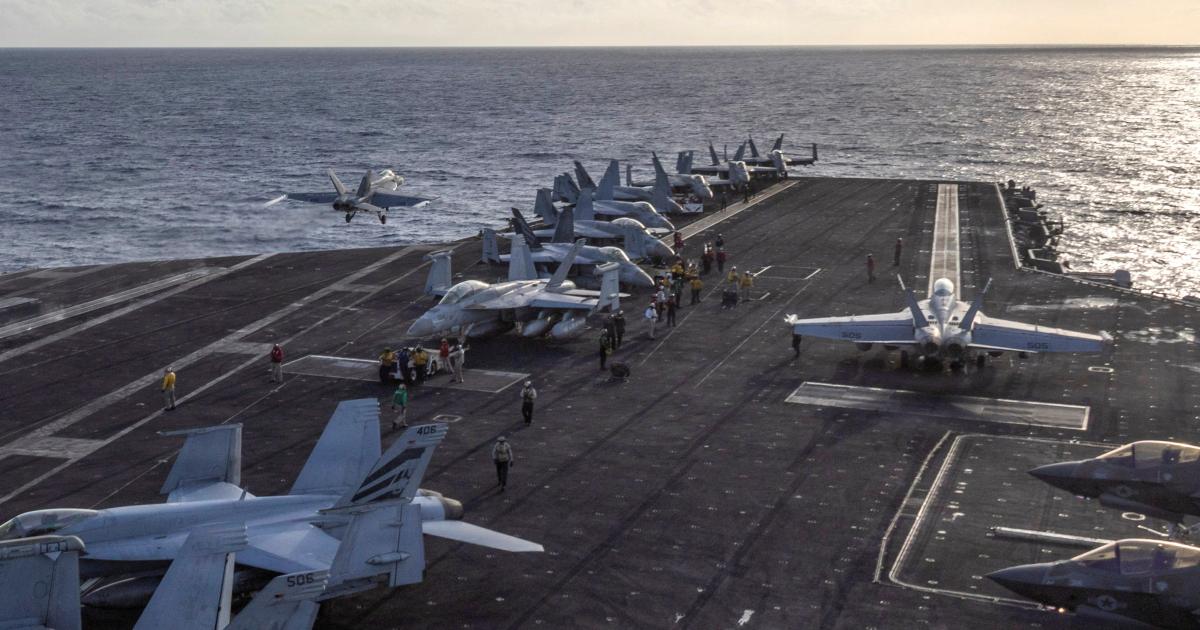
10月8日,“USS”号及其随行的打击群在海上部署320天后返回美国。这次部署接近现代美军的纪录,并已引发争议。随着该打击群的舰艇在数月间一次次未能进行港口访问,舰上状况急剧恶化。水兵们报告称存在物资短缺、管道故障和水污染问题。士气显著下降;甚至有八名水兵试图自杀。当这些舰艇最终离开中东时,它们的困境已登上全国各地的主页头条。
On October 8, the USS and its accompanying strike group returned to the United States after 320 days at sea. The deployment—a near record for the modern American military—had become controversial. As the group’s ships went month after month without a port call, conditions deteriorated precipitously. Sailors reported supply shortages, plumbing issues, and water contamination. Morale dropped markedly; eight sailors even tried to commit suicide. By the time the ships finally left the Middle East, their struggles had made headlines across the country.
“USS”号的艰难经历绝不是自去年2月伊朗战争爆发以来,唯一引发担忧的美军相关事件。军事分析人士对其他航母打击群的漫长部署表达了关切。他们对特朗普政府决定将驻扎在印太地区的士兵和武器撤出该地区并部署到中东感到忧虑。或许最让他们担心的是,美国正在耗尽其精密弹药的库存。
The travails of the are hardly the only story about the U.S. military to generate alarm since the war in Iran began last February. Military analysts have expressed concern about other carrier groups’ lengthy deployments. They have fretted about the Trump administration’s decision to pull soldiers and weapons stationed in the Indo-Pacific out of the region and position them in the Middle East. Perhaps most of all, they have worried as the United States drains its stockpile of sophisticated munitions.
这些问题都有着相同的根本原因:美军的架构并非为了应对数十年来经历的近乎持续的使用而打造。自冷战以来,美国国防规划者将美军构建为随时准备同时参与两场主要冲突的力量。在实践中,这意味着华盛顿建立了一支旨在赢得短促而激烈战争的部队。正因如此,军方没有足够的部队、武器或人员来应对永无止境的冲突,并同时在全球各地使用其力量来威慑敌人和安抚伙伴。
These problems all share the same root cause: the U.S. military is not built for the near-constant use it has experienced for decades. Ever since the Cold War, American defense planners have structured the U.S. armed forces to be ready to fight two major conflicts simultaneously. In practice, that means Washington has constructed a force that is designed to win short, sharp wars. For that reason, the military does not have enough units, weapons, or personnel to handle never-ending conflicts and simultaneously use its forces around the world to coerce enemies and reassure partners.
美国官员目前正试图适度扩充军队规模。更重要的是,他们希望通过巨额资金注入来提升现有武装力量的战斗力。但进行这些调整将异常具有挑战性——而且这些调整是没有必要的。美国是一个高度安全的国家,拥有许多有能力且富裕的伙伴。它不需要一个能够同时在所有地方进行战斗的防御机器。相反,它最好将注意力集中在少数几个问题上并进行相应的缩减。
American officials are now trying to modestly increase the size of the military. More important, they are hoping that huge infusions of money will increase the capability of the existing armed forces. But making these changes will be exceptionally challenging—and they are unnecessary. The United States is a highly secure country with many capable and wealthy partners. It does not need a defense apparatus capable of fighting everywhere all at once. Instead, it would be much better off focusing its attention on a smaller set of issues and scaling down accordingly.
兵力捉襟见肘 美国常规力量消耗了国防预算的80%以上,其结构和规模是针对特定应急情况而设计的——目前是几乎同时与中国、俄罗斯或这两国发生冲突。因此,军方武器的设计宗旨,是在军事规划人员所预计的极其危险的环境中实现最大的杀伤力和生存能力。为此,五角大楼一直强调采购精确、远程和隐形武器。这些武器本应充当砸开敌人防线大门的敲门砖,并允许其他昂贵的先进平台(如F-35战斗机或B-2、B-21轰炸机)投掷大量技术成熟度稍低但依然极具杀伤力的精确武器。
STRETCHED THIN The U.S. nonnuclear forces, which consume more than 80 percent of the defense budget, are structured and sized for particular contingencies—currently, a clash with China Russia, or both nearly simultaneously. The military’s weapons are therefore designed for maximum lethality and survivability in what military planners expect to be an unbelievably dangerous environment. To that end, the Pentagon has emphasized purchasing precise, long-range, and stealthy weapons. These are supposed to kick open the doors of enemy defenses and allow other expensive advanced platforms, such as F-35 fighter jets or B-2 or B-21 bombers, to deliver large quantities of slightly less sophisticated but still quite lethal precision weapons.
华盛顿从未预料到这些战争会持续很久。相反,华盛顿设想,在冲突产生的猛烈压力下,对手会认输,或者战争会升级为核威胁——甚至更糟糕的是——使用核武器。例如,在冷战期间,美国及其盟友曾计划与苏联进行一场极其激烈、大约为期30天的冲突。今天的军事策划者可能对与北京或莫斯科的战争抱有类似的假设。
Washington has never expected these wars to last long. Instead, it imagines that under the fierce pressure such conflicts would generate, the adversary will cry uncle or the war will escalate to nuclear threats or—worse yet—nuclear use. During the Cold War, for example, the United States and its allies planned for an extremely intense, roughly 30-day conflict against the Soviet Union. Today’s military planners have probably made similar assumptions about a war with Beijing or Moscow.
美方的思路是,具备强大作战能力的常规部队和核升级的风险应当能遏制攻击。如果遏制失败,美国策划者希望阻止敌人的攻势,并制造巨大的升级风险,以至于对手会意识到自己的错误并试图改弦易辙。
Highly capable conventional forces and the risk of nuclear escalation, American thinking goes, should deter an attack. If deterrence fails, U.S. planners hope to stop an enemy in its tracks and create escalation risks so great that the adversary will realize its errors and try to reverse course.
但这种思路意味着,华盛顿没有足够的资源来维持漫长的大国冲突。F-35战斗机作为空军、海军和海军陆战队的顶梁柱,每架造价高达1亿美元,根本不是为大规模生产而设计的。作为此类战争初期首选弹药的远程防区外导弹也不是。美军已经开发了复杂的战区弹道导弹防御系统,但其主要目的是保卫美军和必要的军事基础设施——而不是城镇、城市和民用工业。在某些情况下,它们可以用于这一目的,但这会迅速耗尽导弹库存。在与中国或俄罗斯的战争中,当地盟国的平民将需要自行照顾。
But such thinking means that Washington does not have enough resources to sustain long, great-power conflicts. At $100 million each, the F-35 fighter aircraft, a mainstay of the air force, navy, and Marine Corps, is simply not designed for mass production. Neither are the long-range stand-off missiles that would be the preferred munitions in the early days of such a war. The U.S. military has developed sophisticated theater ballistic missile defenses, but their main purpose is to defend U.S. forces and essential military infrastructure—not towns, cities, and civilian industries. They can be used for this purpose under certain conditions, but doing so quickly exhausts the supply of missiles. In a war with China or Russia civilians in local, allied countries will need to look after themselves.
这些问题在华盛顿对伊朗的战争中已经变得显而易见。美国原本可能认为它能迅速压倒这个伊斯兰共和国——一个充其量只是中等强国、尽管有着宏大野心的国家。毕竟,在恰当的情况下,美军能够轻易压倒这类敌人,就像它在1990至1991年的海湾战争中对付伊拉克那样。但华盛顿的敌人们自那以后变得聪明了。它们不再仅仅生产那些旨在威慑和对抗的大国军队的较小、较弱版本。
These problems have become readily apparent in Washington’s war against Iran. The United States likely thought it could rapidly overpower the Islamic Republic—at best a middle power, albeit one with great ambitions. After all, under the right circumstances, the U.S. military handily overmatches these kinds of enemies, as it did Iraq in the 1990–91 Gulf War. But Washington’s enemies have smartened up since then. They no longer simply produce smaller and less capable versions of the great-power militaries that American forces are designed to deter and combat.
相反,它们已经做好准备承受打击并继续战斗,哪怕作战效能处于较低水平。承诺过多而兑现不足过于雄心勃勃的战争计划和失误的政策并不是美军陷入困境的唯一原因。政治也制造了困难。由于美国人民对支持海外战争犹豫不决,美国政客会不惜一切代价避免伤亡。这意味着他们拿走美军为突破大国防御而囤积的所有高端武器,转而将其挥霍在地区冲突上。
Instead, they have prepared themselves to take a beating and keep on fighting, even if at modest levels of effectiveness. OVERPROMISE AND UNDERDELIVER Overly ambitious war plans and faulty policies are not the only reason the U.S. military is struggling. Politics is also creating difficulties. Because the American people hesitate to support wars abroad, U.S. politicians will do anything to avoid casualties. That means they take all the high-end weaponry that the military stockpiles to break down great-power defenses and instead spend it profligately on regional conflicts.
同样地,他们部署稀缺的防空武器来保护盟友的城镇,以免这些盟友考虑寻找新的伙伴或者决定通过对敌人妥协来结束战争。
Similarly, they deploy scarce air defense weapons to protect allies’ towns and cities, lest those allies consider finding new partners or decide to settle a war by compromising with their enemies.
美国决策者通常也过度使用军队。政客们喜欢将外交信息与行动结合起来,部分原因在于他们不再相信外交,这促使他们远超合理限度地秀肌肉或动用武装力量。当被要求采取行动时,指挥官们通常会敬礼并表示同意。其他人则根本坐不住。毕竟,指挥官们接受这些职务是因为他们想要指挥点什么。
U.S. policymakers also generally overuse the military. Politicians like to accompany diplomatic messaging with action, in part because they do not believe in diplomacy anymore, which pushes them to parade or use the armed forces far more often than is warranted. When asked to act, commanders usually salute and say yes. Others simply cannot sit still. Commanders, after all, took on their roles because they wanted to command something.
其结果是一支疲惫不堪的军队。军事媒体上充斥着关于舰艇和飞机不达标的报道,原因是它们服役时间过长,导致维护被推迟。这反过来又给其他部队带来了修理难题。当一艘船必须在干船坞里停留比平时更长的时间来接受充分的修理时,其他船只就必须等待更长的时间才能获得维护——这意味着它们的需求也在增长。
The result is a worn-down military. The defense press is full of stories about ships and aircraft that are not up to standard because they have been out too long, resulting in deferred maintenance. This, in turn, creates repair problems for other units. When a ship must stay in dry dock longer than usual to receive adequate repairs, other ships must wait longer for servicing—which means their needs also grow.
最终,在面临大国挑战时,海军可用的完全就绪的作战舰艇减少了。陆军也存在类似的问题,作战车辆和支援车辆运抵维修仓库时状况之差超出了预期。在空军方面,F-35战机的“完全执行任务能力率”原本就不高,自2021年以来更是从38%恶化至25%。而且,近年来空军飞机的整体战备状态也有所下降,部分原因正是过度劳累。
Ultimately, the navy has fewer fully ready combat ships available in the event of a great-power challenge. The army has similar problems, with combat and support vehicles arriving at maintenance depots in unexpectedly poor condition. In the air force, the F-35’s “full mission capable rate,” which was never great, has deteriorated from 38 percent to 25 percent since 2021. And the overall readiness of air force aircraft has declined in recent years, in part simply because of overwork.
与此同时,美国士兵、水兵、飞行员和海军陆战队员时刻保持警惕,施压并威慑美国的敌人,同时让盟友安心。这也是一种高强度的活动,可能会对人员留任产生负面影响。尽管近年来军方在留住资深士兵方面总体上取得了成功,但不久后可能会遇到困难。自2024年以来,美国海军军舰多次在人员编制不足的情况下出海。这种过度使用带来的最终结果是,军队的锋芒遭到磨钝,钢铁利刃被削弱。
All the while, U.S. soldiers, sailors, pilots, and marines are constantly on guard, coercing and deterring U.S. enemies and reassuring allies. This, too, creates high levels of activity that can negatively affect retention. Although the military has generally been successful at retaining senior enlisted personnel in recent years, it may soon run into difficulty. Since 2024, navy warships have repeatedly gone to sea undercrewed. The ultimate result of this overuse is that the sharp edge of the military is dulled, and the steel blade is weakened.
量体裁衣 美国国防官员深知他们面临着一个问题。目前,他们正试图通过建设一支规模略大且技术能力强得多的军队来解决这个问题。例如,国会似乎准备将五角大楼所谓的基准预算——国会预算办公室将其定义为“配备人员、训练和装备军队的持久成本”——在2027财年增加25%以上,达到1.1万亿美元。五角大楼希望在后续法案中获得比基准预算额外增加3500亿美元的资金。
FIT FOR PURPOSE U.S. defense officials are aware that they have a problem. Currently, they are trying to solve it by building a somewhat bigger and far more technologically capable military. Congress, for example, appears poised to increase the Pentagon’s so-called base budget—which encompasses what the Congressional Budget Office defines as the “enduring costs of manning, training, and equipping the military”—by over 25 percent, or to $1.1 trillion for the 2027 fiscal year. The Pentagon hopes to secure an additional $350 billion over the base budget in a subsequent bill.
国防官员还希望增加4,0000多名新现役军人。但这充其量只是3%的人员增幅,这一增幅实在太小,无法填补解决现有战备问题所需的额外部队。国会希望国防官员购买的更先进武器,也无法克服持续部署和屡次战争带来的压力。国防工业基础勉强能跟上当前的需求,而招募大量新军人可能需要提供高得多的薪酬,而这些薪酬随后又必须发放给所有人。
Defense officials also want to add over 40,000 new service members. But this is, at best, a personnel increase of three percent, which is much too small to fill the additional units needed to solve extant readiness problems. And the fancier weapons Congress hopes defense officials will buy cannot overcome the strain of constant deployments and repeated wars. The defense industrial base is barely keeping up with current demands, and recruiting large numbers of new service members would likely require offering much higher wages, which would then need to be extended to everyone else.
人员成本将开始消耗防务预算中越来越大的份额。美国官员也可以选择实行征兵制,但这会引发强烈反对。
Personnel costs would start consuming an ever-greater share of the defense budget. U.S. officials could instead opt for conscription, but that would produce a backlash.
然而,还有一种选择:缩减规模。华盛顿不应假装自己必须同时具备打赢两场大国战争的能力,而应量力而行。美国应继续建设应对重大突发事件的部队,例如遏制中国的冒险行动。但决策者应同意放缓其他项目。国会应责成五角大楼对武装力量进行审查,并制定一份活动预算,该预算将基于对军队在不损害整体备战状态的前提下,能承担多少真实军事活动——飞行小时数、舰艇出海天数、野外训练天数——的评估。
There is, however, an alternative: scaling down. Instead of pretending that it must be able to fight two great-power wars at once, Washington should cut its policy coat to fit the available cloth. It should continue to build forces for major contingencies, such as deterring adventurism by China. But policymakers should agree to slow down other projects. Congress should task the Pentagon with reviewing the armed forces and come up with an activity budget, which would be based on an assessment of how much real military activity—flying hours, ship days at sea, training days in the field—can be undertaken without harming the readiness of the total force.
然后据此合理分配这些活动。指挥官们理应清楚,30年的高强度运作导致军队遭受了“虚拟损耗”,他们应据此判断军队实际能支持何种水平的演习、前沿部署和地区战争,而不损害其希望时刻保持、以遏制大国战争并在必要时有效作战的能力。美国海军早已知晓其舰队能支持的活动水平,并已在其“优化舰队响应计划”中详细列出。但美国总统和国防部长每当想部署更多兵力时,便无视这一计划。
It would then allocate that activity appropriately. Based on what they ought to know about the virtual attrition the military has suffered thanks to 30 years of hyperactivity, commanders should determine what level of exercises, forward deployments, and regional wars the military can actually support without doing damage to the capabilities it wishes to have ready every day to deter a great-power war and, if need be, wage one effectively. The U.S. Navy already knows the activity level that its fleet can support, which it has detailed in its Optimized Fleet Response Plan. But American presidents and defense secretaries have simply ignored this plan whenever they wanted to deploy more forces.
活动预算不应列为机密,而应作为公开信息,与五角大楼每年发布的美元预算一并公布,后者的详尽摘要可在国防部审计长网站上找到。当政客们想要超越先前商定的活动水平时,他们应当解释原因,并说明计划如何在高强度使用后修复部队。指挥官应将此视为一个道德问题。偶尔应有人因过度使用导致严重问题而辞职。华盛顿应量力而行。
The activity budget should not be classified but instead should be public information, listed along with the dollar budget that the Pentagon publishes annually, voluminous summaries of which can be found at the Defense Department’s comptroller’s website. When politicians want to exceed the activity levels on which they have previously agreed, they should have to explain why and how they plan to repair the force after intense use. Commanders should think of this as an ethical issue. Every now and then, one should resign when overuse causes serious problems. Washington should cut its policy coat to fit the available cloth.
为了减轻自身的负担,华盛顿将需要把一些责任移交给其他各方。尽管需要应对莫斯科的好战冲动——这也是驱动美国国防规划的预想突发事件之一(即与俄罗斯的战争)——但这应该是可行的。如果主要欧洲国家选择这样做,它们拥有远超所需的经济和技术资源来独自应对俄罗斯。因此,跨大西洋协议应当更加坦诚地表明美国准备为欧洲大陆防务承担的有限责任。
To help lighten its load, Washington will need to hand off some responsibilities to others. This should be feasible despite the need to manage Moscow’s aggressive impulses, which are the presumed cause of one of the contingencies—a war with Russia—that drives U.S. defense planning. The principal European states have more than enough economic and technological resources to deal with Russia on their own, if they so choose. The transatlantic bargain should thus be more forthright about the limited liability that the United States is prepared to assume for the continent’s defense.
特朗普政府的《国防战略》对这一事实是坦诚的,但美国的军事活动水平和在欧洲的部署表明,美国并未真正减少其在欧洲防务中的角色。北约最高盟军长官依然是一名美国人,而这个职位本应由欧洲人来担任。数以万计的美军仍然驻扎在欧洲各地;其中许多人应该回国。五角大楼及其在欧洲的美军司令部的网站上,充斥着横跨整个欧洲大陆的演习和行动清单,这些演习和行动不仅涉及前沿部署的美军,还涉及以美国为基地的部队的轮换部署。这些数字同样也应该减少。
The National Defense Strategy of the Trump administration is honest about this fact, but U.S. military activity levels and deployments in Europe suggest that the United States has not truly reduced its role in Europe’s defense. The supreme allied commander of NATO is still an American, when the position should be filled by a European. Tens of thousands of U.S. troops are still based all over Europe; many should come home. Pentagon websites and those of American commands in Europe feature laundry lists of exercises and maneuvers across the continent that involve not only forward-based U.S. forces but also rotating deployments of units based in the United States. These numbers, too, should diminish.
美国官员或许认为,通过增加军备力量就能解决大部分全球安全挑战。然而,更好的解决办法是让美国调整其总体战略,并采取更为克制的行动。华盛顿既没有意愿,也没有足够的资源来同时保障亚洲和欧洲的安全,同时还要应对其他地区(尤其是中东)的长期冲突。事实上,美国本身就是一个非常安全的国家:它经济富裕、自然资源丰富,被广阔的海洋所环绕,而且其邻国大多较为弱小且易于相处。
American officials may want to be able to solve most of their global security challenges by simply buying more forces. But a much better solution is for the United States to change its grand strategy and act with greater restraint. Washington simply does not have the will or the resources to provide for both Asia’s and Europe’s defense while fighting protracted conflicts elsewhere, most recently in the Middle East. Nor, for that matter, does it need to. The United States is inherently a very secure country. It is rich, endowed with bountiful natural resources, insulated by vast oceans, and blessed with relatively weak and pliant neighbors.
只有当亚洲、欧洲或整个中东地区的政治格局发生巨大变化时,美国的国家安全才会受到真正威胁。
Only huge changes in the political constellation of power in Asia, Europe, or the greater Middle East could seriously affect U.S. security.
美国确实应该增强自身的军事实力,并储备足够的原材料以应对这些潜在的变化。但总体而言,美国完全有能力采取更为保守的策略。调整总体战略甚至可能使美国有机会削减国防预算。如果关于美国财政赤字不断扩大的担忧属实,那么五角大楼就需要承担起相应的责任,以改善美国的财政状况。
Washington should buy sufficient military power and stock adequate reserves of raw materials to ensure against such changes. But in general, it can afford to be less proactive. A change in grand strategy might even allow the United States to cut the defense budget. If concerns about the ballooning U.S. deficits are correct, then the Pentagon will need to help pay the bills to set things right.