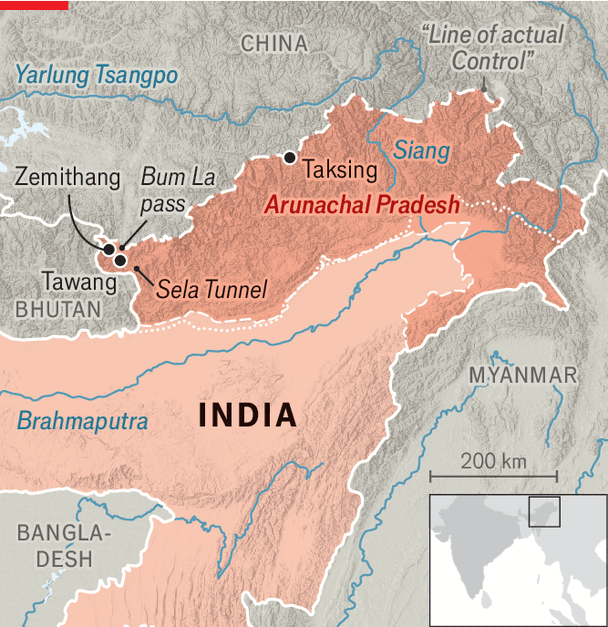
距离印度东北部与中国边境仅10公里的泽米唐村,位于中国主张拥有主权的领土腹地。日常生活却有着浓厚的印度色彩。当地人用印地语交谈、收听宝莱坞歌曲、升挂印度国旗。但偶尔也会出现不受欢迎的“中国存在”。“我的手机总是自动切换到北京时间[快两个半小时],因为我失去了印度网络信号,转而接收到了中国的信号,”一位当地官员抱怨道。他的抱怨道出了印度面临的挑战:在试图改造偏远边疆、赶上对岸大规模基建推进的过程中,困难重重。
JUST 10km from India’s north-eastern border with China, the village of Zemithang lies in the heart of territory claimed by the Chinese. Everyday life feels unmistakably Indian. Locals chat in Hindi, listen to Bollywood songs and fly Indian flags. But occasionally there is an unwanted Chinese presence. “My phone keeps changing to Beijing time [two and a half hours ahead], because I lose my Indian network and pick up the Chinese one,” says a local official. His complaint captures the challenge facing India as it tries to transform its remote frontier, and match a massive infrastructure roll-out on the other side.
印度正向泽米唐及阿鲁纳恰尔邦其他地区倾注混凝土与资金,以巩固对这个喜马拉雅邦的控制。该邦人口不足200万,为中国所声索,中国称之为“藏南”,即西藏南部。该邦也是两国唯一一场战争的主要战场。1962年,中国军队翻越大山,击溃印军并占领了部分地区。中方最终撤军,但那场失败确保了此后双边关系始终紧绷。
India is pouring concrete and money into Zemithang and other parts of Arunachal Pradesh to strengthen its hold over the Himalayan state. Home to fewer than 2m people, it is claimed by China, which calls it Zangnan, or southern Tibet. The state was also the main theatre of the only war between the two countries. In 1962 Chinese soldiers descended through the mountains, overran Indian forces and occupied parts of it. They eventually withdrew, but the defeat has ensured that relations have been edgy ever since.
如今,边境线已平静得多。双方军队隔着“实际控制线”对峙,这条有争议的边界蜿蜒于壮丽的群山峡谷之间(见地图)。除零星冲突外,阿鲁纳恰尔邦自1975年以来未发生过冲突。即使2020年印中军队在加勒万河谷爆发肉搏战——那里在阿鲁纳恰尔邦以西1500公里处——该邦边境依然保持平静。但这是一种“丑陋的稳定”,驻德里的安全分析师阿杰·舒克拉说。
Today the frontier is far calmer. The two armies face each other across the “line of actual control”, a disputed border that runs through spectacular mountains and valleys (see map). Barring a few scuffles, there has been no clash in AP since 1975. Even during hand-to-hand fighting in 2020 between Indian and Chinese troops in Galwan, 1,500km to the west, the border in AP remained quiet. But this is an ugly stability, says Ajai Shukla, a security analyst based in Delhi.
通往印方边境的公路两侧林立军营:估计有9万至12万部队部署在该地区。8月,当地政治团体指控中方在阿鲁纳恰尔邦东部的塔克辛附近有越界行为,但印度政府将这些报道斥为谣言。
The road to the border on the Indian side is lined with military camps: an estimated 90,000-120,000 troops are deployed in the region. In August local political groups alleged there had been Chinese intrusions near Taksing, in eastern AP, though India’s government dismissed the reports as rumours.
最激烈的角逐在于基础设施建设。几十年来,印度官员避免在阿鲁纳恰尔邦修建道路,担心这会为入侵的中国军队提供一条更便捷的南下路线。现在这被视为一个错误:糟糕的连通性阻碍了印度向本国部队补给的能力,也让当地民众与世隔绝。与此同时,中国在其一侧修建了广泛的公路网,以及数百个“军民两用”村庄,这些村庄将民用定居点与军事基础设施结合在一起。
The fiercest contest is over infrastructure. For decades Indian officials eschewed building roads in AP, fearing it would give an invading Chinese army an easier route south. That is now considered a mistake: poor connectivity hindered India’s ability to supply its own troops and kept its citizens isolated. Meanwhile China built an extensive network of roads on its side, as well as hundreds of “dual-use” villages that combine civilian settlements with military infrastructure.
印度正急于补救。“直到加勒万河谷冲突发生前,印度假定与中国的关系会以线性方式改善。那次事件是一个真正的警钟,”希夫·纳达尔大学的贾宾·雅各布说。如今,印度将连通性视为威慑的关键。大部分工作由国防部下属的道路建设机构主导,该机构已在该地区修建了数百公里公路,包括塞拉隧道,该隧道使该地区最大城镇达旺即便在冬季也能保持可达。
India is rushing to make amends. “Until the clashes in Galwan, India assumed that the relationship with China would improve in a linear fashion. That incident was a real wake-up call,” says Jabin Jacob of Shiv Nadar University. These days India regards connectivity as essential to deterrence. Much of the work is led by the defence ministry’s road-building arm, which has constructed hundreds of kilometres of roads in the region, including the Sela Tunnel, which keeps Tawang, the biggest town in the area, accessible even during winter.
建设热潮远不止于修路。阿鲁纳恰尔邦的河流拥有巨大的水电潜力。为加以利用,印度计划修建多座大坝,其中包括其有史以来最大的大坝,拟建在上西昂河上。巩固边境还涉及让边境附近的定居点焕发更多生机。印度官员对卫星图像显示的中国边境村庄迅速扩张感到日益担忧。2023年,印度政府启动了“活力村庄计划”。约270亿卢比(2.86亿美元)已为该邦的项目预留出来,占该邦GDP的6%。
The building drive extends far beyond roads. AP’s rivers have huge hydropower potential. To harness it, India is planning several dams, including its biggest-ever on the Upper Siang river. Securing the border also involves breathing more life into the settlements near it. Indian officials have become increasingly alarmed by satellite images revealing the rapid expansion of Chinese border villages. In 2023 the Indian government launched the Vibrant Villages Programme. Around 27bn rupees ($286m) has been set aside for projects in the state, 6% of the state’s GDP.
目的是遏制该地区的人口外流、吸引人口流入并改善治理。工作重点多集中在基建上。但军方也在协助将该地区打造成旅游景点(仅对印度人开放),为游客提供前往边境哨所参观、接受1962年战争历史教育的机会。在海拔约4600米的班拉山口,士兵陪同旅行团一路抵达边境线,带领大家面向中方一侧高呼“Bharat Mata ki Jai”(“向母亲印度致敬”)。
The aim is to stem migration from the region, draw people in, and improve administration. Much of the focus is on construction. But the army is also helping to turn the area into a tourist attraction (for Indians only), offering visitors access to border posts and history lessons on the 1962 war. At Bum La pass, at around 4,600 metres, soldiers accompany tourist groups right up to the frontier and lead chants of “Bharat Mata ki Jai” (”Victory to Mother India”) while facing the Chinese side.
这一切都受到欢迎。该邦一向是印度较贫穷、较封闭的角落之一,但在2024-25财年(有数据的最新年度),其经济增长了10%,增速位居全国第三。尽管如此,当地居民仍渴望更多、更高质量的发展。当地人担心资金到位太慢,且陷入官僚主义的繁文缛节之中。
All this is welcomed. The state has always been one of India’s poorer and more isolated corners, but in 2024-25 (the latest year for which data are available) its economy grew by 10%, the third-fastest rate in the country. Still, residents crave more development and of better quality. Locals fret that funding takes too long to arrive and gets tangled in bureaucracy.
此类抱怨折射出中印竞争背后的巨大鸿沟。中国拥有更雄厚的经济和军事资源,也享有不受约束的国家执行力优势。据称中国曾强行迁移民众至边境村落。而印度方面则必须应对本地顾虑——例如民众反对修建大坝。
Such complaints reflect the chasm between China and India that shapes their rivalry. China enjoys greater economic and military resources and also the advantage of unfettered state capacity. It is said to have forcibly relocated people to border villages. The Indians, meanwhile, must contend with local concerns—such as opposition to the construction of dams.