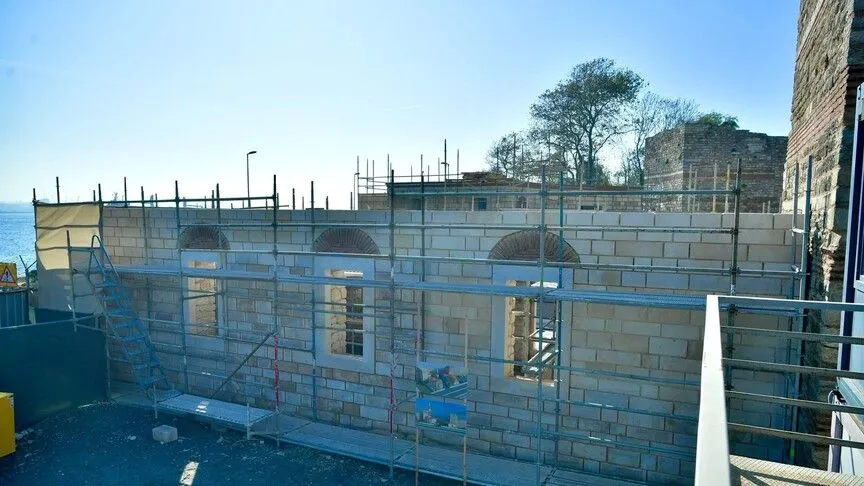
伊斯坦布尔历史天际线上约70年前消失的波斯坦吉拉尔·塔布哈内西清真寺(Bostancilar Tabhanesi Mosque),又名耶德克吉勒清真寺(Yedekciler Mosque),正在该市萨拉伊布尔努区(Sarayburnu)进行修复。
The Bostancilar Tabhanesi Mosque, also known as the Yedekciler Mosque, which disappeared from Istanbul’s historic skyline around 70 years ago, is being restored in the city’s Sarayburnu district.
这座清真寺建于奥斯曼苏丹苏莱曼大帝统治时期,旨在为生病的宫廷园丁提供服务,位于托普卡帕宫海墙之外,介于萨拉伊布尔努与阿赫尔卡普之间。20世纪50年代,因沿海公路建设工程被拆除。
Built during the reign of Ottoman Sultan Suleiman the Magnificent to serve sick palace gardeners, the mosque was located outside the sea walls of Topkapi Palace, between Sarayburnu and Ahirkapi. It was demolished during coastal road development works in the 1950s.
法提赫市政厅主导的修复工作旨在将该建筑作为伊斯坦布尔历史文化遗产的一部分重现于城市中。
Restoration efforts led by Fatih Municipality aim to return the structure to Istanbul as part of the city’s historical and cultural heritage.
几个世纪以来,这座清真寺一直是礼拜场所,也是奥斯曼宫廷周边日常生活的一部分。它的故事也揭示了伊斯坦布尔现代化进程中消失的历史建筑的命运。
For centuries, the mosque served as a place of worship and formed part of daily life around the Ottoman palace. Its story also sheds light on the fate of historical buildings lost during Istanbul’s modernization.
1956年至1960年间实施的城市开发项目改变了萨拉伊布尔努的海岸线和城市肌理,不仅永久改变了该地区的交通网络,也永久改变了其历史天际线。
Urban development projects carried out between 1956 and 1960, which altered Sarayburnu’s coastline and urban fabric, permanently transformed not only the area’s transport network but also its historic skyline.
学术研究也已将该清真寺列入这一时期从海岸线上消失、且通过历史照片追溯出原址的建筑之中。
Academic studies have also identified the mosque among the structures that disappeared from the coastline during this period and whose former locations have been traced through historical photographs.
“20世纪50、60年代清真寺已彻底消失” 法提赫市长梅赫梅特·埃尔贡·图兰(Mehmet Ergun Turan)对阿纳多卢通讯社表示,波斯坦吉拉尔·塔布哈内西清真寺是伊斯坦布尔海墙外紧邻处唯一的清真寺。
‘Mosque had completely disappeared by 1950s, 1960s’ Bostancilar Tabhanesi Mosque was the only mosque located immediately outside Istanbul’s sea walls, Fatih Mayor Mehmet Ergun Turan told Anadolu.
他说:“从于斯屈达尔(Uskudar)或乘船过来时,这是最先映入眼帘、能看到尖塔的清真寺。然而,该建筑从20世纪30年代开始失修。其尖塔于20世纪40年代被拆除。到了20世纪50年代和60年代修建沿海公路时,清真寺已彻底消失。”
“When crossing over to this side from Uskudar or by sea, this was the first mosque whose minaret came into view. However, the structure began falling into disrepair in the 1930s. Its minaret was demolished in the 1940s. By the 1950s and 1960s, when the coastal road was built, the mosque had completely disappeared,” he said.
“今天,我们很高兴将这座清真寺重新恢复到伊斯坦布尔的天际线上,也许是在近100年之后。我们在大量文献中都有它的照片,它的位置标注在地图上,也出现在版画中。”
“Today, we are delighted to restore this mosque to Istanbul’s skyline, perhaps nearly 100 years later. We have photographs of it in numerous documents, its location is marked on maps, and it appears in engravings.”
他强调,他们的目标是修复所有失传的祖辈遗产,并表示:“我们修复的任何一座清真寺都不使用公共资金。它们由捐赠者资助。迄今为止,我们已完成八座清真寺的重建。目前,我们正在进行另外10座类似清真寺的修复工作。”
Underlining that they aimed to restore all lost works of ancestral heritage, he said: “We do not use public funds to build any of the mosques we restore. They are funded by donors. So far, we have completed the reconstruction of eight mosques. We are currently working on the restoration of 10 similar mosques.”