根据周四发表在《科学》杂志上的一项研究,微软的 AI 诊断系统在模拟中正确诊断复杂医疗病例的频率,是全科医生的两倍多。微软 AI 首席执行官穆斯塔法·苏莱曼称这一结果是迈向“医疗超级智能”的一步。该系统被称为 MAI-DxO(简称 DxO),协调多个 AI 智能体,使其像一个医生专家组一样运作。它们向患者提问、开具检查、并对诊断进行讨论。
Microsoft’s AI diagnostic system correctly diagnosed complex medical cases in a simulation more than twice as often as generalist physicians, according to a study published Thursday in Science. Mustafa Suleyman, Microsoft AI’s CEO, called the result a step toward “medical superintelligence.”The system, dubbed MAI-DxO (DxO for short), coordinates several AI agents that act like a panel of doctors. They question a patient, order tests, and debate a diagnosis.
在一项使用《新英格兰医学杂志》复杂病例的模拟中,该系统的正确率为 83%。单独借助参考资料工作的初级保健医生和全科内科医生,正确率为 36%。有一点需要注意:这种复杂程度的病例通常由专科医生或医生团队处理,而他们并未参与此次对比。
In a simulation using complex cases from the New England Journal of Medicine, it was correct 83% of the time. Primary care doctors and general internists, working individually with reference materials, were correct 36% of the time. One note: cases this complex are usually handled by specialists or physician teams, who weren’t part of the comparison.
微软 AI 健康业务副总裁多米尼克·金对 TechCrunch 表示:“这里有一些非常实质性且令人振奋的东西。目前医疗服务交付面临的最大挑战,是医疗专业知识的需求与供给之间日益扩大的错位。” 通过发布这些结果,微软加入了谷歌和 OpenAI 的行列,声称其自身的 AI 能够匹敌或超越医生。
“There is something very substantial and exciting here,” Dominic King, vice president of Health at Microsoft AI, told TechCrunch. “The biggest challenge in healthcare delivery at the moment is the growing mismatch between demand and supply of medical expertise.”In publishing these results, Microsoft joins Google and OpenAI in claiming that its own AI can match or outperform doctors.
该研究自身的数据表明,大部分改进来自于更强大的底层 AI 模型,而微软的编排系统在此基础上又增加了收益。
The study’s own data suggests that much of the improvement comes from more powerful underlying AI models, with Microsoft’s orchestration system adding gains on top.
微软使用多家公司的模型测试了 MAI-DxO,包括 OpenAI、谷歌、Anthropic、Meta 和 DeepSeek,但其最佳结果来自 OpenAI 的 GPT-5 和 GPT-5.5。
Microsoft tested MAI-DxO with models from several companies, including OpenAI, Google, Anthropic, Meta, and DeepSeek, but its best results came with OpenAI’s GPT-5 and GPT-5.5.
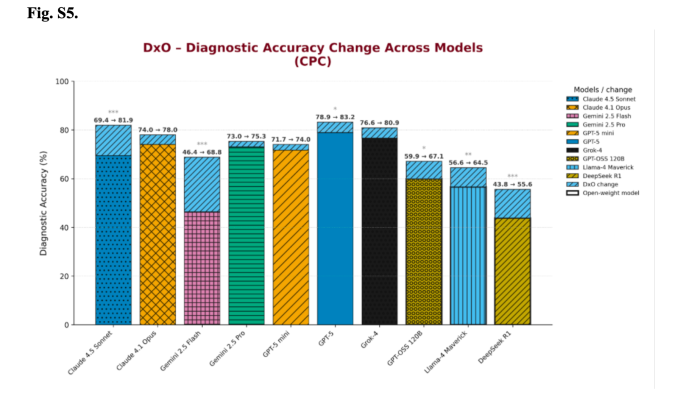
微软在衡量 DxO 时同时考察了成本和准确性,即运行 AI 处理每个病例的估算成本。仅凭一个简短的基础提示词,GPT-5 在复杂病例上的得分为 78.9%,每个病例成本约为 8400 美元。DxO 将该成本降低了约 3000 美元,但准确率仅提高了约四个百分点。在急诊科病例上,GPT-5 单独运行与在 DxO 协助下运行相比,无论在准确率还是成本改进方面,均几乎没有提升。
Microsoft measured DxO on cost as well as accuracy, meaning the estimated cost of running the AI on each case. On its own with a short, basic prompt, GPT-5 scored 78.9% on complex cases at about $8,400 per case. DxO cut that cost by about $3,000 but raised accuracy by only about four points. On emergency department cases, there was little improvement in either accuracy or cost improvement between GPT-5 on its own and with the assist from DxO.
随着2026年4月发布的较新模型GPT-5.5,结果出现了分化。在复杂病例上,DxO将GPT-5.5的准确率从72%提升至近87%,且成本略低。然而,在急诊科病例上,提升再次未显现。无论是否使用DxO,两者得分均约为85%,成本也相近。
With GPT-5.5, a newer model released in April 2026, the results split. On complex cases, DxO increased GPT-5.5’s accuracy score from 72% to nearly 87% at a slightly cheaper cost. However, the gains once again didn’t show up on emergency department cases. Both (with and without DxO) scored about 85% at a similar cost.
DxO在复杂病例和能力较弱的AI模型上帮助最大。例如,Gemini 2.5 Flash单独运行得分为46.4%,配合DxO后接近69%。即便如此,较弱与较强模型之间的差距,仍大于DxO带来的提升幅度。
DxO helps most on complex cases and with less capable AI models. Gemini 2.5 Flash, for example, scored 46.4% on its own but nearly 69% with DxO. Even so, the gap between the weaker and stronger models was larger than the boost DxO provided.
微软研究人员表示,随着模型逼近理论最大值,准确率提升自然会收窄。一位发言人补充道:“DxO编排有助于应对在优化准确率和成本方面的更广泛挑战。”
Microsoft’s researchers said that accuracy gains naturally shrink as models approach the theoretical maximum. “The DxO orchestration helps with the broader challenge of optimization both accuracy and cost,” a spokesperson added.
领导微软打造自家前沿AI工作的苏莱曼告诉《TechCrunch》,公司正与梅奥诊所合作训练一款面向医疗的基础模型,计划明年发布。他认为该模型将使公司“在此实现真正巨大的飞跃”,并称DxO是微软为在医疗领域取得真正突破而构建的基础设施的一部分。
Suleyman, who leads Microsoft’s effort to build its own frontier AI, told TechCrunch that the company is working with Mayo Clinic to train a foundation model for healthcare, with release planned for next year. He believes this model will enable the company to “make really enormous leaps here,” and says DxO is part of the foundational infrastructure Microsoft is building to see real breakthroughs in healthcare.
“我真心认为,到2027年,我们将处于医疗记录编码式突破的前夜,”苏莱曼说。“我认为我们将能够流式传输关于医疗记录可能如何演变的高精度预测,显然,这种前瞻对临床医生而言价值连城。”苏莱曼职业生涯致力于用AI解决医疗问题。他曾是DeepMind的联合创始人,后者于2014年被谷歌收购。次年,谷歌DeepMind收购了金创办的初创公司Hark——一款临床任务管理应用,双方共同推出了DeepMind Health。
“I really believe that in 2027, we will be on the verge of a coding style breakthrough for medical records,” Suleyman said. “I think we’re going to be able to stream highly accurate predictions about how a medical record might unfold, and obviously that kind of foresight for a clinician is gold dust.”Suleyman has spent his career trying to use AI to solve medical issues. He was previously a co-founder of DeepMind, which was acquired by Google in 2014. The following year, Google DeepMind acquired King’s startup Hark, a clinical task management app, and the two of them launched DeepMind Health together.
苏莱曼于2024年加入微软领导其AI部门,金几个月后也随之加入。“我们只是坚定的信徒,”苏莱曼说。
Suleyman joined Microsoft to lead its AI unit in 2024, and King followed a few months later. “We’re just true believers,” Suleyman said.
他说,虽然生成式人工智能在医疗保健领域的应用仍处于早期阶段,但他预计在未来24至36个月内,医疗模型的能力将“提升一个数量级”。
He said while the use of generative AI in healthcare is still early, he expects healthcare models to get “an order of magnitude better in capability within the next 24 to 36 months.”
苏莱曼表示:“正如我们在过去五六年里多次看到的那样,一旦拥有了飞轮效应,进步就会发生得非常快。‘飞轮效应’意味着我们拥有一个投入生产的模型,我们通过现实世界的使用对其进行迭代,以识别模型中的差距,然后修补并改进它们。这在编程领域已经发生过。在此之前,聊天领域也发生过。我认为明年这种情况将开始出现在医疗记录和临床决策支持领域。”通过与波士顿贝斯以色列女执事医疗中心的新合作伙伴关系,微软将在不同的医院环境中评估DxO的临床推理能力。
“As we’ve seen multiple times in the last five or six years, the progress happens very quickly once you have a flywheel,” Suleyman said. “A flywheel means we have a model in production which we are iterating with real world usage in order to identify gaps in the model and then patch them and improve them. That’s what’s happened in coding. It’s what happened in chat before that. And I think next year it’s going to start to happen for medical records and for clinical decision support.”Through a new partnership with Beth Israel Deaconess Medical Center in Boston, Microsoft will evaluate the clinical reasoning capabilities of DxO across different hospital settings.
金恩说:“这项技术已准备好进行现实世界的评估,你可以想象波士顿急诊科在周五晚上面临的问题有多复杂、多多样。”
“This technology is ready for real world evaluations, and you can imagine the complexity and diversity of issues that come from a Boston emergency department on a Friday evening,” King said.
他解释了该研究将如何开展:患者将接受标准治疗,包括分诊、专科医生会诊、治疗、检查,以及关于是否可以安全出院的决定。与此同时,同意参与的患者也将与DxO互动。微软及其合作伙伴将把DxO的建议与人类医生的建议进行对比。
He explained how the study will work: patients will get standard treatment, including triage, time with a specialist, treatments, investigations, and decision on whether it’s safe to discharge. In parallel, those who consent will also engage with DxO. Microsoft and its partners will compare DxO’s recommendations against the human doctors’.
本月,谷歌与贝斯以色列女执事医疗中心合作,在《柳叶刀》上发表了一项临床研究,旨在评估谷歌的AMIE对话式诊断人工智能在现实世界急诊就诊中的表现,同时由人类医生实时监控互动过程。
Google published a clinical study alongside Beth Israel in The Lancet this month to evaluate Google’s AMIE conversational diagnostic AI in a real-world urgent care visits, while human physicians monitored the interactions in real time.
金表示:“我们认为这将是同类研究中规模最大的一项。它不仅涵盖急诊环境,还将覆盖紧急护理环境,并将在研究期结束时为我们提供非常有说服力的证据,证明这些系统未来能够更大规模地部署。”微软在《科学》杂志上发表这项研究的同时,还发布了一份类似宣言的文件,阐述构建医疗超级智能所需的条件。医疗超级智能被定义为“在医学推理和覆盖整个护理过程的协调能力上超越当代最强的人类主导卫生系统的能力”。
“We think this will be the biggest study of its kind,” King said. “It will be across not just emergency settings but urgent care environments, and will give us very compelling evidence by the end of the study period around the ability for these systems to be deployed at greater scale in the future.”Microsoft’s study in Science coincides with a manifesto of sorts around what it will take to build medical superintelligence, defined as “the capacity to surpass the strongest contemporary human-led health systems in medical reasoning and coordination across the full arc of care.”
微软希望超越对单项任务(如回答医学考试题和生成诊断)的基准测试,转而与临床医生和医疗系统整合,以取得更好的结果。
Microsoft hopes to move beyond benchmarking individual tasks — like answering medical exam questions and generating diagnoses — into integrating with clinicians and health care systems for better outcomes.
苏莱曼说:“这是全世界人人都想要的那种技术,这就是为什么我们承诺尽一切努力加速将其推向世界。”他补充说,这一重点可能成为微软相较于其他前沿实验室的差异化优势。
“This is the kind of technology that everybody in the world wants, and that’s why we’re committed to doing everything we can to accelerate its introduction to the world,” Suleyman said, adding that this focus could be a differentiator for Microsoft compared to the other frontier labs.
微软已经在向临床医生销售听写和放射学工具,并将DxO视为对这些努力的扩展。
Microsoft already sells dictation and radiology tools to clinicians and sees DxO as an expansion to those efforts.
苏莱曼说:“在未来几年内,我们必须拥有绝对第一、最先进的医疗临床决策支持产品。”
“We have to have the absolute number one state-of-the-art medical clinical decision support products over the next few years,” Suleyman said.