上海讯 中国正在推动聚光太阳能热发电(CSP)的广泛采用,该技术利用太阳热量发电,旨在将该技术确立为与太阳能光伏和风电并列的另一种可再生能源选择。
SHANGHAI -- China is pushing the widespread adoption of concentrated solar thermal power (CSP), which generates electricity using the sun's heat, aiming to establish the technology as another renewable energy option alongside solar photovoltaic and wind power.
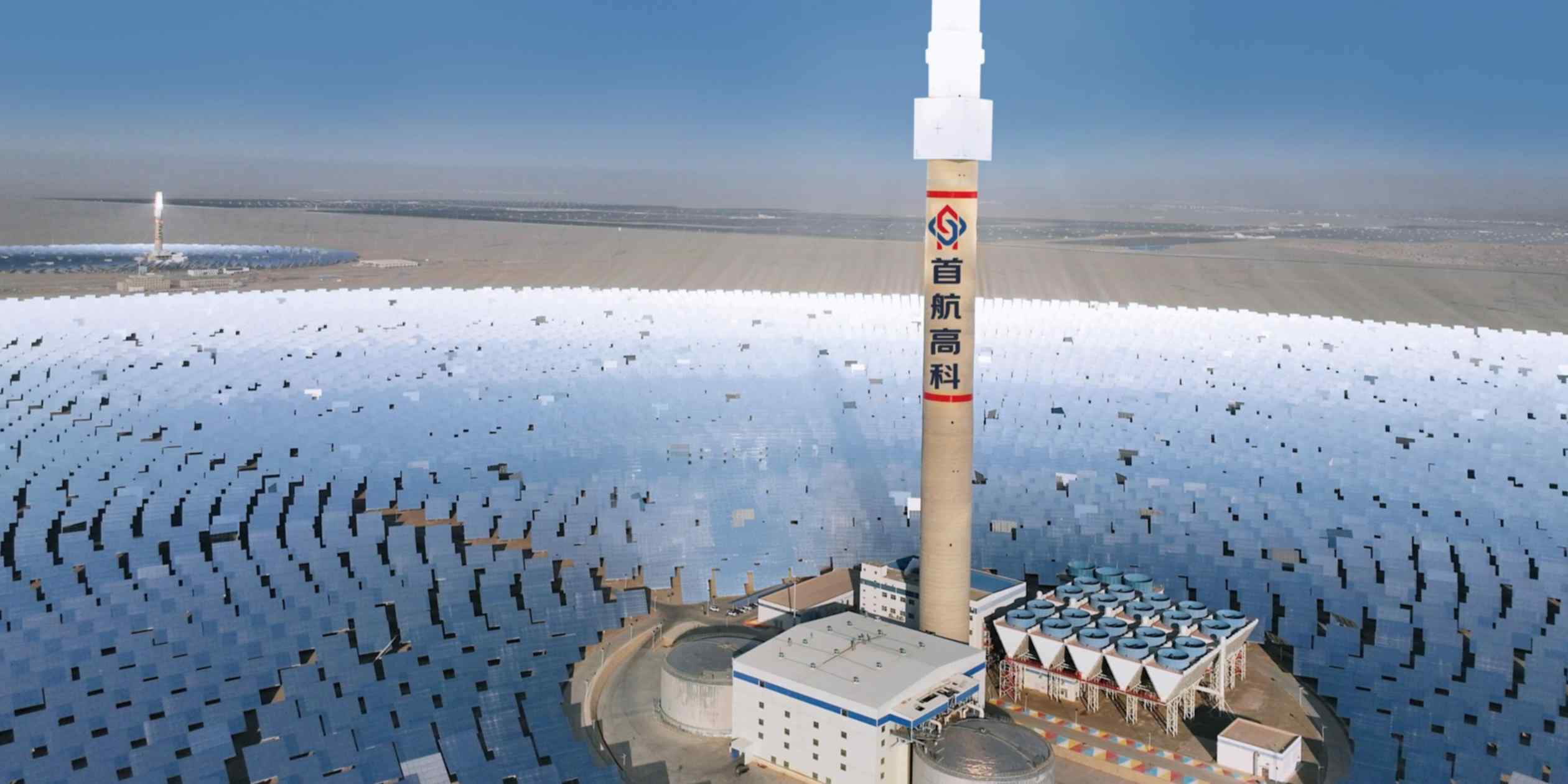
位于内陆省份甘肃的敦煌市,曾是丝绸之路上的枢纽。在城市郊区,距离仍有10多公里,在广袤的沙漠中,闪闪发光的塔楼映入眼帘。这些塔楼是当地公司寿光高科能源科技运营的一座CSP电站的核心。
The city of Dunhuang, in the inland province of Gansu, was once a hub on the Silk Road. On the outskirts of the city, brightly glowing towers, still more than 10 kilometers away, come into view amid the expanse of desert. The towers are the centerpiece of a CSP plant operated by local company Shouhang High-Tech Energy Technology.
这260米高的塔楼并不发光。塔顶看起来耀眼夺目,是因为围绕塔楼直径2.7公里范围内铺设的镜子将阳光反射到塔顶。
The 260-meter towers do not emit light. Their tops appear dazzlingly bright because sunlight is reflected onto them by mirrors spread across an area 2.7 kilometers in diameter around the tower.
超过1万面镜子转动以跟踪太阳运动,将热能引导至塔内循环的液态熔盐中。熔盐被加热至500摄氏度以上,用于给水箱中的水煮沸,产生蒸汽驱动发电涡轮机。大体而言,这就是塔式CSP电站的工作原理。
More than 10,000 mirrors swivel to track the sun's movement, directing thermal energy toward liquid molten salt circulating inside the towers. The molten salt is heated to more than 500 C and used to boil water in a tank, producing steam that drives a power-generating turbine. The set up, broadly speaking, is how tower-type CSP plants work.
与太阳能光伏发电不同,该技术可以在夜间发电。熔盐能有效储存热量,敦煌电站的涡轮机在太阳落山后可继续运行长达11个小时。去年年底,中国政府在推动CSP广泛采用方面作出重大转变。寿光公司在甘肃的CSP电站在10多公里外都能轻易看到。
Unlike solar photovoltaic power, the technology can generate electricity at night. Molten salt stores heat effectively, and the turbine at the Dunhuang plant can continue operating for up to 11 hours after the sun goes down. At the end of last year, the Chinese government made a major shift toward promoting the widespread adoption of CSP. Shouhang's CSP plant in Gansu is easily visible more than 10 kilometers away.
负责监督经济政策的国家发展和改革委员会和国家能源管理局设定了目标,到2030年将CSP装机容量提高到约15吉瓦。他们呼吁在包括青海省和西北地区新疆在内的九个省区加快发展。
The National Development and Reform Commission, which oversees economic policy, and the National Energy Administration set a target of increasing installed CSP capacity to around 15 gigawatts by 2030. They called for accelerated development in nine provinces and areas, including Qinghai province and the northwestern region of Xinjiang.
根据国际可再生能源机构(IRENA)的数据,2025年中国装机光热发电(CSP)容量为1.82吉瓦。中国目前位居世界第二,仅次于西班牙的2.3吉瓦。
China's installed CSP capacity stood at 1.82 GW in 2025, according to the International Renewable Energy Agency (IRENA). The country already ranks second in the world after Spain's 2.3 GW.
中国装机光伏发电容量已超过1200吉瓦。即使实现2030年目标,光热发电也将不足中国光伏发电容量的2%。不过,该目标相当于15座核反应堆的装机量,按单座反应堆典型容量约1吉瓦计算。
China's installed solar photovoltaic capacity exceeds 1,200 GW. Even if it achieves its 2030 target, CSP would amount to less than 2% of the country's solar photovoltaic capacity. Still, the target would be that equivalent of 15 nuclear reactors, based on a typical reactor capacity of around 1 GW.
设定国家目标,中央政府旨在增强企业投资信心,同时降低发电成本,目前光热发电成本是光伏发电的2.6倍。设定目标的政策文件还要求,最终将发电成本降至与燃煤发电相当的水平。
By setting a national target, the central government likely seeks to give companies greater confidence to invest while also bringing down generation costs, which are currently 2.6 times those of solar photovoltaic power. The policy document setting out the target also calls for eventually reducing generation costs to a level comparable with coal-fired power.
建设正在全国铺开。据中国电力企业联合会统计,截至6月底,全国已建成24座光热电站,另有26个项目已开工建设。
Construction is spreading across China. According to the China Electricity Council, 24 CSP plants had been completed nationwide as of the end of June, while construction had already begun at another 26 sites.
大型基建商中国能源工程集团4月在西藏拉萨海拔4541米处开工建设一座光伏与光热联合电站。
China Energy Engineering, a major infrastructure builder, began construction in April on a power plant combining solar photovoltaic and concentrated solar thermal power at an elevation of 4,541 meters in Lhasa, Tibet.
中国广核集团6月中旬在青海开建其宣称的全球最大光热电站。该电站定日镜场面积相当于518个标准足球场。
China General Nuclear Power also began building what it says will be the world's largest CSP plant in Qinghai in mid-June. The facility's mirrors will cover an area equivalent to 518 soccer fields.
光热发电作为常规可再生能源的补充备受关注,但也存在过剩担忧。全国范围内不加节制的建设可能导致中国所谓的“内卷”现象,即过度竞争会侵蚀发电企业和设备制造商的盈利能力。
While CSP is drawing attention as a complement to conventional renewable energy, there are concerns about oversupply. Unchecked construction across the country could lead to the phenomenon known in China as neijuan or "involution," in which excessive competition would erode the profitability of power producers and equipment makers.
这种情况以前发生过。根据国际可再生能源署(IRENA)的数据,中国在过去大约十年里大力扩张太阳能光伏和风能等可再生能源,2025年这两项技术的全球装机容量有一半来自中国。
Such a development has happened before. China has aggressively expanded renewable energy sources such as solar photovoltaic and wind power over roughly the past decade. The country accounted for half of global installed capacity in both technologies in 2025, according to IRENA.
但企业蜂拥进入这些领域压低了设备和其他产品的价格,损害了许多制造商的盈利。如果投资热情过高,光热发电(CSP)同样可能面临过度竞争。
But the rush of companies into those sectors has driven down prices for equipment and other products, hurting earnings at many manufacturers. CSP could likewise encounter excessive competition if investment enthusiasm runs too high.
这一趋势的迹象已经出现。青海省3月宣布计划到2030年左右将其光热发电装机容量(含在建项目)提升至800万千瓦。这意味着单个省份规划的装机容量已超过中央政府全国1500万千瓦目标的一半以上。
Signs of this trend are already emerging. Qinghai province in March announced plans to increase its CSP capacity, including projects under construction, to 8 GW by around 2030. That means a single province is planning capacity equal to more than half the central government's nationwide 15-GW target.
如果其他省份和地区宣布类似计划,地方政府的目标总和可能超过中央政府的目标。北京将需要微调政策,以避免重蹈光伏和风电领域出现问题的覆辙。
If other provinces and regions announce similar plans, the combined targets of local governments could exceed the central government's goal. Beijing will need to fine-tune its policies to avoid repeating the problems seen in photovoltaic and wind power.