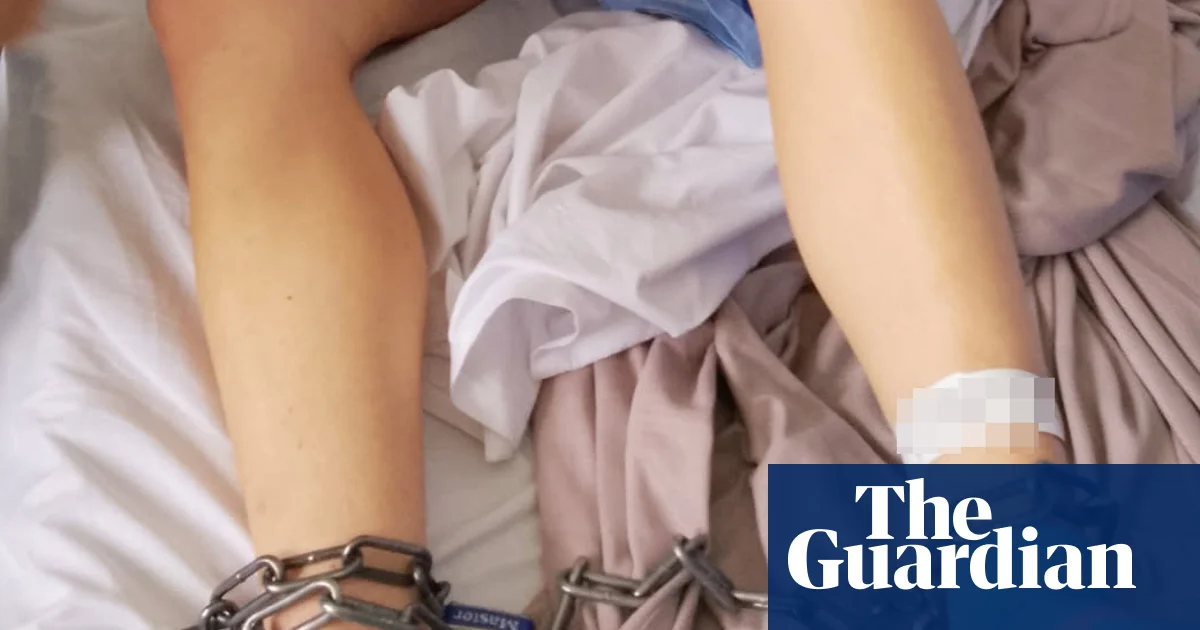
一名原住民少女在被警方逮捕后被锁铐在珀斯一家医院的病床上,其家人表示她应当“被当作一个人对待”。
The family of an Indigenous girl who was shackled to a Perth hospital bed after being arrested by police say she should be treated ‘like a human being’.
照片:家属提供 西澳大利亚司法部为其使用约束措施进行了辩护,此前一名16岁原住民少女在被拘留后,被锁铐在珀斯一家医院的病床上。
Photograph: Supplied by family The Western Australian justice department has defended its use of restraints after a 16-year-old Indigenous girl was shackled to a Perth hospital bed after she was taken into custody.
家属分享的一张照片显示,这名少女的脚踝被锁链捆绑,并锁在病床底部。
A photo shared by the family showed the teenager’s ankles bound in chains and locked to the underside of a hospital bed.
该少女的祖母(为保护孙女身份,其姓名不予公开)指控警方在逮捕这名少女时使用了过度武力,逮捕事由涉嫌疏忽照看儿童,其中包括在她上身赤裸的情况下将其拖拽。这名少女几个月前刚生下一个孩子。
The girl’s grandmother, who cannot be named to protect the identity of her grandchild, alleged police used excessive force while arresting the teenager over allegations of child neglect, including dragging her while she was topless. The teenager gave birth to a child several months ago.
祖母探视了被送往医院的孙女,她是在被司法部工作人员羁押期间因一项未公开的健康问题被送医的。祖母表示,孙女因警方的粗暴对待,胸部和腹部有抓痕。她称在医院使用镣铐令人震惊,并呼吁停止这种做法。“我希望她能被当作一个人对待,因为她就是一个人,”祖母说。
The grandmother, who visited her granddaughter in hospital, where she was taken after the arrest in the custody of department of justice staff for an undisclosed health issue, said her grandchild had scratches on her breasts and stomach from her handling by police. She said the use of the shackles in the hospital was appalling and called for the practice to stop. “I would like for her to have been treated like a human being because she is one,” the grandmother said.
西澳司法部一位发言人表示,无法就该少女的具体案件发表评论,但给被羁押人员戴上约束具符合其政策和程序。
A spokesperson for the WA justice department said it could not comment specifically on the girl’s case but that restraining people in custody was in accordance with its policies and procedures.
“当被羁押人员在非安保医疗机构接受治疗时,会采取适当的约束措施,作为标准的羁押管理实践的一部分,”该发言人说。
“Where a person in custody is being treated in an unsecured medical facility, appropriate restraint measures are used as part of standard custodial management practices,” the spokesperson said.
“医疗从业人员可在认为临床上必要时,要求修改或移除约束具。这些措施旨在确保被羁押人员、医院工作人员、羁押警官和更广泛社区的安全。” 诺加族人、社区倡导者默文·伊兹表示,使用镣铐的做法是“令人发指的暴行”。
“Medical practitioners can request that restraints be modified or removed where deemed clinically necessary. These measures are in place to ensure the safety of the person in custody, hospital staff, custodial officers, and the wider community.”Mervyn Eades, a Noongar man and community advocate, said the practice of using shackles was an “abomination”.
“我们谈论的是一个孩子,不是严重罪犯,”他说。“考虑到过去针对我们民族的暴行,我看着她腿上的镣铐,自然而然会想到殖民统治,以及我们的人民是如何被戴上镣铐的。”
“We’re talking about a child, not a serious criminal” he said. “With past atrocities against our peoples I look at those chains on her legs and I automatically think of colonisation and how our people were placed in them.”
针对警方在逮捕这名少女时使用过度武力的指控,西澳警方发言人表示:“已对警员随身执法记录仪拍摄的画面进行了审查,认定警员在逮捕过程中依政策行事。”发言人称,警方前往该少女住所是应对关于其孩子福利的担忧,到达后发现孩子未受伤害。
In response to allegations excessive force was used to arrest the teenager, a spokesperson for WA police said: “A review of officer body-worn camera vision has been conducted and the officers were found to have acted within policy during the arrest.”They said police went to the girl’s house in response to concerns about the welfare of her child and found upon arrival the children was unharmed.
发言人说:“经过短暂的口头交涉,据称当时在场的该女性试图推开警员闯入住宅,以此抗拒逮捕。随后她被按倒在地并被控制住。”
“After a short verbal exchange, it will be alleged the female, who was present at the time, resisted arrest by attempting to push past officers and enter the residential premises. She was subsequently brought to the ground and placed into custody,” the spokesperson said.
警方指控该少女一项违反保护性保释条件罪、一项危害他人生命、健康或安全罪,以及一项未保护儿童免受伤害罪。
Police charged the girl with one count of breaching protective bail conditions, one count of endangering the life, health or safety of a person, and one count of failing to protect a child from harm.
澳大利亚各州和领地政府因在医院环境中对被监禁者使用镣铐(包括妇女分娩时)而面临压力。
Australian state and territory governments have been coming under pressure over their use of shackles on incarcerated people in hospital settings, including women while they give birth.
10月,维多利亚州参议员莉迪亚·索普(Lidia Thorpe)——一位Gunnai、Gunditjmara和Djab Wurrung族女性——提出立法,禁止在分娩期间给被监禁妇女戴镣铐,并停止对儿童进行脱衣搜查。
In October, Victorian senator Lidia Thorpe, a Gunnai, Gunditjmara and Djab Wurrung woman, introduced legislation to ban shackling of incarcerated women during childbirth and to stop children being strip-searched.
该法案的通过被工党和联盟党阻挠,工党表示“刑事司法系统的责任主要在于州和领地政府”。
Its passage was blocked by Labor and the Coalition, with Labor saying “the responsibility of the criminal justice system predominantly sits with state and territory governments”.
几天后,一名被监禁的原住民女性在昆士兰州分娩时被镣铐铐在医院床上。
Days later, an incarcerated Indigenous woman was shackled to a hospital bed Queensland while she was in labour.
2016年,一名Noongar族男子在西澳出庭应对驾驶罪名时晕倒陷入昏迷,随后被戴上手铐和镣铐铐在医院床上。
In 2016, a Noongar man was handcuffed and shackled to a hospital bed in Western Australia while he was comatose after collapsing during a court appearance for a driving offence.
倡导组织“全国网络”的发言人黛比·基尔罗伊表示,珀斯发生的最新事件表明,联邦政府需要介入监管各州的行为。
Debbie Kilroy, a spokesperson for advocacy group the National Network, said the latest incident in Perth demonstrates why the federal government needed to step in to regulate state actions.
基尔罗伊说:“当政客们告诉我们镣铐是州政府的事时,他们实际上是在说,他们准备把妇女和女孩置于警察和狱警的摆布之下。”
“When politicians tell us that shackling is a state issue, what they are really saying is that they are prepared to leave women and girls at the mercy of police and prison officers,” Kilroy said.
“我们需要问问自己,当我们看着一个16岁的母亲,看到的是一个需要被锁住的人,而不是一个需要照顾的人,这说明了这个国家的什么问题。” 西澳大利亚州检察长和警察部长已被联系置评。
“We need to ask ourselves what it says about this country that we can look at a 16-year-old mother and see someone who needs to be chained down rather than someone who needs care.”The WA attorney general and police minister were approached for comment.