华盛顿,10月23日:随着全球智能手机数量的激增(这些智能手机的使用已经让人类的视觉和听觉系统不堪重负),人们可以轻松地以数字形式分享图片和声音。然而,在远程交流中,嗅觉信息至今仍未能被有效利用。不过这种情况可能很快就会改变。
WASHINGTON, Oct 23 : People can readily share images and sounds digitally, as evidenced by the billions of smartphones in use globally that often overload the human senses of sight and hearing. But smell generally remains missing from remote communication. That could soon change.
研究人员开发出了一种新技术:这种技术配备了一个“电子鼻”,能够识别特定的气味(例如咖啡的独特香气),并指令一个小型、可穿戴的远程设备释放与之相匹配的香味分子。这种数字通信可以在任何距离上进行,无论是隔着房间,还是跨越整个世界。
Researchers have developed technology that features an electronic nose that recognizes certain smells, like the distinctive aroma of coffee, and then instructs a small and wearable remote device to release scent molecules matching it. The digital communication can take place at any distance, from across the room to around the world.
“简单来说,这项技术将‘在这里闻到某种气味’与‘在另一个地方重现这种气味’联系在了一起,”俄亥俄州立大学材料科学与工程专业的博士生杨春宇(Chunyu Yang)解释道。他是发表在《科学进展》(Science Advances)杂志上的这项研究的主要作者。
"In simple terms, it connects 'smelling something here' with 'recreating the corresponding smell somewhere else,'" said Chunyu Yang, an Ohio State University doctoral student in materials science and engineering and lead author of a study describing the technology published in the journal Science Advances.
“我们的目标是将嗅觉信息添加到我们已经能够远程分享的视觉和音频信息中,让这些交流体验更加生动、更具吸引力,”杨春宇说。
"The idea is to add smell to the visual and audio information we already share remotely, making those experiences more engaging," Yang said.
研究人员将这项数字嗅觉技术的最新成果称为“Scentronic”。杨春宇表示:“Scentronic 的独特之处在于它将气味感知与气味生成功能结合在一起,实现了气味的远程共享。据我们所知,我们的研究是首个在紧凑型平台上实现这种整合的技术。”
The researchers call this latest development in the field of digital scent technology "Scentronic." "What makes Scentronic different is that it brings odor sensing and generation together for remote sharing. To the best of our knowledge, our study is the first to explore this integration in a compact platform for remote odor sharing," Yang said.
研究人员制造了一个名为“电子鼻”(e-nose)的设备,该设备利用一组气体传感器来检测与不同气味相关的化学化合物。随后,一个机器学习模型会对这些气味进行分类(例如啤酒、蛋糕、咖啡、橙子和红酒的气味)。
The researchers created an e-nose, a device that uses an array of gas sensors to detect chemical compounds associated with different odors. A machine-learning model then classifies odors that the e-nose has been trained to recognize — beer, cake, coffee, oranges and red wine.
这项技术通过在线平台将气味信息传输给气味生成器,后者会释放相应的香味分子,从而在接收端重现原始气味。需要注意的是,气味分子本身并不会通过互联网进行传输。
The technology uses an online platform to transmit the odor information to a scent generator, which then releases fragrances to recreate the aroma at the receiving end. The scent molecules themselves are not transmitted over the internet.
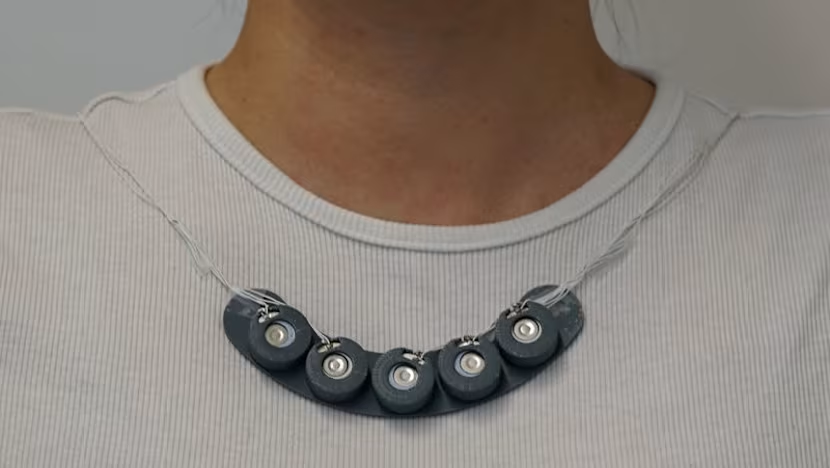
这种电子鼻装置的直径约为6英寸(15厘米),便于携带,但并非设计为可穿戴设备。研究人员开发了多个版本的气味发生器,包括腕带式、项链式和手持式设计。“日常气味”目前,这种电子鼻仅能识别五种气味。
The e-nose device is roughly 6 inches (15 cm) in diameter and is portable, though not designed to be worn. The researchers developed several versions of the odor generator, including wristband, necklace and handheld designs. 'EVERYDAY ODORS' At this point, the e-nose recognizes just the five scents.
杨说:“我们选择这些气味是因为它们是熟悉的日常气味,且具有不同的气味特征,适合作为演示系统的实用范例。我们尚未扩展到这些类别之外。”
"We chose these because they are familiar everyday odors with different scent profiles, making them useful examples for demonstrating the system. We have not yet expanded beyond those categories," Yang said.
杨说:“从原则上讲,更广泛的气味库是可能的,但无限的气味储备远超我们已展示的范围。识别一种气味并准确复刻它是两个独立的挑战。覆盖一系列实用的日常气味是一个更现实的目标,尽管那仍需要大量的开发工作。”接收装置无法复刻Scentronic遇到的每一种气味。
"A broader scent library is possible in principle, but an unlimited repertoire is far beyond what we have demonstrated. Recognizing an odor and accurately reproducing it are separate challenges. Covering a useful range of everyday scents is a more realistic goal, although that would still require substantial development," Yang said. The receiving device cannot recreate every smell Scentronic encounters.
杨说:“要支持更多气味,我们需要训练电子鼻识别它们,并在气味发生器中提供相应的香精液体。”研究人员看到了该技术的多种潜在应用。
"To support additional odors, we would need to train the electronic nose to recognize them and provide corresponding scented liquids in the odor generator," Yang said. The researchers see various potential applications for the technology.
杨说:“例如,人们可以与远方的家人或朋友分享一顿饭菜的气味。其他潜在应用包括更具沉浸感的虚拟现实和增强现实体验,以及允许顾客远程试闻特定气味的在线购物。”“研究原型”杨说,该研究及装置的开发是在没有公司参与的情况下进行的。
"For example, someone could share the scent of a meal with family or friends who live far away. Other potential applications include more immersive virtual and augmented reality experiences and online shopping that allows customers to sample selected scents remotely," Yang said. 'A RESEARCH PROTOTYPE' The research was conducted and the devices developed without the involvement of a company, Yang said.
杨说:“目前,这只是一个研究原型。要走向商业化,需要更大、更多样化的训练数据集,以及在现实条件下可靠的气味识别能力,因为在现实中气味往往以混合物的形式出现。”
"At present, this is a research prototype. Moving toward commercialization would require a larger, more diverse training dataset and reliable odor recognition under real-world conditions, where smells often occur in mixtures," Yang said.
“气味发生器还需要进一步开发,以在保持紧凑、使用方便的同时支持更多气味。其他考量因素包括气味还原度、可重复填充性、耐用性、制造成本以及反复接触香薰雾气的安全性,”杨说。
"The odor generator would also need further development to support more scents while remaining compact and convenient to use. Other considerations include scent fidelity, refillability, durability, manufacturing costs and the safety of repeated exposure to the scented mist," Yang said.
智能手机的功能日益强大。未来它们能否融入气味技术,使得例如在俄亥俄州立大学橄榄球赛前的尾门聚会上,一个人给朋友打电话时,能分享视频、音频以及烤架上热狗的香气?
Smartphones are becoming increasingly capable. Could they in the future incorporate scent technology so that, for instance, a person at a tailgate party before an Ohio State football game could call a friend and share video, audio and the aroma of hot dogs on the grill? "In principle, a smartphone could connect to a scent-generating accessory.
“原则上,智能手机可以连接一个产生气味的配件。将所有部件集成到手机内部会更具挑战性,因为气味储存仓、电子元件和雾化器都会占用空间并增加重量。小型化和便捷的补充方式将是重要的考量因素,”杨说。
Integrating everything into the phone itself would be more challenging because the scent reservoirs, electronics and atomizers all take up space and add weight. Miniaturization and convenient refilling would be important considerations," Yang said. "The tailgate example illustrates the idea well.
“尾门聚会的例子很好地说明了这一构想。未来的系统有可能将视频和音频与相应的气味结合起来,前提是它能识别相关气味,且接收端拥有合适的气味配方。我们目前的系统尚未演示烤热狗气味或尾门聚会上那种精确气味混合物的传输,”杨说。
A future system could potentially combine video and audio with a corresponding scent, provided it could recognize the relevant odor and the receiver had a suitable scent formulation available. Our current system has not demonstrated the transmission of a grilling-hot-dog scent or the exact mixture of smells at a tailgate party," Yang said.