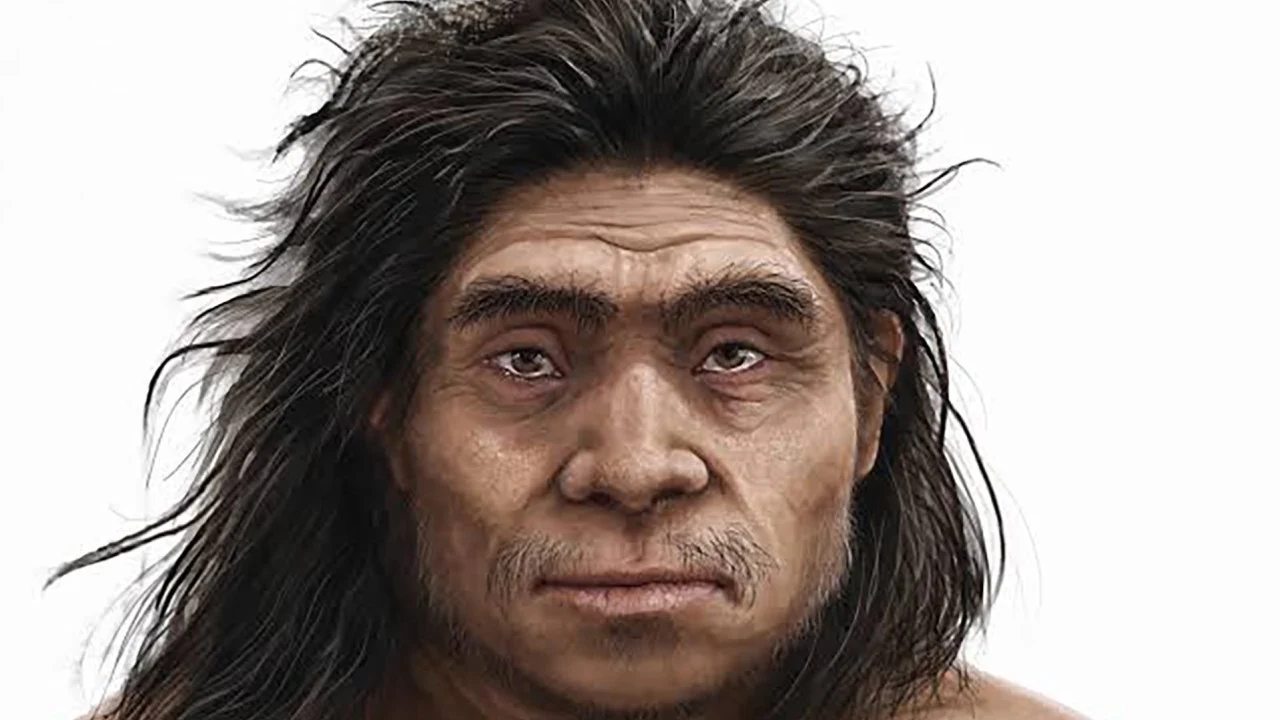
中国科学家终于还原了丹尼索瓦人的面貌,这一神秘的古人类物种此前仅通过DNA证据和化石碎片为人所知。
Chinese scientists have finally put a face onto the Denisovans, a mysterious species of ancient humans who were previously known only through the evidence of their DNA and fossil fragments.
据认为,这种人类曾在数千年前生活在西伯利亚以及东亚和东南亚部分地区。
The hominids were thought to have lived in parts of Siberia and East and Southeast Asia thousands of years ago.
此次面部复原工作基于1976年至1979年间在中国北方泥河湾盆地徐家窑这一重要考古遗址出土的化石。
The work of reconstructing their face was based on fossils excavated from Xujiayao, a major archaeological site in northern China’s Nihewan Basin, between 1976 and 1979.
科学家们还确认,这一批古人类遗骸属于丹尼索瓦人谱系,从而得以复原他们的外貌。
Scientists also confirmed that the collection of ancient human remains belonged to the Denisovan lineage, allowing them to reconstruct what they looked like.
这些遗骸距今13.8万至19.9万年,包括长期以来让古生物学家困惑不已、难以在古人类家谱中确定归属的颅骨和牙齿。
The remains, dated between 138,000 and 199,000 years old, included skull bones and teeth that had long puzzled palaeontologists trying to classify where they fit on the ancient human family tree.
在没有完整颅骨可供研究的情况下,由北京中国科学院古脊椎动物与古人类研究所古生物学家傅乔梅领导的团队,不得不从碎片中复原其面部特征。
Without any complete skulls to work with, the team, led by Fu Qiaomei, a palaeontologist at the Institute of Vertebrate Paleontology and Paleoanthropology in Beijing, had to reconstruct their features from fragments.
据官方报纸《科技日报》报道,他们得出结论:丹尼索瓦人的颅骨低而宽,骨质相当厚。脑颅两侧相对平坦而非圆润,下颌骨后部相当宽阔。
They concluded that their skulls were low and wide, with fairly thick bones. The sides of the braincase were relatively flat rather than rounded, while the back section of the lower jaw was quite wide, according to the official newspaper Science and Technology Daily.
科学家们在周三发表于同行评审期刊《自然》的论文中写道:“这一分析提供了丹尼索瓦人特征的全貌,展示了既让人联想到其他古人类(如厚颅顶)又具备现代人特征(例如强烈弯曲的颞鳞)的性状。”
“This analysis provides a comprehensive view of Denisovan features, showing both traits reminiscent of (such as a thick cranial vault) and those characteristic of modern humans (for example, a strongly arched temporal squama),” the scientists wrote in a paper published in the peer-reviewed journal Nature on Wednesday.
研究人员还通过发现一种关键蛋白标记物,确认了这些化石属于丹尼索瓦人,该标记物在尼安德特人和现代人中均未发现。
The researchers were also able to confirm that the fossils were Denisovans through the discovery of a key protein marker that was not found in Neanderthals and modern humans.
虽然提取古DNA几乎不可能,但蛋白质比DNA能保存更久而不完全降解。
While the extraction of ancient DNA is almost impossible, proteins can survive longer than DNA without fully degrading.
研究人员表示:“古蛋白质组学结果显示,许家窑人属于丹尼索瓦人”,并补充说,“他们与其他东亚晚中更新世古人类(如金牛山人、大理人和华龙洞人)的相似性表明,它们都属于丹尼索瓦人谱系。”该研究还显示,“丹尼索瓦人可能生活在东亚,时间跨度至少为[30万至4.5万年前],与西伯利亚丹尼索瓦人的时间范围相平行。”
“The palaeoproteomic results revealed Xujiayao hominins as Denisovans,” the researchers said, adding that their “similarities with other East Asian late Middle Pleistocene archaic Homo (such as Jinniushan, Dali and Hualongdong) indicate that they all belong to the Denisovan lineage.”The study also showed that “Denisovans could have lived in East Asia from at least [300,000 to 45,000 years ago], paralleling the temporal range of Siberian Denisovans”.
他们“是一个分布广泛的人类谱系,适应了西伯利亚、东亚和东南亚各种生态区,包括高海拔高原、亚热带森林和岛屿环境。”
It was “a broadly distributed homo lineage that adapted to diverse ecological zones, including the high-altitude plateau, subtropical forest and insular environments, across Siberia, East Asia and Southeast Asia.”