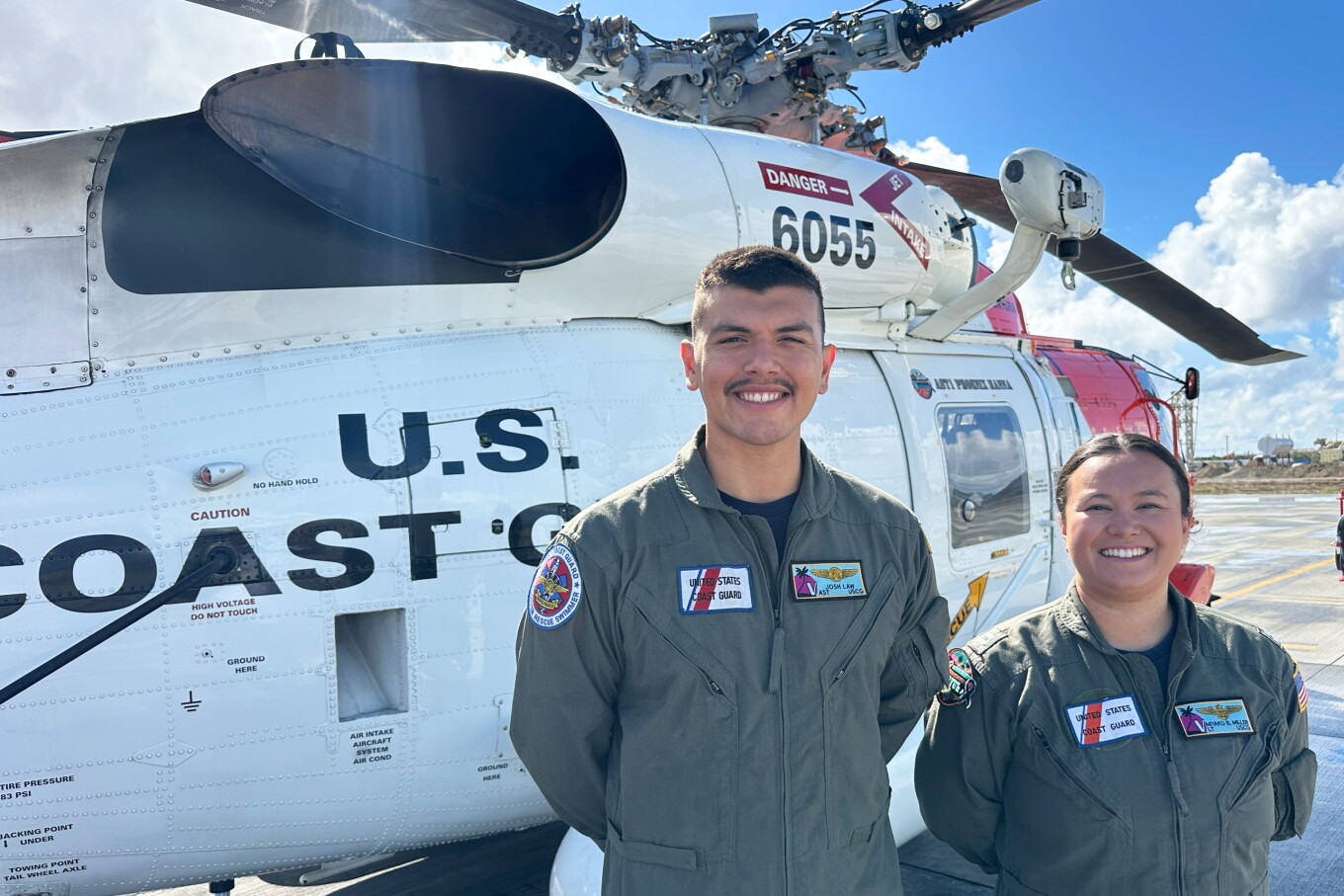
杰米·丁 洛杉矶 —— 乔希·劳身系安全带,在漆黑的夜晚,从一架美国海岸警卫队直升机上被缓缓放入汹涌的太平洋,距离墨西哥海岸尚远。
JAIMIE DING LOS ANGELES — Strapped into a harness, Josh Law was lowered from a U.S. Coast Guard helicopter into the rough Pacific Ocean in the pitch black night, far off the Mexican coast.
直升机旋翼的下洗气流猛击水面,激起水雾和湍流。这名海岸警卫队救生游泳员在噪音中听不见任何声音,在黑暗中也看不见任何东西。1.8 米到 2.4 米(6 到 8 英尺)高的海浪不断拍打着他。
The force of the helicopter blades pummeled the water, whipping up spray and turbulence. The Coast Guard rescue swimmer couldn’t hear anything over the noise or see anything in the darkness. Waves of 6 to 8 feet (1.8 to 2.4 meters) pummeled him.
他能做的只有跟随直升机探照灯的光束,希望它能引领他找到被抛入冰冷海水中的二十多人,他们距离墨西哥下加利福尼亚半岛海岸约 225 公里(140 英里)。他独自救起了其中 16 人。
All he could do was follow the searchlight from the helicopter with the hope it would lead him to the more than two dozen people flung into the cold waters some 140 miles (225 kilometers) off the coast of Mexico’s Baja peninsula. He would personally rescue 16 of them.
“那时我已精疲力竭,”24 岁的劳在获救后接受美联社首次采访时说,“我们睡得很少。但我经历的根本无法与他们当时相比……我只能时刻提醒自己这一点。” 在 10 月 16 日黎明前的两个小时里,劳是水中唯一将那艘倾覆船只上的人员救出水面的人。另有 11 人至今未被寻获。海岸警卫队于周日晚间终止搜救。
“I was experiencing exhaustion at that point,” Law, 24, told The Associated Press in his first interview since the rescue. “We had very little sleep. But what I was experiencing was nothing compared to what they were at that point ... I just had to keep that in mind.”Over the next two hours in the predawn hours of Oct. 16, Law was the sole person in the water who would get the people whose boat had capsized out of the water. Eleven others were never found.
劳描述了这场沿偏远航线展开的惊心动魄的救生行动,该航线常有偷渡船只出没。船只为何出现在那里以及从何处出发,是联邦调查的一部分。目前不清楚该船是迷失方向、发生引擎故障、被冲入大海,抑或本就打算驶往那么远的地方。搜救人员仅发现了疑似船只的残骸碎片。墨西哥领事馆表示,所有获救者均为墨西哥人。
The Coast Guard called off its search late Sunday. Law described the dramatic operation to save lives along a remote route frequented by migrant smuggling boats. What the boat was doing out there and where it originated from are part of a federal investigation. It was unclear if the vessel got lost, had engine failure, was swept out to sea or meant to go that far. Only what were believed to be pieces of the boat were found.
海岸警卫队称,美国海关及边境保卫局正在调查并询问幸存者,但该局未回复多次询问,未说明该船只是否为偷渡船。求救信号于凌晨 1 点左右发出。
All who were rescued are Mexican, the Mexican consulate said. The Coast Guard said U.S. Customs and Border Protection was investigating and interviewing the survivors, but the agency did not respond to multiple inquiries on whether the vessel was a migrant smuggling boat.
有人报告称,他们的船在墨西哥恩森纳达海岸外的太平洋中部正在下沉。
The mayday call came in around 1 a.m.
几分钟内,位于洛杉矶西北部文图拉的美国海岸警卫队航空站警报拉响,将劳和同事们从睡梦中惊醒。
Someone said their boat was sinking in the middle of the Pacific Ocean off the coast of Ensenada, Mexico.
直升机飞行员米亚科·米勒中尉检查了飞行条件,并规划了航线,将带领四名机组人员飞越美墨边境以南的广阔海域。
Within minutes, the alarm sounded at the U.S. Coast Guard Air Station in Ventura, northwest of Los Angeles, rousing Law and his colleagues from their sleep.
劳穿上干式潜水服、脚蹼,准备好医疗用品,然后系上安全带,该安全带将连接在缆绳上,用于将他从飞机上放入海中。凌晨2点,他们从文图拉的海岸警卫队基地起飞。
Helicopter pilot Lt. Miyako Miller checked flying conditions and planned the flight route that would take the crew of four over the vast ocean south of the U.S. border. Law prepared his dry suit, fins and medical items, then put on a harness that would be hooked onto a cable to lower him down from the aircraft into the ocean.
米勒佩戴夜视仪以协助在黑暗中飞行。她说,那晚没有月光,她依靠星星导航。
By 2 a.m., they were taking off from the Coast Guard station in Ventura. Miller wore night vision goggles to help her fly in the dark.
当机组人员接近报告的沉船位置时,米勒在远处发现了一丝微弱的闪光。
She said she relied on the stars, with no moonlight that night.
接着,她发现水面上漂浮着疑似碎片,但难以辨认具体是什么。米勒小心驾驶直升机掠过该区域,将飞机降低至距水面约40英尺(12米)处悬停。
As the crew approached the reported location of the sinking, Miller spotted a tiny flicker of light in the distance. Then she spotted what looked like debris floating in the water, but it was difficult to distinguish what it was.
米勒说:“我正竭力通过夜视仪向外观察,保持外部视觉参照。”她补充道,与此同时,“飞行机械师在指挥我如何定位直升机。”恩森纳达西南约250英里(400公里)处是瓜达卢佩岛,这是一个生物圈保护区,因大量大白鲨出没而闻名。
Miller carefully navigated the helicopter over the area, lowering the aircraft until it was hovering about 40 feet (12 meters) above the water. “I’m doing my best to maintain my references externally by looking outside through the night vision goggles,” Miller said, adding that meanwhile “the flight mechanic is telling me where to position the helicopter.”Some 250 miles (400 kilometers) southwest of Ensenada, Mexico, is Guadalupe Island, a biosphere reserve that is well known as a place brimming with great white sharks.
劳说,当他把自己挂在缆绳上、系着安全带滑入海中时,并没有去想水里有什么。
Law said he didn’t think about what was in the water as he hooked himself to a cable and zipped into the ocean, strapped in a harness.
分秒必争。虽然劳的干式潜水服能提供一定保暖,但他知道其他人已经在低温致命的水中待了数小时。劳说,他在机组人员探照灯的引导下,得以看清水中的人员。
There was no time to waste. While Law’s dry suit provided some warmth, he knew the others had already spent hours in hypothermic temperature waters. Law said he was guided by a searchlight from the crew, which allowed him to catch a glimpse of the people in the water.
他们分散在一片宽阔的水域中。一些人穿着救生衣,衣服上有微小的灯光,正是米勒最先发现的那种闪烁光点。其他人则紧紧抓住彼此、救生浮标和残骸碎片,浑身发抖,踩水以保持漂浮。
They were scattered across a wide area. Some were wearing life vests that had tiny lights that produced the flicker first spotted by Miller. Others clung onto one another, buoys and pieces of wreckage, shivering and treading water to stay afloat.
劳说,他游向他们,将他们翻转到仰面朝天的姿势,用胳膊搂住他们,采用“伴侣拖曳”技术将他们拖拽上来。他蹬腿游泳,把他们带到能向飞行机械师发出信号、放下吊篮接人上来的位置。
Law said he swam to them, flipped them on their backs, put his arm over them and pulled them up using the “buddy tow” technique. Kicking his legs to swim, he carried them to the spot where he could signal the flight mechanic to lower a basket for them to be picked up.
“单手抓着幸存者,另一只手向直升机打信号并操作装置,”他说。
“With one hand, I’m holding the survivor. With the other, I am signaling to the helicopter and working with the device,” he said.
他一个个把他们放进吊篮。随后吊篮被吊起至直升机,机组人员把每个人接进机舱,再把吊篮放下来。
He placed them into the basket, one by one. Then it was hoisted up to the helicopter where the crew got each person into the aircraft before lowering the basket again.
劳的干式潜水服慢慢灌进水,水位漫至膝盖,感觉像挂着重物拖着他游泳。接下来的90分钟里,劳在巨浪中来回游动奋战。
Law’s dry suit slowly filled up to his knees with water, feeling like weights pulling on him as he swam. Over the next 90 minutes, Law battled heavy waves while swimming back and forth.
由于直升机已满载且燃料所剩无几,机组人员决定飞往圣迭戈海岸警卫队基地,那里有救护车在等候。
With a packed helicopter and dwindling fuel, the crew decided to head to the Coast Guard station in San Diego where ambulances were waiting.
返航途中,劳处理了三名他形容为伤势“严重”的人员,为他们止血。海岸警卫队在周六的一份声明中说,有几处伤口“与鲨鱼咬伤一致”,海岸警卫队提供了救命的急救措施。
On the flight, Law treated three people with what he described as “bad” wounds, staunching the bleeding. Several of the injuries were “consistent with shark bites” and the Coast Guard provided life-saving first aid, the agency said in a statement Saturday.
海关与边境保卫局官员前往医院,表示将在幸存者病情允许出院后,依据移民法对他们进行处理。美国官员称,获救者中近一半已被遣返回墨西哥。
Customs and Border Protection officers went to a hospital and said they would process the survivors according to immigration laws after they were medically cleared. Nearly half of those rescued have since been returned to Mexico, U.S. officials said.
劳和机组人员当天上午返回文图拉——他说,这是他经历过的时间最长的救援行动。
Law and his crew returned to Ventura that morning — it was by far the longest rescue operation he had ever done, he said.
对另外11人的搜寻又持续了两天,但无果而终。海岸警卫队联同墨西哥和美国海军,共同搜寻了超过2,441平方英里(6,322平方公里)的区域,累计耗时89小时。
The search for the 11 others continued for another two days to no avail. The Coast Guard, alongside Mexico and the U.S. Navy, searched more than 2,441 square miles (6,322 square kilometers) for a combined 89 hours.
移民越来越多地转向偷渡客提供的高风险替代方案,选择走海路以避开戒备森严的陆地边境。被称为“潘加船”的小船在夜间从下加利福尼亚出发,有时向北航行数百英里(公里)。
Migrants are increasingly turning to the risky alternative offered by smugglers to travel by sea to avoid heavily guarded land borders. Small boats called pangas leave Baja at night and sometimes travel hundreds of miles (kilometers) north.