有一批天体尤其难以解读。它们发出刺眼的光芒,释放出长波长的红光,其耀眼程度堪比整个星系。它们体积微小,只占一个像素。而且它们无处不在。韦布太空望远镜拍摄的几乎每张照片中都会出现几个。2023年,研究人员开始称它们为“小红点”。天文学家曾多次将韦布对准这些小红点,从这些光像素中榨取宝贵的新信息。
One batch of objects proved especially difficult to interpret. They glowed blindingly bright, emitting red light with long wavelengths and shining as brilliantly as a whole galaxy. They were tiny, spanning just a pixel. And they were everywhere. A couple appear in almost every image Webb takes. In 2023, researchers started calling them “little red dots.”Astronomers have repeatedly pointed Webb toward the little red dots, wringing precious new information from these pixels of light.
最初,研究人员认为这些点看起来有点像星系。后来,他们得出结论,小红点看起来更像是位于多数星系核心的超大质量黑洞。这些庞然大物本身是暗黑的,但它们强大的引力会猛烈吸走气体和附近的其它物质,产生一圈圈炽热、旋转的碎片,其光芒完全盖过了周围的恒星。
Initially, researchers thought the dots looked kind of like galaxies. Later, they concluded that little red dots look more like the supermassive black holes that sit at the heart of most galaxies. These monstrous masses are themselves dark, but their formidable gravity violently vacuums up gas and other nearby matter, generating rings of hot, swirling detritus that completely outshine the stars around them.
接着,在2025年春天,两支天文学家团队同时宣布观测到了一对与其它所有小红点都不同的小红点。事实上,它们与以往见过的任何天体都不同。
Then, in the spring of 2025, two teams of astronomers simultaneously announced observations of a pair of little red dots that were unlike all the rest. In fact, they were unlike any object ever seen.
“在我们用地面望远镜进行的数百万次[观测]中,”德国海德堡马克斯·普朗克天文研究所的研究员、其中一个研究小组的负责人安娜·德格拉夫(Anna de Graaff)说,“没有什么东西看起来像这些光源。”
“In all the millions of [observations] we’ve taken with ground-based telescopes,” said Anna de Graaff, a researcher at the Max Planck Institute for Astronomy in Heidelberg, Germany, and head of one group, “there’s nothing that looks like these sources.”
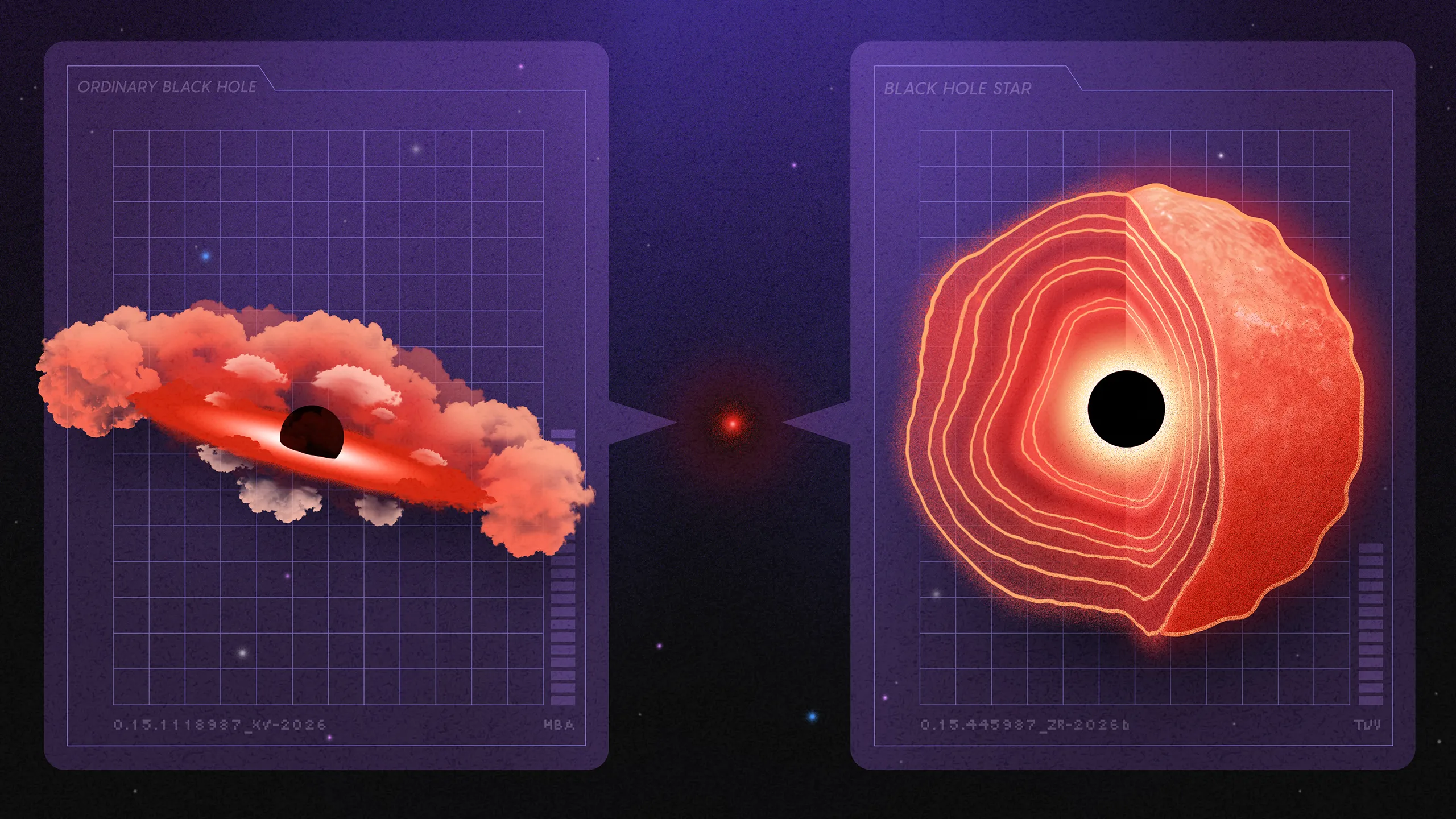
这两支天文学家团队提出,他们正在观测一种全新的天体:一块颠倒的氢团块,它散发着数十亿个太阳的光芒,同时在其核心深处隐藏着一个黑洞。他们将其称为“黑洞星”。在9月份发布的一篇论文中,天文学家将这一分析推进了一步。他们认为,韦布望远镜正在见证超大质量黑洞在庞大恒星核心内部的诞生。“一种根本性的新现象正在发生,”夏威夷大学的天文学家罗汉·奈杜(Rohan Naidu)说。
The two teams of astronomers propose that they are looking at a new astronomical object: a topsy-turvy lump of hydrogen that shines with the light of billions of suns while hiding a black hole deep in its core. They call it a “black hole star.”In a paper posted in September, astronomers took this analysis a step further. They argued that the Webb telescope is witnessing the births of supermassive black holes inside the cores of colossal stars. “There is a fundamentally new phenomenon afoot,” said Rohan Naidu, an astronomer at the University of Hawai’i.
但并非所有人都认同这种大胆的解释。它引发了一系列后续研究,并重新点燃了关于这些奇特光点本质的激烈争论。“这个领域已经变得非常两极分化,”麻省理工学院研究小红点的天体物理学家安娜-克里斯蒂娜·埃勒斯说。
But not everyone agrees with this bold interpretation. It has sparked a flurry of follow-up research and reignited a fierce debate over the nature of these peculiar pinpricks of light. “The field has gotten very polarized,” said Anna-Christina Eilers, an astrophysicist at the Massachusetts Institute of Technology who studies little red dots.
随后,他们进行了更仔细的观察。德格拉夫领导了一项名为“红色未知数:明亮红外河外巡天”(Rubies)的巡天项目,奈杜则共同领导了另一项名为“幻影还是奇迹”(MOM)的巡天项目。这些是韦布望远镜针对遥远天体(包括小红点)进行连续数小时观测的一系列巡天项目之一。他们精确地列表记录了每个光点发出的光谱颜色及其亮度。
Then they took a closer look. De Graaff led one survey, called Red Unknowns: Bright Infrared Extragalactic Survey (Rubies), and Naidu co-led another survey, called Mirage or Miracle (MOM). These were two of a wave of surveys that trained the Webb telescope on distant objects, including little red dots, for hours at a time. They tabulated precisely what shades of light were coming from each dot and how bright the shades were.
这种被称为光谱的详细颜色分解,为天文学家提供了远比最初观测更为详细的信息。不同的原子会发出极其细微的、不同色调的光,因此光谱为了解该天体粒子的运动情况提供了一个方向。
This detailed color breakdown, known as a spectrum, told astronomers a far more detailed story than the initial observations had. Different atoms shine in subtly different hues, so the spectrum provided a sense of what the object’s particles were doing.
小红点光谱中令人震惊的发现是,氢的颜色被抹开并跨越了多种色调。通常情况下,看到这种效应意味着你正在直接观测一个暴露的黑洞。黑洞以极快的速度在其周围搅动氢云,而这些氢云会根据其速度发射出略有不同的颜色。最终的效果是,你看到的不再仅仅是氢的色调,而是一个被称为宽线的颜色范围。这个范围越宽,速度最快的氢云飞得就越快,黑洞的质量也就越大。
The bombshell discovery in the little-red-dot spectra was that the colors of hydrogen were smeared out across multiple shades. Usually, seeing such an effect means you’re looking straight at an exposed black hole. Black holes whip hydrogen clouds around them at furious rates, with the clouds emitting slightly different colors depending on their speed. The net effect is that instead of seeing just the hue of hydrogen, you see a range of colors called a broad line. The wider this range, the faster the fastest hydrogen clouds are flying—and the more massive the black hole.
许多天文学家得出结论,巨大的黑洞点缀着宇宙,掩盖了其宿主星系中恒星的光芒。作为黑洞,这些小红点之所以会显得发红,是因为尘埃——一种比气体复杂得多的颗粒状物质——阻挡了它们的蓝光。
Many astronomers concluded that big black holes dotted the universe, washing out the light of the stars in their host galaxies. As black holes, the little red dots would appear red because dust—grainy stuff much more complicated than gas—was blocking their blue light.
然而它们看起来依然很诡异。大多数超大质量黑洞在吞噬周围大团的气体流时会闪烁不定。它们还会在宇宙中发射强大的X射线。大多数小红点似乎这两件事都没做。
Yet they still seemed weird. Most supermassive black holes flicker as they gulp down chunky streams of gas around them. They also beam powerful x-rays across the universe. Most little red dots seemed to be doing neither of these things.
但这并没有让天文学家们太苦恼;他们预计在早期宇宙的混乱时期会看到一些奇异的现象。而且至少这些黑洞没有打破任何宇宙学理论。
But that didn’t trouble astronomers much; they expected to see some strangeness during the pandemonium of the early universe. And at least the black holes weren’t breaking any cosmological theories.
接着,在2025年春,德格拉夫和奈杜的团队公布了迄今为止最诡异的两个点。
Then, in the spring of 2025, de Graaff’s and Naidu’s teams unveiled the two strangest dots yet.
这两个小红点之所以与众不同,是因为它们红得厉害。韦布在它们的蓝端光谱中几乎没有探测到光。而在某一种特定的红色波段,这些颜色突然变得非常、非常亮。这一被称为巴尔末跳跃的特征,在观测炽热的氢气球时可以看到——通常是某些类型的恒星,或者是许多恒星组成的星系。在恒星核心深处,核聚变喷发出热量和光线,这些热量和光线缓慢渗透到恒星表面。
What made these two little red dots exceptional was how red they were. Webb picked up almost no light in the bluer hues of their spectra. And at a particular shade of red, the colors abruptly got much, much brighter. This feature, known as a Balmer break, is something you see when looking at a hot ball of hydrogen gas—typically, certain types of stars or galaxies, which are made of many stars. Deep in a star’s core, nuclear fusion pumps out heat and light, which slowly filters up to the star’s surface.
在那里,氢原子可以被激发,从而阻挡较蓝的光,只让较红的光透过。这些红色的光谱呈现出驼峰状,揭示了恒星表面的整体温度。
There, hydrogen atoms can become energized in a way that blocks bluer light and lets through only redder light. These red colors have a hump-shaped spectrum that reveals the overall temperature of the star’s surface.
但这些新发现的小红点不可能是真正意义上的恒星——它们太亮了。而且它们看起来也不太像黑洞。黑洞具有不同温度的各种环状结构。它们通常不会产生巴尔末跳跃,也不会产生表明恒星表面在均匀约5000开尔文温度下燃烧的红色驼峰状曲线。
But the new little red dots couldn’t literally be stars—they were way too bright. And they didn’t look much like black holes either. Black holes have an assortment of ringlike structures of different temperatures. They don’t typically produce a Balmer break, or the red, hump-shaped curve indicative of a stellar surface burning at a uniform 5,000 or so degrees Kelvin.
奈杜和德格拉夫得出结论,他们看到的是第一批兼具黑洞活力与恒星外表的事物:黑洞恒星。
Naidu and de Graaff concluded that they were looking at the first examples of something combining the vigor of a black hole with the outward appearance of a star: a black hole star.
从外表看,黑洞恒星会表现为一个巨大的氢气聚集团。如果我们的太阳被替换成一颗黑洞恒星,它的范围将延伸到冥王星轨道十几倍以外。在朝向边缘的区域,这颗恒星将处于不稳定的沸腾状态,其外层会不断剥落,并以爆炸的方式喷射出质量。“这将是一个非常混乱的系统,物质不断被吹出又落回,”德格拉夫说,“我可不想靠得太近。”
From the outside, a black hole star would appear as a huge agglomeration of hydrogen gas. If our sun were replaced with a black hole star, it would extend a dozen times farther than the orbit of Pluto. Out toward the edge, the star would boil unstably, sloughing off outer layers and explosively ejecting mass. “It’s going to be a very messy system where stuff is being blown out and falling back in,” de Graaff said. “I wouldn’t want to come too close.”
在星体最深处的中心,黑洞对外界而言是不可见的,但它将为恒星提供能量。这个黑洞会吸积周边的气体,使其急剧加热,并向外推射光和能量,从而阻止外层的氢气向内坍缩。通过这种方式,黑洞将构成恒星的“引擎”,类似于我们太阳由聚变驱动的核心。再向外围,围绕黑洞盘旋的物质将辐射出一系列色彩,并缓慢向表面移动。
Deep in the center, invisible to the outside world, the star would be powered by a black hole. This black hole would pull gas around it, dramatically heating it and pushing light and energy outward, which would keep the outer layers of hydrogen from collapsing inward. In this way, the black hole would form the “engine” of the star, analogous to the fusion-powered core of our sun. Moving outward, material swirling around the black hole would beam out a range of colors that would slowly make their way toward the surface.

正如某些恒星的情况一样,接近表面的氢气会阻挡较蓝的光,同时让较红的光通过。德格拉夫和奈杜从理论上推测,最终的结果将是一个气体表面,其发光亮度与一个更裸露的黑洞一样耀眼,但同时又带有巴尔末跃迁(Balmer break)以及一万开尔文(应为5,000开尔文)恒星的光滑红色隆起。额外的好处是,这个气体“茧”还将阻挡X射线,且气体不会发生太大的闪烁——这将解释围绕其他一些小型红点的两个谜团。
And as with certain stars, the hydrogen near the surface would stop the bluer light while letting the redder light pass through. The end result would be a gassy surface shining as brightly as a more exposed black hole but with the Balmer break and smooth red hump of a 5,000-kelvin star, de Graaff and Naidu theorized. As a bonus, the gas “cocoon” would also block x-rays, and the gas wouldn’t flicker much—which would explain two mysteries surrounding other little red dots.
但是,那些据信是由氢气在黑洞周围高速盘旋而产生的宽谱线又该如何解释呢?另一个研究小组提供了一种可能的解释。
But what about the broad lines, supposedly caused by hydrogen swirling fast around a black hole? Another group provided a possible explanation.
这个包括曼彻斯特大学天文学家瓦季姆·鲁萨科夫在内的小组,一直在仔细研究观测得最清楚的小红点的宽发射线。宽发射线呈现出尖锐的山峰形状。但鲁萨科夫和合作者们注意到,在许多情况下,这些“山峰”的坡度比它们来自黑洞周围高速运动的气体时的预期要稍微平缓一些。因此他们提出,氢元素光谱的很大一部分展宽可能不是来自旋转的气体,而是来自光子在电子上的散射。
That group, which included Vadim Rusakov, an astronomer at the University of Manchester, had been scrutinizing the broad lines of the best-observed little red dots. Broad lines take the shape of a sharp mountain peak. But Rusakov and collaborators noticed that in many cases, these mountains sloped slightly more gently than would be expected if they came from fast-moving gas around a black hole. So they suggested that instead of coming from rotating gas, much of the spread of the hydrogen colors could come from light scattering off electrons.
鲁萨科夫说,他们用数字方法从数据中移除了这种由电子引起的模糊效应。在那之后,这些宽发射线看起来不再那么宽了,而是更像光线穿过特定状态下缓慢翻腾的氢气壳层,这类似于人们对黑洞恒星的预期。德格拉夫团队、奈杜团队和鲁萨科夫团队这三个团队于2025年3月20日发布了他们的研究成果——正如一些研究人员所称的那样,这是“黑洞恒星日”。
They digitally removed the effect of this electron-induced smudging from their data, Rusakov said. After that, the broad lines stopped looking quite so broad and started looking more like light passing through a sluggishly churning shell of hydrogen gas in a particular state, similar to what you’d expect to see from a black hole star. The three teams—de Graaff’s, Naidu’s, and Rusakov’s — posted their findings on March 20, 2025—“black hole star date,” as some of the researchers called it.
黑洞恒星可能代表了超大质量黑洞发展过程中的一个新阶段:首先,一个黑洞会在氢气壳层的中心形成,其周围伴随着一个由正常恒星组成的婴儿星系。然后,随着时间的推移,黑洞将吞噬出它的茧,在清除氢气的过程中增加质量。
Black hole stars could represent a new stage in the development of a supermassive black hole: First, a black hole would form in the center of a shell of hydrogen, together with a baby galaxy of normal stars around it. Then, over time, the black hole would eat its way out of its cocoon, gaining mass as it cleared the hydrogen gas away.
奈杜说:“我们正在看到种子。这可能是宇宙中每一个大质量黑洞的诞生。”即使在发现第一个小红点多年之后,关于它们的许多事情仍未定论。科尔比学院的天体物理学家戴尔·科切夫斯基回忆说,他在2026年4月于科罗拉多州阿斯彭举行的一场会议上主持了一场关于它们的讨论。他首先回顾了一个他希望毫无争议的想法,即它们微量的蓝光。他说:“小组爆发了争论,我们甚至连第一个要点都没能通过。”
“We are seeing the seed,” Naidu said. “This is the birth of potentially every massive black hole in the universe.”Even years after the discovery of the first little red dot, not much about them is settled. Dale Kocevski, an astrophysicist at Colby College, recalls leading a discussion about them at an April 2026 conference in Aspen, Colorado. He started by recapping what he hoped would be an uncontroversial idea about their trace amounts of blue light. “The group erupted into argument, and we couldn’t even get past the first bullet point,” he said.
许多天文学家仍然辩称,那些小红点是传统黑洞——即使是这对新发现的天体也不例外。“数据确实非常有说服力,”剑桥大学的罗伯托·马约利诺(Roberto Maiolino)说,“我对这种解读持更多怀疑态度。”对于支持黑洞恒星的每一个论点,马约利诺都迅速予以反驳。缺乏闪烁?在早期宇宙中,黑洞可能拥有更稳定的食物供应,因此可能吃得更整洁。
Many astronomers still argue that little red dots are traditional black holes—even the new duo. “The data is really compelling,” said Roberto Maiolino of the University of Cambridge. “I’m a little bit more dubious about the interpretation.”For each point in favor of black hole stars, Maiolino fires off a quick rebuttal. The lack of flicker? In the early universe, black holes may have had a steadier food supply and may therefore have been tidier eaters.
缺乏X射线?标准星系黑洞被一圈厚厚的气体和尘埃环所环绕,这可以阻挡大部分X射线。他认为没有理由怀疑这些小红点除了是标准的超大质量黑洞之外,还会是其他什么东西。
The lack of x-rays? Standard galactic black holes are ringed by a thick doughnut of gas and dust, which can block most x-rays. He sees no reason to suspect the little red dots of being anything other than standard supermassive black holes.
他说,这些新天体的红色非常引人注目,他也同意这意味着黑洞和我们之间一定存在大量气体。但这些气体可以是以气环的形式存在,或者是充满黑洞上空部分区域的蓬松云团,而不是黑洞恒星周围的气体壳。马约利诺认同,电子散射很可能导致了一些小红点光谱中谱线的变宽。但他也指出,电子散射同样会模糊来自超大质量黑洞的氢线。
The redness of the new objects is striking, he said, and he agrees that it means there must be a ton of gas between the black hole and us. But that gas could come in the form of the doughnut, or as puffy clouds that fill in patches of the black hole’s sky, as opposed to the shell of gas around a black hole star. Maiolino agrees that electron scattering likely contributes to broadening the lines in the spectra of some of the little red dots. But electron scattering also smears hydrogen lines from supermassive black holes, he said.
马约利诺和他的合作者、加利福尼亚大学圣克鲁斯分校的皮耶罗·马达乌(Piero Madau)认为,这些红点的红色主要来自于我们观察它们的角度。最红的点是我们恰好从侧面看到的那些,它们含气体的气环挡住了我们的视线。詹姆斯·韦布空间望远镜也看到了一些“小蓝点”。马约利诺和马达乌在2026年春季指出,这些可能是从正上方观察到的、相同的暴露黑洞。他们还诉诸奥卡姆剃刀原理——在这种情况下,他们认为黑洞是解释各种颜色小点的更简单理论。
Maiolino and his collaborator, Piero Madau of the University of California, Santa Cruz, argue that the redness of the dots comes mainly from the angle at which we see them. The reddest dots are those that we happen to see edge on, their gassy doughnuts blocking our view. Webb also sees some “little blue dots.”These could be the same exposed black holes, viewed top-down, Maiolino and Madau pointed out in spring 2026. They also appeal to Occam’s razor—in this case arguing that black holes are a simpler explanation for little dots of all colors.
在这个阶段,无论是黑洞还是黑洞恒星这两种理论,都可以与韦布望远镜所看到的情况相吻合。“我认为没有令人信服的理由更偏爱其中哪一个,”马萨诸塞大学阿默斯特分校的天文学家毛罗·贾瓦利斯科(Mauro Giavalisco)说,他的职业生涯大部分时间都在解读遥远星系的光谱。
At this stage either theory—black hole or black hole star—could match what the Webb telescope has seen. “I don’t think that there is a compelling reason to prefer one or the other,” said Mauro Giavalisco, an astronomer at the University of Massachusetts, Amherst, who has spent much of his career interpreting the spectra of distant galaxies.

为了检验他们的解读,天文学家需要更清晰的画面,了解黑洞恒星可能是如何形成的,以及他们确切地期望它们呈现出什么样的外观。
To test their interpretations, astronomers need a clearer picture of how black hole stars might form and how exactly they expect them to look.
贝格尔曼早在2006年就与玛尔塔·沃隆特里(Marta Volonteri)和马丁·里斯(Martin Rees)一同提出了准恒星(quasi-stars)的存在,以解释对那些看起来大得不可思议的黑洞的观测结果。他们的准恒星理论为制造一颗黑洞恒星提供了一种途径:巨大气云的核心坍缩直接形成黑洞,并将气云的其余部分聚集在其周围。
Begelman had proposed the existence of quasi-stars back in 2006, along with Marta Volonteri and Martin Rees, to explain observations of what looked like impossibly massive black holes. Their quasi-star theory offers one way to make a black hole star: The core of a vast gas cloud collapses to directly form a black hole, gathering the remainder of the cloud around it.
2025年,贝格尔曼和他的合作者贾森·德克斯特(Jason Dexter)将准恒星模型应用到了那些小红点上。他们估计,准恒星可以在短短数百万年内迅速组合成型,然后进入一种更成熟的形态,看起来就会和那些小红点一模一样。它们会以这种形态持续数千万年——其存在的时间足以让韦布望远镜发现它们。
In 2025, Begelman and his collaborator Jason Dexter applied the quasi-star model to the little red dots. They estimated that quasi-stars could quickly assemble themselves in a few million years before settling into a more mature form that would look just like little red dots. They would do this for tens of millions of years—lasting long enough for Webb to spot them.
2026年,贾瓦利斯科与一个团队合作,进一步充实了将准恒星作为黑洞恒星起源的模型,他发现这是一种很自然的方式,能够解释小红点为何会掩盖正在吞噬物质的黑洞的迹象。他指出,我们的太阳也施展了同样的把戏,隐藏了其剧烈的核聚变,只是规模要小得多。“我们有数不清的氢弹每秒都在爆炸,然而我们却看不到其中任何一个,”他说。
In 2026, Giavalisco worked with a team to flesh out the quasi-star model as an origin for black hole stars, which he finds to be a natural way of explaining how little red dots could mask the signs of a feeding black hole. He points out that our sun performs the same trick, hiding its explosive fusion, just on a much smaller scale. “We have billions and billions of hydrogen bombs exploding every second, and yet we see none of them,” he said.
贾瓦利斯科和他的合作者发现,他们的新准恒星模型比最初的模型更加契合德格拉夫(de Graaf)和奈杜(Naidu)观测到的天体的光谱。他认为,准恒星理论是对这些小红点的一个合理解释,但同时也对其他观点保持开放态度。“我只想知道真相,”他说。
Giavalisco and his collaborators found that their new model of a quasi-star fit the spectra of de Graaf’s and Naidu’s objects even better than the initial models had. He thinks the quasi-star theory is a plausible explanation for the little red dots but remains open to other ideas. “I just want to know the truth,” he said.
与此同时,研究人员开始寻找另一种特征模式:如果小红点是形成于早期宇宙的黑洞星,那么随着它们各自摆脱外壳并显露出内部的黑洞,它们应该会随着时间的推移而变得越来越少。
In the meantime, researchers are starting to search for another distinguishing pattern: If little red dots are black hole stars formed in the early universe, then they should grow rarer over time as they each break free from their shells and reveal their inner black holes.
在科尔比学院的科切夫斯基及其合作者对划分到不同时期的红色和蓝色小点进行的2026年8月普查中,他们恰恰发现了这种模式。在数据中,随着宇宙接近20亿至30亿年的年龄,小红点似乎消失了——这作为初步证据表明,小红点作为黑洞星,可能确实是许多超大质量黑洞类似青春期的阶段。
In an August 2026 census of both red and blue dots broken up into different eras, Kocevski of Colby College and his collaborators found exactly that pattern. In the data, as the universe approaches 2 billion to 3 billion years of age, the little red dots seem to vanish—preliminary evidence that little red dots, as black hole stars, might really be a puberty-like phase for many supermassive black holes.
理论学者们已经在研究这种类似青春期的阶段可能会是怎样的。在9月8日发布的一项新分析中,奈杜、德格拉夫、艾勒斯及其合作者测试了一系列方法,用于推断黑洞星内部黑洞“种子”的质量。这些隐藏的黑洞似乎远不如标准的、暴露的黑洞那么巨大。科学家们提出,詹姆斯·韦布空间望远镜正在捕捉超大质量黑洞星——质量可达太阳的100万倍——正在孕育宇宙第一批大型黑洞的过程。
Theorists are already working out what that puberty-like phase might be like. In another analysis, posted on September 8, Naidu, de Graaff, Eilers, and their collaborators tested out an assortment of techniques for deducing the mass of a black hole “seed” inside a black hole star. These hidden black holes seemed to be far less massive than standard, exposed black holes. The scientists propose that Webb is catching supermassive black hole stars—up to 1 million times the mass of the sun—in the act of incubating the universe’s first big black holes.
包括科切夫斯基在内的一些研究人员仍然不确定。科切夫斯基怀疑宇宙是一个纷繁复杂的地方,一些小红点确实像黑洞星阵营所主张的那样具有恒星的特征。他认为,其他小红点则会更类似于标准黑洞,正如另一个阵营所主张的那样。“我有一种偷偷的直觉,那就是我们双方都对了,”他说。
Some researchers, including Kocevski, still aren’t sure. Kocevski suspects that the universe is a messy place, and that some little red dots are truly as starlike as the black hole star camp is arguing. Others, he thinks, will be more like standard black holes, as the other camp argues. “I have a sneaking suspicion that we’re both right,” he said.
原文经西蒙斯基金会旗下在编辑上保持独立的出版物《量子杂志》(Quanta Magazine)许可转载。该杂志的宗旨是通过报道数学、物理科学和生命科学的研究进展与趋势,来增强公众对科学的理解。
Original story reprinted with permission from Quanta Magazine, an editorially independent publication of the Simons Foundation whose mission is to enhance public understanding of science by covering research developments and trends in mathematics and the physical and life sciences.