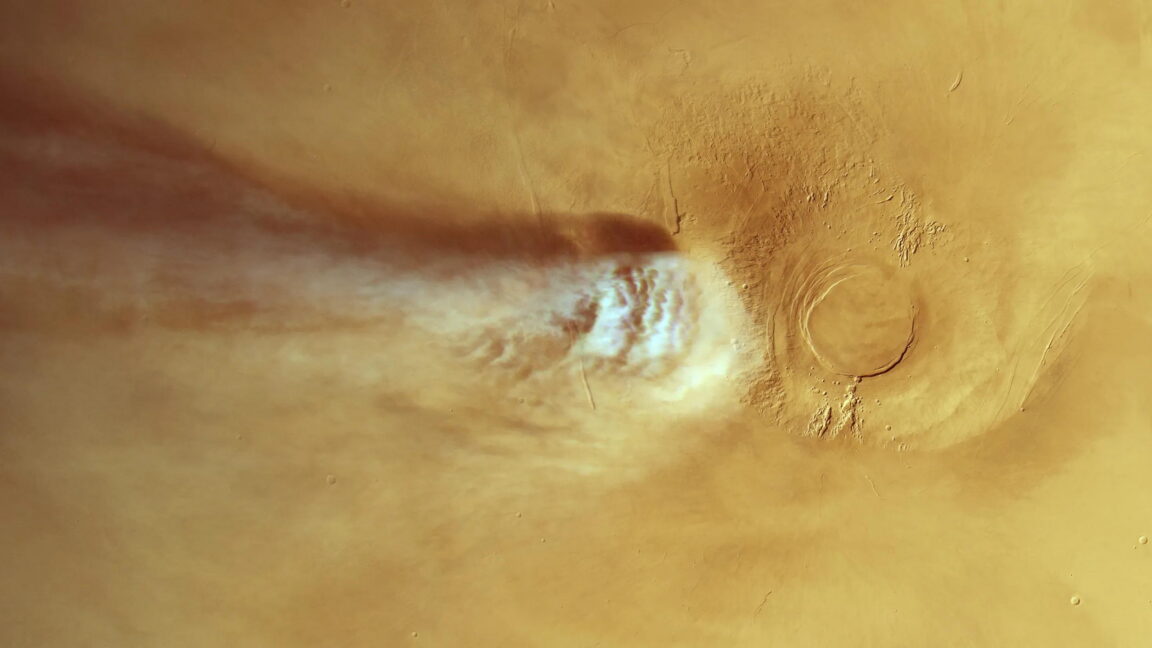
在火星的春季和夏季,每天早晨都会出现一条纤细而极长的云,然后又消失。
Every morning during the Martian spring and summer, a thin and extremely long cloud emerges, only to disappear again.
这条飘渺的云带出现在阿尔西亚山附近,并逐渐拉长,直到超过1000英里——大约相当于纽约到堪萨斯城直线距离——然后消散。这个过程会持续数月。
The wispy formation appears near the volcano Arsia Mons and gradually elongates until it reaches over 1,000 miles—about the distance from New York to Kansas City as the crow flies—before dissipating. This cycle then repeats for several months.
自2018年首次被探测器记录以来,科学家们一直未能找到一个合理的解释来解释这条通常被称为阿尔西亚山长云(AMEC)的云的存在。直到现在。
Since it was first recorded by a probe in 2018, scientists have been unable to find a plausible explanation for the existence of this cloud, often referred to as the Arsia Mons Elongated Cloud (AMEC). Until now.
最近,研究人员首次成功地模拟了这条云的形成过程,他们的研究结果表明,它可能由一个在任何行星大气层中都未曾直接观测到的物理过程驱动。
Recently, researchers successfully modeled the cloud’s formation for the first time, their results suggesting that it may be driven by a physical process that has never been directly observed in any planet's atmosphere.
“我们发现需要包含一些奇异的物理学……这些物理学虽然包含在教科书中,但被视为理论性的,通常认为不会在自然界中发生。它以前肯定没有被观察到过,”巴黎索邦大学的行星科学家、该研究的首席作者豪尔赫·埃尔南德斯-贝纳尔在一份新闻稿中说。“一旦我们将这些物理学纳入我们的模拟中,AMEC就如我们所愿地出现了。”
"We found that we needed to include some exotic physics… physics that, while included in textbooks, is treated as theoretical and usually thought not to happen in nature. It certainly hasn’t been seen in action before," Jorge Hernández-Bernal, a planetary scientist at Paris’ Sorbonne Université and lead author of the study, said in a press release. "Once we included this physics in our simulations, the AMEC emerged just as we hoped.”