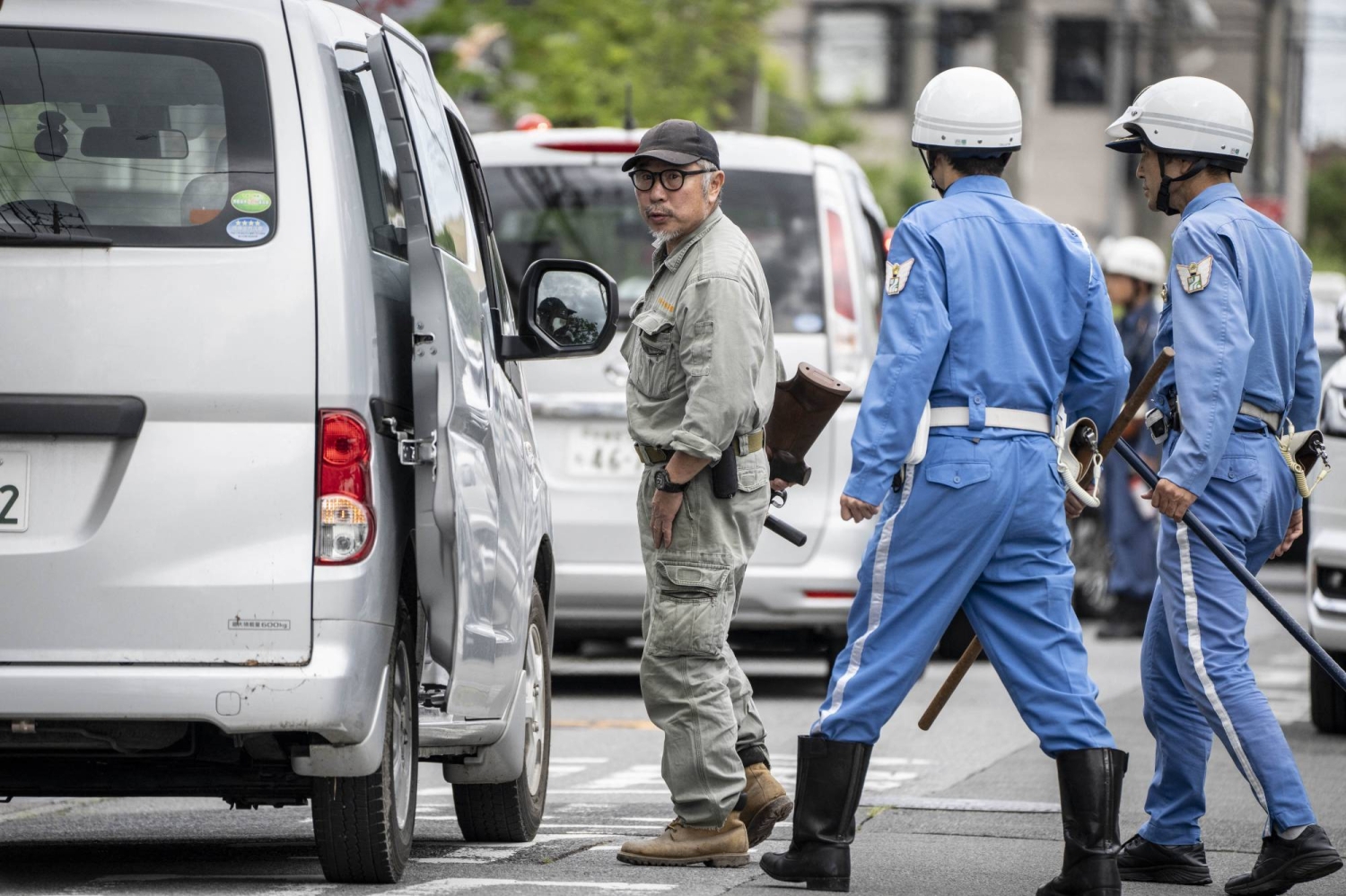
栃木县宇都宫市 — 宇都宫市处于紧张状态。那是6月初,一头熊在栃木县县厅所在地横冲直撞,让这座拥有50万人口的城市陷入瘫痪。
Utsunomiya, Tochigi Pref. – Utsunomiya was on edge. It was early June and a bear was running rampant in the Tochigi Prefectural capital, throwing the city of 500,000 into a state of paralysis.
学校停课,居民惊慌失㧏地检查自家庭院有无动物踪迹,当地动物园的专家被派往现场控制熊只。
Schools were closed, residents were frantically checking their gardens for any signs of the animal and specialists from the local zoo were deployed to bring the bear under control.
为期三天的追捕在一名动物园饲养员在一处民宅附近用麻醉枪射中熊只后结束。
The three-day chase ended when a zookeeper shot the bear with a tranquilizer gun near a private residence.
这起在电视和网络上广泛播放的惊险一幕,是日本人熊冲突日益增多的最新案例。
The dramatic episode, which was widely shown on TV and the internet, was the latest in a growing number of conflicts between humans and bears in Japan.
继上一财年熊害事件数量创历史新高 — — 全国共有238人遭袭、13人死亡 — — 之后,日本正为今秋又一波冬眠前的目击、遭遇和袭击高峰做准备。专家表示,今年橡果丰收相对较好,将让许多熊吃得足够饱,很可能避免去年秋天在东北和关东地区上演的惨剧重演。
Following last fiscal year’s record-breaking number of bear-related incidents — nationwide, 238 people were attacked and 13 were killed — Japan is bracing for another pre-hibernation surge in sightings, encounters and attacks this fall. So far, experts say the relatively rich acorn harvests this year would keep many bears sufficiently fed, likely preventing the recurrence of horrors played out across the Tohoku and Kanto regions last autumn.
但从中长期来看,日本的挑战将持续存在,宇都宫发生的此类事件只是其他社区可能发生情况的前兆。
But in the medium to long term, Japan’s challenges will continue, with incidents like the one in Utsunomiya being only a harbinger of what could happen in other communities.
全国性对策 去年11月,中央政府制定了紧急防熊袭击计划,旨在积极减少全国熊的数量,并增加熊管理和捕杀的人员与资源,包括更广泛地采用“公务猎人”制度。今年3月,政府跟进出台了一份路线图,列出了到2030年要采取的措施,例如将全国负责捕熊的市町村职员人数增加两倍至2500人,将捕熊陷阱数量增加一倍至1万个。
Nationwide countermeasures Last November, the central government compiled an emergency bear attack prevention plan aimed at actively reducing the number of bears in the country and increasing staff and resources for bear management and culling, including through the wider adoption of “government hunters.”In March, the government followed up with a roadmap outlining steps to take by 2030, such as tripling the number of municipal officials in charge of capturing bears to 2,500 and doubling the number of bear traps to 10,000 across the nation.
政府还根据评估结果,为各地区设定了具体的熊只捕杀数量目标。评估认为,长期以来作为保护对象、且仍被国际自然保护联盟(IUCN)列为易危物种的亚洲黑熊,在东北、关东和中部地区已出现过度繁殖。
The government also set region-specific goals for the number of bears to cull, based on the assessment that the number of Asian black bears — long the target of conservation efforts and still classified as a vulnerable species by the International Union for Conservation of Nature — had become overpopulated in the Tohoku, Kanto and Chubu regions.
政府的目标是到2030财年,将东北、关东和中部地区的黑熊数量分别降至当前水平的62%、67%和63%。在估计有11600头棕熊栖息的北海道,政府计划到2030财年将棕熊数量减少至8200头。
It aims to reduce the bear population in Tohoku, Kanto and Chubu to 62%, 67% and 63% of the current level, respectively, by fiscal 2030. In Hokkaido, home to an estimated 11,600 brown bears, the government aims to reduce the population of that species to 8,200 in fiscal 2030.
对于近畿和中国地区,政府计划采取幅度较小的减少措施,仅捕杀约900头熊,以维持当前种群数量。
The government is planning a less drastic reduction in the number of bears in the Kinki and Chugoku regions, culling just enough — about 900 bears — to keep the current population level.
根据去年建立的新紧急捕杀制度,猎人经地方政府许可后,现在可以在居民区射杀熊只。截至10月12日,已依据该制度开枪36次。
Under a new emergency culling system instituted last year, hunters can now shoot bears in residential areas with permission from local authorities. Guns have been fired 36 times under the system as of Oct. 12.
循证方法 但仅靠捕杀无法解决长期存在的问题。兵库县立大学野生动物管理学教授、环境省熊对策专家小组成员横山真弓主张采取长期的、循证的方法。她表示,虽然政府出台的一系列新举措值得欢迎,但培养专家和积累数据需要数年时间。
Evidence-based approach But culling alone won’t solve longstanding problems. Mayumi Yokoyama, professor of wildlife management at the University of Hyogo and a member of an expert panel on bear management measures under the Environment Ministry, advocates for a long-term, evidence-based approach. She says that while the series of new measures taken by the government is welcome, it will take years to nurture specialists and accumulate data.
横山长期呼吁野生动物管理应考虑到日本人口老龄化和减少的现状。她指出,不仅是熊,鹿、野猪和猴子也在荒废或监管减少的农田中迅速繁衍并扩大栖息地,导致农作物受损加剧。
Yokoyama has long called for wildlife management that takes into account the nation’s aging population and decline, saying not just bears but deer, boars and monkeys have grown rapidly and expanded their habitats in abandoned or less-monitored farm fields, intensifying crop damage.
应环境省要求,日本学术会议于2019年汇总了一份建议清单,呼吁对野生动物种群进行科学监测,推行针对废弃农地的社区主导型对策,利用野味,并培养野生动物管理专家。但她回忆说,政府的努力在那之后不久便烟消云散了。
In response to a request from the Environment Ministry, the Science Council of Japan in 2019 put together a list of proposals, calling for scientific monitoring of wildlife populations, community-based solutions for abandoned farmlands, utilization of wild meat and nurturing of wildlife management experts. But government efforts fizzled out soon after that, she recalls.
“这一次,相关省厅都作出了回应,并为各项对策预留了预算,这是非常大的举措,”她说。“但在一线,数据和专家短缺的状况依然存在。这些问题无法一夜之间解决。”她说,各市町村政府目前正在争夺全国有限的野生动物管理专家,并指出日本需要培养更多此类人才,以便让年轻研究者能够在这个领域看到长期的职业前景。
“This time, related ministries all responded and set aside budgets for various measures, which is a very big move,” she said. “But on the ground, the lack of data and specialists persists. They cannot be improved overnight.”Municipal governments are now competing to hire the limited number of wildlife management specialists in the country, she said, noting that Japan needs to educate more of them so young researchers can envision a long-term career in this field.
另一个主要问题是,由于许多都道府县缺乏数据和持续监测所需的人力资源,全国究竟有多少只熊并没有准确的统计。例如,6月新潟县政府宣布,将该县熊只数量的估算中位数从约1400只上调至8747只——增加了六倍。因此,当地专家警告说,不能排除熊只出没于新潟县市区的可能性。
Another major issue is that, because of the lack of data and human resources for continued monitoring in many prefectures, there’s no precise count of how many bears there are in the nation. In June, for example, the Niigata Prefectural Government announced it raised the estimated median number of bears in the prefecture from around 1,400 to 8,747 — a sixfold increase. As a result, local experts warned that the possibility of bears roaming Niigata cities could not be ruled out.
有些都道府县的情况较好。在兵库县,包括横山在内的官员和研究人员已对熊只种群进行了25年以上的监测。
Some prefectures have done better than others. In Hyogo Prefecture, officials and researchers, including Yokoyama, have monitored the bear population for over 25 years.
20世纪90年代末,兵库县官员启动了一项新计划,捕捉靠近人类居住区的熊只,用防熊喷雾等手段对其进行“惩罚”,然后将其放归野外。
In the late 1990s, Hyogo officials started a new program that involved capturing bears that ventured too close to human settlements, “punishing” them with bear spray and other methods, and releasing them back into the wild.
被放归的熊只植入了微芯片,以便研究人员追踪其行为。该县目前拥有一个约3000只植入微芯片熊只的数据库,并以此来估算熊只种群数量。县政府决定,一旦熊的数量超过800头,即开始实施捕杀。
The released bears were tagged with microchips so researchers could track their behavior. The prefecture now has a database of some 3,000 microchipped bears, which it uses to estimate the bear population. The prefecture decided to start culling if the number of bears exceeded 800.
官员确认,熊的数量在2016年达到了这一阈值,且熊群数量以每年15%的速度增长。这促使兵库县从保护政策转向捕杀政策。
The officials confirmed that the number hit the threshold in 2016 and that the bear population had grown at a rate of 15% a year. This prompted Hyogo to move from conservation to culling.
此外,捕杀熊时会进行解剖,以便官员收集年龄、营养状况等生物学数据。据横山介绍,该县已以此方式分析了700多头熊。
Furthermore, when the bears are culled, they are dissected so the officials can collect biological data such as age and nutritional condition. Over 700 bears have been analyzed this way in the prefecture, according to Yokoyama.
城市熊 与此同时,城市熊的存在使熊类管理变得更加复杂,所谓城市熊是指那些已适应人类聚居环境、频繁进入居民区觅食的熊。
Urban bears Meanwhile, bear management is being complicated by urban bears, or those who have become accustomed to human populations and frequently roam into residential neighborhoods to search for food.
现任亚洲黑熊研究所所长、前秋田县政府官员前田和彦指出,由于橡果产量增加,明年城市熊数量可能激增。
Kazuhiko Maita, a former official at Akita Prefectural Government who now heads the Institute for Asian Black Bears, points to a possible surge in urban bears next year due to increased acorn production.
他说:“当橡果产量遵循自然周期、出现丰收年时,出生的幼崽会增多。随后一年如果遭遇凶作,母熊就会带着幼崽下山进入人类居住区。
“When acorn production follows its natural cycle and the crop is abundant, more cubs are born,” he says. “Then the following year, if there’s a poor crop, mother bears with their cubs come down into human-inhabited areas.
“母熊被捕杀后,体长仅约50厘米的幼崽就会被遗弃。这些幼熊没有野外生存经验,留在人类聚居地,逐渐变成我们所谓的城市熊。”前田说,随着这一过程不断重复,明年4月可能会在城市地区出现更多体型异常巨大的熊。
“When the mothers are culled, their cubs, which are only about 50 centimeters long, are left behind. Having had no experience with life in the wild, these young bears remain in human settlements and gradually become what we call urban bears.”As this process repeats over time, we may see more cases of exceptionally large bears emerge in urban areas next April, Maita says.
虽然宇都宫市抢占了许多新闻头条,但今年春天,秋田市、仙台市和福岛县郡山市也都出现了刚结束冬眠的熊踪迹。
While Utsunomiya grabbed many of the headlines, this spring also saw post-hibernation bears turning up in the cities of Akita, Sendai and Koriyama, Fukushima Prefecture.
气候变化的影响 横山和前田均表示,关于变暖的星球对日本近年熊目击事件和袭击事件增加的影响,仍有许多未知之处。
Impact of climate change A lot remains unknown about the effects of a warming planet on recent rises in Japan of bear sightings and attacks, both Yokoyama and Maita say.
林业综合研究所的研究人员在2019年的一篇论文中写道,过去40年来气温上升可能扰乱了这一橡子收获周期,并将其从以前的三至四年缩短为两年。
Researchers at the Forestry and Forest Products Research Institute wrote in a 2019 paper that rising temperatures over the past 40 years may have disrupted this harvest cycle of acorns and shortened it to two years instead of three to four years previously.
横山说,北海道知床半岛的棕熊以鲑鱼为主食,可能会受到海水温度上升以及随之而来的溯河洄游鲑鱼减少的影响。
Yokoyama says that bears in the Shiretoko Peninsula of Hokkaido, which have a salmon-heavy diet, may be affected by rising ocean temperatures and the resulting fall in salmon traveling upstream.
横山说:“但我们几乎没有数据来证实气候变化的影响;我们甚至不知道到底存在多少只熊。”
“But we have very little data to substantiate the effects of climate change; we don’t even know how many bears exist to begin with,” Yokoyama says.
舞田说,6月出现在宇都宫的那只雄熊可能并非外出觅食。它在交配季节闯入城市,此时雄熊为争夺雌熊会激烈争斗。他说,战败的熊常被赶出深山,长途跋涉到竞争对手较少的地区。经过三天的搜捕,是动物园饲养员矶铁夫终结了这场风波。
The male bear in June that turned up in Utsunomiya was probably not out hunting for food, Maita says. It ventured into the city during the mating season, when male bears fight fiercely for female bears. Bears that lose are often driven out of the mountains and travel long distances to areas with few competitors, he says. After a three-day hunt, it was zookeeper Tetsuo Iso who put an end to the saga.
随着事态发展,在宇都宫动物园工作的65岁饲养员矶铁夫应县政府要求协助捕捉熊只。由于该熊在市内活动范围广泛,经常消失在民宅周围的灌木丛中,对他和其他官员而言,第一个挑战仅仅是找到它。
As the drama unfolded, Iso, a 65-year-old worker at Utsunomiya Zoo, was asked by the prefectural government to help capture the bear. Because the bear traveled widely across town, often disappearing into bushes around homes, the first challenge for him and other officials was simply to locate it.
矶铁夫说,6月9日,即受市政府调动两天后,当他最终与熊面对面时,这只动物似乎已认命。
When Iso, the zookeeper, finally came face to face with the bear on June 9, two days after being mobilized by the city, the animal seemed resigned to its fate, he says.
熊被逼入一处住宅狭窄的灌木区,四周被一栋公寓楼、一个停车场、一道1.8米高的铁皮围栏和一个庭院棚屋包围。能见度很差。
The bear was cornered into the narrow bushy area of a residential property, surrounded by a condominium, a parking lot, a 1.8-meter-high sheet metal fence and a garden shed. Visibility was poor.
他在宇都宫郊外的动物园接受最近的采访时回忆道:“警察官员问我,如果熊从灌木丛冲出来,我能不能击中它。”他形容这次任务极其危险,可能危及生命。“我说我会扣动扳机,但无法保证能击中那只熊,”他说。围绕这起事件的媒体大肆报道只给矶的关键时刻增添了压力。
“Police officials asked me if I could hit the bear if it bolted out of a bush,” he recalled during a recent interview at the zoo on the outskirts of Utsunomiya, describing the mission as highly dangerous and potentially life-threatening. “I said I would pull the trigger, but I couldn’t guarantee I would hit the bear,” he said. The media circus around the incident only added pressure to Iso’s big moment.
“到处都是围观者和油管博主,媒体直升机在头顶嗡嗡盘旋。”矶寻找一个能安全瞄准麻醉枪的位置。他开了两枪,但都脱靶打在了地上。
“There were all kinds of onlookers and YouTubers, and media helicopters buzzing overhead.”Iso looked for a position from where he could aim the tranquilizer gun safely. He fired two shots, but both missed and hit the ground.
最后,他绕到房子后面的停车场,用枪在围栏的金属板之间撬开一条小缝。他看到了熊的头和胸口那道白色的新月形斑纹,从约一米外朝胸口开枪,击中了熊,结束了这场追逐。
Finally, he moved around to the parking lot behind the house and used his gun to create a small space between the fence’s metal sheets. He saw the bear’s head and the white crescent mark on its chest, and fired toward the chest from about a meter away, striking the bear and ending the chase.
“当我瞄准枪口时,它看着我却没咆哮,”矶说,并指出他在动物园给生病动物治疗时经常使用麻醉枪。“我认得那个眼神,那是它认命的眼神,因为动物园里的动物有时也会露出同样的表情,当它们知道末日来临时。”
“When I aimed my gun, he looked at me but didn’t growl,” Iso says, noting he routinely uses tranquilizer guns at the zoo when treating sick animals. “I know that look, when he accepted his fate, because animals in the zoos sometimes show that same expression when they know their end is near.
后来,当局依照县里的政策将这只熊处死。一旦熊尝到了人类食物的滋味,它们就很可能再次闯入人类聚居区。
The bear was later killed by authorities in line with prefectural policy. Once bears get an appetite for human food, they are likely to venture into human settlements again.
“我为它感到难过。它恐惧了好几天——最后还是被杀了,”矶说。无论那只熊出现在宇都宫的原因是什么,它都不会是最后一只。
“I felt sorry for it. He was terrified for days — and killed in the end,” Iso said. Regardless of the reason that bear turned up in Utsunomiya, he won’t be the last.
据栃木县政府野生动物损害对策组组长丸山哲也介绍,长期以来几乎只生活在日光、那须等东北部茂密森林里的栃木县熊群,多年来逐渐向西扩展了栖息地。
Bears in Tochigi, which had long lived almost exclusively in the lush forests in northeastern areas such as Nikko and Nasu, have gradually expanded their habitats westward over the years, according to Tetsuya Maruyama, leader of wildlife damage control group at the Tochigi Prefectural Government.
他说,这一次官员们成功捕获了熊且未造成人员伤亡。宇都宫市于3月编制了一份包含详细流程图的紧急熊类捕杀手册,这起到了帮助作用。但这起事件凸显了地方政府有必要加强应对准备。
This time, the officials were able to capture the bear without harming anybody. The fact that the city of Utsunomiya had compiled an emergency bear culling manual with a detailed flow chart in March helped, he says. But the incident has highlighted the need for local authorities to step up their preparedness.
“我们意识到,应该准备更多盾牌和防熊喷雾,并改善警察、县政府与地方自治体之间的协调,”他说。“县内有些自治体至今仍未制定应急手册。它们应尽快制定,以便更好地应对突发情况。”
“We realized that we should have more shields and bear sprays ready, and improve coordination between police, the prefecture and local municipalities,” he says. “There are municipalities in the prefecture that still don’t have emergency manuals made. They should create them soon to better prepare for contingencies.”