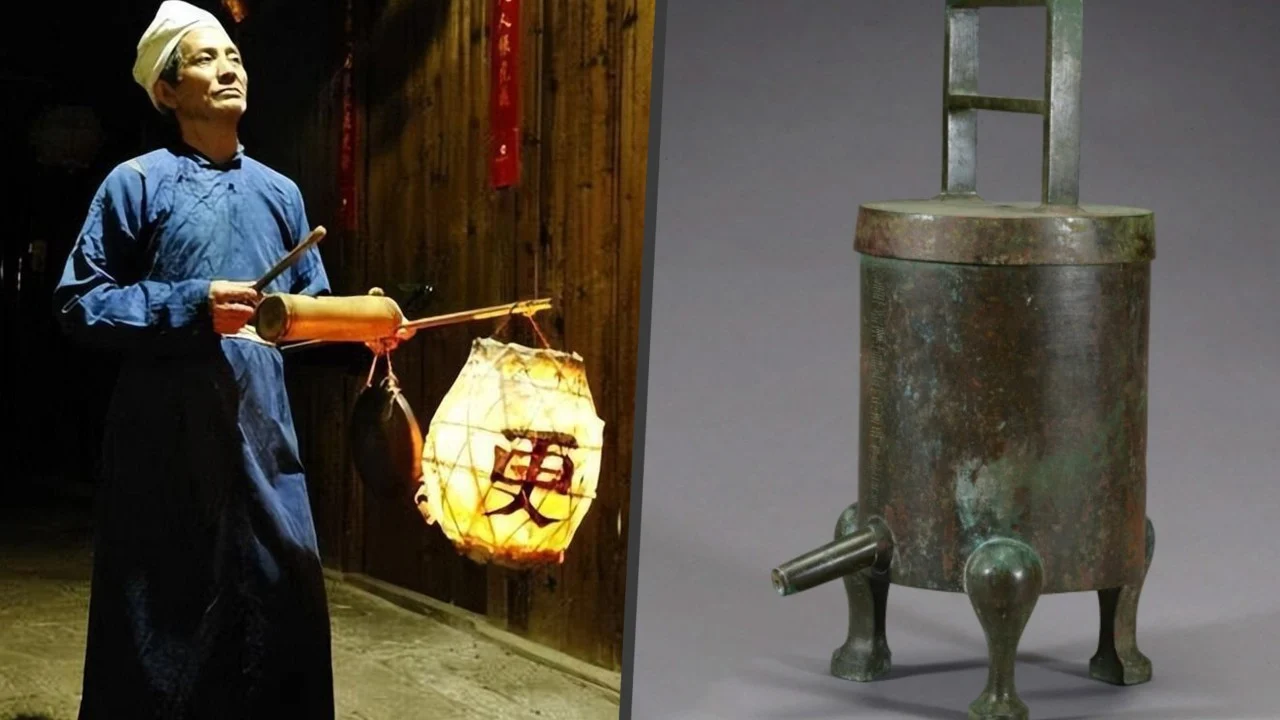
在古代中国,在机械钟表和数字设备出现之前,人们主要依靠更夫来报时、防火并维持日常作息。但更夫是如何报时的呢?中国古代更夫主要使用两种方法:漏壶和香烛。漏壶,又称水钟,通过容器中水流的匀速流出来计量时间。
In ancient China, before the advent of mechanical clocks and digital devices, people relied mainly on night watchmen to keep time, prevent fires and maintain their daily routines. But how did the watchmen tell the time? Chinese night watchmen mainly used two methods: clepsydras and incense sticks. A clepsydra, also known as a water clock, measures time through the regulated flow of water from a vessel.
古代中国人将夜晚划分为五更。每更约两小时,但具体时长随季节变化。初更通常从晚上7点持续到9点,而第五更、即末更则在凌晨5点左右结束。浮箭漏壶据称是中国古代更夫使用的主要计时装置。
The ancient Chinese divided the night into five . Each lasted around two hours, though the exact duration varied by season. The first usually ran from 7pm to 9pm, while the fifth and final ended around 5am. The float-arrow clepsydra is said to have been the main timekeeping device used by Chinese night watchmen.
据信,浮箭漏壶最早出现于汉朝(公元前202年—公元220年)。它利用浮力原理工作:随着水位下降,浮箭露出水面的部分越来越多。更夫可从箭杆上的刻度读取时间。
The float-arrow clepsydra is believed to have first appeared during the Han dynasty (202 BC–220). It worked through buoyancy: as the water level dropped, more of the floating arrow became visible above the water. The watchman could read the time from the marks on the arrow.
唐宋时期(618—1279年),出现了一种更复杂的版本,由三个滴漏桶组成。单个桶可能无法提供准确计量,因为水位下降时箭杆下降速度会变慢。在三桶系统中,中间的桶始终保持满水状态,使得底桶的出水流速更加恒定。
During the Tang and Song dynasties (618–1279), a more complicated version was developed, consisting of three dripping buckets. A single bucket might not provide an accurate measurement, because the arrow descended more slowly as the water level fell. In the three-bucket system, the middle bucket remained full, making the flow of water from the bottom bucket more consistent.
古代漏壶也采用不同材质制作。宫廷使用的漏壶由金、银、玉制成。
Clepsydras were also made from different materials in ancient times. Those used in the royal palace were made of gold, silver and jade.
有专人专门负责宫廷计时事务。据记载唐朝历史的经典史著《唐六典》记载,皇城内有近400人照料精复杂的滴漏桶。他们的职责包括给桶注水、观察箭杆指示的时间并向更夫报时。更夫在巡逻街道时会敲击木梆或锣,向街坊邻里报时。除了漏壶,夜间更夫还使用另一种传统计时法:燃烧香枝。香枝计时始于南北朝时期(386年—589年)。
Many people were specially assigned to manage timekeeping in the royal court. According to the , a classic historical work about the Tang dynasty, nearly 400 people in the imperial city tended the elaborate dripping buckets. Their duties included replenishing the buckets, observing the time shown on the arrow and reporting it to the night watchmen. The watchmen would then strike a wooden clapper or gong as they patrolled the streets, announcing the time to residents in the neighbourhood. Alongside the clepsydra, night watchmen also used another traditional timekeeping method: burning incense sticks. Incense-based timekeeping began during the Northern and Southern dynasties (386–589).
香枝计时不如滴漏计时准确,因为一根香枝燃烧多久取决于其材质和周围环境。
Time measured by incense was less accurate than time measured by dripping buckets, because how long an incense stick took to burn depended on its material and the surrounding environment.
因此,虽然“一炷香”是常用的时间单位,很像现在的小时或分钟,但并非所有香枝都标准化。一根香可能燃烧15分钟到一小时不等。
Thus, although “the time it took to burn an incense stick” was a commonly used unit of time, much like today’s hour or minute, it was not standardised across all incense sticks. A stick could burn for anywhere from 15 minutes to an hour.
据记载,1073年,长江以南地区遭遇严重干旱导致漏壶无法工作,一名叫沈立的官员发明了一套名为“五香计”的计时工具。
According to , in 1073, when a severe drought struck the region south of the Yangtze River and prevented clepsydras from working, an official named Shen Li invented a set of timekeeping tools called the five incense counter.