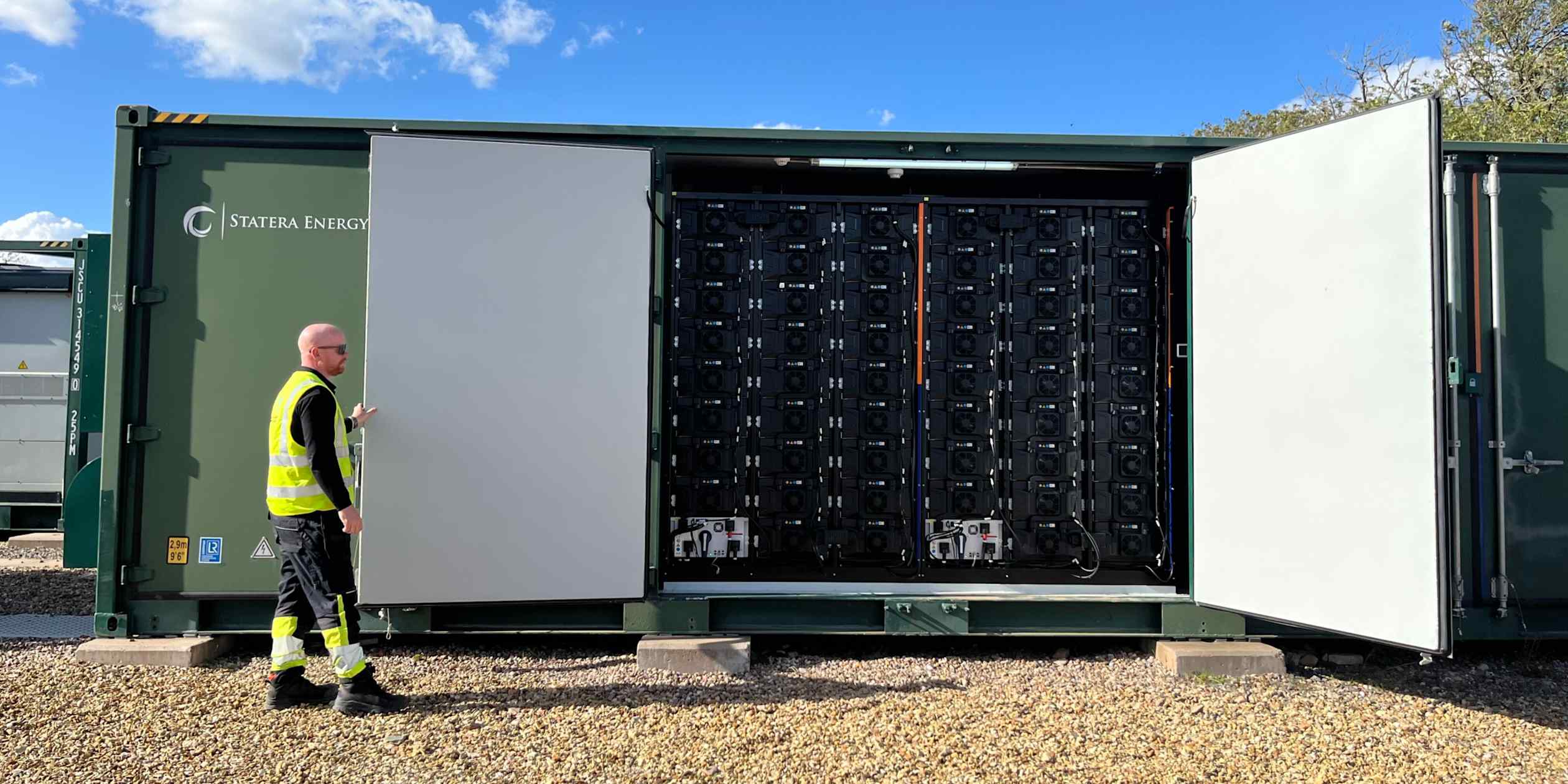
东京/英国莱斯特 —— 在英格兰东米德兰兹地区城市莱斯特郊外绿树成荫的地带,一块不起眼的土地上摆放着 30 个集装箱。这些整齐排列的箱体内装满了电池和逆变器组合,储存的电量足以供 16 万户家庭使用两小时。
TOKYO/LEICESTER, England -- In the leafy outskirts of Leicester, a city in England's East Midlands, an unassuming land houses 30 shipping containers. The long rows of boxes are filled with a combination of batteries and inverters, which have the capacity to store enough energy to power 160,000 homes for two hours.
该站点由 Gresham House 运营,后者是英国最大的电池储能系统(BESS)资产开发商和运营商之一,也是这一对可再生能源转型至关重要的领域的早期布局者。BESS 负责在需要时分配电池中储存的电力。
The site is operated by Gresham House, one of the U.K.'s largest developers and operators of battery energy storage system (BESS) assets and an early mover in a sector becoming critical to the renewable energy transition. BESS is responsible for distributing the electricity stored in batteries when it is needed.
对于日本五大综合商社之一的住友商事而言,莱斯特站点既展示了日本未来可能的模样 —— 一个 BESS 在平衡更多可再生能源供电的电网中发挥日益重要作用的电力市场,也提供了如何实现这一目标的经验教训。
For Sumitomo Corp., one of Japan's five major trading houses, the Leicester site offers both a glimpse of what Japan could become -- an electricity market where BESS plays an increasingly important role in balancing a grid powered by more renewable energy -- and lessons in how to get there.
住友商事于 5 月宣布与 Gresham House 合作,在英国开发五个 BESS 项目,每个项目持股 25%。住友商事总部设在东京,其储能业务部门负责人滨田茂伸表示:“英国在电力批发市场使用 BESS 方面,大概领先日本五年。”
Sumitomo announced in May that it had partnered with Gresham to develop five BESS projects in Britain, taking a 25% stake in each. "The U.K. is probably five years ahead of Japan in terms of using BESS in electricity wholesale markets," said Shigenobu Hamada, head of the energy storage business unit at the Tokyo-based company.
他说:“通过直接参与市场,我们想亲身体会 BESS 是如何被利用和优化的。如果英国代表日本五年后的样子,我们就能把这些经验带回日本,在市场形成之前率先付诸实践。” 随着住友商事在国内迅速扩张电池业务,这些经验可能极具价值。该公司目前在日本运营约 10 兆瓦并网 BESS,但预计到 2027 年装机容量将达到 100 兆瓦,目标是到 2030 年拥有超过 500 兆瓦的项目组合。滨田茂伸表示,这可能使其占据国内市场 10% 至 15% 的份额。
"By getting directly involved in the market, we want to learn firsthand how BESS is being utilized and optimized," he said. "If the U.K. is where Japan could be five years from now, we can bring those lessons back to Japan and put them into practice ahead of the market." Those lessons could be valuable as Sumitomo rapidly expands its battery business at home. The company currently operates around 10 megawatts of BESS connected to the electricity grid in Japan, but expects capacity to reach 100 MW by 2027 and aims to have a portfolio of more than 500 MW by 2030. Hamada said that could give it a 10% to 15% share of the domestic market.
作为这一推进的一部分,据消息人士透露,住友商事目前正在日本南部九州地区开发日本最大的电网级储能电站(BESS)项目之一。
As part of the push, the company is now developing one of Japan's largest grid-scale BESS projects in the southern Kyushu region, according to sources.
住友商事的扩张正值日本寻求依靠电池储能来容纳更多可再生能源电力之际。日本的目标是到2040财年,太阳能和风能发电量占总发电量的30%至40%,高于目前的10%左右。由于其发电量随天气波动,提高其占比将需要更多电池来储存过剩电力,并在需要时将其送回电网。
Sumitomo's expansion comes as Japan looks to battery storage to accommodate more renewable power. Japan is aiming for solar and wind to account for 30% to 40% of electricity generation in fiscal 2040, up from around 10% now. Because their output fluctuates with the weather, increasing their share will require more batteries to store excess electricity and return it to the grid when needed.
然而,据智库能源经济与金融分析研究所(IEEFA)称,尽管到2025年底新BESS项目的申请容量已激增至170吉瓦以上,但实际已物理接入电网的容量仅为0.62吉瓦。相比之下,英国已超过8吉瓦。
Yet while applications for new BESS projects have surged to more than 170 gigawatts by the end of 2025, according to the Institute for Energy Economics and Financial Analysis, or IEEFA, a think tank, only 0.62 GW of capacity has actually been physically connected to the electricity grid. In contrast, the U.K. has more than 8 GW.
位于英格兰莱斯特的电池储能系统拥有足以供16万户家庭使用两小时的储能容量。
The battery energy storage system in Leicester, England, has the capacity to store enough energy to power 160,000 homes for two hours.
“尽管项目储备量巨大,但由于目前通过的容量极少,日本仍处于早期市场阶段,”咨询公司Rystad Energy的高级分析师Chris Wilkinson表示。
"Japan is still an early-stage market despite an enormous pipeline, since very little capacity has passed through so far," said Chris Wilkinson, senior analyst at Rystad Energy, a consultancy.
英国的一个经验教训是,电池盈利模式的变化可以有多快。Wilkinson表示,频率响应市场——即向电池支付费用以快速充放电来帮助维持电网稳定——最初是盈利的。但随着更多电池进入市场、价格下跌,“优化运营商不得不将策略转向套利和电力交易。”Wilkinson预计日本将经历类似的转变。“日本的运营商应规划以套利和交易作为长期的核心收入来源,”他说。
One lesson from Britain is how quickly the ways batteries make money can change. The frequency response market, which pays batteries to rapidly charge or discharge to help keep the power grid stable, was initially profitable, Wilkinson said. But as more batteries entered the market and prices fell, "optimisers had to switch strategies towards arbitrage and [power] trading." Wilkinson expects Japan to undergo a similar shift. "Operators in Japan should plan for arbitrage and trading to be the long-term core revenue," he said.
住友商事希望从其在英国的业务中汲取经验。滨田指出,英国蓬勃发展的日内电力市场——即在接近用电需求时买卖电力——是储能电站运营商的重要收入来源。而在日本,这一市场尚未起步。
That is something Sumitomo hopes to learn from its U.K. operations. Hamada pointed to Britain's booming intraday power market, where electricity is bought and sold close to when it is needed, as an important source of revenue for BESS operators. In Japan, the market has yet to take off.
滨田表示:“我认为日本最终必然会朝这个方向发展。通过我们自身投资英国市场,并积累通过日内电力交易获取收益的实操经验,我们相信能为日本电力系统中储能电池的有效利用做出贡献。” 然而,日本的储能电站运营商仍面临多重挑战。能源经济与金融分析研究所(IEEFA)在3月的一份报告中指出,接入电网的拥堵“仍是主要瓶颈”,部分原因是投机性项目提案的激增。
"I believe Japan will inevitably move in this direction eventually," Hamada said. "By investing in the U.K. market ourselves and gaining hands-on experience in generating revenue through intraday power trading, we believe we can contribute to the effective use of battery storage within Japan's electricity system." However, multiple challenges remain for BESS operators in Japan. Congestion in connecting to the grid "remains the primary bottleneck," spurred in part by speculative project proposals, IEEFA said in a March report.
报告补充称,与其他市场相比较高的电池成本“给新投资带来了额外挑战”,成本仍为全球基准的2.5至3倍。电力市场参与者还指出,缺乏负电价是一大障碍。
It added that high battery costs compared to other markets "present an additional challenge for new investment," with costs remaining 2.5 to 3 times higher than global benchmarks. Power market participants have also pointed to the lack of negative pricing as a barrier.
在欧洲,当电力供应超过需求时,电价经常转为负值,这通常发生在可再生能源发电量高的时期。储能电站运营商可利用这种价格暴跌,在电价极低或为负时储存能源——实际上是获得报酬来储能——并在电价较高时放电。
In Europe, power prices frequently turn negative when electricity supply outstrips demand, often during periods of high renewables generation. BESS operators can take advantage of such price crashes, storing energy at times when prices are extremely low or negative -- effectively getting paid to store energy -- and discharging it when prices are higher.
与此同时,日本设有每千瓦时0.01日元(不足一美分)的电价下限。
Japan, meanwhile, has a floor price of 0.01 yen, or a fraction of a cent, per kilowatt-hour.
欧洲能源技术公司Volue企业销售副总裁卡米拉·拉森表示,对储能电站开发商而言,负电价“是一个非常重要的信号”,并补充说,在欧洲,这一直是投资电池的“强力激励”。
For a BESS developer, negative pricing is "a very important signal," said Camilla Larsen, vice president of enterprise sales at European energy technology company Volue, adding that in Europe, it has been a "strong incentive" to invest in batteries.
“如果我们让市场发挥作用,最终将趋向[电力供需]平衡,因为我们将拥有必要的投资[用于储能电站等项目]。是的,[储能开发商]是为了盈利而这么做,但同时这也在帮助电力系统,”她说。
"If we allow the market to work, it will eventually converge towards [electricity supply and demand] balance because we will have necessary investment [on things like BESS]. Yes [BESS developers] do it to make a profit but at the same time it is helping the power system," she said.