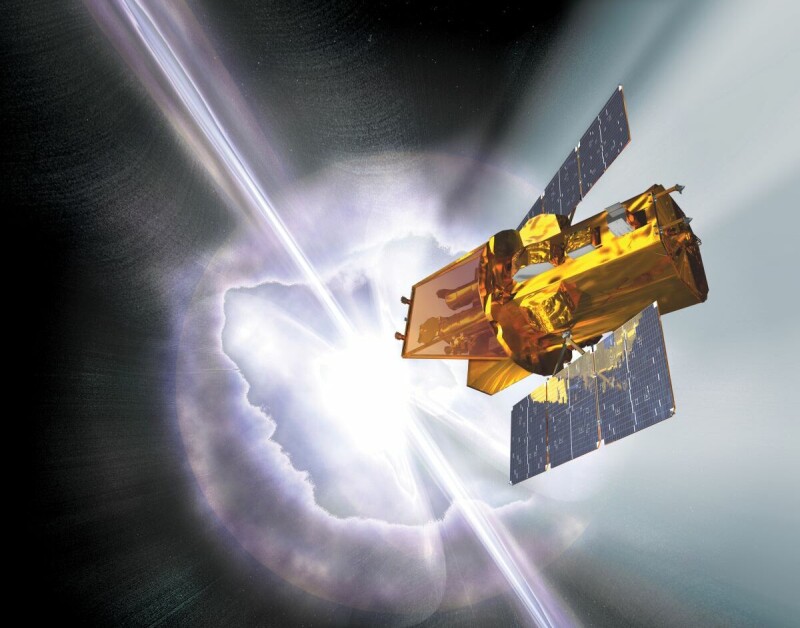
美国国家航空航天局(NASA)的“雨燕”天文台于10月20日进行了最后一次观测,预计将在未来几周内重返大气层,此前夏季的一次救援尝试失败。
NASA's Swift observatory made its final observation on October 20 and is expected to re-enter the atmosphere in the next few weeks after a failed rescue attempt over the summer.
“雨燕”天文台旨在研究伽马射线暴,于2004年11月20日发射,原定任务为期两年。它已运行近22年,但大气阻力正不可避免地降低航天器的轨道高度,因此再入大气层很可能就在其发射22周年前夕。“雨燕”没有推进系统来自救。目前,“雨燕”运行在距地表不到171英里(约275公里)的轨道上,这意味着它无法在指向天文目标时保持望远镜稳定。
Designed to study gamma-ray bursts, Swift was launched on November 20, 2004, on a two-year mission. It has lasted almost 22 years, but atmospheric drag is inexorably lowering the spacecraft's orbit, so reentry is likely just shy of the vehicle's 22nd anniversary. Swift has no propulsion system to save itself. Swift is now orbiting at an altitude of less than 171 miles above Earth's surface, meaning it cannot keep its telescopes steady when pointing at astronomical targets.
由于航天器无法再补偿增加的阻力,它进入了安全模式。随后,地面发送了一条指令,根据NASA的说法,这“实际上结束了‘雨燕’的运行,为其再入做准备”。
Because the spacecraft could no longer compensate for the increased drag, it dropped into safe mode. A command was then sent from the ground that, according to NASA, "effectively ended Swift operations to prepare it for re-entry."
近年来,由于太阳活动增强,“雨燕”下降速度加快。去年,NASA授予Katalyst Space公司一份合同,执行一项高风险、高回报的任务,将天文台推升至更高轨道。“雨燕”的科学运行被缩减,以最大化Katalyst Space的LINK航天器实施任务的机会,但遗憾的是,两者从未完成会合,工程师们选择重新激活运行,以榨取尽可能多的科学成果。预期的副作用是航天器受到的阻力增加,正如预料的那样,“雨燕”迅速下沉,直到不得不停止运行。
The descent of Swift has accelerated in recent years due to increased solar activity. Last year, NASA awarded Katalyst Space a contract for a high-risk, high-reward mission to boost the observatory to a higher orbit. Swift's science operations were curtailed to maximize opportunities for Katalyst Space's LINK spacecraft, but alas, a rendezvous never happened, and engineers opted to reactivate operations to eke out as much science as possible. The expected side effect was increased drag on the spacecraft and, as expected, Swift sank rapidly until operations had to cease.
在漫长的生命周期中,“雨燕”是一台惊人高产的仪器。据NASA称,它观测了2000多次伽马射线暴和1400多次超新星爆发。它进行了全天X射线巡天,并观测到恒星被黑洞撕裂。完整的“雨燕”数据档案约为12太字节。对于本只应运行两年的设备来说,这成绩着实不俗。如今,NASA面临的问题是,它没有“雨燕”的直接替代者。
Swift has been an astonishingly productive instrument during its long life. According to NASA, it has observed more than 2,000 gamma-ray bursts and more than 1,400 supernova explosions. It has conducted an all-sky X-ray survey and seen stars shredded by black holes. The full Swift archive comes to approximately 12 terabytes. Not too bad for something that was only supposed to last two years. NASA now faces the problem that it has no direct replacement for Swift.
除了致敬该天文台的贡献外,美国国家航空航天局(NASA)总部天体物理学部主任肖恩·多马加尔-戈德曼在一份声明中表示:“为了支持在‘后斯威夫特时代’快速响应宇宙事件,我们正在探索利用并增强NASA现有空间望远镜机群的能力,范围涵盖从快速入轨的商业能力到高效、创新的新任务。” ®
As well as paying tribute to the observatory's contributions, Shawn Domagal-Goldman, director of the Astrophysics Division at NASA Headquarters in Washington, said in a statement: "To support rapid response to cosmic events in a post-Swift world, we're exploring our ability to use and augment NASA's fleet of existing space telescopes, from fast-to-orbit commercial capabilities to efficient, innovative new missions." ®