
互联网上的信任本应是现代密码学的奇迹之一。恶意网站可能试图冒充你的银行或电子邮件提供商,但网页浏览器的设计初衷就是拦截这些伪造网站。地址栏锁形图标背后的加密强度极高,即便超级计算机运行数千年也无法破解。
Trust on the internet is supposed to be one of the marvels of modern cryptography. A malicious website may try to impersonate your bank or email provider, but web browsers are designed to block the fake. The encryption behind the padlock in the address bar is so strong that even supercomputers running for millennia wouldn’t be able to break it.
至少理论上是这样。上周,全球科技界收到了一个严峻的提醒:这套系统只能像我们信任的监管机构那样强大。
That, at least, is the theory. Last week brought a grim reminder to the global tech community that the system is only as strong as the institutions we trust to police it.
Chrome、Safari 和 Firefox 等浏览器不会独立验证地球上的每一个网站。相反,它们将这一权力外包给几十家商业和政府关联实体,称为证书颁发机构。它们是互联网的公证人。但当担保方本身不可信时会发生什么?
Browsers such as Chrome, Safari, and Firefox don’t independently verify every website on earth. Instead, they outsource that power to a few dozen commercial and government-linked entities known as Certificate Authorities. They are the internet’s notaries. But what happens when the guarantor can’t be trusted?
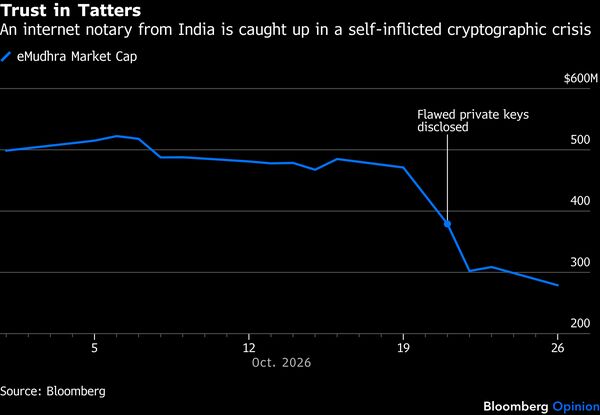
10 月 21 日,总部位于班加罗尔的 eMudhra Ltd.(印度唯一的此类认证机构)让互联网集体经历了一次恐慌。该公司披露,其八个私钥——这些数字代码是网络安全的基石,本应在严格受控条件下在安全的离线芯片内生成,永远不应被人眼看见——却极其容易被猜中。
On Oct. 21, Bengaluru-based eMudhra Ltd., the only such certification authority from India, gave the internet a collective panic attack. The firm disclosed that eight of its private keys — digital codes so foundational to online security that they are supposed to be created inside secure, offline chips under tightly controlled conditions and never seen by human eyes — were laughably easy to guess.
事实上,其中一个私钥就是“四”。不是四位数代码,就是单个数字 4。
In fact, one of them was four. Not a four-digit code. Simply the number 4.
更糟的是,该公司称,这些泄露的凭证自 2025 年中以来已进入大型科技公司信任的系统。它们一直未被发现,直到一位外部研究人员从公开数据中推导出这些数字,并通知了 Apple Inc.、Google、Microsoft Corp. 和 Mozilla Corp.。任何猜中该答案的人——这项壮举如此基础,几乎不需要人工智能工具——都将拥有数字世界的万能通行证,能够为几乎任何网站创建伪造身份,而浏览器会将其视为真实有效。
Worse, these compromised credentials had made their way into systems trusted by Big Tech firms since mid-2025, the company said. They went undetected until an outside researcher deduced the numbers from public data and alerted Apple Inc., Google, Microsoft Corp., and Mozilla Corp. Anyone who hit upon that solution — a feat so basic it hardly required artificial-intelligence tools — would have possessed the digital equivalent of a master passkey, creating counterfeit identities for virtually any website that browsers would accept as genuine.
更离奇的一幕随即上演。随着股价暴跌,eMudhra 发布第二份声明,哀叹“社交媒体对这一事件的放大程度带来的审视与其占比不成比例”,称该业务部门的收入仅占其总收入的 1% 左右。公司表示将自愿退出全球网页认证业务,并强调并未签发任何欺诈性凭证。
The more bizarre spectacle, however, came next. With its stock in free fall, eMudhra issued a second statement lamenting that “the level of social media amplification around this incident has brought scrutiny that is out of proportion” to a division accounting for barely 1% of its revenue. The firm said it would voluntarily withdraw from the global web-certification business, stressing that no fraudulent credentials had been minted.
印度电子与信息技术部(MeitY)也以类似口吻介入。该部门在承认事件严重性并宣布由专门小组展开调查的同时,指责部分社交媒体账号制造恐慌。它补充称,对本地网站和应用程序的影响非常有限,且持续时间很短。
India’s Ministry of Electronics and IT, or MeitY, jumped into the fray with a similar line. While acknowledging the seriousness of the incident and announcing an investigation by a special team, it accused some social-media accounts of fear-mongering. The impact on local websites and applications has been very limited and for a short period, it added.
然而,互联网安全分析师远未被说服。浏览器已屏蔽可疑证书,但互联网远不止 Chrome 和 Safari。智能电表、支付终端、嵌入式服务器及其他联网设备可能数年不进行安全更新,且可能永远不会检查某个证书是否已被宣布不安全。这意味着,在你的手机或电脑上已修复的受损密钥,在其他地方可能仍被信任,从而在所有人都以为问题已解决很久之后,仍可能留下“僵尸后门”。
However, internet security analysts are far from convinced. Browsers have blocked the suspect certificates, but the internet extends far beyond Chrome and Safari. Smart meters, payment terminals, embedded servers, and other connected devices may go years without security updates and may never check whether a certificate has been declared unsafe. That means compromised keys that have been fixed on your phone or computer could remain trusted elsewhere, potentially leaving behind zombie backdoors long after everyone thinks the problem has been solved.
只有彻底、独立的取证调查,才能让全球软件界放心,确认这只是一场失误,而非蓄意欺骗。这一区别至关重要,因为受损的数字公证机构长期以来一直被用作国家治理和监控的工具。2011 年,荷兰证书机构 DigiNotar BV 遭黑客攻击,目标是针对 30 万伊朗 Gmail 用户发动所谓的“中间人攻击”。伪造的凭证让第三方能够窃听甚至篡改两人之间的对话。
Only a thorough, independent forensic probe would reassure the global software community that this was a blunder, and not deliberate deception. It’s an important distinction because compromised digital notaries have long been used as tools of statecraft and surveillance. DigiNotar BV, a Dutch certificate agency, was hacked in 2011 to target 300,000 Iranian Gmail users in so-called man-in-the-middle attacks. The forged credentials allowed third parties to eavesdrop on — and even alter — conversations between two persons.
新德里对全球浏览器生态的严苛有着切身体会。2014年,谷歌发现印度国家信息中心为其多个域名签发了未经授权的证书,该机构还曾不当为雅虎签发凭证。微软的注册表信任该机构的凭证,不得不将其清除,因为Internet Explorer和Chrome的用户可能面临风险。后果十分严重。各大浏览器对印度实施了严格限制,后来又完全放弃了中国官方互联网认证机构CNNIC。印度国家信息中心则被降级,只能处理gov.in等本国主权域名。
New Delhi has firsthand experience of how unforgiving the global browser ecosystem can be. In 2014, Google discovered unauthorized certificates issued for several of its domains by India’s National Informatics Centre, an agency that had also improperly issued credentials for Yahoo. Microsoft, whose registry trusted the authority's credentials, had to weed them out because users of Internet Explorer and Chrome were potentially exposed. The fallout was severe. Major browsers slapped strict curbs on India and later dropped China’s official internet notary, CNNIC, altogether. The NIC was relegated tog domestic sovereign domains like gov.in.
如今传递给eMudhra的信息,与12年前传递给印度国家信息中心的信息如出一辙。一家出售信任的企业,承受不起耗尽自身关键原材料的代价。DigiNotar在遭入侵后数周内便破产倒闭。赛门铁克曾是认证领域的巨头,在多次违反签发规则后出售了其业务。
The message to eMudhra is the same as it was to the NIC 12 years ago. A business that sells trust can’t afford to run out of its vital raw material. DigiNotar collapsed into bankruptcy within weeks of its breach. Symantec, once a titan of certification, sold its operations after repeated violations of issuance rules.
新德里这种敏感的反应适得其反。多年来,印度电子和信息技术部一直在推动一个自给自足的印度愿景,涵盖本土浏览器、数据托管和国内数字公共基础设施。印度官员常常对依赖西方技术感到不满,主张一个拥有14亿人口的国家理应拥有自己的技术。但数字主权无法建立在愤慨之上,它需要信任。印度不应将全球的强烈反应斥为小题大做,而应坚持要求这家毕竟属于私有的公司做到完全透明。
The prickly reflex from New Delhi is counterproductive. For years, MeitY has pushed a vision of a self-reliant India across local browsers, data hosting, and domestic digital public infrastructure. Indian officials have frequently bristled at their dependence on Western technology, arguing that a nation of 1.4 billion deserves its own. But digital sovereignty can’t be built on indignation. It requires trust. Instead of dismissing the global uproar as overkill, India should insist on complete transparency from what is, after all, a privately owned firm.
不要用愚蠢足以解释的事情归咎于恶意——这就是所谓的汉隆剃刀。但这把刀是双刃的。如果不能对无能给出令人信服的解释,人们就会开始寻找险恶的阴谋。
Never attribute to malice that which is adequately explained by stupidity. Or so goes the adage known as Hanlon’s razor. But the blade cuts both ways. Fail to provide a convincing account of incompetence, and people will start to look for sinister conspiracies.
那对印度数字雄心构成的风险,将比eMudhra灾难性的密码学问题更大。
That would pose a bigger risk to India’s digital ambitions than eMudhra’s catastrophic cryptography.