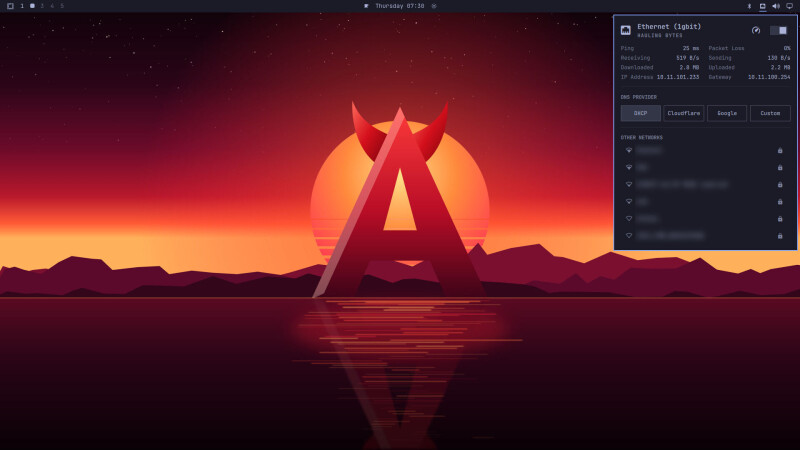
Omarchy 已经占据了我们大量的版面篇幅,但它的一个新“触角”正伸向此前未曾涉足的 FreeBSD。Daemonarchy 将基于 Wayland 的 Omarchy 桌面带入了 BSD 世界。这是 FreeBSD 项目创始人之一 Jordan Hubbard 的一项独立尝试,与最初基于 Linux 的 Omarchy 并无关联。我们在 8 月曾对 Omarchy 进行过评测,印象不佳。
Omarchy has already taken up plenty of our column inches, but a new tentacle is reaching into the hitherto untouched FreeBSD. Daemonarchy brings Omarchy's Wayland-based desktop to the BSD world. It's an independent effort by Jordan Hubbard, one of the original founders of the FreeBSD project, and it's unaffiliated with the original Linux-based Omarchy. We looked at Omarchy in August and didn’t like it much.
它并不完全算得上一个 Linux 发行版。那意味着它是一套由统一工具整体管理的连贯软件包集合。Omarchy 只是一堆应用程序和预设配置的集合,借助 LLM 机器人打包后提供下载。你必须使用它自带的专用脚本来更新,而不能用底层 Arch Linux 的标准工具——而在我们的测试中,该更新脚本在虚拟机中运行时便因报错而中止。
It isn't exactly a Linux distribution. That implies it's a coherent set of packages managed as a whole by uniform tools. Omarchy is a collection of apps and preconfigured settings, packaged up with the help of LLM bots and put up for download. You have to update it using its own special script, rather than the standard tools of the underlying Arch Linux – and in our testing, that update script fell over with error messages when running in a VM.
然而,世上没有坏的宣传,Omarchy 颇受欢迎且用户持续增长。它不断吸引赞助,也吸引了从 Windows 和 macOS 迁移而来的新用户,他们似乎乐于将其怪异、不一致且临时拼凑的 UI 视为一种挑战:试图在作为 Omarchy UI 核心的平铺合成器 Hyprland 中关闭窗口。在 Omarchy 中,窗口没有标题栏,更别提那些老派的可点击窗口控制按钮了。
However, there's no such thing as a bad press, and Omarchy is popular and growing. It keeps on attracting sponsorship as well as new users migrating from Windows and macOS, who seem to relish its bizarre, inconsistent, and ad hoc UI as a challenge: trying to close a window in Hyprland, the tiling compositor that forms the core of Omarchy's UI. In Omarchy, windows don't have title bars, let alone anything as old-fashioned as window control buttons you can click.
要关闭窗口,必须使用按键组合。在大多数 Linux 窗口环境中,那是标准的 Alt-F4。但这里不行。接着我们试了 Super+W——在 Mac 上那是 Command+W,自 1984 年左右起就代表“关闭窗口”。依然无效。我们在 Reddit 上找到了答案——是 Super + C。Daemonarchy 并无直接关联。它是 Omarchy 所用各种工具和组件的 FreeBSD 移植版集合,每个组件都单独适配以在 FreeBSD 上运行,并汇总打包成一个可安装的 ISO 镜像。
To close a window, you must use a keystroke. In most Linux windowing environments, that's the standard Alt-F4. Not here. Next, we tried Super+W – on a Mac, that's Command+W, which has meant "close the window" since 1984 or so. Still no. We found an answer on Reddit – it's Super + C. Daemonarchy is not directly related. It's a collection of FreeBSD ports of the various tools and components that went into Omarchy, individually adapted to run on FreeBSD, and collected together into an installable ISO image.
当前版本为 1.3.1。值得注意的是,在大约 10 天内,Daemonarchy 已经历了 10 个版本发布。
The current release is version 1.3.1. Remarkably, in approximately 10 days, Daemonarchy has gone through 10 releases.
多个软件包是由 jkh@freebsd.org 近期移植的 —— 这是 Jordan Hubbard 的电子邮件地址。如果这个名字听起来耳熟,他是 FreeBSD 项目的创始人之一,职业生涯颇为丰富,曾在多家公司任职。本刊 25 年前曾以名字提及他,当时 Wind River 收购了 BSD/OS 供应商 BSDi。次年,Hubbard 加入 Apple,协助改进新版 Mac OS X 底层基于 BSD 的 Unix 层。
Multiple packages are recent ports by jkh@freebsd.org – the email address of Jordan Hubbard. If the name rings a bell, he was one of the original founders of the FreeBSD project, and has had an interesting career in which he’s worked at various companies. The first mentioned him by name 25 years ago, when Wind River bought BSD/OS vendors BSDi. By the following year, Hubbard was at Apple, where he helped freshen up the BSD-based Unix layer underneath the new Mac OS X. In 2015, he helped launch the NextBSD project to modernize FreeBSD with Apple Darwin components, which as we reported in July was recently restarted.
2015 年,他协助启动 NextBSD 项目,旨在利用 Apple Darwin 组件实现 FreeBSD 现代化;正如我们在 7 月所报道,该项目近期已重启。新的 NextBSD 工程正在借助 LLM 编码助手构建。从一个月内新增 18 个 Linux 工具的 FreeBSD 移植包,以及十天内发布十个新操作系统捆绑包版本便可推断,Hubbard 同样在利用 LLM 加速这一快速开发流程:Daemonarchy 的 GitHub 代码库同时包含 AGENTS.md 和 SKILL.md 文件,指向 Hubbard 自己的 Literate AI 项目,该项目代码库将其描述为 “一个供编码代理遵循正确软件开发生命周期实践的元框架”,并称其 “基于 Donald Knuth 的文学编程理念”。
The new NextBSD effort is being built with the help of LLM coding assistants. As you might surmise from 18 new FreeBSD ports of Linux tools in a month, as well as from ten releases of the new OS bundle in as many days, Hubbard too is using LLMs to assist in this rapid development process: Daemonarchy’s GitHub repository contains both AGENTS.md and SKILL.md files, which point to Hubbard's own Literate AI project, whose repo describes it as a "A meta-harness for coding agents to follow proper Software Development Lifecycle practices", and says it is "Based on literate programming ideas from Donald Knuth".
文档相当丰富,包括列出目标的项目规格说明。大量格式化的 Markdown 文本在一定程度上也是 LLM 机器人的典型特征,不过我们不清楚这是供人类阅读,还是用于指导机器人 —— 也可能两者兼备。灵感的萌芽似乎源于英国 IT 顾问 Sam Sheridan 的一条 LinkedIn 动态,他在文中批评在搭载 Nvidia 显卡的新安装 FreeBSD 15.1 系统上进行配置的困难。
There’s quite a bit of documentation, including a project specification with a list of goals. Lots of formatted Markdown text is also something of an LLM bot hallmark, though, and it’s not clear to us if this is intended for humans to read, or to guide the bots. Possibly, it's both. It looks like the germ of inspiration was a LinkedIn post by UK IT consultant Sam Sheridan, in which he criticized the difficulty of configuring a new installation of FreeBSD 15.1 with an Nvidia card.
他说得没错:我们自己也曾撰文述及其中涉及的大量工作。Sheridan 的 LinkedIn 动态引来 Ralph Kepper 的评论:“我就直说吧…… FreeBSD 版的 omarchy,这是丑陋的真相,没人爱听但它就摆在那儿。”
He's right: we have written about how much work is involved ourselves. Sheridan's LinkedIn post provoked a comment from Ralph Kepper saying "I'm just gonna say it… omarchy for FreeBSD, its the ugly truth and no one likes it but there it is. omarchy will get us the youngsters and if we do it right we will inspire some great minds along the way".
Omarchy 将吸引年轻用户,如果我们做得好,还能在此过程中激发一些优秀的思想。Hubbard 已经在该讨论串中发表过评论,看起来那句随口一说的话促成了(如果您原谅我们用这个显而易见的双关语)这一项目。Daemonarchy 基于 FreeBSD CURRENT,这意味着它构建在将成为 FreeBSD 16 的基础之上——后者计划于 2027 年 12 月发布。
Hubbard had already commented in the thread, and it looks to us like that passing comment has prompted (if you will forgive us the obvious pun) this effort. Daemonarchy is based on FreeBSD CURRENT, which means that it's built on top of what will become FreeBSD 16 – planned for December 2027.
勇于尝试者现在就可以运行它。目前它以 MacBookPro16,1 为目标,即 2019 款 16 英寸 MacBook Pro——基于 Intel 的 MacBook 最后几代产品之一。几年前,《注》FOSS 编辑部参加了 EuroBSDCon,并会见了几位核心项目成员。显然,运行开发中的 CURRENT 分支对于硬核 FreeBSD 用户来说相当正常。如果您需要询问如何获取或运行它,那么这个 FreeBSD 版本不适合您。
The intrepid can get run it now, though. Currently it targets the MacBookPro16,1, meaning the 2019 models of the 16-inch MacBook Pro – one of the final generations of Intel-based MacBooks. A couple of years ago, the Reg FOSS desk attended EuroBSDCon and we met several core project members. Apparently, running the development work-in-progress CURRENT branch is quite normal for hardcore FreeBSD types. If you need to ask how to get it or run it, then this is not the version of FreeBSD for you.
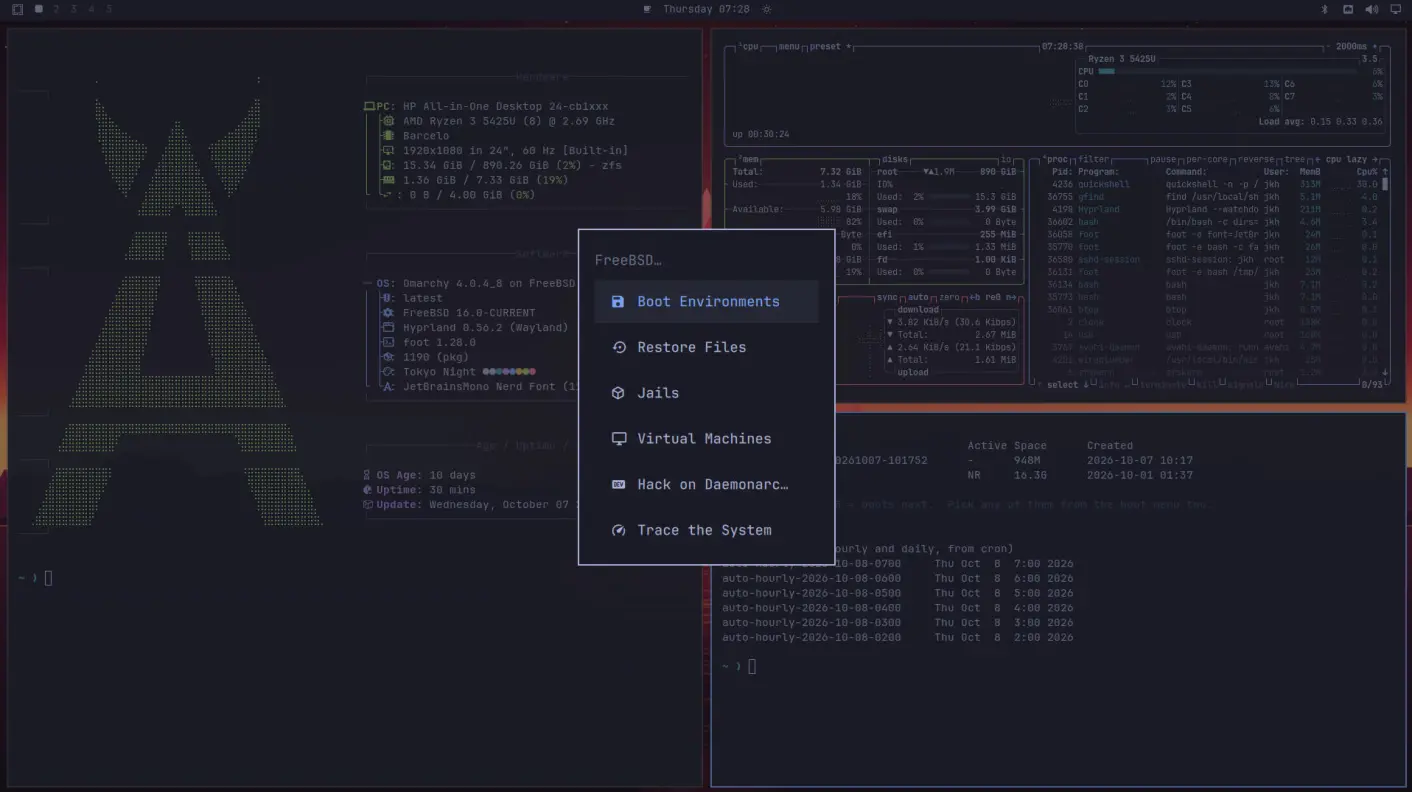
我们个人不太喜欢 Omarchy。我们不太喜欢其视觉设计,也不喜欢其组件选择——而且我们确实不习惯其用户界面。如前所述,macOS 和 MS Windows 都已有成熟的键盘 UI,我们对两者都熟练且得心应手。既然 Linux 是在 x86 PC 平台上设计和构建的操作系统,我们认为它应坚持既定的通用用户访问 (CUA) UI。其核心要素首次亮相于 41 年前的 Windows 1.0。
We do not personally like Omarchy much. We don't much like the visual design, or the choice of components – and we really didn't get on with the user interface. As mentioned, there are already established keyboard UIs for both macOS and MS Windows, and we’re adept and comfortable with both. As Linux is an OS designed and built on the x86 PC platform, we feel that it should stick to the established Common User Access UI. Its core elements débuted in Windows 1.0, 41 years ago.
它比 Linux 本身早得多,并导致了 DOS、OS/2、所有后续版本的 Windows 以及或多或少所有 Linux GUI 的广泛 UI 标准化……至少直到最近年轻黑客们推出的一系列 Wayland 合成器,他们不懂如何高效驾驭窗口。我们不是说它无法改进,但重新发明这个特定的轮子,在我们看来是 XKCD 927 的一个现成案例。然而,Kepper 说到了点子上:Omarchy 很流行,而一个 FreeBSD 版本——摆脱了其颇具争议的创作者的直接影响——可能会为 FreeBSD 赢得一些新粉丝。
It's quite a bit older than Linux itself, and led to widespread UI standardization across DOS, OS/2, all subsequent versions of Windows, and more or less all Linux GUIs… at least until the recent rash of Wayland compositors from young hackers who don't know how to drive windows efficiently. We are not saying it can't be improved upon, but re-inventing this particular wheel strikes us as a worked example of XKCD 927. However, Kepper has a point: Omarchy is trendy, and a FreeBSD version – freed of the direct influence of its controversial creator – might win FreeBSD some new fans.
即使并非如此,Daemonarchy 项目也可能产生更广泛的影响。首先,该项目可能有助于创建一个易用的图形化 FreeBSD 安装程序和一个友好的桌面版本。它也与 FreeBSD 项目内部关于使用 AI 编程助手的持续辩论息息相关。我们曾在 2025 年 9 月提及此事,但至今尚无公开的决定宣布。在那篇文章中,我们重点介绍了 Sylve。
Even if not, the Daemonarchy project could have wider impact. For one thing, the effort could help the creation of an easy, graphical FreeBSD installer and a friendly desktop version. It’s also very relevant to the ongoing debate about the use of AI coding assistants in the FreeBSD project. We mentioned this in September 2025 and there’s been no public announcement of a decision yet. In that article, we highlighted Sylve.
该项目的 GitHub 页面将其描述为“用于在 FreeBSD 上管理 Bhyve、Jails、ZFS、网络等的轻量级 GUI”,但该项目的雄心远不止于此。开发者最近分享了一段他们新的 FreeBSD 图形化安装程序的视频,我们认为它看起来确实非常出色。对于 Daemonarchy 似乎可能产生的另一种影响,我们则不太看好。鉴于 FreeBSD 项目的联合创始人正忙着在协助下将代码移植并开发提交到项目仓库,那么核心团队不太可能通过禁止 AI 贡献来回应。
® 注:感谢读者 Graham Perrin 向我们推荐了 Daemonarchy —— 以及启发它的那条讨论串。
The project GitHub describes this as a “lightweight GUI for managing Bhyve, Jails, ZFS, networking, and more on FreeBSD”, but the project has even wider ambitions than that. The developers recently shared a video of their new graphical installer for FreeBSD, and we think it looks very good indeed. We are less keen on the other impact that Daemonarchy seems likely to have. With the FreeBSD project's co-founder busily committing code to the project repositories that he is porting and developing with the assistance of Claude, then it seems highly unlikely that the core team will respond by banning AI contributions. ® Bootnote Our thanks to reader Graham Perrin for drawing our attention to Daemonarchy – and the thread that inspired it.