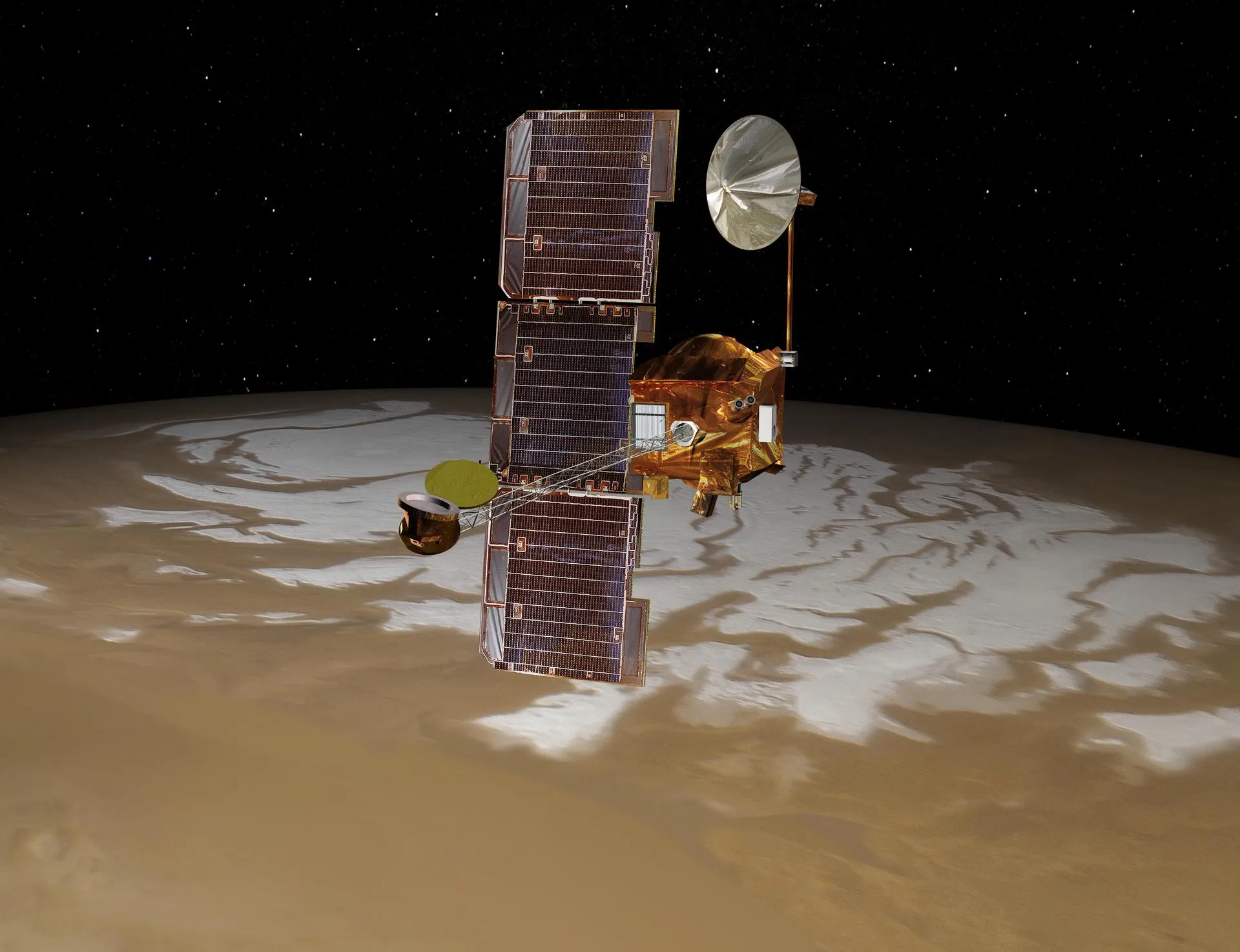
美国国家航空航天局(NASA)的“火星奥德赛号”探测器运行时间之长,甚至可以免费租车了。该探测器于2001年10月24日抵达火星。它与其20岁的“兄弟”——“火星勘测轨道飞行器”(MRO)运行的时间,远超任何目睹它们发射的人所能梦想的程度。
NASA’s Mars Odyssey spacecraft has been operating for so long, it can rent a car without any fees. The spacecraft arrived at the Red Planet on October 24, 2001. It, along with its 20-year-old sibling, the Mars Reconnaissance Orbiter (MRO), have operated longer than anyone watching their launches could have dreamed possible.
拥有如此长期的火星表面上空观测记录,改写了火星过去和现在水的故事。让这两位老练的轨道器运行如此之久,仅靠卓越的工程技术、持续不断的问题解决——还有一点运气。但科学家们担心,尽管它们留下了辉煌的遗产,“奥德赛号”和MRO会不会成为同类探测器的终结者,至少对于火星而言是这样。
Having such a long record of observations from above the Martian surface has rewritten the story of water on the planet, past and present alike. Keeping the wizened orbiters going for so long has been possible only thanks to great engineering and constant problem solving—and a little luck. But scientists wonder whether, despite their storied legacies, Odyssey and MRO will be the last of their kind, at least for the Red Planet.
普渡大学行星科学家布里奥尼·霍根并未参与这两个任务,她表示:“‘奥德赛号’和MRO是有史以来最高产的航天器之一”,并称它们对NASA的整体火星研究计划“至关重要”。例如,“奥德赛号”对火星冰层的观测,以及MRO观察地表特征随时间变化的能力,各自都让科学家以前所未有的深度洞察到火星是一个充满活力的星球,而非一块死岩石。
“Both Odyssey and MRO are some of the most productive spacecraft that have ever existed,” says Briony Horgan, a planetary scientist at Purdue University who isn’t affiliated with either mission, calling them “critical” to NASA’s overall Mars research program. Odyssey’s observations of the planet’s ice, for example, and MRO’s ability to see surface features change over time have each given scientists unprecedented insight into Mars as a vibrant planet rather than a lump of rock.
“奥德赛号”和MRO还将人类与NASA的每一辆火星车连接起来,因为火星车无法直接与地球通信。对于原本只打算运行几年的一对轨道器来说,这是一个令人印象深刻的遗产。
Odyssey and MRO also connect humans to every NASA rover, which can’t communicate with Earth directly. It’s an impressive legacy for a pair of orbiters that were only meant to last just a few years.
太空是一个极其恶劣的环境,只有运气和韧性才能让设备在其中存活数十年。尤其棘手的是高能粒子对机械部件的轰击;一次足够强大的撞击对足够精密的装置来说可能是致命的。而且,工程师可以随时监控绕地轨道的卫星,但与火星的带宽更为有限——科学探测器可能每周只能联系一次或两次,伯克利加州大学的行星与空间物理学家罗布·利利斯(Rob Lillis)说,他曾参与多颗近期火星轨道器的工作。“火星探测器必须能够自行管理,”他说。
Space is a notoriously harsh environment that takes luck and resilience to survive for decades. Particularly tricky is the barrage of high-energy particles hitting machinery; a powerful enough strike to a delicate enough apparatus can be fatal. And whereas engineers can keep constant tabs on satellites orbiting Earth, bandwidth to Mars is more limited—science spacecraft might only check in once or twice a week, says Rob Lillis, a planetary and space physicist at the University of California, Berkeley, who has worked on a range of more recent Mars orbiters. “A Mars craft has to be able to manage by itself,” he says.
失去一个仪器固然不佳,但失去电源或计算系统可能会使整艘探测器报废。美国航空航天局(NASA)常常为航天器的关键部件配备冗余,以确保在重要部件失效时,任务可以依靠备用部件继续运行,直至工程师排除故障。
Losing an instrument is bad, but losing the power or computing systems can brick the whole craft. NASA often doubles up on vital parts of a spacecraft to ensure that if something important fails, the mission can run off the spare until engineers can troubleshoot a problem.
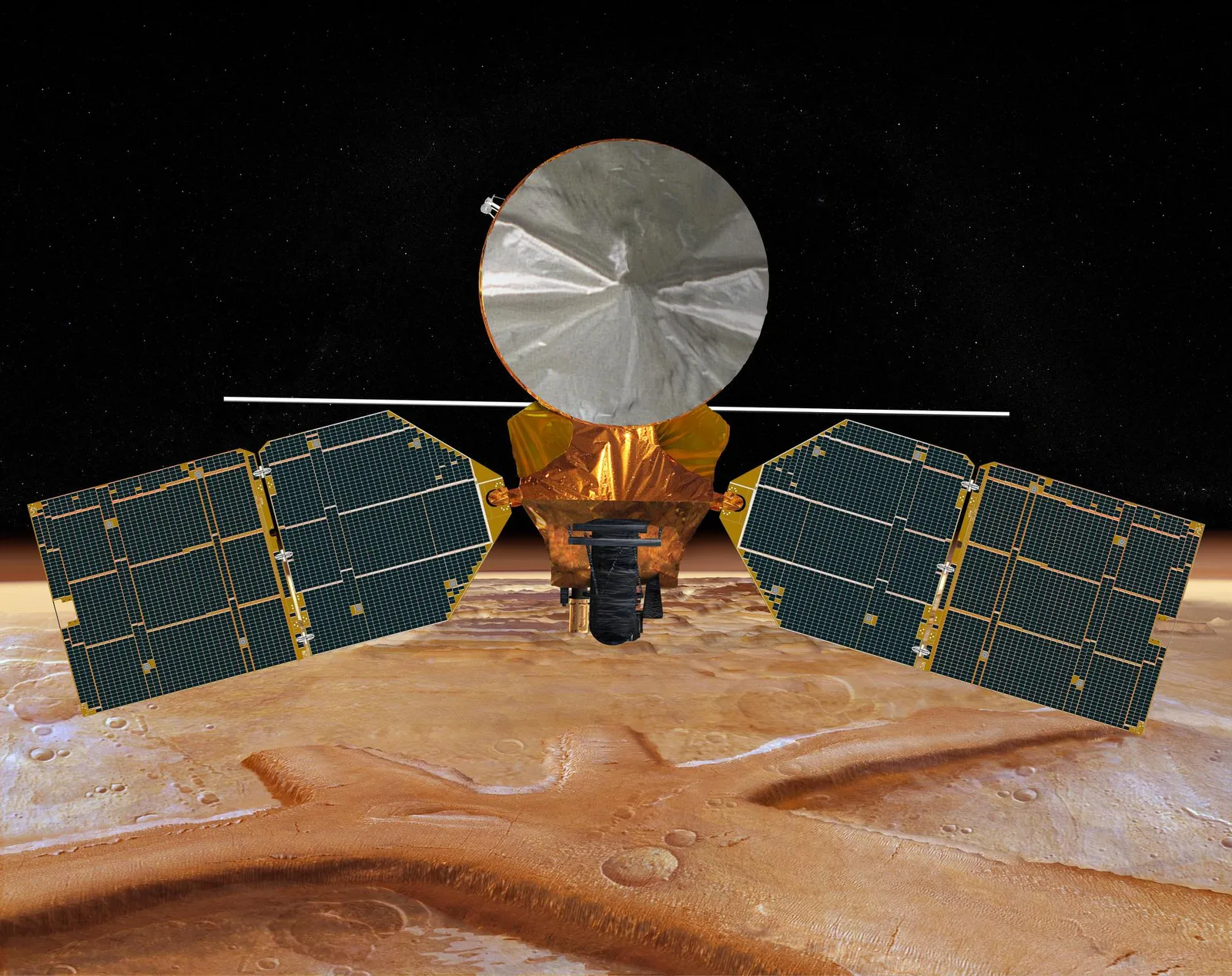
在火星勘测轨道器(MRO)的案例中,它面临的一个挑战恰恰源于其持久性。该轨道器通过将摄像头看到的星空与机载星图进行比对来确定精确位置和姿态——但出现了一个小问题。“MRO 已经足够老,以至于其中一些星星已经在夜空中移动了——虽然非常微小,但确实已经移动了,”美国宇航局喷气推进实验室(JPL)的工程师、MRO 首席工程师保罗·菲塞勒(Paul Fieseler)说。微小的错位使航天器产生混乱,去年工程师不得不发送更新的星图,以确保 MRO 在未来仍能保持正确的姿态。
In the MRO’s case, one challenge it’s faced is ironically due to its staying power. The orbiter determines its precise location and orientation by comparing what its cameras see with a stellar atlas onboard—with just one hiccup. “MRO is actually old enough that some of those stars have moved across the night sky—very slightly, but they have moved,” says Paul Fieseler, an engineer at NASA’s Jet Propulsion Laboratory and chief engineer for MRO. The tiny misalignments confused the spacecraft, and last year, engineers had to send up an updated map to keep MRO oriented into the future.
奥德赛号(Odyssey)目前面临的最大风险仅仅是燃料耗尽——它使用燃料进行微小的姿态调整以维持在太空中的方向。该航天器没有燃料表——在没有重力将燃料压到底部的情况下,无法测量体积——因此 NASA 无法确定它还剩多少燃料。工程师们已经即兴想出新方法,以极少量的燃料一次性完成全部操作,力求延长其使用寿命。
Odyssey’s greatest risk right now is simply running out of propellant it uses to make tiny adjustments to maintain its orientation in space. The spacecraft doesn’t have a fuel gauge–without gravity to push the fuel down, there’s no volume to measure–so NASA can’t be sure how much juice it still has. Engineers have improvised new ways to fully operate the spacecraft on just a few drops at a time in a bid to extend its life.
专家表示,这两艘航天器都受益于美国宇航局臭名昭著的“更快、更好、更便宜”时代的失败教训。1999年,美国宇航局失去了两个抵达火星的任务:先是火星气候探测者号在大气层中烧毁,仅仅几个月后,火星极地着陆者号在抵达时出现失误,撞上了火星表面。调查认定,每一起灾难都是由在更平常的领域或许可称为粗心错误的原因造成的。第一次是由于依赖英制单位的地面系统与使用公制单位的飞行系统之间沟通不畅,第二次则是由于测试期间未被发现的软件错误。
Experts say both spacecraft benefited from failures during NASA’s infamous “faster, better, cheaper” era. In 1999, NASA lost two missions arriving at Mars: First the Mars Climate Orbiter burned up in the atmosphere, and then, just months later, the Mars Polar Lander botched its arrival and slammed into the surface. Each catastrophe, investigations determined, was caused by what might in more pedestrian realms be dubbed careless mistakes. The first was due to miscommunication between a ground system relying on imperial units and the flight system using metric, while the second was due to a software error not caught during testing.
“这些失败深深印在组建奥德赛号航天器团队的脑海中,”喷气推进实验室工程师、火星奥德赛号项目与任务经理格伦·哈文斯说。在这些损失带来的刺痛之下,美国宇航局在发射前投入更多精力完善奥德赛号和火星勘测轨道飞行器,将每艘航天器设计得尽可能具有韧性,并测试每一个微小部件和每一种系统配置。
“Those failures were very much on the mind of the team pulling together the Odyssey spacecraft,” says Glen Havens, an engineer at JPL and project and mission manager of Mars Odyssey. With those losses stinging, NASA invested more in perfecting the Odyssey and MRO spacecraft before launch, designing each to be as resilient as possible and testing every tiny component and every system configuration.
一个关键原则是美国宇航局所称的“余量”——相当于航天器随身带点零食,以防万一。
One key principle is what NASA calls “margin”—the spacecraft equivalent of carrying a snack, just in case.
“意外情况可能发生,你要确保航天器能够存活下来,”密歇根大学航天工程师尼尔顿·雷诺说,他并未参与这两个任务。菲泽勒指出,火星勘测轨道飞行器发射时携带的电池和推进剂都超过了严格所需,而这一余量如今正让该任务得以继续,美国宇航局希望再运行它十年。
“Unexpected things might happen, and you want to make sure the spacecraft will survive,” says Nilton Renno, a spaceflight engineer at the University of Michigan who hasn’t worked on either mission. MRO launched with a larger battery and more propellant than it strictly needed, Fieseler notes, and that margin is now keeping the mission going, with NASA hoping to operate it for another decade.
但在环绕火星运行时,最好不要把任何事情视为理所当然。就在去年,美国宇航局在火星大气与挥发物演化探测器于火星远侧意外失去动力后,失去了这艘已运行11年的航天器——它是美国宇航局最年轻的红色星球轨道器。随着奥德赛号和火星勘测轨道飞行器继续老化,关于美国宇航局接下来将推出哪些火星轨道器的问题依然悬而未决。
But orbiting Mars, it’s wise not to take anything for granted. Just last year, NASA lost the 11-year-old Mars Atmosphere and Volatile Evolution—its youngest Red Planet orbiter—after the spacecraft unexpectedly lost power on the far side of the planet. As Odyssey and MRO continue to age, questions linger about what Mars orbiters come next for NASA.
美国国家航空航天局(NASA)已聘请蓝色起源公司建造一颗专用通信卫星,在至少五年内将大量数据传回地球——但与其前身不同,那些前身最初是科学任务,后来才转为通信工作,这颗轨道器将仅为其他航天器中继信号。
The agency has hired Blue Origin to build a dedicated communications satellite to beam scads of data back to Earth for at least five years—but unlike its forebears, which began as science missions before turning to communications work, this orbiter will only relay signals for other spacecraft.
NASA的火星科学议程仅包含相对有限的项目。其中一项任务由利利斯负责,包括两颗目前正在飞往火星的轨道器,旨在研究这颗行星如何对太阳持续喷发的带电粒子流做出反应。但即便是他也称该任务“处于规模太小而无法开展良好科学研究的边缘”。此外还有“天降”任务,计划在短短两年内搭乘首艘核推进航天器发射三架小型直升机——这是一个令人震惊的极短时间表,而该任务回答核心科学问题的能力极其有限。
NASA’s Mars science agenda includes only relatively limited projects. One mission, which Lillis leads, features two orbiters currently on their way to study how the planet responds to the constant stream of charged particles flowing off the sun. But even he calls the mission “right on the edge of being too small to do good science.”Then, there’s Skyfall, the trio of small helicopters meant to launch aboard the first nuclear-propelled spacecraft within just two years—a shockingly rapid timeline, and for a mission with minimal ability to answer meaty research questions.
在科学家看来,这些举措都没有真正建立在“奥德赛”号和“火星勘测轨道器”(MRO)的遗产之上,甚至可能引发人们对之前那些臭名昭著的火星任务失败的担忧。“他们当然在推行‘更快、更便宜’,”霍根说。“在这种环境下开展良好的科学研究将困难得多。”
To scientists, none of these initiatives quite build on the legacy of Odyssey and MRO and may even raise the specter of the infamous Mars failures that came before. “Certainly they’re pushing for faster, cheaper,” Horgan says. “It’s going to be a lot more challenging to do good science in that environment.”