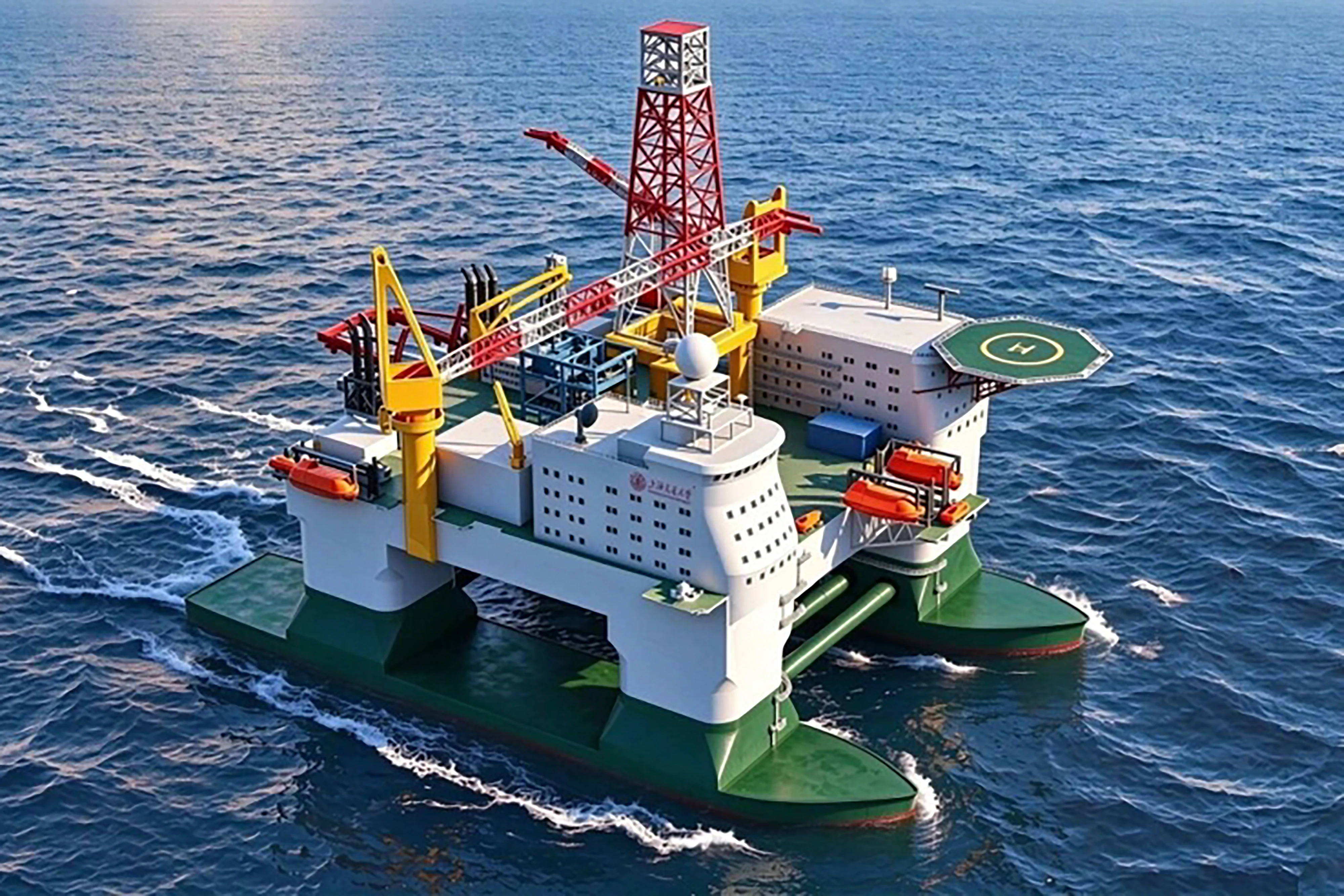
中国的大型海洋科学基础设施——一座航母大小的浮动式人工岛——已正式进入工程建设阶段。
China’s massive maritime science infrastructure – an aircraft carrier-sized floating artificial island – has officially entered its engineering construction phase.
据当地媒体报道,10月18日,该设施牵头研制单位上海交通大学与中国船舶集团有限公司旗下的一家造船厂签署了一份价值超过27亿元人民币(约4.05亿美元)的建造合同。
On October 18, Shanghai Jiao Tong University (SJTU), the facility’s lead developer, signed a construction contract worth over 2.7 billion yuan (US$405 million) with a shipbuilder under China State Shipbuilding Corporation, according to local media reports.
据《上海观察》10月21日报道,这座半潜式双船体平台是全球首个可移动、自给自足的人工岛,预计将于2030年6月前全面完工并交付。
The semi-submersible twin-hull platform is the world’s first mobile, self-sustaining artificial island and is expected to be fully completed and delivered by June 2030, news outlet Shanghai Observer reported on October 21.
在深海和远洋考察期间,传统科考船难以在狂风巨浪中长时间保持静止。在这种剧烈颠簸的环境中,船上的精密光学仪器和分析天平无法正常工作。
During deep-sea and far-ocean expeditions, traditional research vessels struggle to remain stationary in gale force winds and massive waves for extended periods. In such violently pitching environments, on-board precision optical instruments and analytical balances cannot function properly.
相反,固定式海上平台虽然庞大且抗风浪能力强,但缺乏自航能力,无法根据不断变化的研究需求进行迁移。
Conversely, while fixed offshore platforms are massive and highly resistant to wind and waves, they lack self-propulsion and cannot be relocated to suit changing research needs.
因此,这座超大型浮动研究平台满足了一种独特的需求,其革命性在于机动性与永久性的结合。
The ultra large floating research platform therefore fills a unique need, and what makes it revolutionary is its combination of mobility and permanence.
与受燃料和补给限制的固定研究站或传统船只不同,这座浮岛可以以11节(约20公里/小时,即12.4英里/小时)的速度巡航,同时可支持200多名研究人员。
Unlike fixed research stations or conventional vessels constrained by fuel and supplies, the floating island can cruise at 11 knots, or about 20 km/h (12.4pmh), while supporting more than 200 researchers.
据上海交通大学介绍,该设施正式命名为“深海全天候驻留浮动研究设施”,被列为中国“十四五”规划中的国家重大科学基础设施项目,也被称为“远海浮动移动岛”,是十年研究和规划的结晶。
Officially named the Deep-Sea All-Weather Resident Floating Research Facility and designated as a major national scientific infrastructure project in China’s 14th five-year plan, the facility – also dubbed a “far-sea floating mobile island” – is the culmination of a decade of research and planning, according to SJTU.
该平台长138米(453英尺),宽85米,主甲板高出水面45米,大约相当于15层楼高。
The structure measures 138 metres (453 feet) long and 85 metres wide, with its main deck sitting 45 metres above water – roughly the height of a 15-storey building.
这意味着,即使在掀起 20 米高巨浪的极端海况下,海浪也无法冲破并淹没主甲板上的核心实验区和生活区。
This means that, even in extreme sea conditions churning up 20-metre waves, the swells would be unable to breach and flood the core laboratory zones and living quarters on the main deck.
该平台的最大排水量约为 7.4 万吨,超过全球绝大多数常规驱逐舰和科考船,接近大型航空母舰的规模。中国最新的航空母舰“福建舰”排水量超过 8 万吨。
The platform’s maximum displacement is about 74,000 tonnes, surpassing the vast majority of conventional destroyers and research vessels worldwide and approaching the scale of a large aircraft carrier. China’s newest aircraft carrier, the Fujian, has a displacement of more than 80,000 tonnes.
其双体设计使其能在 7 级海况(即 6 至 9 米高浪的“巨浪”海况)下作业,并能在高达扩展蒲福氏风力等级 17 级的台风中生存。
Its twin-hull design allows it to operate in sea state 7, namely “high” seas with six to nine-metre waves. And it can survive typhoons as intense as up to Force 17 on the Extended Beaufort Scale.
值得注意的是,尽管它官方定位为民用科研平台,但项目背后的工程师已提出防核爆设计。
Notably, while it is officially a civilian research platform, engineers behind the project have proposed a nuclear-blast-proof design.
为支持长期、高强度的深海科研,该“海上移动科研平台”拥有由主平台系统、船载实验室系统和岸基保障网络组成的综合架构。
To support prolonged, high-intensity deep-sea research, the floating island features comprehensive architecture comprising a main platform system, a shipborne laboratory system and a shore-based support network.
船载部分设有六大实验室,专门研究重型海洋装备与系统技术、海洋灾害气象观测以及海洋生态系统长期观测等核心领域。
The shipborne component features six laboratories dedicated to researching core fields such as heavy marine equipment and systems technology, marine disaster meteorological observation and the long-term observation of marine ecosystems.
据中国官方通讯社新华社 5 月报道,项目首席科学家、上海交通大学海洋学院院长周萌表示,该设施将在高端装备海试、台风近距离探测和海洋科学观测等场景中表现出色。
According to China’s state news agency Xinhua in May, Zhou Meng, the project’s chief scientist and dean of SJTU’s School of Oceanography, said the facility would excel in scenarios such as sea trials for high-end equipment, close-range typhoon detection and marine scientific observation.
周萌补充说,这一巨型设施还将面向全球科研机构和企业开放共享。
The mega facility would also be open to, and shared with, global research institutions and enterprises, Zhou added.