
大多数大型企业已经在倾听员工心声。2026年9月中旬,基于AI的员工倾听平台Remesh在其自有平台上对美国和英国的107位人力资源领导者进行了调查。其中80%表示其组织拥有正式的倾听计划。然而,仅有18%认为其方法“非常有效”,47%认为有很大的改进空间。因此,悬而未决的问题是:所有这些倾听究竟产出了什么。
Most large companies already listen to their employees. In mid-September 2026, Remesh, an AI-powered employee listening platform, surveyed 107 HR leaders in the US and UK on its own platform. And 80% said their organization had a formal listening program. Only 18% called their approach very effective, though, and 47% saw substantial room to improve it. So the open question is what all that listening actually produces.
员工对此存疑,盖洛普于2024年11月发布了相关报告。根据该机构研究人员的数据,仅有8%的员工“强烈同意”其组织会根据调查采取行动。另有38%无法判断组织是否采取了任何行动。而收集反馈只是容易的部分。
Employees have their doubts, as reported by Gallup in November 2024. According to the firm’s researchers, only 8% of employees strongly agree their organization takes action on surveys. Another 38% couldn’t say whether it does anything at all. And collecting feedback is the easy part.
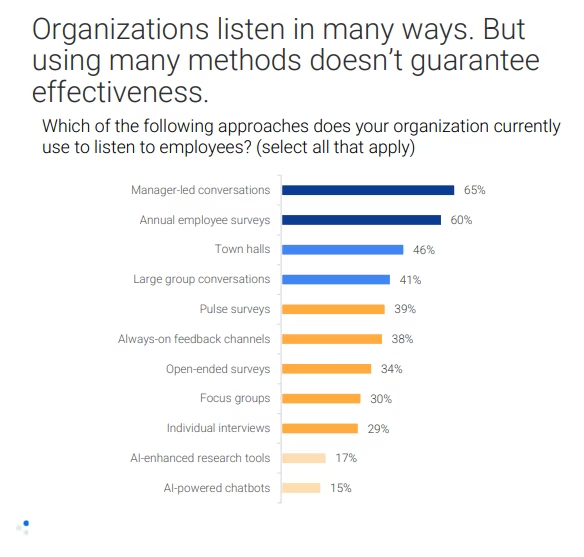
渠道增多,回答雷同 观察企业倾听的发展,你会发现主要是工具变多了。研究中的HR领导者平均使用4.1种倾听方法。经理主导的谈话(65%)和年度员工调查(60%)位居前列。在大型组织中,这一平均值上升至4.7种。
More Channels, Same Answers Look at how enterprise listening has grown and you’ll mostly find more instruments. The HR leaders in the study use 4.1 listening methods on average. Manager-led conversations (65%) and annual employee surveys (60%) lead. In large organizations, the average climbs to 4.7.
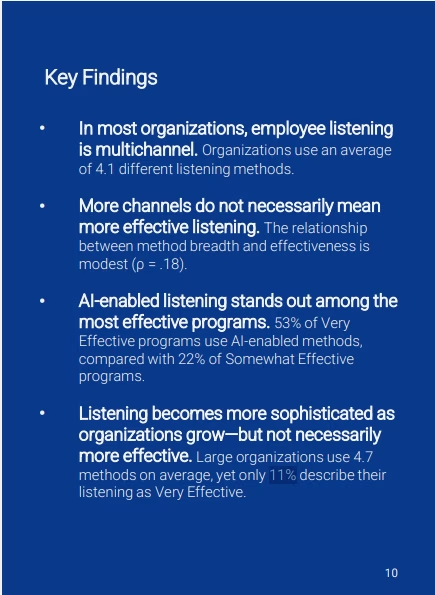
这么多渠道并未带来多少信心。研究发现,一个项目使用的方法数量与领导者对其有效性的评价之间仅存在微弱关联。相关系数为0.18。而在大型组织的HR领导者中,仅有11%认为其倾听“非常有效”。
All those channels haven’t bought much confidence. The study found only a modest link between how many methods a program uses and how effective leaders rate it. The correlation was .18. And among HR leaders at large organizations, just 11% called their listening very effective.
与此同时,赌注不断升高。《2026年全球职场现状报告》显示,2025年全球员工敬业度降至20%,为2020年以来最低水平。研究人员估算,由此造成的生产力损失成本约为10万亿美元,占全球GDP的9%。
Meanwhile, the stakes keep climbing. The State of the Global Workplace 2026 report found that global employee engagement fell to 20% in 2025, its lowest level since 2020. Researchers put the cost at about $10 trillion in lost productivity, which is 9% of global GDP.
“衡量员工敬业度很重要,但这只是第一步,”Remesh员工研究部董事总经理帕特里克·海兰表示。“真正的改进需要与员工交谈,理解分数背后的原因,并找出对组织变革有意义的机会。”这就是有效倾听超越衡量的地方。调查能帮助组织识别重要的模式和值得关注的领域。与员工的对话有助于解释这些模式,揭示不同的经历和观点,并找出有意义的变革可能产生最大影响的地方。
“Measuring employee engagement is important, but it’s just the first step,” says Patrick Hyland, Managing Director of Employee Research at Remesh. “Real improvement requires talking with employees, understanding what’s behind the scores, and identifying meaningful opportunities for organizational change.”This is where effective listening moves beyond measurement. Surveys can help organizations identify important patterns and areas of concern. Conversations with employees can help explain those patterns, reveal different experiences and perspectives, and identify where meaningful changes might make the greatest difference.
然而,这正是人力资源领导者排名最低的特质。在被要求对有效倾听的十个特质进行排名时,只有3%的人将“能够解释员工为何有如此想法和感受”排在第一位。它并列排在最后一位。
Yet that’s the quality these HR leaders rank lowest. Asked to rank ten attributes of effective listening, only 3% put “explains why employees think and feel as they do” first. It tied for last place.
如何将员工反馈转化为行动 来自组织员工的反馈,在结果需要转化为决策时,往往会失去价值。这意味着一个分数可以让管理者找到有问题的团队或地点,但它很少说明是什么导致了问题。而这正是人们选择解决方案时所需要的。
How to Turn Employee Feedback Into Action Feedback from an organization’s workers tends to lose value when a result has to turn into a decision. This means that a score can point a manager to the team or location with a problem. But it rarely says what’s driving it. And that’s exactly what someone needs to pick a fix.
人力资源领导者知道这是薄弱环节。在被问及组织擅长什么以及应在哪些方面改进时,他们把“行动”和“跟进落实”分别排在了两个榜单的首位(28%和29%)。紧随其后的是闭环反馈,两次都为25%。
HR leaders know this is the weak spot. Asked what their organizations do well and where they should improve, they put action and follow-through at the top of both lists (28% and 29%). Closing the loop came next, at 25% each time.
这项工作通常落在管理者肩上,而他们自己的敬业度也在下降。盖洛普报告称,2024年至2025年间,全球管理者敬业度从27%降至22%。一年内下降了五个百分点。把一组干巴巴的数字交给敬业度最低的管理层,要求他们给出行动计划,这无异于让他们瞎猜。
That job usually lands on managers, who are running low themselves. Gallup reports that global manager engagement dropped from 27% to 22% between 2024 and 2025. Five points, in one year. Hand the least engaged layer of management a bare number and ask for an action plan. You’ve set them up to guess.
更好的做法是把某一项具体发现带回给产生它的员工,进行一场实时对话。这个数字为什么是这样的?应该改变什么?领导者随后可以看到有多少人支持每种解释。接下来是最多项目会跳过的一步:回到员工那里,告诉他们决定了什么、为什么这样决定,以及什么不会改变。这些人力资源负责人希望这一环节被内置到流程中,35%的人将其列为理想倾听项目的三大优先事项之一。
A better route takes one specific finding back to the employees who produced it, in a live conversation. Why does the number look like this? What should change? Leaders can then see how many people back each explanation. After that comes the step most programs skip: going back to employees with what was decided, why, and what won’t change. These HR leaders want it built in, with 35% listing it among their top three priorities for an ideal listening program.
这样做的话,一项调查结果就会变成一份议程。盖洛普的最佳实践组织展示了这可以带来什么结果:这些组织中79%的管理者敬业投入,几乎是全球平均水平的四倍。
Done that way, a survey result turns into an agenda. Gallup’s best-practice organizations show where that can lead, with 79% of their managers engaged, nearly four times the global average.
员工倾听平台现在必须做到什么 过去,人力资源负责人在选购平台时会问渠道数量。现在更好的问题是:它能否足够快地解释一项结果,以便有人据此采取行动?在任何人撰写摘要之前,开放式回答必须被量化,并统计有多少员工支持每个主题。匿名性必须足够强,让人们说出真实想法。而且结果需要在问题仍然存在时送达。
What an Employee Listening Platform Has to Do Now HR leaders shopping for a platform used to ask about channel count. The better question now is whether it can explain a result fast enough for someone to act on it. Open-ended answers have to be measured, with a count of how many employees back each theme, before anyone writes a summary. Anonymity has to be strong enough that people say what they really think. And results need to arrive while the issue is still live.
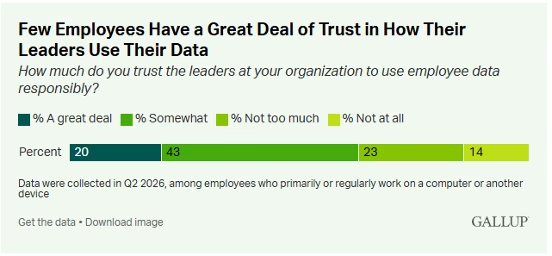
坦诚可能是最难的部分。研究中有三分之一的人力资源负责人(33%)将安全、可信的畅所欲言环境列为三大优先事项之一。员工方面还没有做到。盖洛普于2026年9月24日报道称,在使用电脑或其他设备的员工中,只有20%“非常信任”其领导者会负责任地使用员工数据。在所有员工中,仅有19%表示,工作中有某个人与他们谈论过其组织收集的数据。
Candor may be the hardest part. A third of the HR leaders in the study (33%) named a safe, trusted environment for speaking up as a top-three priority. Employees aren’t there yet. Gallup reported on September 24, 2026, that among employees who work on a computer or other device, only 20% trust their leaders “a great deal” to use employee data responsibly. Just 19% of all employees say someone at work has spoken with them about the data their organization collects.
Remesh 的设计初衷即是满足这些需求,该公司支持最多 1000 名员工参与实时对话,以及最多 5000 人参与跨 46 种语言的异步对话。参与者用自己的语言作答,随后匿名对同事的回答做出反应,从而让领导者看到哪些想法引起广泛共鸣、哪些观点开始出现分歧。它可与企业现有的调查平台并行使用。调查告诉你该往哪里看,对话则告诉你究竟看到了什么。
Remesh was built with those requirements in mind, with the company supporting live conversations with up to 1,000 employees and asynchronous conversations with a maximum of 5,000 across 46 languages. People respond in their own words and then anonymously react to colleagues’ answers so leaders see which ideas resonate widely and where views start to divide. It runs next to whatever survey platform a company already uses. The survey tells you where to look and the conversation tells you what you’re looking at.
倾听的成效取决于带来了什么改变 当被问及什么能让倾听变得有效时,这 107 位人力资源领导者将“带来有意义的改变”排在首位:23% 的人将其列为第一位,47% 的人将其列入前三位。这是一个很高的标准,也是公平的标准。
Listening Is Measured by What Changes Asked what makes listening effective, the 107 HR leaders put “leads to meaningful change” first: 23% ranked it number one and 47% placed it in their top three. It’s a high bar, and a fair one.
从一项发现着手是个合理的起点。把它带回给提出该发现的人,询问其背后的原因,并告知他们因该发现而发生了什么改变。想要将自己的项目与这些同行进行对标的领导者,可在完整研究报告中查看全部结果。
One finding is a reasonable place to start. Take it back to the people who gave it, ask what’s behind it and tell them what changed because of it. Leaders who want to benchmark their own program against these peers can find the complete results in the full study.