汉堡初创公司 MuRay 融资 710 万欧元,用于探测致密金属部件内部结构,例如 3D 打印火箭发动机和燃气轮机。该公司利用缪子——一种能穿透 X 射线无法穿透材料的微小粒子——来实现这一目标。
Hamburg startup MuRay has raised €7.1M to look inside dense metal parts, such as 3D-printed rocket engines and gas turbines. It does this with muons, tiny particles that pass through materials that block X-rays.
这笔资金总额由 350 万欧元私募融资和 360 万欧元公共资助组成,其中包括欧盟“地平线欧洲”研究计划的一项资助。
The total combines a €3.5M private round with €3.6M in public funding, including a grant from the EU’s Horizon Europe research programme.
First Momentum Ventures 领投私募轮,Caelora 跟投领投。Caelora 是一家激光公司,于今年从德国核聚变初创公司 Marvel Fusion 分拆而出。
First Momentum Ventures led the private round, co-led by Caelora, a laser company that spun out of German fusion startup Marvel Fusion this year.
MuRay 表示,Superangel VC、Nordic Science Investments、Mätch VC、Arcas VC 和 Tiny VC 也参与了投资。
Superangel VC, Nordic Science Investments, Mätch VC, Arcas VC and Tiny VC also took part, MuRay said.
据公司介绍,X 射线只能穿透几厘米厚的钢材。相比之下,缪子可穿透一米以上厚的钢材及其他致密金属。
X-rays can only get through a few centimetres of steel. Muons, by contrast, can pass through more than a metre of steel and other dense metals, according to the company.
MuRay 产生可控缪子束,并利用自研探测器和 AI 软件构建部件内部的 3D 图像。
MuRay generates a controlled beam of them and uses its own detectors and AI software to build 3D images of what is inside a part.
公司称,其方法还能区分 X 射线下外观相同的材料,且使部件承受的辐射剂量更低。目标是让制造商能在生产线上直接检测部件内部隐蔽缺陷,扫描耗时从数小时缩短至数分钟。
The company says its method can also tell apart materials that look the same on an X-ray, while exposing the part to less radiation. It aims to let manufacturers check parts for hidden flaws while they are still on the production line, with scans taking minutes rather than hours.
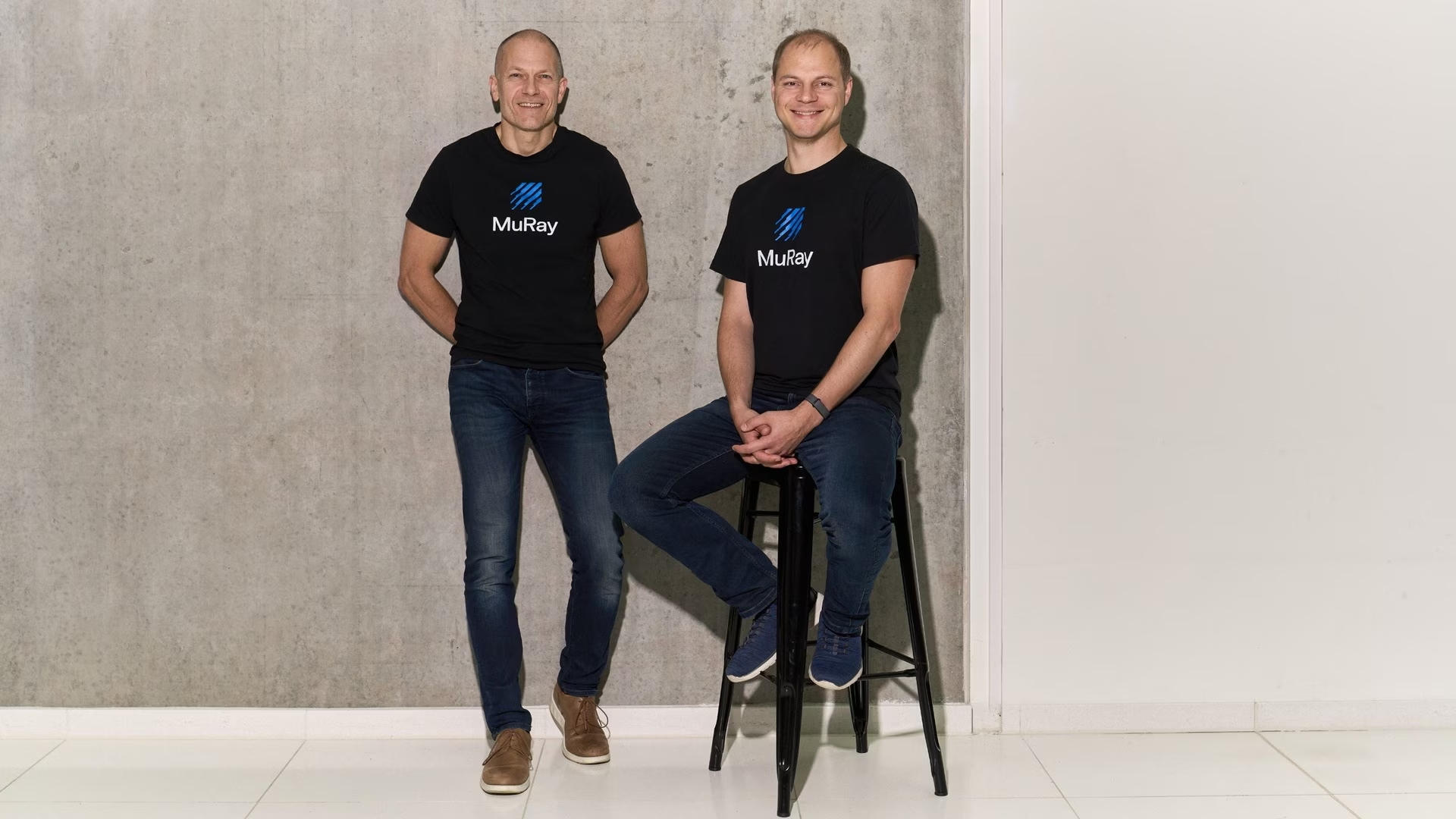
“X 射线在几厘米厚的钢材前就达到极限,但现代工业的许多产品——从可重复使用火箭到燃气轮机——所用金属厚度远超此限,”MuRay 联合创始人兼联合首席执行官 Andi Hektor 表示。
“X-rays reach their limit at a few centimetres of steel, yet much of modern industry, from reusable rockets to gas turbines, is built from metal far thicker than that,” said Andi Hektor, MuRay’s co-founder and co-CEO.
MuRay 孵化自位于汉堡的德国粒子物理研究中心 DESY。联合创始人兼联合首席执行官 Kristjan Põder 曾领导 DESY 面向工业和医疗用途的激光等离子体加速器研究,而 Hektor 此前联合创立了 GScan,利用自然产生的缪子扫描大型结构。
MuRay grew out of DESY, the German particle physics research centre in Hamburg. Co-founder and co-CEO Kristjan Põder led DESY’s work on laser-plasma accelerators for industrial and medical use, while Hektor previously co-founded GScan, which uses naturally occurring muons to scan large structures.
两人于 2025 年创立公司,并于同年 11 月结束保密模式,当时获得 32.5 万欧元早期融资。
The pair launched the company in 2025 and came out of stealth that November with €325,000 in early funding.
“这笔资金将帮助我们继续验证物理原理,同时向工业客户交付首项服务,”Põder 表示。
“This funding will help us continue proving the physics whilst delivering our first service to industrial customers,” said Põder.
MuRay计划于2027年在汉堡利用DESY现有的电子束,首次为工业客户提供成像服务。其首套由紧凑型激光驱动加速器供电的全尺寸系统预计于2029年推出。
MuRay plans to open its first imaging service for industrial customers in 2027, using DESY’s existing electron beam in Hamburg. Its first full-scale system, powered by a compact laser-driven accelerator, is due in 2029.
该公司与德国航空航天中心(DLR)旗下的德国航天局合作,已对如何检测火箭发动机进行了建模。随着航天硬件需求增长,该公司计划于2027年进行首次真实发动机测试。该公司还在与多个国际港口洽谈,探讨利用该技术识别货物中的核材料。
With the German Space Agency at DLR, it has modelled how to inspect a rocket engine. It plans its first real engine test in 2027, as demand for space hardware grows. The company is also in talks with international ports about using the technology to spot nuclear materials in cargo.
该公司在塔林也设有分支机构,计划到2027年底将员工规模扩大至约25人。目前它正在汉堡招聘七名物理学家和工程师,其中包括其人工智能团队和缪子源团队的创始负责人。
The company, which also has a branch in Tallinn, plans to grow to about 25 staff by the end of 2027. It is now hiring seven physicists and engineers in Hamburg, including founding leads for its AI and muon source teams.