据美国研究人员称,中国第四艘航空母舰——普遍被认为是该国首艘采用核动力系统的航母——最早可能于明年下水,北京正致力于打造一支能够将海军和空军力量投射至远离本土海岸之远的舰队。
China’s fourth aircraft carrier, widely believed to be the country’s first with a nuclear-powered system, could launch as early as next year, according to US researchers, as Beijing pursues a fleet capable of projecting naval and air power far beyond its shores.
2027年下水将与中国人民解放军建军百年相吻合,建军节在8月1日。北京此前曾利用重大军事纪念日展示武装力量建设成果。
A launch in 2027 would coincide with the centenary of the People’s Liberation Army, with the anniversary falling on August 1. Beijing has previously used major military anniversaries to showcase developments in its armed forces.
总部位于华盛顿的战略与国际研究中心(CSIS)周二发布的一份更新评估报告称,本月的卫星图像显示,这艘军舰——通常被称为004型——的建造阶段与中国第三艘航母“福建号”2021年5月时的阶段相当,后者约一年后于2022年6月下水。
The Washington-based Centre for Strategic and International Studies (CSIS) said in an updated assessment on Tuesday that satellite imagery from this month showed the warship – commonly referred to as the Type 004 – at a construction stage comparable to that of China’s third carrier, the Fujian, in May 2021, about a year before its June 2022 launch.
这表明004型可能于明年入水。不过,分析人士警告称,由于其体型更大、动力系统可能更复杂,以及不可预见的问题,其进度可能与“福建号”不同。北京不公开建造时间表。
This suggests the Type 004 could enter the water next year. However, analysts cautioned that its larger size and potentially more complex propulsion system, as well as unforeseen issues, could put it on a different schedule from the Fujian. Beijing does not disclose construction timelines.
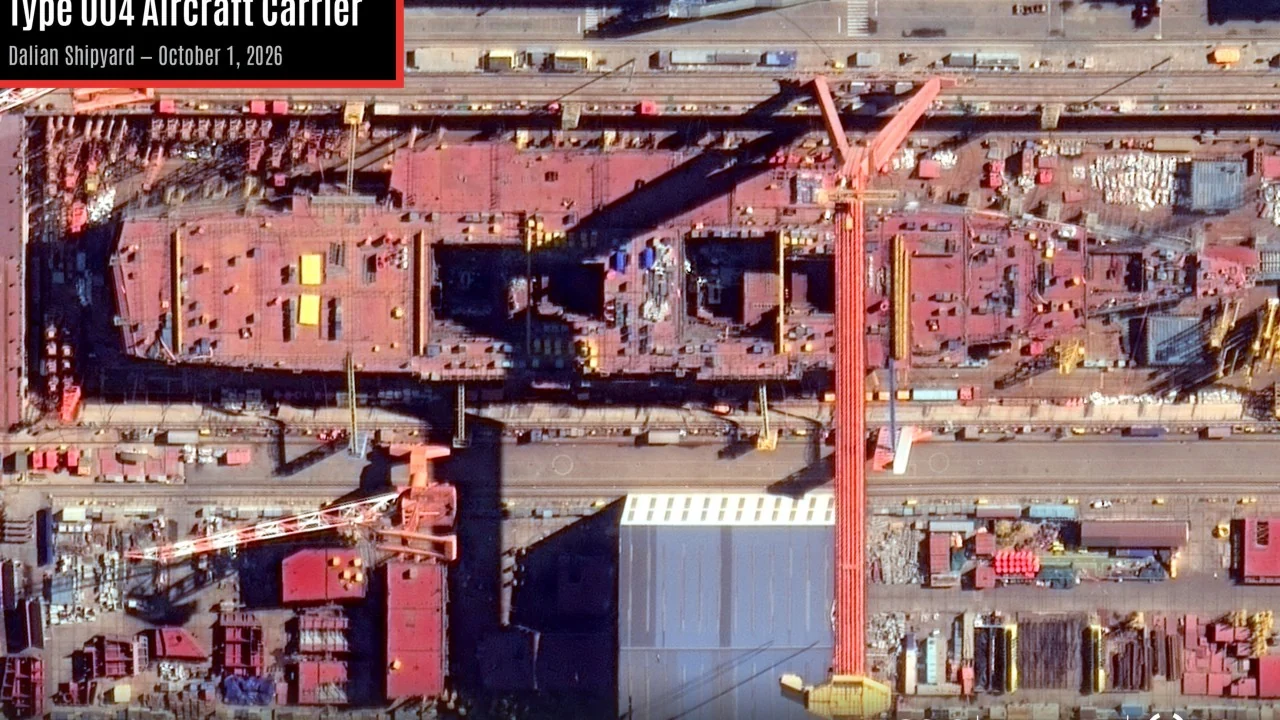
最新照片显示,004型位于中国东北部大连船厂的干船坞内,尚未安装飞行甲板或舰岛上层建筑。
The latest photographs show the Type 004 in a dry dock at Dalian Shipyard in northeastern China without its flight deck or island superstructure.
航母下水并不意味着已具备作战服役能力。例如,“福建号”直到去年11月才正式入列服役,距其下水已过去三年多。
Launching a carrier does not mean it is ready for operational service. The Fujian, for example, was only commissioned in November last year, more than three years after its launch.
CSIS中国能源项目副主任、该评估报告合著者布莱恩·哈特表示,2027年底下水是合理的。
Brian Hart, deputy director of the CSIS China Power Project and a co-author of the assessment, said that a late-2027 launch was plausible.
他说:“如果建造保持这一进度,且遵循与‘福建号’相似的建造时间表,如果该舰于2027年底或2028年初下水,我不会感到惊讶。”
“If construction continues at this pace, and if it follows a similar construction timeline to the Fujian, I would not be surprised if the vessel launches by the end of 2027 or early 2028,” he said.
据CSIS称,未完工的舰体长约322米、宽约46米(1056英尺乘151英尺),但其最终尺寸仍不清楚。
According to CSIS, the unfinished hull measures about 322 metres long and 46 metres wide (1,056 feet by 151 feet), although its final dimensions remain unclear.
一位要求匿名的影像分析师估计,该舰船体长度更接近327米。他表示,若飞行甲板延伸至可见船首之外,完工后的舰艇长度可能达339米,这将使其长度与美国海军最大的航空母舰相当。
An imagery analyst who requested anonymity estimated the hull was closer to 327 metres long. He said the completed vessel could be up to 339 metres if its flight deck extended beyond the visible bow, which could make it comparable in length to the US Navy’s largest aircraft carriers.
哈特表示,最新照片还显示,上层船体段正在安装,其中包括支撑飞行甲板的结构,该飞行甲板延伸范围远超下层船体。
Hart said the latest photographs also showed upper hull sections being installed, including structures to support a flight deck extending considerably farther than the lower hull.
该影像分析师同样预计,飞行甲板模块和舰岛上层建筑将在下水前安装,而甲板铺设、阻拦索、传感器和武器的安装则可在下水后靠泊码头时完成。
The imagery analyst similarly expected the flight-deck modules and island superstructure to be installed before launch, while deck surfacing and the installation of arresting gear, sensors and weapons could be completed pierside afterwards.
提及战略与国际研究中心(CSIS)的最新评估,退役美国海军上校、前美国太平洋舰队情报局局长吉姆·范内尔表示,大连造船的“范围、规模和速度”让他“更加确信”中国海军第四艘航母最有可能于明年下水。
Referring to the latest CSIS assessment, Jim Fanell, a retired US Navy captain and former US Pacific Fleet intelligence chief, said the “scope, scale and speed of the construction at Dalian” had left him “even more convinced” that the Chinese navy’s fourth carrier was most likely to be launched next year.
虽然中国的建造顺序不详,但进度也可能取决于其预期的核动力系统何时以及如何安装。
While China’s sequence of construction is not known, progress could also depend on when and how its expected nuclear propulsion system is installed.
另一位退役美国海军上校、兰德公司高级政策研究员布拉德利·马丁也认为明年下水是可行的。
Another retired US Navy captain, Bradley Martin, who is a senior policy researcher at the Rand Corporation, also considered a launch next year feasible.
他说:“中国确实拥有海军核动力经验,所以我认为说2027年下水并不算太大的跨度。”
“China does have experience with naval nuclear power, so I don’t think it’s a huge stretch to say that launch will occur in 2027,” he said.
马丁表示,下水前安装动力装置和轴系、完成舰体和上层建筑以及涂覆水下涂层将是“有利的”。
Martin said that before launch it would be “advantageous” to install the propulsion plant and propeller shafts, complete the hull and superstructure and apply underwater coatings.
他说:“视核动力集成是否棘手而定,下水与实际具备作战能力之间可能存在两到三年的间隔。”
“Depending on whether integration of nuclear propulsion proves challenging, there could be a two [to] three-year lapse between launch and actual readiness to operate,” he said.
该影像分析师提出疑问,反应堆是否会在大连安装,又或是未完工的船体可能会被转移至他处进行该项工作。
The imagery analyst raised questions about whether the reactors would be installed at Dalian or whether the unfinished hull might be moved elsewhere for that work.
004型航母预计也将配备电磁弹射系统,体现了北京对其航母舰队的长期野心。
The Type 004, which is also expected to feature an electromagnetic aircraft launch system, reflects Beijing’s longer-term ambitions for its carrier fleet.
据2025年五角大楼的一份报告,中国海军计划到2035年再建造六艘航空母舰,使其舰队规模可能达到九艘。
According to a 2025 Pentagon report, the Chinese navy aims to build six more aircraft carriers by 2035, potentially bringing its fleet to nine.
分析人士表示,这样的扩张将需要大幅加快生产速度,包括同时建造多艘舰艇。
Analysts said such an expansion would require significantly accelerating production, including building multiple vessels simultaneously.
范尔表示,004型航母在大连的建造表明中国可以在两个不同的造船厂建造大型航母。但他质疑这些设施是否能交付预计的舰队规模,认为到2035年拥有六艘现役航母更为现实。
Fanell said the Type 004’s construction at Dalian showed China could build large carriers at two separate shipyards. But he questioned whether those facilities could deliver the projected fleet, suggesting six operational carriers by 2035 was more realistic.
他表示,要达到九艘可能需要第三个建造地点,尽管目前没有证据表明存在这样的地点。
Reaching nine might require a third construction site, he suggested, although there was no evidence of one.
哈特表示,中国“可能”在大连和建造福建舰的江南造船厂同时建造航母。他还指出,海南岛屿屿海军基地有一个可容纳航母的干船坞,他说这可以为“维护和改装现役航母提供额外产能”,从而腾出其他干船坞用于新舰建造。
Hart said it was “conceivable” China could build carriers simultaneously at Dalian and Jiangnan Shipyard, where the Fujian was built. He also pointed to a carrier-capable dry dock at the Yulin Naval Base on Hainan island, which he said could provide “additional capacity to maintain and refit existing carriers”, freeing other dry docks for new construction.
美国海军战争学院J.C.韦尔海事战略讲座教授詹姆斯·R·霍姆斯认为,如果中国海军确定了一种其领导层认可的设计,九艘航母的舰队是“可行的”。
James R. Holmes, who holds the J.C. Wylie Chair of Maritime Strategy at the US Naval War College, considered a nine-carrier fleet “feasible” if China’s navy had settled on a design acceptable to its leadership.
“中国当然有工业产能,像生产香肠一样大量建造这些船体,就像它建造055型巡洋舰和其他主要水面战斗舰艇一样,”他说。
“China certainly has the industrial capacity to start cranking these hulls out like sausages, much as it has Type 055 cruisers and other major surface combatants,” he said.
更大规模的舰队还可能显著扩大北京的军事选择,使其能够在印度洋和西太平洋持续开展航母行动。
A larger fleet could also significantly expand Beijing’s military options, allowing it to sustain carrier operations in the Indian Ocean and western Pacific.
“规模如此之大的舰队将提供足够的船体来应对西太平洋——中国主要感兴趣的战区——的事件,同时为远海行动创建一支远征舰队,”霍姆斯说。
“A fleet that size would provide enough hulls to manage events in the western Pacific, China’s primary theatre of interest, while creating an expeditionary fleet for operations out of area,” Holmes said.
马丁表示,中国航母可能无法在可产生的飞机出动次数上与美国航母相抗衡,并且在与美军交战的高度争议水域中将处于脆弱境地。
According to Martin, Chinese carriers might not match their US counterparts in the number of aircraft missions they could generate and would be vulnerable in heavily contested waters during a conflict with US forces.
他说,它们更广泛的价值在于为中国决策者提供“全球冲突中的选择”,即使这些舰艇在与美国海军的直接对抗中并非决定性因素。
He said their broader value was to provide Chinese decision-makers with “options in conflicts worldwide”, even if the vessels were not decisive in a direct confrontation with the US Navy.