在西南省份贵州,花江峡谷大桥横跨一个被陡峭群山环绕的深谷。这是一项令人难以置信的工程壮举。这座大桥的钢桁梁长1400米,悬在距江面625米的高空,是世界最高桥:几乎可以把两座埃菲尔铁塔叠放在桥下。该桥于去年9月通车,官员们夸耀说,它使跨越峡谷的行程时间从两小时缩短到两分钟。
In the south-western province of Guizhou, the Huajiang bridge straddles a yawning valley hemmed in by steep mountains. It is a mind-boggling feat of engineering. With a 1,400-metre steel deck suspended 625 metres above a river, the bridge is the world’s highest: two Eiffel Towers could almost be stacked beneath it. Opened in September last year, officials boast that it cuts journey times across the canyon from two hours to two minutes.
此类奇观未来可能越来越少。中国多年来在桥梁、隧道、高速公路、高速铁路和机场上的巨额投入正开始逐渐减少。然而,关于这些投入是否值得的疑问可能会越来越多。花江峡谷大桥承载的是一条机动车道(即中国所称的高速多车道公路——高速公路)。但该地区偏远且贫困,不太可能出现大交通流量。当地政府大力宣扬建桥者的技术成就,却很少提及22亿元人民币(3.3亿美元)的成本何时能够收回——尽管有道路通行费和它吸引来的游客。
Fewer such marvels are likely to be built. China’s years-long splurge on bridges, tunnels, expressways, high-speed rail and airports is beginning to tail off. Questions are likely to grow, however, about whether it was worthwhile. The Huajiang bridge carries a motorway (or expressway, as China calls its high-speed multi-lane roads). But the area is remote and impoverished; heavy traffic is unlikely. The local government talks up the bridge-builders’ technical achievement; far less so the likelihood that the 2.2bn yuan ($330m) cost will ever be recouped, despite road tolls and the tourists it has attracted.
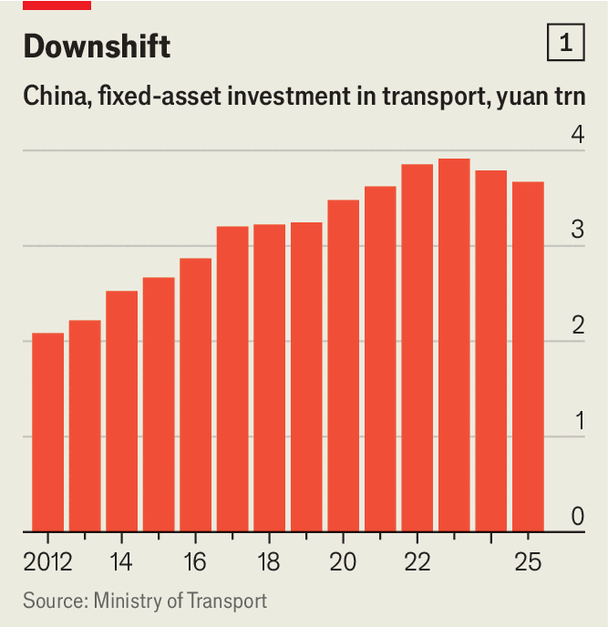
2015年,时任世界银行中国办事处主任的郝福满表示,既然在新交通基础设施上投入了这么多,中国应该把注意力转向保持其良好状态。然而中国并没有踩刹车。直到2023年,交通相关固定资产投资才达到峰值——当年投入了3.9万亿元(见图1)。当局似乎终于同意了郝福满的观点。今年7月,一位交通部门高级官员表示,中国主要交通网络已“完成91%”,国家将从扩大规模转向升级现有基础设施。郝福满开玩笑说,他之前没意识到自己“如此有远见”。
In 2015 Bert Hofman, who was then the head of the World Bank’s office in China, said that having invested so much in new transport infrastructure, the country should turn its attention to keeping it in good shape. Yet China did not apply the brakes. It was not until 2023 that investment peaked in transport-related fixed assets—3.9trn yuan was spent that year (see chart 1). The authorities finally seem to agree with Mr Hofman. In July this year a senior transport official said China’s main transport network was “91% complete”, and the country would pivot from expanding to upgrading existing infrastructure. Mr Hofman jokes that he had not realised he was “so far-sighted”.
诚然,未来还会有更多基础设施建成。中国每年在交通基础设施上的投资占GDP的2.6%。这一比例远低于2007至2009年全球金融危机之后——当时中国推出大规模刺激计划,该比例一度达到9%。但与比如美国相比,这一比例仍然高得惊人:2024年美国在这方面的支出仅占GDP的0.6%。
To be sure, plenty more will be built. China’s annual investment in transport infrastructure is 2.6% of GDP. That is a far lower share than after the global financial crisis of 2007-09, when it reached 9% as the country unleashed a massive stimulus package. But it remains strikingly high compared with, say, America, where the outlay was just 0.6% of GDP in 2024.
截至去年年底,中国已建成超过5万公里的高速铁路,约占全球总里程的70%。中国计划到2035年再建2万公里——大约是欧洲目前运营的高铁线路长度的1.5倍。而且中国还将在交通之外的其他类型基础设施上投入资金。中国已 earmarked 在未来五年内投入25万亿元用于电网、数据中心、移动电话网络、物流、运河和管道(官方称之为“六网”)。
By the end of last year, China had built more than 50,000km of high-speed rail, about 70% of the global total. It plans to build another 20,000km by 2035—roughly 1.5 times the length of such tracks in operation in Europe. And China will also spend money on other types of infrastructure beyond transport. It has earmarked 25trn yuan over the next five years for electric grids, data centres, mobile-phone networks, logistics, canals and pipelines (the “six networks”, as it calls such stuff).
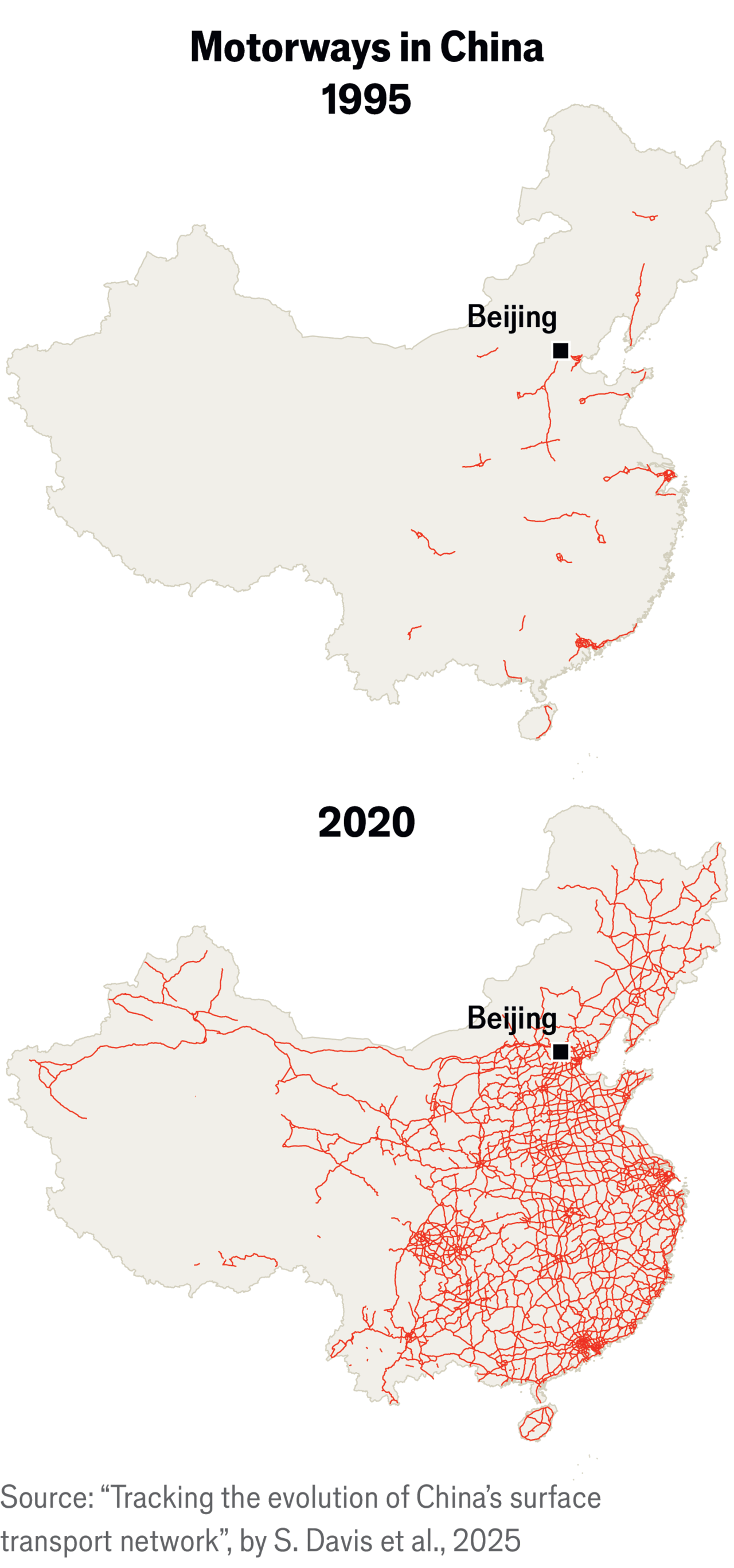
但在交通基础设施建设方面,中国最突出的需求已经得到满足。官员们恳切地念叨“要想富,先修路”的日子早已一去不复返(这在中文里是一句押韵的对句)。自1990年开通第一条高速公路以来,中国已建成约20万公里这类快速道路(见图)——约为美国高速公路长度的两倍。目前中国约有270个商业机场,是1990年的三倍。美国的机场数量是中国的两倍,但差距正在缩小——中国每年新增六个全新的机场;而美国几乎不建任何新机场。
But in the building of transport infrastructure, China’s most conspicuous needs have been met. Long gone are the days when officials would pleadingly intone that “if you want to get rich, first build roads” (it’s a rhyming couplet in Chinese). Since opening its first expressway in 1990, China has built about 200,000km of such whizzy roads (see map)—about twice the length of motorways in America. There are now about 270 commercial airports, three times as many as in 1990. America has twice the number, but the gap is narrowing—China is adding half a dozen entirely new airports a year; America rarely builds any at all.
人道主义代价巨大:数百万人被赶出家园,为公路、铁路、机场及其他此类项目让路——往往未经他们同意,有时几乎没有补偿。然而,这个国家变得更富裕了,国内外对交通网络的赞誉往往溢于言表。西方人对中国快速、舒适的列车赞不绝口,常常将其与自己国家破败的铁路网络作对比。花江大桥只是众多令人惊叹的纪录创造者之一,从全球最快的列车(时速430公里,往返于上海与其机场之间)到最长的公路隧道(22.1公里,位于最西端的新疆地区),不一而足。
The humanitarian cost has been enormous: millions have been turfed off their land to make way for roads, railways, airports and other such projects—often without their consent and sometimes with little compensation. The country, however, has grown richer, and praise for the transport network, at home and abroad, is often effusive. Westerners gush about China’s fast, comfortable trains, often contrasting them with the dilapidated state of their own rail networks. The Huajiang bridge is among numerous awe-inspiring record-setters, from the world’s fastest train (430km per hour, between Shanghai and its airport) to its longest motorway tunnel (22.1km, in the far-western region of Xinjiang).
在任何国家,权衡交通基础设施的效益都很困难。铁路很少能收回资本或产生商业利润:历史上铁路建设的热潮曾让投资者血本无归,但留下的铁轨在此后数十年间推动了经济增长。中国的铁路和高速公路网络不能孤立地评判。在一些地方,它们释放了旧线路和旧公路的运力。它们能缩短货运时间和成本。中国人如今出行方便得多。这种流动性扩大了劳动力市场,提高了制造业效率,使企业能够在更大的范围内吸纳工人和供应商。
Weighing up the benefits of transport infrastructure is difficult in any country. Railways rarely pay back capital or yield a commercial profit: historical railway-building manias have ruined investors but left behind tracks that boosted economic growth for decades afterwards. China’s rail and expressway networks cannot be judged in isolation. In some places they free up capacity on older lines and roads. They can cut journey times and costs for freight. Chinese people now move around much more easily. Their mobility expands labour markets and makes manufacturing more efficient, letting firms draw on workers and suppliers across a much larger area.
然而,一些中国专家认为,国家的投资远远超出了必要。中国科学院的路大道曾将高铁称为“大跃进”。这并非褒奖——它指的是毛泽东在20世纪50年代末让中国“超英赶美”的努力。那场运动导致了大规模饥荒。
Some Chinese experts, however, argue that the country has invested far more than necessary. Lu Dadao of the Chinese Academy of Sciences has called high-speed rail a “great leap forward”. That is not a compliment—it refers to Mao’s effort in the late 1950s to make China “surpass Britain and catch up with America”. That led to mass famine.
陆先生并非在暗示这次会爆发这样的灾难,但他在去年的一篇文章中主张,交通基础设施“已显著超出实际需求”。他说,其成就“付出了巨大代价”。另一位批评者是中泰证券的经济学家李迅雷。中泰证券是一家国有控股券商。李迅雷在8月写道,中国在交通基础设施建设中“忽视了产能过剩”。在一个对政府的批评受到严重压制的国家,这些言论可谓相当尖锐。
Mr Lu is not suggesting there will be such a disaster this time, but in an essay last year he argued that transport infrastructure had “significantly outpaced actual demand”. He said its achievements had “come at a significant cost”. Another critic is Li Xunlei, an economist at Zhongtai Securities, a state-controlled brokerage. In August Mr Li wrote that China had “overlooked excess capacity” in its building of transport infrastructure. In a country where criticism of the government is heavily muted, these are strong words.
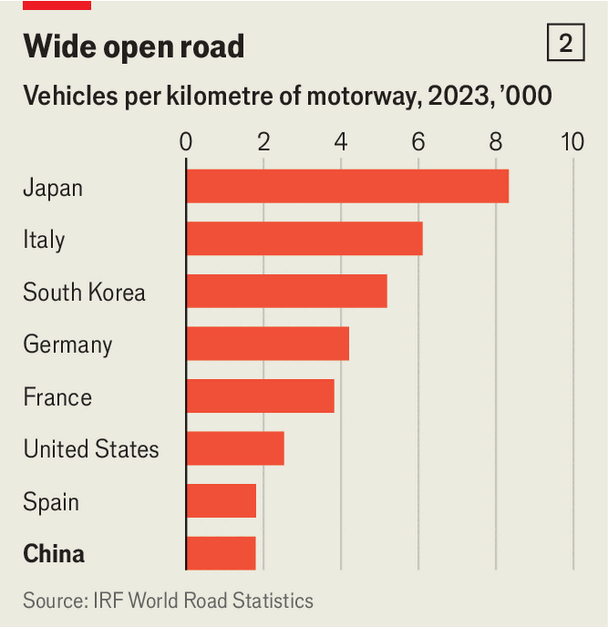
李迅雷的分析指出,最需要快速道路的较富裕沿海地区(如上海和浙江)与建设速度最快的地区(如较贫困的西南省份云南和广西)之间存在错配。李迅雷在谈到2014年至2024年间的数据时写道:“高速公路建设最多的地区,货运需求的增长反而最少。”2020年,中国每公里高速公路对应的车辆数略低于1800辆,远低于大多数富裕国家的比例(见图2)。
Mr Li’s analysis notes a mismatch between the wealthier coastal regions that most need fast roads—such as Shanghai and Zhejiang—and those where they are being built the fastest, such as the poorer south-western regions of Yunnan and Guangxi. “The areas with the most expressways built saw the least increase in freight demand,” Mr Li wrote of the years between 2014 and 2024. In 2023 China had just under 1,800 vehicles for each kilometre of motorway, far lower than the ratio in most rich countries (see chart 2).
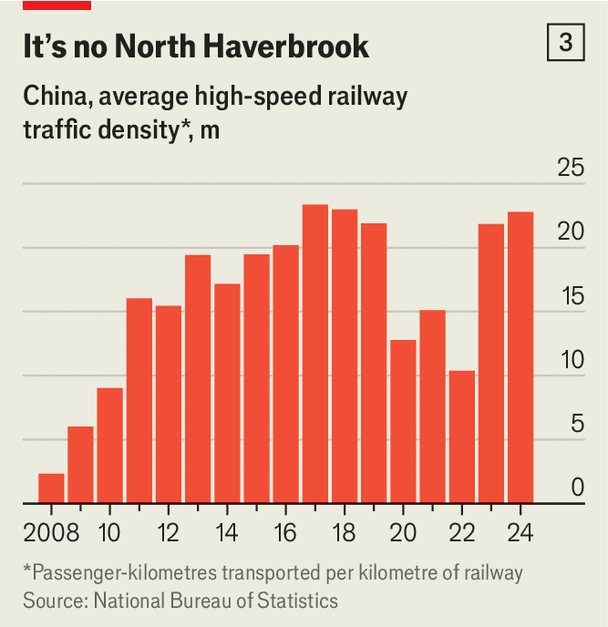
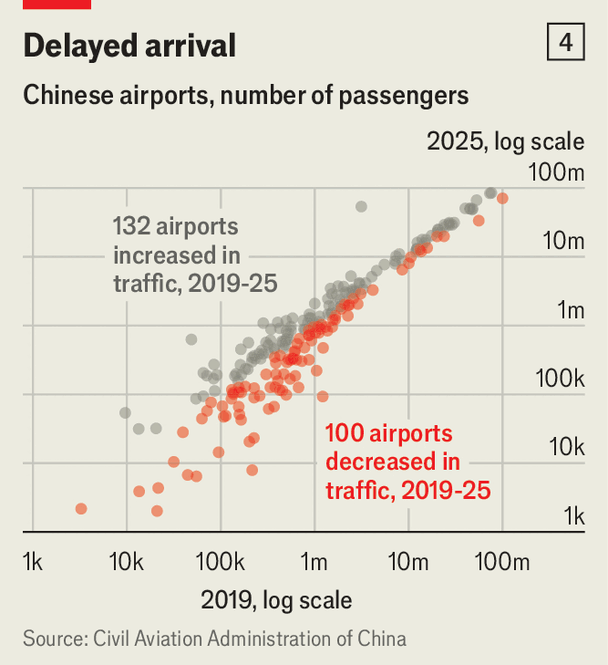
中国的大量新基础设施利用率不足。较贫困的内陆地区的高速铁路服务,空座率高于例如盈利能力很强的北京至上海线路。世界银行2019年的一份评估报告称:“在许多线路上……收入可以覆盖服务运营,但不足以维护基础设施。”商业机场也有类似问题。根据中国民用航空局的数据,2019年至2025年间,43%的机场旅客数量出现下降(不包括2019年以来新开通的机场)。下降主要集中在主要枢纽以外的机场。
A lot of China’s new infrastructure is underused. Fast rail services in poorer inland regions have more empty seats than, say, the highly profitable line from Beijing to Shanghai. “On many lines…revenue can cover the operation of services but is insufficient to maintain the infrastructure,” said a World Bank review in 2019. Commercial airports have a similar problem. Between 2019 and 2025, 43% of them saw a drop in traveller numbers (not counting airports newly opened since 2019), according to data from the Civil Aviation Administration of China (see chart 4). Declines were concentrated in airports outside major hubs.
与新铁路线和机场相关的豪华建筑遍地开花,就更没有什么经济道理了。在较小的贫困城市,火车站和机场航站楼往往十分巨大,以奢华的超现代风格建造,令游客惊叹。以中国北方中型沿海城市烟台为例。其国际机场于2015年启用,釉面穹顶和流畅曲线在去年的凡尔赛建筑奖(Prix Versailles)评选中赢得“世界最美机场”称号。此类面子工程让网上的西方人目瞪口呆。在YouTube上输入“中国基础设施”,然后尽情欣赏搜索结果吧。这无疑让北京的领导人感到高兴。
Even less economic rationale exists for the proliferation of lavish buildings linked to the new rail lines and airports. In small poorer cities, rail stations and airport terminals are often colossal—built in extravagant ultra-modern style to awe visitors. Take Yantai, a medium-sized coastal city in northern China. The glazed dome and sleek curves of its international airport, opened in 2015, won the title of “world’s most beautiful airport” at the Prix Versailles last year. Such vanity projects impress slack-jawed Westerners online. Type “China infrastructure” into YouTube and feast your eyes on the results. This surely pleases leaders in Beijing.
然而,高层官员对与此同时不断累积的债务就不那么高兴了。地方政府承担了高速公路和铁路地方段的大部分建设成本。由地方政府融资工具持有、不在资产负债表上的地方政府债务可能达到72万亿元人民币,相当于GDP的51%。较贫困地区最依赖这类方法——贵州就是一个例子。最终,中央政府很可能不得不为花江大桥买单。管理负担将意味着用于医疗和社会保障的资金减少:这两个领域都急需资金,尤其是为了鼓励消费者支出。
Top officials are, however, less happy about the debts that have piled up alongside. Local authorities have borne much of the cost of building expressways and local sections of rail. Local-government debt held in off-balance-sheet vehicles may amount to 72trn yuan, or 51% of GDP. Poorer regions have relied most on such methods—Guizhou, for one. In the end, the central government will probably have to pick up the tab for the Huajiang bridge. Managing the burden will mean less money for health care and social security: both badly in need of funding, not least to encourage consumers to spend.
如果政府赌的是需求最终将赶上运输基础设施的大规模扩张,那么它应该考虑一个迫在眉睫的问题。中国人口正在迅速老龄化,而老年人不像年轻人那样经常出行。根据联合国的预测,到2050年,中国人口将减少1.5亿。因此,铁路和航空网络上的乘客将会减少,能够欣赏花江大桥令人叹为观止的景色的人也将减少。
If the government is betting that demand will eventually catch up with the enormous expansion of transport infrastructure, it should ponder a looming problem. China’s population is ageing rapidly, and the old do not travel as much as the young. By 2050 it will shrink by 150m, according to UN projections. There will thus be fewer passengers on the network. And fewer to admire the breathtaking views from the Huajiang bridge.