在波兰西南部城市弗罗茨瓦夫,加布里埃拉的教室大半天都充满了活力。但到了周四,随着宗教课的开始,大多数孩子都溜走了。宗教课是选修课,每周仅限一小时,但即便这样,对12岁的加布里埃拉来说有时也嫌太多,她说她羡慕那些可以选择退出的孩子。她班上18名学生中,只有三人选修宗教课。
For most of the day, Gabriela’s classroom in Wroclaw, a city in south-western Poland, is a hive of activity. But on Thursdays, as religion class starts, most of the kids trickle away. Religion lessons are optional and limited to one hour a week, but even that is sometimes too much for 12-year-old Gabriela, who says she envies the kids who get to opt out. Of the 18 pupils in her class, only three take religion.
波兰是欧洲最虔诚的国家之一,92%的成年人自认是天主教徒。但宗教信仰正在下降。完全不信教的成年人比例在不到十年内翻了一番,达到22%。周日弥撒出席率已从2005年的45%降至30%以下。教堂婚礼、洗礼和神职人员数量均有所下降,教会被迫从国外招募人员。在波兰南部城市凯尔采的一所神学院,近三分之一的见习神父来自非洲。
Poland is one of Europe’s most religious countries, with 92% of adults identifying as Catholic. But religiosity is declining. The share of adults who do not practise at all has doubled in under a decade, to 22%. Sunday Mass attendance has fallen from 45% in 2005 to below 30%. Church weddings, baptisms and priest numbers have dropped, and the church has been forced to look abroad for recruits. At a seminary in Kielce, in southern Poland, nearly a third of the trainee priests are from Africa.
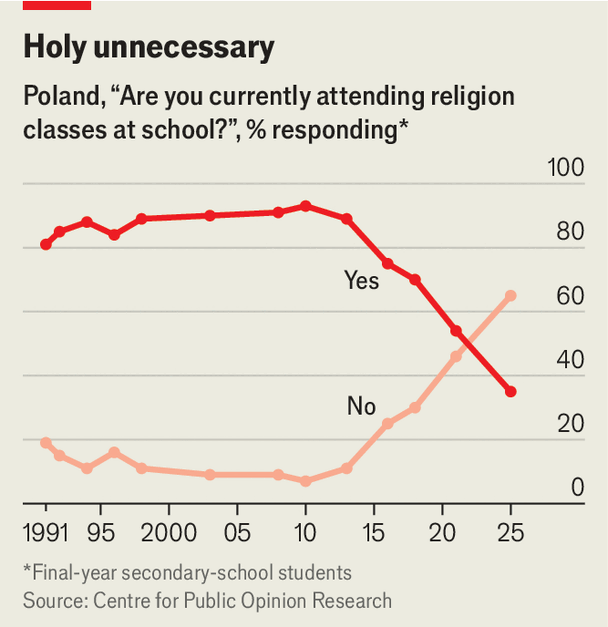
这种流失在年轻人中尤为严重。从20世纪90年代波兰废除共产主义,直到2010年代初,高中毕业班选修宗教课的学生比例一直徘徊在90%左右。到去年,这一比例已跌至35%(见下图)。无神论者的比例为24%,是成年人的四倍。世界各地的年轻人往往比父母更不信教,但在波兰,这种代际差距异常巨大。“这里的世俗化进程比任何地方都快,”学者兼神父安杰伊·科比林斯基说。
The exodus is especially acute among the young. From the 1990s, when Poland scrapped communism, until the early 2010s the share of secondary-schoolers in their final year who took religion courses hovered around 90%. By last year it had dipped to 35% (see chart). The share who are non-believers is 24%, four times the figure for adults. Youngsters everywhere tend to be less religious than their parents, but in Poland the generation gap is unusually wide. “Secularisation here is happening faster than anywhere else,” says Andrzej Kobylinski, an academic and priest.
一个因素是经济增长,这往往会促进世俗化。波兰在这方面的表现非同寻常:按购买力平价调整的人均GDP在二十年间翻了四倍,使该国的实际收入水平达到与西班牙大致相当的程度。与此同时,2010年代末爆发的一系列神职人员性侵丑闻玷污了教会的声誉。
One factor is economic growth, which tends to boost secularism. Poland’s record on that front is extraordinary: GDP per head, adjusted for purchasing power, has quadrupled in two decades, propelling the country to about the same real income level as Spain. Meanwhile, a rash of clerical sexual-abuse scandals in the late 2010s tarnished the church’s reputation.
另一个因素是教会领袖与右翼民粹主义政党法律与公正党(PiS)之间的非正式联盟,该党在2015年至2023年间执政。这疏远了许多年轻人以及各年龄段的女性:2020年,在由PiS提名人员主导的宪法法庭实施近乎全面的堕胎禁令后,数十万人走上街头抗议。新冠疫情也留下了印记。封锁期间弥撒出席率暴跌,至今未恢复。过去十年里,对堕胎和同性婚姻的支持率有所上升。
Another element was an informal alliance between church leaders and the right-wing populist Law and Justice (PiS) party, which governed from 2015-23. That alienated many youngsters, and women of all ages: hundreds of thousands protested in 2020 after the constitutional court, dominated by PiS appointees, imposed an almost total ban on abortion. Covid left a mark, too. Attendance at mass plummeted during the lockdowns, and has not recovered. Support for abortion and same-sex marriage has risen in the past decade.
但更自由开放的社会并不总能带来自由开放的政策。总理唐纳德·图斯克领导的政府涵盖中间派、进步派、左翼和保守派。他在2023年竞选期间承诺放宽堕胎禁令,但联盟内部的分歧阻碍了这一点。欧盟最高法院的一项裁决迫使波兰承认在国外缔结的同性婚姻,但该国自身的法律甚至没有同性民事结合的规定。7月,作为PiS盟友的总统否决了本将赋予同性伴侣部分权利的立法。
But a more liberal society has not always made for liberal policies. Donald Tusk, the prime minister, heads a government spanning centrists, progressives, leftists and conservatives. During his campaign in 2023 he pledged to ease the abortion ban, but splits in his coalition have prevented that. A ruling by the European Union’s top court has forced Poland to accept gay marriages conducted abroad, but the country’s own laws have no provision even for same-sex civil unions. In July the president, a PiS ally, vetoed legislation that would have granted some rights to same-sex partners.
世俗化并未削弱保守派反对派,反而正在重塑它。联盟党(KWiN)正在挑战PiS作为波兰主要反对党的地位。尽管其许多政客是天主教强硬派,但KWiN的议程很少涉及教会。它主要关注欧洲怀疑论、“男性圈”氛围、低税收和阻止移民。
Rather than weakening the conservative opposition, secularisation is reshaping it. The Konfederacja (KWiN) party is challenging PiS as Poland’s main opposition. Although many of its politicians are Catholic hardliners, KWiN’s agenda pays little attention to the church. It focuses mainly on Euroscepticism, manosphere vibes, low taxes and stopping migration.
“世俗化对右翼不构成威胁,”KWiN联合主席克日什托夫·博萨克说。宗教只占“我们整体政治信息的一小部分”。这或许能解释该党在年轻人和宗教冷漠者中的吸引力。民调显示,它在年轻人中的支持率高于任何其他政党。
“Secularisation is not a threat to the right,” says Krzysztof Bosak, KWiN’s co-leader. Religion takes up “a very small fraction of our overall political message”. That may explain the party’s appeal among the young and religiously indifferent. Polls suggest it enjoys more support from the young than any other party.
与此同时,法律与公正党(PiS)的支持率已跌至20%以下。为了从“联盟党”(KWiN)和波兰皇冠联盟——一个更加极端(且常带有反犹倾向)的极右翼团体——手中赢回选民,法律与公正党今年提名一名民族主义天主教徒作为总理候选人。但这疏远了该党的温和派。7月,由前总理马特乌什·莫拉维茨基(Mateusz Morawiecki)率领的40名议员脱离法律与公正党,组建了一个新的中右翼团体“发展加”(Development Plus)。
Meanwhile PiS has seen its support fall to under 20%. In hopes of winning back voters from KWiN and the Confederation of the Polish Crown, an even more extreme (and often antisemitic) far-right group, PiS this year picked a nationalist Catholic as its candidate for prime minister. But that alienated the party’s moderates. In July a group of 40 MPs headed by Mateusz Morawiecki, a former prime minister, left PiS to form a new centre-right grouping, Development Plus.
萨塞克斯大学的亚历克斯·谢尔比亚克(Aleks Szczerbiak)表示,过去在波兰,保守派取胜的秘诀是“在经济问题上偏左、在道德和文化问题上偏右、且非常虔诚”。他说,这一公式已失效。如今,右翼的凝聚力不再源于信仰,而是源于恐惧——无论是对移民、“觉醒”文化还是欧盟的恐惧。科比林斯基(Kobylinski)先生表示,这反映了欧洲其他地区的发展趋势,并指出了世俗化的民粹右翼政党“德国另类选择党”(AfD)。
In the past, says Aleks Szczerbiak of the University of Sussex, the conservative recipe for success in Poland was to be “left-wing on economic issues, right-wing on moral and cultural issues, and very religious”. That formula has expired, he says. Now the right’s binding force is no longer faith but fear—whether of immigrants, woke culture or the EU. Mr Kobylinski says this mirrors developments elsewhere in Europe, pointing to the secular, populist-right Alternative for Germany.
对图斯克先生而言,好消息是距离大选不足一年,他领导的执政党公民联盟(KO)在民调中位居第一。坏消息是,公民联盟及其盟友缺乏足够席位组建政府。目前,法律与公正党和极右翼合计拥有足以组建多数派的份额。右翼内部严重分裂;在上一次竞选中,“联盟党”誓言绝不与法律与公正党共同执政。但若他们克服分歧上台,将形成一股比以往更世俗、却也更极端的右翼力量。■
The good news for Mr Tusk is that with less than a year before a general election, his ruling Civic Coalition (KO) is in first place in the polls. The bad news for him is that KO and its allies lack the votes to form a government. For now, PiS and the far right together have a big enough share to form a majority. The right is deeply divided; in the last campaign KWiN vowed never to rule with PiS. But should they overcome their differences and take office, it would be as a more secular yet more extreme right-wing force than ever.■