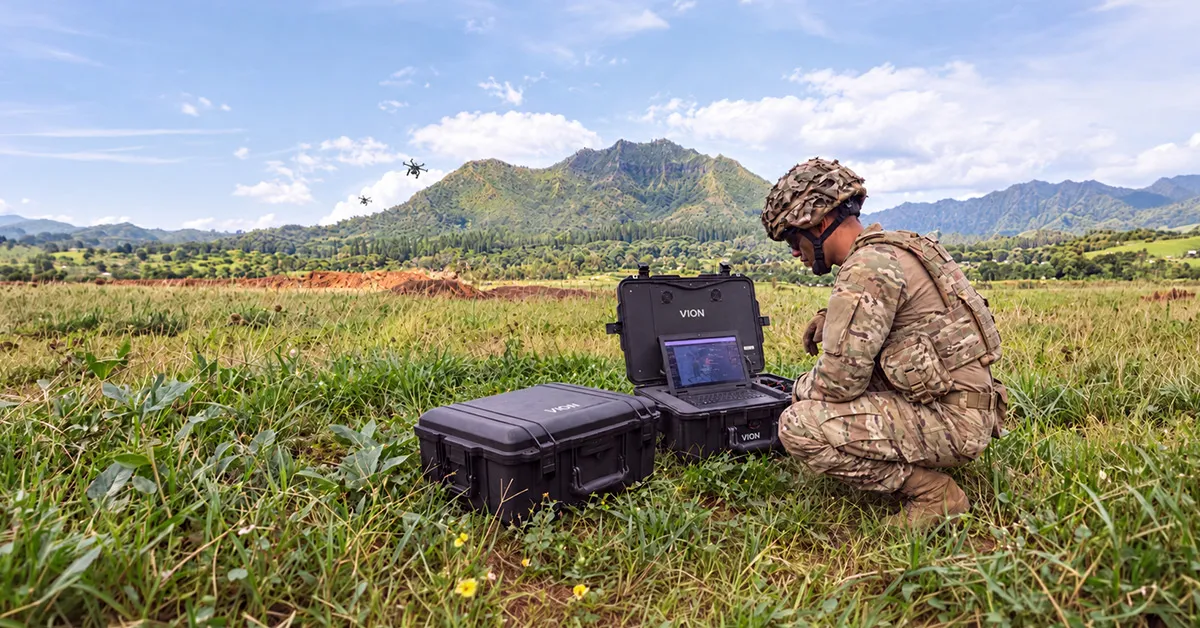
通用动力公司于周四公布了一款名为 Vion 的新型人工智能驱动、便携式通信系统,这是一种任务合作伙伴环境(Mission Partner Environment)解决方案。虽然其基本目的是为地面部队提供一个手提箱大小的平台,用于交换信息和文件,但公司表示,其真正价值在于能够连接盟友系统。
General Dynamics revealed a new artificial intelligence-enabled, portable communications system on Thursday called the Vion, a Mission Partner Environment solution. Although its basic purpose is to give ground troops a suitcase-sized platform to exchange messages and files, the company said its real value is how it connects allied systems.
在接受《军时报》采访时,通用动力信息技术公司防务机构副总裁杰森·迈尔斯解释说,Vion 能帮助地面部队在偏远环境中快速与指挥中心和联盟部队建立安全连接。
In an interview with Military Times, Jason Myers, vice president of defense agencies at General Dynamics Information Technology, explained that Vion can help ground troops quickly establish secure connections with a command center and coalition forces from remote environments.
他指出,Vion 采用开放架构和人工智能技术,能够连接外部网络、适配或修补连接,并翻译书面信息、语音备忘、视频等内容,同时保持零信任网络安全防护。
Using open architecture and AI, he said Vion will connect with outside networks, adapt to or patch connections and translate written messages, voice memos, videos and more, all while maintaining zero-trust cybersecurity protections.
迈尔斯说:“我们希望提供一个全方位的产品,但不想把用户锁定在某一套方案中,或让他们无法使用已经投入的资源。”
“We wanted to provide an all-encompassing offering, but we didn’t want to lock somebody into an offering or not be able to use where they’ve already invested,” Myers said.
他补充说,大多数组织希望拥有定制的通信套件,而多数公司则倾向于提供只能与专有设备和软件配合使用的平台。但这些做法会使系统的更新或升级变得困难且成本高昂。
He added that most organizations want a custom communications kit, and most companies aim to provide platforms that only work with proprietary equipment and software. But those things can make it challenging and expensive to update or upgrade systems.
他说:“我们的想法是,‘是的,我们将使用成熟的技术’,但随着新技术的出现,我们会毫不犹豫地进行拆除和替换。如何在这种模块化架构中安全地实现这一点,真的与当前的做法截然不同。”
“What we wanted to do is say, ‘Yes, we’re going to use proven technologies,’ but as new things come out, we are absolutely ripping and replacing those, and how to do that securely, in that modular architecture, is really, really different than how things are being done today,” he said.
据该公司介绍,GDIT 参与了一场由联合参谋部 J6 主导、名为“奥林匹斯火力”(Olympus Fires)的演示活动,国防信息系统局(DISA)在活动中探索改进“联盟信息环境”(CIE)的途径,该局将 CIE 描述为“基于零信任和数据中心性原则构建的现代化架构”。
According to the company, GDIT participated in a Joint Staff J6-led demonstration called Olympus Fires, where the Defense Information Systems Agency, or DISA, explored ways to improve the Coalition Information Environment, or CIE, which it described as “a modernized architecture built on the principles of Zero Trust and data centricity.”
在 6 月的一个小组讨论中,美国陆军中校、DISA 作战司令部整合与计划主管大卫·考特(David Courter)解释称,该活动的目标是“整合并联合我们的环境,而无需每次都复制一个新环境”。在解释 CIE 解决方案的必要性时,DISA 组件采购主管杰森·马丁(Jason Martin)提到了 3 月发生的一起友军误伤事件,当时科威特防空系统误将三架美国 F-15E“打击鹰”战斗机击落。
At a panel discussion in June, U.S. Army Lt. Col. David Courter, DISA’s Combatant Command Integration and Plans chief, explained the goal of the event was to “broker and federate our environments together without replicating a new environment every time.”Explaining the need for the CIE solutions, Jason Martin, DISA’s Component Acquisition Executive, referenced a friendly fire incident in March, in which Kuwaiti air defenses mistakenly shot down three U.S. F-15E Strike Eagle fighter jets.
马丁说:“过去 50 年,我们一直在构建孤岛式网络、孤岛式应用和孤岛式环境,以便在内部利用自己的数据开展协作。我们不能再这样做了。我们必须融合网络,必须即插即用,必须互通有无……我们必须以统一声音运作并维持指挥控制。”
“We’ve spent the past 50 years building siloed networks, siloed applications and siloed environments to collaborate internally with our own data. We can no longer do that,” Martin said. “We have to converge networks. We have to plug and play. We have to talk to one another … We have to operate and maintain command and control with a single voice.”
迈尔斯(Myers)表示,GDIT 目前正在为 Vion 走采购流程,但拒绝透露对方是谁。不过,他认为就服务而言,Vion “将拥有非常长的生命周期,能在其中持续为任务增值”。
Myers said GDIT is currently working through the acquisitions process for Vion but declined to say with whom. However, he said he thinks Vion, in terms of service, will “have a very long life in where it can add value to the mission.”