
两年前,阿根廷一名法官下令要求一部西班牙语词典删除将“犹太人”定义为“吝啬或放高利贷”的释义,但负责该词典的机构至今仍未遵照执行——这让提起诉讼的犹太团体感到不满。这一定义反映了长期以来将犹太人与贪婪和放贷联系在一起的观念,莎士比亚笔下的夏洛克等文学人物以及数百年的反犹偏见强化了这一刻板印象。
Two years after an Argentine judge ordered a Spanish dictionary to drop a definition of “Jewish” as “miserly or usurious,” the institution responsible for the dictionary has yet to comply — frustrating the Jewish groups that brought the case. The definition reflects a long history of associating Jews with greed and moneylending, a stereotype reinforced by literary figures such as Shakespeare's Shylock and by centuries of anti-Jewish prejudice.
总部位于马德里的西班牙皇家语言学院是一家语言标准化机构,该机构无视了此地一名联邦法官于2024年9月作出的裁定,并为其词典辩护称,词典记录的是词语的实际使用方式,包括贬义用法。犹太团体则认为,保留这一定义会使一种反犹刻板印象延续下去。“我们理解词典反映的是某些人使用语言的方式,但同样不可否认的是,很多人是通过词典来学习的,”拉丁美洲犹太大会(CJL)负责监测网络歧视问题的成员阿里尔·西德勒上个月对犹太电讯社表示。
The Royal Spanish Academy, the Madrid-based language-standardization institution that is ignoring a September 2024 order by a federal judge here, has defended its dictionary as a record of how words are used, including pejorative meanings. Jewish groups argue that preserving the definition perpetuates an antisemitic trope.“We understand that the dictionary reflects how some people use language, but it is also true that many people learn through the dictionary,” Ariel Siedler, a member of the Latin American Jewish Congress (CJL) who monitors online discrimination, told the Jewish Telegraphic Agency last month.
“这就是为什么加入那条释义显得负面。目的是避免强化歧视,否则这种歧视会通过词典延续下去。”2024年的这项裁定作出前一个月,CJL和阿根廷犹太政治伞形组织DAIA对学院院长圣地亚哥·穆尼奥斯·马查多及其他官员提起刑事控告,指控他们“通过‘犹太人’一词的歧视性定义煽动对犹太社区的仇恨”。裁决公布后,穆尼奥斯·马查多对西班牙国家通讯社埃菲社表示,尽管该裁决在西班牙无法执行,但出于对阿根廷法院以及CJL的上级组织世界犹太人大会的尊重,他将研究这一裁决。
“这是法官的裁决;因此,我们以最大的尊重接受它——尤其是考虑到提出申诉的机构中包括世界犹太人大会,”他对埃菲社说。
“That is why adding that definition seems negative. The aim was to avoid reinforcing discrimination, which would be perpetuated through the dictionary." The 2024 order came a month after CJL and DAIA, Argentina's Jewish political umbrella organization, filed a criminal complaint against Santiago Muñoz Machado, the academy's director, and other officials. It accused them of “inciting hatred against the Jewish community through the discriminatory definition of the term 'Jew'.”When the ruling came down, Muñoz Machado told EFE, the Spanish state-run news agency, that he would examine the ruling even though it is unenforceable in Spain, out of respect for the Argentine courts and the CJL's parent body, the World Jewish Congress.“It is a judge's ruling; therefore, we receive it with the utmost respect — all the more so given that the petitioners behind it include the World Jewish Congress,” he told EFE.
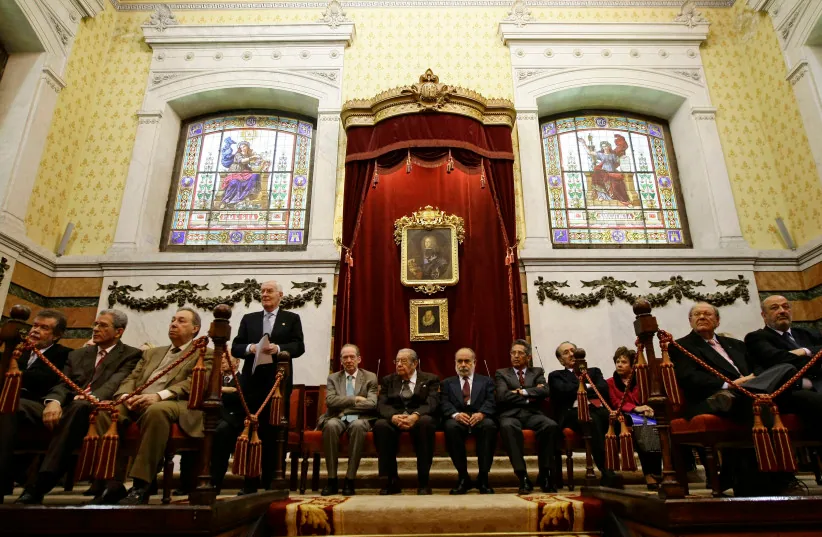
尽管如此,他当时表示,他仍然坚持自己在2023年对CJL(犹太组织)说过的话,当时他回应了该犹太组织直接提出的删除该释义的请求。“如果(学院)把‘Jew’定义为‘吝啬鬼’,那是因为人们就是这样使用这个词的,”他说。他强调,词典是记录语言,而不是发明语言,删除一个释义未必能阻止人们使用这种说法。该学院的在线《西班牙语词典》为“judío”(Jew/犹太人的)列出了五个义项。
Nonetheless, he said then, he still held to what he had told the CJL in 2023, when he responded to the Jewish body's direct request to remove the definition.“If the [academy] defines 'Jew' as 'miserly,' it is because that's how people use the word,” he said. He emphasized that dictionaries document language rather than invent it, and that deleting a definition would not necessarily prevent people from using the expression. The academy's online Dictionary of the Spanish Language lists five meanings for “judío” (Jew/Jewish).
最前面的释义分别是“希伯来人的”、一个“信奉犹太教的人”、“古代亚洲国家朱迪亚的本地人”,以及“属于或关于朱迪亚或犹太人的”。第五个义项将其描述为一个“吝啬或放高利贷”的人。据追踪西班牙语使用情况的网站IEDRA称,2021年——即CJL首次向该学院投诉的那一年——词典开始补充说明这一用法“具有冒犯性或歧视性”。
The first definitions are “Hebrew,” a person “who professes Judaism,” a “native of Judea, a country of ancient Asia,” and “belonging or relating to Judea or the Jews.”The fifth describes it as a person who is “miserly or usurious.”In 2021 — the year the CJL first complained to the academy — it began to add that this usage is “offensive or discriminatory,” according to IEDRA, a website that tracks Spanish language usage.
英语词典通常也收录“Jew”的反犹含义,同时注明此类用法具有冒犯性。为西班牙语学院词典辩护的人表示,这部词典的教育作用应当优先。“词典的作用是解释和理解。如果不收录一个词可能具有的各种含义,就不可能正确阅读古代或现代文本,”学院成员、西班牙小说家阿图罗·佩雷斯-雷维特在2024年阿根廷法院作出裁决时对《国家报》说。
English-language dictionaries routinely include antisemitic meanings of “Jew” while also noting that such usage is offensive. Defenders of the Spanish academy's dictionary said the work's educational role should prevail. “The dictionary serves to explain and understand. Without collecting the various meanings that a word can have, it would be impossible to properly read ancient or modern texts,” Arturo Pérez-Reverte, an academy member and a Spanish novelist, told El País in 2024, when the Argentine court issued its ruling.
“皇家西班牙语学院词典不是语言的规范警察,而是记录语言过去如何被使用、现在如何被使用的公证人。”该学院删除冒犯性释义是有先例的。
“The RAE dictionary is not the normative police of the language, but the notary that draws up a record of how the language was used and how it is used now.”There is a precedent for the academy removing an offensive definition.
西班牙律师博尔哈·卢汉·拉戈在2023年促使西班牙皇家语言学院修改了“律师”一词的词条,该词条原本包含“健谈”和“话多”的定义。巴拿马的犹太社区得知他的成功后,便委托卢汉·拉戈去说服学院删除带有冒犯性的“犹太人”释义。美国和拉丁美洲的20多个犹太团体签署支持了这一行动。该学院总部位于马德里,成立于1713年,是西班牙语的首要权威机构,与另外22家学院(大多位于拉丁美洲)协调语言标准。
Spanish lawyer Borja Luján Lago in 2023 got the academy to modify the entry for the word “lawyer,” which included the definitions “talkative” and “chatty.”Panama's Jewish community, hearing of his success, tapped Luján Lago to persuade the academy to remove the offensive “Jewish” definition. More than 20 Jewish groups in the United States and Latin America signed onto the effort. Based in Madrid and founded in 1713, the academy is the leading authority on the Spanish language, coordinating linguistic standards with 22 other academies, mostly in Latin America.
根据塞万提斯学院2025年的报告,全球约有6.36亿人使用西班牙语。西班牙语使用人口最多的国家包括墨西哥(1.38亿)、美国(6550万)、哥伦比亚(5310万)、西班牙(4890万)和阿根廷(4750万)。
Approximately 636 million people worldwide are Spanish speakers, according to the Instituto Cervantes' 2025 report. The countries with the largest Spanish-speaking populations include Mexico (138 million), the United States (65.5 million), Colombia (53.1 million), Spain (48.9 million) and Argentina (47.5 million).