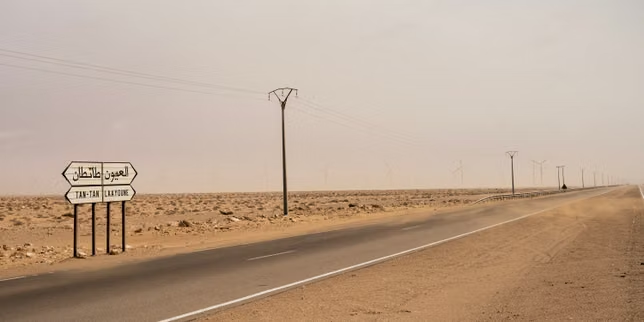
在通往西撒哈拉的“唐纳德·J·特朗普高速公路” —— 这条连接提兹尼特和达赫拉的道路上,卡车司机常在18公里处首次停靠。过了这个地点,随着沥青路面延伸进沙漠腹地,休息区变得愈发稀少。在阿尔甘树丛中坐落的小杜阿尔(农村村落)布纳马内,一座崭新的加油站在不到两年前开业,配备便利店、烤肉餐厅、肉铺、带露台的咖啡馆和洗车房。
On the Donald J. Trump Highway – the road that leads to Western Sahara, between Tiznit and Dakhla – truck drivers often make their first stop at kilometer 18. Rest areas become scarcer after that, once the asphalt plunges into the desert expanses. In the small douar (rural village) of Bounaamane, nestled among argan trees, a brand-new gas station opened less than two years ago, complete with a convenience store, grill restaurant, butcher shop, café with a terrace and car wash.
10月下旬的这个清晨,不愿透露姓氏的穆罕默德表示他对这条路很满意。“很高兴,甚至可以说很开心,”他裹着紫色毛衣微笑着说,此时阳光仍迟迟未能温暖摩洛哥南部这片干旱土地。他说,这条路“比以前好一千倍”。自从旧国道1号 —— “狭窄、常被沙子覆盖、被重型卡车压得坑洼不平” —— 改建为双向各两车道、部分路段限速达100公里/小时的高速公路后,他的行程变得轻松得多。
This late October morning, Mohammed, who did not want to give his last name, said he was won over. "Happy, even," he smiled, bundled up in a purple sweater as the sun was still slow to warm the arid lands of southern Morocco. The road, he said, "is a thousand times better than before." For him, journeys have become much less exhausting since the old National Route 1 – "narrow, often covered with sand and worn down by heavy trucks" – was turned into a two-lane road in each direction, with speed limits on some stretches reaching 100 kilometers per hour.
据报道,这条新高速公路于2024年底建成通车,甚至促使企业重新使用这条路线抵达摩洛哥南部和西撒哈拉。拉巴特称该领土为其“南部省份”,但寻求独立的“波利萨里奥阵线”成员对该地区主权存有争议,他们得到阿尔及利亚支持,并被联合国列为“非自治领土”。
The opening of the new expressway, completed at the end of 2024, reportedly even prompted businesses to use the route again to reach southern Morocco and Western Sahara. Rabat calls this territory its "Southern Provinces," but it is disputed by pro-independence members of the Polisario Front, who are supported by Algeria and classified by the United Nations as a "non-self-governing territory."
“这是不争的事实,我们每趟能节省五到六个小时的行程时间,”摩洛哥洲际公路运输协会主席阿梅尔·兹吉努通过电话表示。“我们在燃油上的节省相当可观,每趟约300到400升柴油,”换句话说,视卡车而定几乎相当于一整箱油。“这是一项相当了不起的成就,”这位协会负责人继续说道,“也正在帮助打开通往南部的大门。”
"It's undeniable, we save between five and six hours of travel time," said Amer Zghinou, president of the Association marocaine des transports routiers intercontinentaux [Moroccan Association of Intercontinental Road Transport], reached by phone. "Our savings on fuel are considerable, on the order of 300 to 400 liters of diesel per trip," in other words, almost a full tank depending on the trucks. "It's quite an achievement," the group leader continued, "which is also helping open up the South."