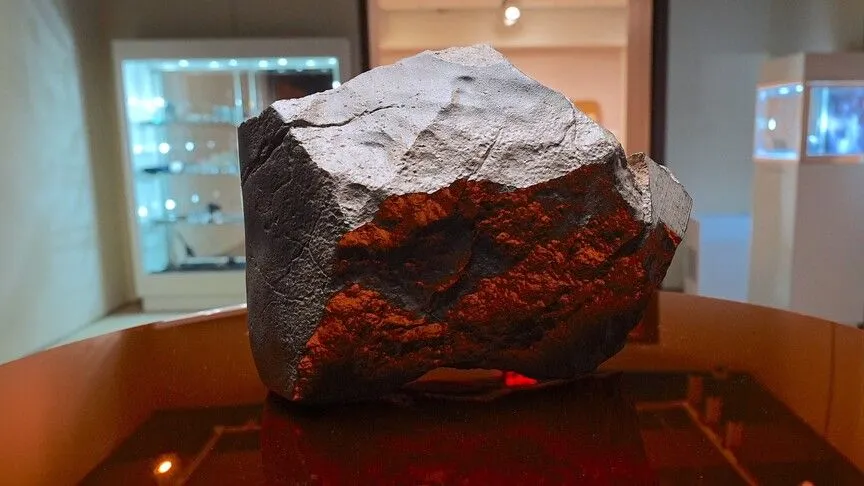
2022年在马里发现的一块陨石可追溯至41亿多年前,为科学家提供了关于火星古老地壳和水历史的罕见见解,这是根据一项最新研究得出的结论。
A meteorite discovered in Mali in 2022 dates back more than 4.1 billion years, offering scientists rare insights into Mars' ancient crust and water history, according to a recent study.
美国国家航空航天局(NASA)资助的研究人员确定,在撒哈拉沙漠发现的、重约800克(1.8磅)的Teghaza 001陨石源自火星,是迄今在地球上发现的最古老的火星陨石之一。
NASA-funded researchers have determined that Teghaza 001, an approximately 800-gram (1.8-pound) meteorite found in the Sahara Desert, originated on Mars and is among the oldest Martian meteorites ever discovered on Earth.
这块陨石以马里发现地的盐滩命名,是已知约435块火星陨石之一。相关研究成果于周四发表在《科学》杂志上,这是据NASA喷气推进实验室(JPL)消息。
Named after the salt plain in Mali where it was discovered, it is one of roughly 435 known Martian meteorites. The findings were published Thursday in the journal Science, according to NASA's Jet Propulsion Laboratory (JPL).
该研究对这块陨石进行了初步表征,其中含有一种独特的火成(即火山)矿物组合。这些矿物为火星地壳如何在岩浆冷却过程中形成,以及后来如何受地下水改变提供了线索。另一项于6月发表在《科学进展》上的研究则考察了该陨石的水含量及其对火星早期表面的启示。
The study provides an initial characterization of the meteorite, which contains a distinctive combination of igneous, or volcanic, minerals. These minerals offer clues about how Mars' crust formed as magma cooled and was later altered by subsurface water. A separate study published in Science Advances in June examined the meteorite's water content and its implications for the planet's early surface.
“只有当我们开始仔细观察时,才意识到这块陨石确实独一无二,”该研究的第一作者、位于南加州JPL的研究员杨柳(Yang Liu,音译)说。“论文的审稿人之一称其为火星的‘罗塞塔石碑’。” Teghaza 001是在地球上发现的三块最古老的火星陨石之一。其他两块包括ALH84001,其几乎完全由一种矿物组成,年龄相仿;以及“黑美人”,形成于约21亿年前。
"It was only after we started looking closely that we realized this meteorite is really unique," said Yang Liu, the study's lead author and a researcher at JPL in Southern California. "One of the paper's reviewers called it a Rosetta Stone for Mars." Teghaza 001 is among the three most ancient Martian meteorites found on Earth. The others include ALH84001, which is composed almost entirely of one mineral and is of a similar age, and "Black Beauty," which formed about 2.1 billion years ago.
这块陨石的矿物成分类似于NASA“火星勘测轨道飞行器”在火星布满陨石坑的南部高地观测到的物质。尽管其确切起源仍不清楚,但研究人员根据其矿物学和化学特征确定了几个潜在的来源地。
The meteorite's mineral composition resembles material observed by NASA's Mars Reconnaissance Orbiter in the planet's cratered southern highlands. Although its exact origin remains unknown, researchers identified several potential locations consistent with its mineralogy and chemistry.
“这是我们第一次从以前从未采集过样本的火星区域获得一块火星地壳岩石,”该研究的第二作者李·塞珀(Lee Saper)说。他在喷气推进实验室(JPL)担任博士后研究员期间开展了这项研究,现为美国国家航空航天局(NASA)位于硅谷的艾姆斯研究中心的科学家。
"This is really our first piece of Martian crust from a part of Mars we've never had a sample of before," said Lee Saper, the study's second author, who conducted the research as a postdoctoral scholar at JPL and is now a scientist at NASA's Ames Research Center in Silicon Valley.
“塞珀说:“它记录了水与岩石的相互作用,甚至可能保留了火星大气在失去水分时的印记。”
"It records interactions of water and rock and maybe even an imprint of the Martian atmosphere as it was losing water," Saper said.
古代水的证据 新墨西哥大学的研究人员最初通过分析其氧同位素(作为地球化学指纹)将特加扎001(Teghaza 001)鉴定为火星陨石。它似乎属于雪儿陨石类,这是最常见的火星陨石类型。
Evidence of ancient water Researchers at the University of New Mexico initially identified Teghaza 001 as Martian by analyzing its oxygen isotopes, which act as geochemical fingerprints. It appeared to belong to the shergottite class, the most common type of Martian meteorite.
然而,刘玉琳注意到了不寻常的纹理和矿物,值得进一步研究。她的团队发现了锆石晶体,这种晶体能保存岩石形成的信息,帮助科学家确定其年龄。
However, Liu noticed unusual textures and minerals that warranted further investigation. Her team discovered zircon crystals, which preserve information about a rock's formation and help scientists determine its age.
来自加州理工学院的合著者弗朗索瓦·蒂索(Francois Tissot)协助应用了他团队开发的原位铷-锶定年技术。该方法利用指甲盖大小的碎片分析单个矿物颗粒,从而为未来研究保留了大部分珍贵的陨石。
Francois Tissot, a co-author from the California Institute of Technology, helped apply an in-situ rubidium-strontium dating technique developed by his team. The method analyzes individual mineral grains using a fragment smaller than a fingernail, preserving most of the rare meteorite for future research.
蒂索说:“目前,我们是世界上极少数能够进行这种定年分析的实验室之一,也是首个对如此古老的火星陨石进行定年的实验室。我们希望这能为更多火星陨石,或从其他行星、卫星和小行星带回的样本进行定年铺平道路。”
"Right now, we are one of very few labs in the world able to perform this kind of age-dating, and the first to date such an ancient Martian meteorite," Tissot said. "Our hope is to pave the way for dating even more Martian meteorites, or samples returned from other planets, their moons and asteroids." The results showed that water altered the rock around 4.1 billion years ago, suggesting it originally formed even earlier. Evidence from its oxygen isotopes, texture and chemistry points to a dynamic water cycle on early Mars.
结果显示,水在约41亿年前改变了这块岩石,表明其最初形成时间甚至更早。来自氧同位素、纹理和化学成分的证据指向早期火星存在一个动态的水循环。
Researchers say further studies of Teghaza 001 could help clarify how water interacted with rocks and shaped the planet's early geological history.
研究人员表示,对特加扎001的进一步研究有助于阐明水如何与岩石相互作用并塑造了这颗行星早期的地质历史。刘玉琳说:“我们只是触及了表面。”
"We've only scratched the surface," Liu said.