人类对在太空居住有着宏大的计划,从正在开发的新空间站到计划在月球上建立基地。甚至有人希望有一天人们能在火星上生活。目前正在开展工作,以弄清如何建造栖息地来支持这些雄心。
Humans have grand plans for residing in space, from a new space station under development to a planned base on the moon. Some even hope that one day people can live on Mars. There’s work underway to figure out how to build habitats to support those ambitions.
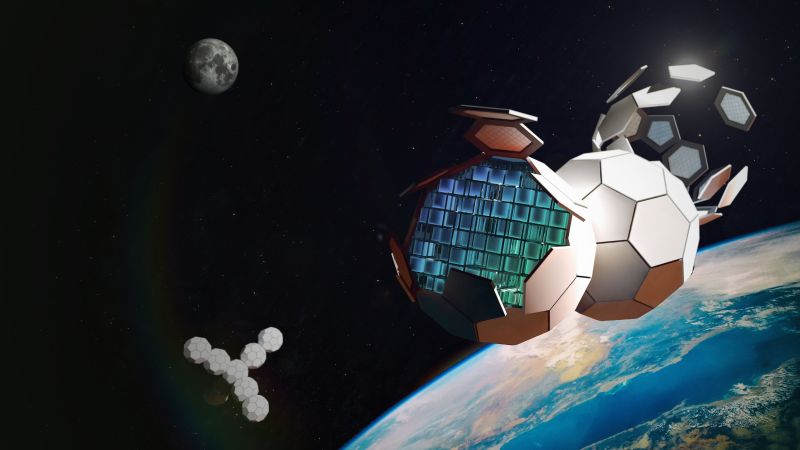
正在测试的创新之一是 TESSERAE:磁性、自组装瓷砖。该瓷砖由 Ariel Ekblaw 在麻省理工学院攻读博士学位期间发明,可以堆叠在火箭内部,并在太空中释放,随后它们能够自主相互连接——利用电控永磁体、摄像头和人工智能——形成预定形状。
One of the innovations being tested is TESSERAE: magnetic, self-assembling tiles. Invented by Ariel Ekblaw while pursuing her PhD at the Massachusetts Institute of Technology, the tiles can be stacked on top of each other inside a rocket and released in space, where they can autonomously attach to each other — employing electro-permanent magnets, cameras and AI — to create a predetermined shape.
一旦它们锁定在一起,结构就可以加压,从而允许人类在内部生活。
Once they’re latched together, the structure can be pressurized, allowing humans to live inside.
“它们可以自组装成比将它们送入太空的火箭大得多的结构,”现为非营利性空间建筑研发实验室 Aurelia Institute 创始人兼首席执行官的 Ekblaw 表示,该实验室进一步改进了这些瓷砖。
“They can self-assemble into something way bigger than the size of the rocket that they came up in,” said Ekblaw, who is now the founder and CEO of Aurelia Institute, a nonprofit space architecture research and development lab that has further refined the tiles.
她补充说,这将使人类能够在太空建造“堪称科幻级别的、巨大、宏伟的结构”。
That could allow humans to build “science-fiction-worthy, big, grand structures” in space, she added.
从 20 世纪 90 年代末开始,组装国际空间站(ISS)花费了数十次任务,火箭将其零部件逐件运送到近地轨道。在太空中,机械臂和出舱宇航员协助完成了组装。
Starting in the late 1990s, it took dozens of missions to assemble the International Space Station (ISS), which rockets carried piece-by-piece to low Earth orbit. In space, robotic arms and spacewalking astronauts helped put it together.
近年来,多家公司一直在开发新型空间结构,旨在最大限度地减少运输它们的火箭内部所占空间,并测试新的建造方法。
Recent years have seen a number of companies developing new kinds of space structures designed to take up minimal space in the rockets that transport them, and testing new construction methods.
2016 年,Bigelow Aerospace 向国际空间站发射了一个充气结构。它通过 25 次短促的充气过程、历时 7 小时完成充气,至今仍连接在国际空间站上。
In 2016, Bigelow Aerospace sent an inflatable structure to the ISS. It was inflated with 25 short bursts of air over 7 hours, and it remains attached to the ISS today.
Sierra Space一直在测试其三层楼高的充气栖息舱,而今年早些时候,与Voyager Technologies(航行者科技公司)建立战略合作伙伴关系的Max Space公司推出了新型可展开栖息舱模块。“我们需要可扩展且专为人类实际在离地环境下生活和作业而建造的空间房产,”其联合创始人兼首席执行官Saleem Miyan告诉Space.com网站。
Sierra Space has been testing its three-story inflatable habitat, and earlier this year, Max Space, which has a strategic partnership with Voyager Technologies, unveiled new expandable habitat modules. “We need real estate that is scalable and built for how humans will actually live and operate off Earth,” Saleem Miyan, its co-founder and CEO, told Space.com.
一些机构正试图从根本上减少将材料运往太空的需求。欧洲航天局(ESA)的科学家们探索过利用陨石粉尘制作乐高式砖块,而中国正在研究如何利用月壤制砖。
Some are trying to reduce the need to bring material to space at all. European Space Agency (ESA) scientists have explored making LEGO-type bricks from meteorite dust and China is investigating how to make bricks with lunar soil.
奥地利维也纳理工大学的建筑师兼空间研究员Sandra Häuplik-Meusburger告诉CNN,建造太空栖息地面临诸多挑战——从如何保护人类免受辐射伤害,到运输材料,再到如何设计“能长期适应不同人群需求”的空间。她补充说,像TESSERAE这种可适应性建筑可能会有所帮助,“这样你可以建造某种东西,也许20年后又能将其用于其他用途。”
Sandra Häuplik-Meusburger, an architect and space researcher at the Vienna University of Technology, in Austria, told CNN that there are numerous challenges when it comes to building space habitats — from how to protect humans from radiation, to transporting materials, to how to design spaces “that can work for a long time for different kinds of people.”Adaptable architecture, like TESSERAE, could be helpful, “so that you can build something and maybe in 20 years you use it for something else,” she added.
Ekblaw表示,该技术的可重构性是其关键创新之一。“你完全可以拆下磁贴,再装上新磁贴,对它们进行重新配置,”她说。
The technology’s reconfigurability is one of its key innovations, said Ekblaw. “You could absolutely pop tiles off and pop new tiles on and reconfigure them,” she said.
不仅仅是栖息地。一些初创公司正考虑将数据中心和太阳能农场送入太空,以利用全天候的阳光。其他公司则希望将制造业移出地球。
It’s not just habitats. Some startups are looking at putting data centers and solar farms into space, to take advantage of 24/7 sunlight. Others are hoping to take manufacturing off planet Earth.
“目前就像淘金热一样,”Häuplik-Meusburger说。存在“来自许多不同参与者的浓厚兴趣。”TESSERAE——即用于探索可重构、自适应环境的镶嵌电磁空间结构——已于2020年和2022年在国际空间站上进行了小规模测试,测试用磁贴宽度仅几英寸。
“It’s like a gold rush at the moment,” said Häuplik-Meusburger. There is “a lot of interest from a lot of different players.”TESSERAE — which stands for Tessellated Electromagnetic Space Structures for the Exploration of Reconfigurable, Adaptive Environments — have been tested on a small scale aboard the ISS in 2020 and 2022, with tiles a few inches wide.
最新款磁贴——边缘装有摄像头,以便在自组装过程中相互“看见”——将于12月或1月在国际空间站内接受测试。Ekblaw表示,如果一切顺利,这些磁贴将首次组装成球形结构——“可能有巨型沙滩球那么大”。接下来的测试将由Rendezvous Robotics负责,这是Aurelia Institute的分拆公司,将协助该技术商业化。10月28日,该公司宣布已筹集2000万美元资金。
In December or January, the latest tiles — which have cameras on their edges to allow the tiles to see each other as they self-assemble — will be put to the test inside the ISS. If all goes well, the tiles will form a ball-shaped structure for the first time said Ekblaw — “maybe the size of a giant beach ball.”After that, the next test will be handled by Rendezvous Robotics, a spin off from Aurelia Institute, which will help commercialize the technology. On October 28, it announced that it had raised $20 million in funding.
Rendezvous Robotics目前正在开发的磁贴采用电磁铁,宽度约为1至3英尺(约30至90厘米)。公司正致力于扩大尺寸,并计划于2028年在国际空间站外、太空严酷环境中进行首次演示。Ekblaw表示,届时将涉及多块磁贴自组装成平面形状。她同时也是Rendezvous Robotics的联合创始人兼董事会主席。
The tiles currently under development by Rendezvous Robotics use electromagnets and are about one to three feet wide. The company is working on scaling up the size, and it plans to do its first demo in 2028, outside the ISS, somewhere in the harsh environment of space. That will involve several tiles self-assembling into a flat shape, said Ekblaw, who is also the co-founder and board chair of Rendezvous Robotics.
大型基础设施尚属遥远。Ekblaw表示,该技术首个切实可行的用例可能是用于电信的大型天线和太阳能阵列。接下来,“它们或许能为太空AI数据中心的建设做出贡献,”她说。“基本上,任何在太空中的超大型基础设施都适用。”
Grand infrastructure may be a way off. Ekblaw said that the first realistic use cases for the technology could be large antennas used for telecommunications and solar arrays. Next up, “they may be able to contribute to the future of AI data center build outs in space,” she said. “Basically, anything that’s really big infrastructure in space.”