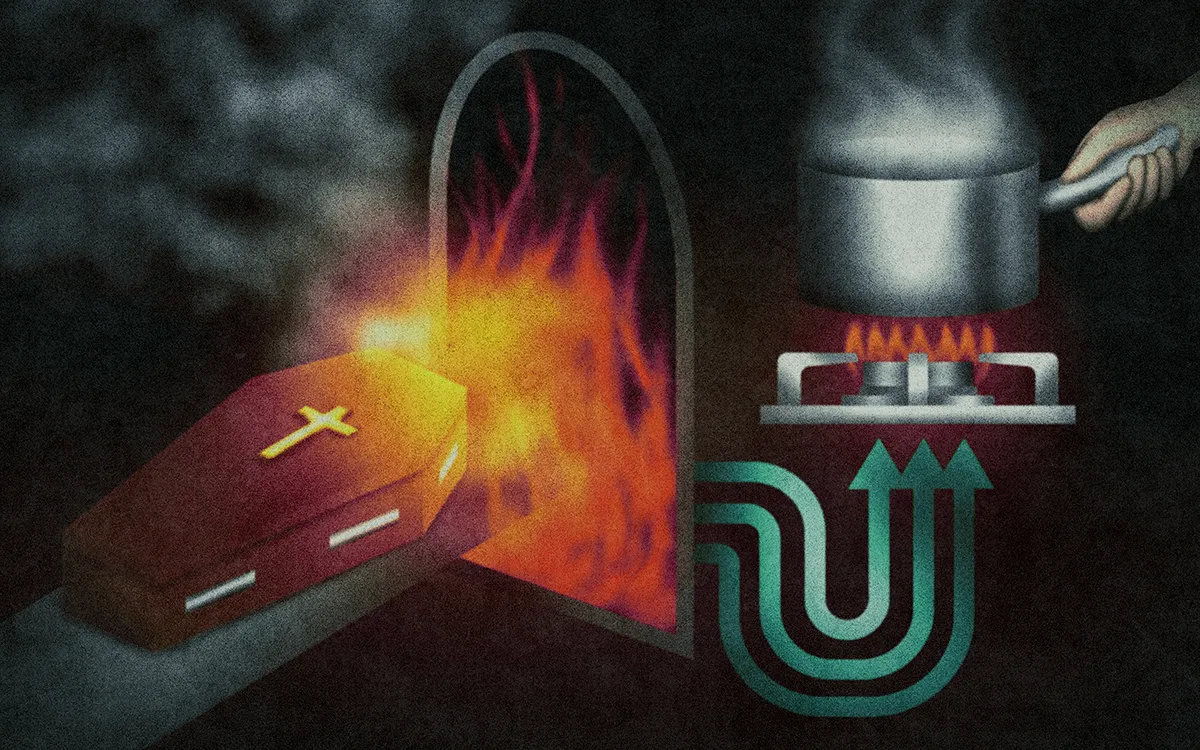
2011年,英格兰雷迪奇区议会尝试了一件在英国几乎闻所未闻的事情。工作人员宣布,他们将利用附近一座火葬场的热量为当地游泳池供暖。
In 2011, Redditch Borough Council in England tried something that hardly anyone in the UK had heard of before. Staff announced they were going to warm the local swimming pool with heat from a nearby crematorium.
随即引发了公众的强烈抗议。该计划登上了国际新闻头条,一位工会官员称其“令人作呕,是对居民的侮辱”。(该工会Unison的一位发言人表示,这并非该组织当时的官方立场,目前也不是。)“你所做的不过是加热一个散热器,然后通过管道把热量送出去,”伯明翰以南雷迪奇和布罗姆斯格罗夫议会的盖伊·雷文斯说,“但死亡始终是一个敏感的话题,不是吗?”最终,铺天盖地的媒体报道逐渐平息。该项目赢得了一项环保奖项,自2013年以来,该火葬场一直在为雷迪奇的游泳池供暖。
A public firestorm ensued. The plans were met with international headlines, and a labor union official branded them “sick and an insult to residents.” (A spokesman for the union, Unison, says this was not—and is not currently—the organization’s official position.)“All you’re doing is basically heating a radiator and sending the heat down a tube,” says Guy Revans, of Redditch and Bromsgrove Councils, just south of Birmingham. “But death is always an emotive subject, isn’t it?”Eventually, the relentless press coverage faded away. The project won a green award, and the crematorium has warmed Redditch’s swimming pool since 2013.
尽管在北美极为罕见,但欧洲国家多年来一直在从火葬场收集热量。火葬场可提供的热量总量并不大,但随着人们寻求减少葬礼对环境的影响,利用火葬场的废热提供了一种降低碳排放强度的途径。
Although extremely rare in North America, European countries have been harvesting warmth from crematoria for years. The total volume of heat available from crematoria is modest, but as people search for ways of reducing the environmental impact of funeral rites, utilizing crematoria waste heat provides a way to lower their carbon intensity.
雷迪奇每年大约进行1200次火化。一个热交换器从该设施两台燃气炉排放的烟气中捕获热量,这是去除补牙材料中汽化汞过程的一部分,之后剩余气体被排放到大气中。
Roughly 1,200 cremations are carried out every year in Redditch. A heat exchanger captures heat from flue gases emitted by the facility’s two gas-fired ovens as part of a process to remove vaporized mercury from dental fillings, before venting the remaining gas into the atmosphere.
这是许多火葬场的常见流程。换句话说,多余的热量往往是被顺带捕获的,这意味着下一个问题是:浪费这些热量是否合理——还是加以利用?在雷迪奇,热交换器连接着一个水循环系统,该管道在地下延伸200米,最终到达另一个<||begin▁of▁sentence||># 为游泳池供热的热交换器。
That’s a common process at many crematoria. In other words, excess heat is often captured by default, meaning the next question is, does it make sense to waste the heat—or use it? In Redditch, the heat exchanger connects to a water loop that travels 200 meters underground, eventually reaching another heat exchanger supplying the swimming pool.
雷文斯补充说,如此巨大的水体“起到了热汇的作用,这很有帮助”。“白天你把热量输入其中,它会在相当长的时间内保留这些热量。”该休闲中心还配备了燃气锅炉,可在需要时提供更多热量。总体而言,该系统每年为市议会节省了数万英镑的燃料费用。
Helpfully, such a sizable body of water “acts as a heat sink”, adds Revans. “You put heat into it during the day, it retains that heat for a considerable length of time.”The recreation center also has gas-fired boilers that can provide more heat when necessary. Overall, the system has saved the council tens of thousands of pounds per year in fuel costs.
近期其他地方也出现了类似的项目。苏格兰阿伯丁一所正在建设中的学校将从该市火葬场获取多余的热量。该火葬场已经依靠废热来为自身场所供暖。
Similar projects have emerged elsewhere recently. A school currently under construction in Aberdeen, Scotland, will receive excess heat from the city’s crematorium. The crematorium already relies on waste heat to warm its own premises.
“他们当时只利用了可用热量的一小部分,其余的都排入了大气,”阿伯丁供热与电力公司首席执行官伊恩·戴维森说。他表示,该系统现已获得全面规划许可。火葬场每年将提供略低于1吉瓦时的热量,大约满足该校总需求量的一半。热泵将满足该设施其余的需求,整个系统预计将于2027年2月全面投入运行。
“They were only utilizing a tiny amount of the heat available; the rest was going to the atmosphere,” says Ian Davidson, chief executive of Aberdeen Heat & Power, who says that the system now has full planning permission. The crematorium will provide just under 1 gigawatt-hour of heat annually, roughly half the school’s total requirement. A heat pump will cover the rest of the facility’s needs, and the entire system should be fully operational by February 2027.
一些火葬场在追求绿色资质方面走得更远。将于2028年在芬兰坎加萨拉启用的火葬场将接入该镇的区域供热网络——这是一个为超过6500户家庭供应热水供暖的管道系统。该火葬场将完全依靠电力运行,部分电力来自其屋顶的太阳能电池板。
Some crematoria are going even further in their pursuit of green credentials. The crematorium that will open in Kangasala, Finland, in 2028 will be connected to the town’s district heat network, a system of pipes that supplies more than 6,500 homes with hot water for heating. The crematorium will be fully electric, powered partly by solar panels on its roof.
“这是一件特别的事,”参与该项目的Thenco Oy公司能源与建筑系统顾问蒂莫·海基拉说,“我真的很高兴能参与其中。”在坎加萨拉,冬季气温可能连续数周保持在零摄氏度以下。海基拉表示,芬兰正在推动减少使用天然气供暖。尽管天然气曾可从邻国俄罗斯廉价获得,但俄罗斯入侵乌克兰以及对气候变化的担忧促使芬兰寻求替代方案。在一些地方,这意味着利用来自不寻常来源的废热,包括火葬场。
“It’s a special thing,” says Timo Heikkilä, an energy and building systems consultant at Thenco Oy, who is working on the project. “I’m really glad I get to be a part of this.”Winter temperatures in Kangasala can remain below 0 degrees Celsius for weeks on end. In Finland, there is a push to use less natural gas for heating, says Heikkilä. Although once cheaply available from neighbouring Russia, that country’s invasion of Ukraine and concerns over climate change have prompted Finland to seek alternatives. In some locations, this means utilizing waste heat from unusual sources, including crematoria.
“芬兰人,”海基拉说,“相当务实。”伊恩·拉德金曾在英国管理多家火葬场,目前是英国火葬协会的董事会成员。他说,许多火葬场正变得越来越注重环保。如今,软件可以安排燃气炉的启动时间与葬礼仪式相协调,从而确保不浪费能源,例如只在需要时才开启。一些火葬场会将棺木存放长达72小时,以便多具遗体可以依次火化,这样效率更高。
“Finns,” says Heikkilä, “are quite practical.”Ian Rudkin, who has managed multiple crematoria in the UK and is currently a board member of the Cremation Society of Great Britain, says many crematoria are becoming more eco-conscious. Today, software can schedule the firing of gas ovens to align with funeral services, ensuring they don’t waste energy and are only turned on when needed, for example. And some crematoria hold coffins for up to 72 hours, so that several may be cremated in a sequence, which is more efficient.
“我们最初引入这一做法时,(家属们)似乎有点震惊,”拉德金说。然而,人们很快就变得更加接受了。“他们会说这样的话,‘爸爸以前在家里总是随手关灯来省电。’”但美国马修斯环境解决方案公司战略总监保罗·塞勒表示,在美国的火葬场实施热回收技术更为困难。在美国,区域供热网络很少见,火葬场往往为私人所有。这意味着连接各建筑所需的热交换器和管道投资更高。
“When we first brought that in, [families] seemed a little bit shocked,” says Rudkin. Soon, however, people became more accepting. “They’d make comments like, ‘Dad always used to turn the light off at home to save energy.’”But implementing heat recovery tech at crematoria in the US is more difficult, says Paul Seyler, director of strategy at Matthews Environmental Solutions. There, district heat networks are rare, and crematoria tend to be privately owned. That means the investment needed for heat exchangers and pipework necessary to link buildings together is higher.
“我们正在研究并密切关注此事,因为一旦在经济上可行,我们希望能够提供解决方案,”塞勒说。他补充道,毕竟,浪费热量就是浪费资源。塞勒表示,除了少数小规模实验外,他并不知道美国有任何利用火葬场热量的完全投入运行的系统。
“We’re studying this and watching it closely because, when the economics align, we’d like to be in a position to offer a solution,” says Seyler. Wasted heat is, after all, just a waste of resources, he adds. Besides a few small-scale experiments, Seyler says he isn’t aware of any fully operational systems in the US that utilize heat from crematoria.
最接近的例子在加拿大魁北克省圣泰雷兹的一座殡葬综合设施。这座3255平方米的建筑内设有家庭室、一座大型礼拜堂、一个火葬场和一间厨房等设施。十多年前安装的热交换器吸收火化烟气中的热量,并将其分配到整个综合设施,包括人行道,用于冬季融雪。
The closest example is in Canada at a funeral complex in Sainte-Thérèse, Quebec. This 3,255-square-meter building houses family rooms, a large chapel, a crematorium, and a kitchen, among other facilities. Heat exchangers installed just over a decade ago soak up heat from cremation flue gases and distribute it around the complex, including the sidewalks to melt snow in the winter.
“业主起初并不赞同,因为他认为这可能会引发伦理困境,”设计工程师马丁·罗伊和莉安·科克顿在《ASHRAE杂志》上发表的一篇关于该项目的文章中回忆道。
“The owner was not immediately on board as he thought it may have posed an ethical dilemma,” recall design engineers Martin Roy and Lianne Cockerton in an article about the project, published in the ASHRAE Journal.
如今,访客经过接待区的一块LED屏幕,屏幕上显示着建筑的能源性能,部分基于热交换器的运行情况。虽然该建筑的部分供暖需求以及火化仍然使用燃气,但新系统每年估计可减少29公吨温室气体排放。
Now, visitors pass an LED screen in the reception area that displays the energy performance of the building, based partly on the heat exchanger’s operation. While gas is still used for some of the building’s heating needs, as well as for cremations, the new system saves an estimated 29 metric tons of greenhouse gas emissions annually.
巴斯大学死亡与社会研究中心副研究员汉娜·拉姆布尔表示,从火化中回收热能是试图抵消人类对环境造成的“毁灭性影响”的一种方式。“我能看出,这会是人们可能选择在特定火葬场火化的一个原因。”
Recovering heat from cremations is one way of attempting to counter the “devastating impact” that humans have had on the environment, says Hannah Rumble, an associate at the University of Bath’s Centre for Death and Society. “I can see that would be a reason why people might choose to be cremated at a particular crematorium.”
《连线》联系的大多数火葬场表示,他们不会向家属或哀悼者强调余热回收技术的存在,不过阿伯丁市议会的一位女发言人补充说,该市议会将在“新系统投入运营前开展一些公众宣传活动,以确保透明度”。英国独立人道主义葬礼和婚礼司仪盖纳·多尔蒂表示,利用火葬场的余热是“明智的”,不过她认为,对许多有环保意识的人来说,自然葬可能更可取——即用裹尸布包裹遗体或将其放入可生物降解的棺材中,让遗体在自然环境中分解。
Most crematoria contacted by WIRED say they do not emphasize the presence of heat recovery technology to families or mourners, though a spokeswoman for Aberdeen City Council adds that the council there will “undertake some public awareness-raising on the new system before it is operational to ensure transparency.”Gaynor Doherty, an independent humanist funeral and wedding celebrant in the UK, says using waste heat from crematoria is “sensible,” though she suggests a natural burial, where bodies are simply shrouded or placed in biodegradable coffins and allowed to decompose in the environment, might be preferable to many eco-minded people.
火化的碳强度因设施而异,但燃气火化每次的碳排放可能在250千克左右。从这一过程中回收热量可以抵消部分排放(一家公司声称可节省100千克),但并非全部。
The carbon intensity of cremation varies from facility to facility, but could be around 250 kilograms of carbon per gas-fired cremation. Recovering heat from the process offsets some of those emissions (one company claims savings of 100 kilograms) but not all.
2024年发表的一项研究估计,如果英国所有火葬场的余热都被回收利用,它们可能只能满足全国总供暖需求的1%。这听起来很少,但供暖脱碳是出了名的困难,因此任何有助于实现这一目标的干预措施都可能很有价值。此外,有些人可能会觉得,分享自己火化产生的热量很有意义。
A study published in 2024 estimated that, if all crematoria in the UK were tapped for waste heat, they might only meet 1 percent of the county’s total heating needs. This sounds small, but decarbonizing heat is notoriously difficult, so any interventions to achieve that can be valuable. Plus, some people may feel that sharing the heat from their cremation could carry a lot of meaning.
在芬兰,坎加萨拉的全电火葬场产生的热量不会像燃气火葬场那样多,但它将全天候运行,因为利用电力温和地补充烤箱内陶瓷材料中保持的热量,运行效率更高。由于连接了区域供热网络,当悼念者从新火葬场的葬礼仪式返回家中时,可以想象,他们走进家门后感受到的温暖中,至少有一小部分可能来自他们所爱之人的火化。
In Finland, the all-electric crematorium in Kangasala will not produce as much heat as a gas-fired equivalent, though it will run 24/7 because it’s more efficient to operate by using electricity to gently top up heat retained in ceramic materials within the ovens. The connection to the district heat network means that, when mourners return home from funeral services at the new crematorium, it is conceivable that at least a small portion of that warmth they feel after stepping through their front doors will come from the cremation of the person they loved.
海基拉说,参与这个项目引发了他的一些重大思考。“我考虑过这件事,一旦我的大限到了,我希望被火化,我希望我的余热被回收利用,”他说。“这是明智之举。这是你能为世界做的最后一件好事。”
Heikkilä says working on the project has prompted some big questions for him. “I have thought about it, and once my time is up, I would like to be cremated, and I would like my waste heat to be recycled,” he says. “It’s the sensible thing. The last favor you can do for the world.”