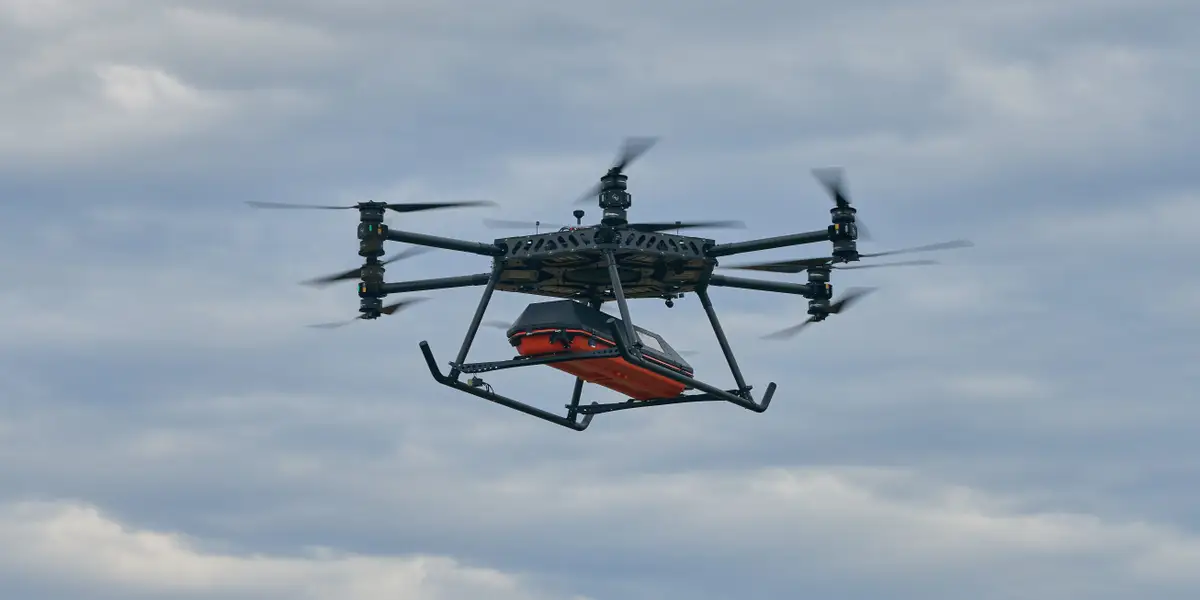
伊久姆以为自己要死了。一次毁灭性的爆炸炸掉了这名乌克兰步兵左脚的一部分,他失血过多。更糟糕的是,俄罗斯士兵正在逼近他的阵地,没有简单的逃生路线。这时来了一架无人机——一架巨大的六旋翼飞行器,底部装有一个封闭式担架。它在离伊久姆阵地约10米处降落,位于靠近雷区的高草丛中。光纤电缆散落在该区域各处,他担心这些隐患会阻止救援无人机起飞。
Izyum thought he was going to die. A devastating blast had taken part of the Ukrainian infantryman's left foot, and he had lost a lot of blood. To make matters worse, Russian soldiers were closing in on his position, and there was no easy escape. Then came a drone — a massive six-rotor aircraft with an enclosed stretcher underneath. It landed roughly 10 meters away from Izyum's position, in tall grass beside a minefield. Fiber-optic cables were strewn across the area, and he worried the hazards would prevent the rescue drone from taking off.
伊久姆头晕恶心,战友们帮他挪到了这架不同寻常的飞行器旁。他调集仅剩的一点力气,把自己抬进了担架舱。随着无人机升空,他呼吸稍微顺畅了一些,终于感到一丝解脱。
Dizzy and nauseous, Izyum's comrades helped him over to the unusual aircraft. Summoning what little strength he had left, he hoisted himself into the stretcher capsule. As the drone lifted off, he breathed a little easier, at last feeling some sense of relief.
伊久姆是两名被新型专用“星门”无人机从战场上空运撤离的乌克兰士兵之一,这款无人机由乌克兰公司SkyFall近期发布。本月,这两名伤员在连续两次救援任务中被医疗撤离。伊久姆和KVN本周在接受《商业内幕》采访时描述了这些任务。KVN是乌克兰第475独立突击团的无人机飞行员,曾驾驶“星门”执行救援。两人均通过翻译交谈,并仅以呼号公开身份,出于安全考虑。
Izyum is one of two Ukrainian soldiers who have been airlifted out of combat by the new specialized StarGate uncrewed aircraft, which was recently unveiled by Ukrainian company SkyFall. The wounded soldiers were medically evacuated this month in back-to-back rescue missions. Izyum and KVN, a drone pilot in Ukraine's 475th Separate Assault Regiment who flew StarGate during the rescues, described the missions to Business Insider in interviews this week. Both spoke through a translator and were identified only by their call signs for security reasons.
无人机空中伤员撤离是乌克兰正在开创的新概念。本月的救援任务属于实战中此类任务的首批案例。士兵和国防工业官员表示,预计未来将看到更多此类任务,并认为这种实验性战术是一项关键能力,特别是在医疗队和机器人都无法接近伤员的时刻。目前,这种方法被视为最后手段——当战场条件阻碍所有其他撤离方式时的“破玻璃应急”选项。接到任务电话时,KVN的大女儿刚出生。
Casualty evacuation by aerial drone is a new concept being pioneered in Ukraine. This month's rescue missions were among the first of their kind in combat. Soldiers and defense industry officials say they expect to see more of these missions in the future and believe this experimental tactic is a critical capability, especially in moments when neither medical teams nor robots can reach wounded troops. Right now, this approach is seen as a last resort — a break-glass option for when battlefield conditions prevent all other evacuation methods. KVN's first daughter had just been born when the call came in.
第475突击团,代号9.2,正在为一次特种行动做准备,领导层需要他来操控主无人机。一辆车正在赶来接他。他很快抵达乌克兰一处未公开的地点,执行这次行动——营救第129独立重型机械化旅的一名伤员。这次行动的核心是“星门”(StarGate),这是一款重型六旋翼无人机,由天降公司专门为代号9.2的部队研制,用于伤员后送。
The 475th assault regiment, known as CODE 9.2, was preparing for a special operation, and leadership needed him to fly the main drone. A car was on its way to pick him up. He soon arrived at an undisclosed location in Ukraine for the operation, the rescue of a wounded soldier from the 129th Separate Heavy Mechanized Brigade. At the center of the operation was StarGate, a heavy hexacopter that SkyFall developed for CODE 9.2 specifically for casualty evacuation purposes.
该无人机于10月中旬亮相,距离KVN的任务仅隔数天。乌克兰正越来越多地借助机器人来后送战场上的伤员。随着侦察无人机和攻击无人机蜂拥于前线,几乎任何移动都伴随着巨大风险,这使得救援小组前去接回伤员变得十分危险。地面机器人是一种解决方案,但崎岖的地形会限制其活动范围。在其他后送方式无法实施时,重型六旋翼无人机便成为一种选择。
The drone was unveiled in mid-October, only days before KVN's mission. Ukraine is increasingly turning to robots to evacuate wounded soldiers in combat. With surveillance and attack drones swarming the front lines, almost any movement carries tremendous risks, making it dangerous for teams to retrieve casualties. Ground robots are one solution, but tough terrain can limit where they can go. Heavy hexacopters have emerged as an option when other extraction methods are not possible.
本月早些时候,乌克兰首次使用空中无人机完成伤员后送,用古尔祖夫防务公司研制的“重击”Ayudag-6重型起重无人机救出了第30独立机械化旅的一名步兵。此后又执行了两次任务。KVN是这两次任务的飞手,操控的是天降公司的“星门”无人机。KVN回忆说,他的第一次后送行动发生在夜间。参与救援行动的有数十人——大部分来自代号9.2的部队,但也有一些来自其他军事单位。
Earlier this month, Ukraine carried out its first casualty evacuation using an aerial drone, rescuing an infantryman from the 30th Separate Mechanized Brigade with a Heavy Shot Ayudag-6 heavy lift drone developed by Gurzuf Defence. There have since been two more missions. KVN was the pilot for both, flying Skyfall's StarGate drone. KVN recalled that his first evacuation happened at night. There were dozens of people — most of them from CODE 9.2, but some from other military units — involved in the rescue operation.
天降团队也参与了策划。KVN当时很紧张。要抵达伤员所在位置,意味着要飞行20英里往返,穿越遍布俄罗斯无人机和电子战的区域,这些威胁可能使任务失败。于是乌克兰人组织了一套类似打击编队的方案,十余架无人机与“星门”一同飞行,保护它免受攻击,把俄罗斯的注意力从救援行动上引开,并轰炸撤离点附近的敌方阵地。
The SkyFall team also participated in the planning. KVN was nervous. Reaching the casualty meant flying 20 miles out and back through areas flooded with Russian drones and electronic warfare that threatened to derail the mission. So the Ukrainians assembled something akin to a strike package, with more than a dozen drones flying alongside StarGate to protect it from attack, draw Russian attention away from the rescue, and bomb enemy positions near the evacuation point.
俄罗斯的第一人称视角(FPV)无人机起初阻止了救援无人机载着受伤士兵起飞,但最终天空放晴。KVN说,他的双手在发抖,但他依靠StarGate内置的稳定技术以及队友的支持,稳住了无人机,也稳住了自己的神经。第一次撤离耗时30分钟。StarGate的航程不足以完成全程40英里的往返飞行,因此KVN不得不在每一段航程的中途降落,让地面团队更换电池。
Russian first-person-view (FPV) drones initially prevented the rescue drone from taking off with the wounded soldier, but eventually the skies cleared. KVN said his hands were shaking, but he relied on StarGate's built-in stabilization technology and his teammates' support to steady the drone and his nerves. The first evacuation took 30 minutes. StarGate didn't have the range for the full 40-mile round trip, so KVN had to land it halfway on each leg so ground teams could swap out the batteries.
任务结束后,KVN抓紧时间补了一觉。第二天早上醒来时,他得知第二次撤离已获批准,即将展开。伊久姆是乌克兰第1领土防卫旅的一名步兵,他坐在地上休息。他的小队奉命守住一处他们刚刚攻占的阵地。当伊久姆站起身时,他触发了爆炸,炸掉了他左脚的一部分。战友们把他拖进一个掩体,立即为他绑上止血带。
After the mission, KVN grabbed some much-needed sleep. When he woke the next morning, he learned that a second evacuation had been approved and would soon be underway. Izyum, an infantryman in Ukraine's 1st Territorial Defense Brigade, sat down on the ground to rest. His team had been tasked with holding a position they had just assaulted. When Izyum stood up, he triggered a blast that tore off part of his left foot. His comrades pulled him into a dugout and immediately applied a tourniquet.
他们通过无线电向指挥官报告,伊久姆受了重伤,需要撤离。情况十分危急。任何试图步行前往更高级别救治的尝试,都意味着要在俄罗斯无人机和地雷的威胁下穿越约20英里。伊久姆失血过多,体力迅速衰竭。鉴于伤势严重,他绝不可能独自完成这段路程。他的战友们将不得不冒着生命危险帮助他走完这段路。而随着前线杀伤区变得愈发危险,乌克兰越来越多地使用地面机器人撤离受伤士兵,但这些机器人无法抵达他的位置,因为池塘、小河和林线阻挡了它们的去路。
They radioed back to their commanders that Izyum had suffered a severe injury and needed evacuation. The situation was dire. Any attempt to walk to higher-level care would mean navigating roughly 20 miles of Russian drone and mine threats. Izyum had lost so much blood, and his strength was fading fast. Given the severity of his injuries, he would never have been able to make that trek on his own. His fellow soldiers would have had to risk their lives to help him make the journey. And ground robots, increasingly used by Ukraine to evacuate wounded soldiers as the front-line kill zone grows more perilous, couldn't reach his position because ponds, small rivers, and tree lines blocked their path.
旅部领导层得出结论,唯一的选择是通过空中撤离他。而由于有人驾驶直升机实际上已不可能使用,他们需要一架无人机。StarGate被选中执行这项任务。伊久姆觉得自己回不了家了。
Brigade leadership concluded that the only option was to evacuate him by air. And with crewed helicopters effectively out of the question, they needed a drone. StarGate was chosen for the mission. Izyum didn't think he was going to make it home.
他的机组人员深入前线,俄军近在咫尺。有一次,敌人距离他们只有5米。最终,救援无人机抵达了。当“星门”无人机在一片地雷和线缆的杂乱中降落时,乌克兰部队使用“吸血鬼”无人机——天降公司制造的较小型的六旋翼无人机——轰炸俄军,将他们逼退。KVN说,在雷区附近降落是他在这次任务中面临的最大挑战之一,不过俄罗斯无人机和电子战的威胁也是问题。
His crew was so deep on the front lines, and the Russians were close. At one point, the enemy was only 5 meters out. Eventually, the rescue drone arrived. As the StarGate drone landed amid a mess of mines and cables, Ukrainian forces used Vampire drones, smaller hexacopters made by SkyFall, to bomb the Russians and keep them at bay. KVN said landing near the minefield was one of the biggest challenges he faced during the mission, though Russian drone and electronic warfare threats were also problems.
他说,他不得不“像忍者一样”飞行来躲避它们。即便有了无人机和地面机器人等新技术,撤离受伤士兵也并非易事,规划、准备和执行都需要时间。从伊久姆受伤到他获救,将近两天过去了。当他降落并打开胶囊舱看到友好的面孔时,自爆炸以来他第一次感到安全。任务终于结束时,KVN也感到如释重负。伊久姆接受了四次手术,失去了一只脚的一半。
He said he had to fly "like a ninja" to avoid them. Even with new technologies such as drones and ground robots, evacuating wounded soldiers isn't an easy process, and it takes time to plan, prepare, and execute. Nearly two days passed between Izyum's injury and his rescue. When he landed and opened the capsule to see friendly faces, he finally felt safe for the first time since the blast. KVN, too, felt an overwhelming sense of relief when the mission was finally over. Izyum had four surgeries and is missing half his foot.
他很快将被转移到康复机构。他在乌克兰东北部的一家医院接受采访时说,他感谢每一位救他性命的人。一些乌克兰官员承认,大型救援六旋翼无人机很容易成为俄罗斯的目标,并表示它们只应在最极端的情况下使用。然而,KVN和伊久姆都表示,空中无人机伤员撤离应扩大为标准做法;例如,CODE 9.2计划为这些任务组建专门部队,天降公司也计划在公司内部建立一个专门负责撤离的部门。
He will soon be transferred to a rehabilitation facility. Speaking from a hospital in northeast Ukraine, he said that he is grateful to everyone who saved his life. Some Ukrainian officials have acknowledged that large rescue hexacopters could be easy targets for Russia and said that they should only be used in the most extreme circumstances. Both KVN and Izyum, however, said that aerial drone casualty evacuations should be expanded as standard practice; CODE 9.2, for instance, plans to create dedicated units for these missions, and SkyFall is aiming to build out a department within the firm specifically for evacuations.
“星门”无人机每架造价约5万美元,最多可承载330磅,飞行速度可超过每小时60英里,并配备了生存能力特性,例如人工智能导航和通信冗余。天降公司表示,其目标是到2026年底能够每月制造1000架无人机。
StarGate drones — which cost roughly $50,000 a unit, can carry up to 330 pounds, and can fly at speeds over 60 miles per hour — are equipped with survivability features, such as artificial intelligence-enabled navigation and communication redundancies. SkyFall said it aims to be able to make 1,000 drones a month by the end of 2026.