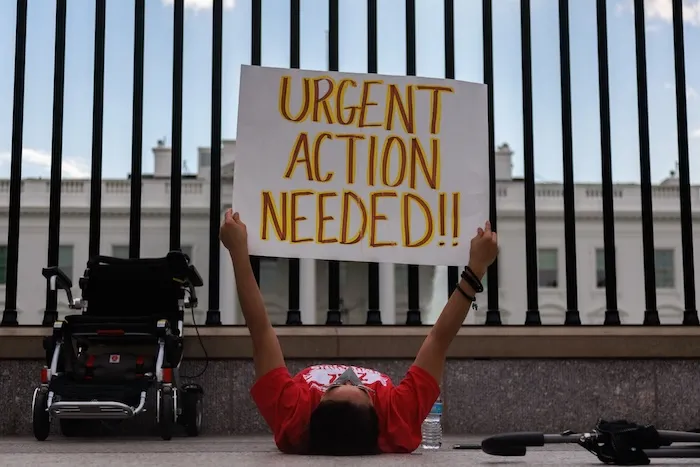
新冠疫情构成了自1990年《美国残疾人法案》(ADA)颁布实施以来,美国最大规模的群体致残事件。其规模难以衡量:数百万美国人,甚至可能达数千万,正与长新冠共存。许多人——从农场工人到白领高管——仍留在职场中,有的是出于自愿,有的则为养家糊口付出了难以持续的代价。
Covid constitutes the largest mass disabling event in the United States since the Americans with Disabilities Act became law in 1990. It’s hard to measure the scale: Millions of Americans, maybe tens of millions, live with Long Covid. Many, from farmworkers to white-collar executives, are still in the workforce—some by choice, some paying an unsustainable price to support themselves or their families.
在该法案2021年周年之际,总统乔·拜登在白宫玫瑰园发表讲话,宣布长新冠将依据联邦法律被视为一种残疾。卫生与公众服务部(HHS)于2023年甚至专门设立了一个长新冠办公室。简而言之,《美国残疾人法案》涵盖长新冠,这保障了合理便利措施,旨在让患有该病症的人能够工作。
On the act’s anniversary in 2021, President Joe Biden announced in a White House Rose Garden speech that Long Covid would be treated as a disability under federal law. The Department of Health and Human Services in 2023 even established an office dedicated to Long Covid. In short, the ADA extends to Long Covid, which guarantees reasonable accommodations meant to allow people with the condition to work.
对于那些仍能工作的人——一项研究发现约占8成——便利措施往往是使其能够工作的关键。未提供便利措施的长新冠成本不断累积:据一项估算,仅2022年因该病症导致的失业和工时损失成本就超过120亿美元,并伴随住房不安全等连带问题。
For those who can work at all—around 8 in 10, one study found—accommodations are often what makes it possible. The costs of unaccommodated Long Covid have piled up: Lost jobs and hours of work from the condition cost over $12 billion in 2022 alone, by one estimate, with attendant issues like housing insecurity.
如今,特朗普政府的反工人、反残疾转向——卫生与公众服务部于2025年撤销了其长新冠办公室——在长新冠便利措施问题上制造了恐惧和困难的氛围,企业界的抵制浪潮和AI驱动的“老板软件”蔓延更是雪上加霜。雇主们在便利措施问题上与员工对抗的底气更足了,尽管有证据表明,提供便利措施总体上能提高留任率和生产力。我采访的学术研究、研究人员和就业律师均表明,不提供长新冠便利措施给员工和企业双方带来的成本与挑战正在上升。
Now, the Trump administration’s anti-worker and anti-disability turn—HHS dismantled its Long Covid office in 2025—has created a climate of fear and difficulty around Long Covid accommodations, exacerbated by corporate backlash and the spread of AI-powered “bossware.”Employers have been emboldened to fight their staff on accommodations, despite evidence that they lead to more retention and productivity overall. And academic studies, researchers, and employment attorneys I spoke with suggest that the costs and challenges of not accommodating Long Covid are rising for both employees and firms.
特朗普总统重返白宫已将近两年,随着数百万人因反复感染而患上长新冠,拜登政府时期保护长新冠患者的联邦机构如今表现冷漠,甚至公开敌视。
Almost two years into President Donald Trump’s return to office, as millions more people develop Long Covid through repeat infections, federal institutions that protected people with Long Covid under the Biden administration are now indifferent or openly hostile.
劳工部悄然删除了关于长新冠与职场的指导文件,该文件曾表示该部门“致力于支持经历长新冠及其相关症状、希望继续工作或重返职场的个人”,并指导雇主采取数十项切实可行的措施——从排班灵活性和职责重组,到照明和人体工学方面的实际调整。
The Department of Labor quietly deleted guidance on Long Covid and the workplace that said the department was “committed to supporting individuals experiencing Long COVID and its related conditions who want to keep working or return to work,” instructing employers on dozens of straightforward means to do so—from flexibility around scheduling and restructuring of roles to practical changes around lighting and ergonomics.
平等就业机会委员会(EEOC)曾于2022年警告雇主,在招聘和评估员工时使用人工智能极可能助长偏见,并触犯《美国残疾人法案》(ADA),但自那以后,尽管AI使用激增,该委员会再未发布任何类似指导。它也未正视与之紧密相关的“老板软件”问题:这种员工监控软件追踪从按键记录到上厕所休息的一切,在裁员中扮演着日益重要的角色——残疾工作者指控其对他们产生不成比例的影响。
The Equal Employment Opportunity Commission, which in 2022 warned employers that using AI in hiring and evaluating employees was likely to promote bias and run afoul of the ADA, has not published any similar guidance since, despite the explosion in its use. Nor has it addressed the closely related issue of bossware: employee surveillance software that tracks everything from workers’ keystrokes to bathroom breaks, which plays a growing role in layoffs—and which disabled workers have alleged affects them disproportionately.
“至少就我合作过的当事人而言,我认为他们每一个都已经非常害怕,仅仅因为提出合理便利要求就可能丢掉工作,”总部位于加利福尼亚、在残疾法领域有丰富背景的就业律师希拉里·本汉姆-贝克说。2024年一份报告发现,近半数未披露合理便利需求的残疾工作者和求职者不敢提出要求——即便是在劳工部和EEOC更为活跃的时期。而且,职场以本汉姆-贝克称为“模糊、主观”的理由拒绝提供合理便利变得更容易了。
“At least of the folks that I’ve worked with, I think every single one of them is already very scared of losing their job just for asking for an accommodation,” said Hillary Benham-Baker, a California-based employment lawyer with extensive background in disability law. A 2024 report found that nearly half of disabled workers and job seekers who didn’t disclose their need for accommodations were afraid to ask for them—even under a more active Department of Labor and EEOC. And it’s become easier for workplaces to deny accommodations on what Benham-Baker calls a “mushy, subjective” basis.
“在某些政府执政时期,当局对确保法律足够进步、足够了解现有的一些弱点并加以强化,以便让人们能以任何可能的方式继续留在职场,既表现出敏感度,坦白说也符合逻辑,”她补充道。“但现在已不再是这种情况了。”
“Under certain administrations, there is sensitivity to, and frankly logic behind, making sure the law is sufficiently progressive and sufficiently aware of what some of the existing weaknesses are, and strengthening it so that you can get people to continue in the workforce in whatever capacity they can,” she added. But that’s no longer the case.
“律师们会给我打电话,他们代表雇主,”科默福德说,“他们试图规避一些保护人们的条款……他们的做法是寻找困难为由,以豁免为人们提供便利的义务。”残疾保险索赔也变得同样棘手。她说,保险业“知道白宫里有他们的朋友。”李·弗罗斯特是较早感染新冠的美国人之一,2020年2月在百健公司的“超级传播者”会议上染病。
“I’ll get calls from lawyers who represent employers,” Comerford said, “and they’re trying to get around some of the provisions that protect people…what they do is they look for a hardship basis to excuse having to accommodate people.”And disability insurance claims have become similarly challenging. The insurance industry, she said, “knows they’ve got a friend in the White House.”Lee Frost was among the earlier Americans to contract Covid, at the Biogen “superspreader” conference in February 2020.
她现在经历一系列持续症状。当时,弗罗斯特在一家“不接受”提供便利的职场每周工作60至80小时;她告诉我,休过病假的同事似乎常受裁员波及。换了工作——她现在在一家医疗非营利组织工作——改变了她继续工作的能力。
She now experiences a range of persistent symptoms. At the time, Frost worked 60- to 80-hour weeks in a workplace “not open” to accommodations; she told me that co-workers who had taken medical leave seemed to often be affected by layoffs. A change of workplace—she now works for a healthcare nonprofit—transformed her ability to continue working.
“我需要休息时就能休息,感觉轻松多了,”弗罗斯特告诉我。“我感到更安全了,这让我更能享受生活。” 旨在保护长新冠患者权益的监管体系中的某些要素依然在运作,即便在联邦政府其他方面的打压之下。司法部残疾权利科负责监督《美国残疾人法案》(ADA)的执行,该科由一名职业联邦雇员而非政治任命官员领导。
“I can take breaks when I need to, and I just feel more at ease,” Frost told me. “I feel safer, and that’s just made me be able to enjoy life more.”Some elements of the regulatory system meant to protect workers with Long Covid still operate, even amid other federal attacks. The Department of Justice’s Disability Rights Section, which oversees ADA enforcement, is led by a career federal worker, not a political appointee.
平等就业机会委员会(EEOC)负责裁决依据《美国残疾人法案》提出的职场歧视申诉,目前仍在积极追究残疾歧视案件,这与针对反跨性别歧视的案件形成对比。但一项于8月发布的分析发现,极少数长新冠案件能进入平等就业机会委员会审理:“对这种新发、复杂疾病的裁决极其稀缺,凸显了旨在执行残疾歧视法的法律框架和法院程序存在缺陷,”作者写道。
The EEOC, which adjudicates ADA workplace discrimination claims, is still actively pursuing disability cases, unlike those pertaining to anti-transgender discrimination. But vanishingly few Long Covid cases make it to the EEOC, a analysis found in August: The “scarcity of rulings on this new, complex illness underscores shortcomings within the legal frameworks and court processes” meant to enforce disability discrimination law, the authors wrote.
塞顿霍尔大学法学教授多伦·多夫曼表示,除上述障碍外,症状和严重程度的多变性以及对长新冠认识有限,使得该病症在法律层面更难应对——尽管有《美国残疾人法案》保护,但在职场中更易遭遇质疑。这与本汉姆-贝克所谓的新冠“政治化空间”相吻合:一个致力于淡化疫情严重性的政府,既得利益驱使其对长新冠问题少有作为,尽管这会带来经济及其他代价。
Among other obstacles, the variability of symptoms and severity and limited understanding of Long Covid make the condition more challenging to address under the law—and more likely to face skepticism in the workplace, despite ADA protections, said Doron Dorfman, a Seton Hall University law professor. That dovetails with what Benham-Baker called the “politicized space” of Covid itself: An administration committed to downplaying its severity has a vested interest in doing little to address it, despite economic and other costs.
平等就业机会委员会拒绝履行一项公开记录请求,该请求旨在获取自2021年以来每年提交的与长新冠相关的《美国残疾人法案》申诉数量。平等就业机会委员会的统计数据显示,残疾案件总体呈增长趋势——从2021财年的近23,000起增至2025财年的36,000多起——推测其中包含长新冠患者。
The EEOC declined to fulfill a public records request for how many people have filed ADA claims related to Long Covid annually since 2021. EEOC statistics show that disability cases overall have increased—from just under 23,000 in fiscal year 2021 to over 36,000 in fiscal year 2025—which presumably does include people with Long Covid.
作为一场大规模致残事件,长新冠让《美国残疾人法案》(ADA)的局限性置于显微镜之下。“该立法实际上并没有给你太多发挥创意的余地,”新泽西州律师科默福德说,“因为雇主手中的‘王牌’是有权以造成过度困难为由拒绝提供便利条件。”
As a mass disabling event, Long Covid has put the limitations of the ADA under a microscope. “The legislation really doesn’t give you a whole lot of leeway to be that inventive,” said Comerford, the New Jersey lawyer, “because the ultimate trump card on the part of the employer” is the power to deny accommodations on the basis of undue hardship.
多夫曼所谓的长新冠的“流动性”使情况更加复杂。科默福德表示,一个更强有力的 ADA 将使企业更难以拒绝提供便利条件,只要员工的工作完成得好。ADA 以前也曾得到加强,最近一次是 2008 年,当时联邦立法使其对残疾的定义更加宽泛。
That’s compounded by what Dorfman called the “fluidity” of Long Covid. A more robust ADA, Comerford said, would make it harder for firms to deny accommodations as long as employees’ work gets done. And the ADA has been strengthened before, most recently in 2008, when federal legislation made its definition of disability more expansive.
但去年当我与前众议员托尼·科埃略交谈时,他是 ADA 的主要起草人,他警告不要在当前的政治气候下直接修改 ADA——他说这可能导致攻击,使法案变得更糟。今天的共和党已非当年初版法案通过时的那个共和党,该法案由老布什总统签署生效。
But when I spoke last year to former Rep. Tony Coelho, the ADA’s primary author, he cautioned against new efforts to directly change the ADA under the current political climate—which he said could lead to attacks that alter it for the worse. Today’s Republican Party isn’t the one that helped pass the initial bill, which President George H.W. Bush signed into law.
本汉姆-贝克仍认为,应该为雇主提供更详尽的指导,说明如何与长新冠患者共事,即使最终由州层面出台。“指导意见非常有用,”她说,“这些指导意见将被广泛分发……并由雇主审阅,以了解他们的义务是什么。”
Benham-Baker does still think there should be more extensive guidance for employers on how to work with people with Long Covid, even if it ultimately comes from the state level. “Guidance can be very useful,” she said, “and that guidance will be widely distributed…and reviewed by employers to understand what their obligations are.”