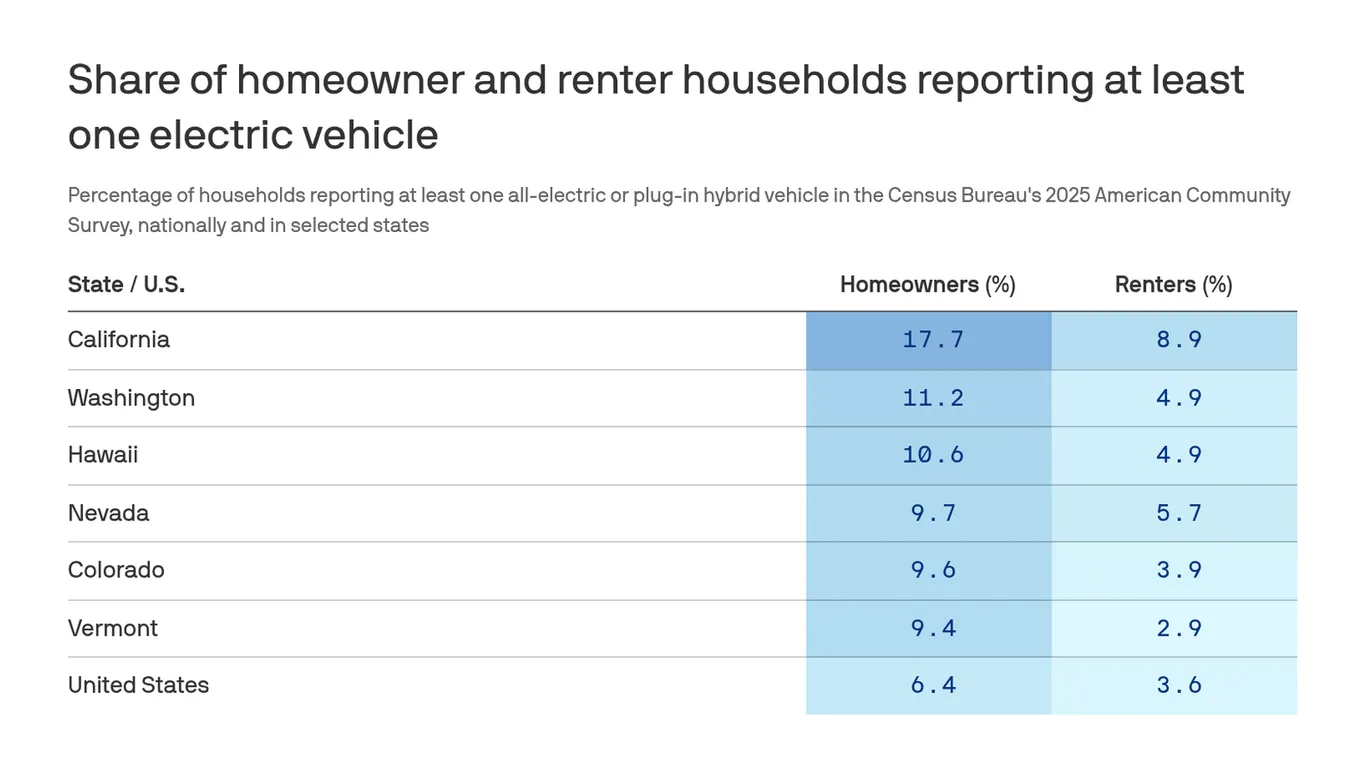
数据来源:美国人口普查局,2025年美国社区调查1年期估计;表格制作:Russell Contreras/Axios 2025年,美国房主拥有电动汽车的可能性几乎是租房者的两倍,新的人口普查数据显示,揭示了美国向电动汽车转型过程中存在的显著鸿沟。
Data: U.S. Census Bureau, 2025 American Community Survey 1-year estimates; Table: Russell Contreras/Axios Homeowners were nearly twice as likely as renters to have an electric vehicle in 2025, new Census data show, revealing a striking divide in America's shift to electric cars. Why it matters
重要性房主身份只是影响电动汽车普及的一个因素,但可靠的充电接入至关重要——这让拥有私人车道或车库的房主比租房者更具优势,尤其是居住在多户型建筑中的租房者。
Homeownership is just one factor in EV adoption, but reliable access to charging is critical — giving homeowners with private driveways or garages an advantage over renters, particularly those in multifamily buildings. By the numbers:
数字解读:根据周四发布的2025年美国社区调查,约730万美国家庭——占全国1.34亿家庭的5.5%——报告拥有至少一辆电动汽车。
About 7.3 million U.S. households — 5.5% of the nation's 134 million — reported having at least one EV, according to the 2025 American Community Survey released Thursday.
- 房主报告拥有电动汽车的比例为6.4%,而租房者为3.6%。
• Homeowners reported EVs at a rate of 6.4%, compared with 3.6% of renters.
- 加利福尼亚州以总计13.8%的比例领跑全国,是全国平均水平的两倍多。
• California led the nation at 13.8% overall, more than twice the national rate.
- 北达科他州(1.3%)、怀俄明州(1.6%)和路易斯安那州(1.6%)排名最低之列。
• North Dakota (1.3%), Wyoming (1.6%) and Louisiana (1.6%) ranked among the lowest. State of play:
现状:人口普查局首次询问在家停放车辆的家庭是否拥有或租赁电动汽车,提供了一个关于谁已转用电动汽车的全国性快照。
For the first time, the Census Bureau asked households with vehicles kept at home whether they owned or leased an EV, offering a nationwide snapshot of who has gone electric.
- 这些数据涵盖纯电动汽车和插电式混合动力汽车。
• The figures cover fully electric vehicles and plug-in hybrids.
我们的观察: Axios交通记者Joann Muller表示,许多因素(包括地方政府政策)都可能影响电动汽车普及率,但归根结底,取决于负担能力和充电接入。• 收入较高的房主更有能力负担电动汽车,有时将其作为第二辆车。
Our thought bubble: Many factors, including local government policies, can influence EV adoption rates, but ultimately, it comes down to affordability and access to charging, says Axios Transportation Correspondent Joann Muller • Homeowners with higher incomes are more likely to afford EVs, sometimes as a second car.
深度看点:佛蒙特大学和加州大学戴维斯分校研究人员2026年的一项研究发现,在佛蒙特州伯灵顿,租赁房产安装家用充电桩的成本更高。
The intrigue: 2026 study by researchers at the University of Vermont and University of California, Davis, found higher home-charger installation costs at rental properties in Burlington, Vermont.
- 即使研究人员考虑了房屋价值和车辆偏好等因素后,租房者采用纯电动汽车的可能性也较低。
• Renters were also less likely to adopt fully electric vehicles, even after researchers accounted for home values and vehicle preferences.
聚焦:即使是全美电动汽车普及率最高的加利福尼亚州,新的普查数据显示,房主与租户之间也存在显著差距。
Zoom in: Even California, the nation's EV leader, has a sharp homeowner-renter divide, new Census data show.
- 约 17.7% 的房主表示拥有电动汽车,而租户这一比例为 8.9%。
• About 17.7% of homeowners reported an EV, compared with 8.9% of renters.
- 硅谷核心区所在的圣克拉拉县以 24.1% 的家庭拥有率领跑全美,约合 16.3 万户家庭。
• Santa Clara County, home to much of Silicon Valley, led the nation at 24.1% of households — roughly 163,000 households.
华盛顿州(8.9%)、夏威夷州(8.5%)和内华达州(8.2%)位列各州前茅。
Washington (8.9%), Hawaii (8.5%) and Nevada (8.2%) ranked among the leading states.
- 加州之外,科罗拉多州博尔德县和弗吉尼亚州劳登县均记录在案的比例为 13.9%。
• Outside California, Boulder County, Colorado, and Loudoun County, Virginia, each recorded 13.9%. Yes, but:
但需注意:加州租户的电动汽车拥有率高于全美房主的整体水平。
California renters reported EVs at a higher rate than homeowners nationwide.
- 普查数据未追踪充电设施获取情况,也未解释家庭选择电动汽车的原因。
• The Census figures don't track charging access or explain why households choose EVs.
- 由于仅有一年数据,也无法判断房主与租户之间的差距是否已扩大。
• With only one year of data, they also can't tell us whether the homeowner-renter gap has grown.