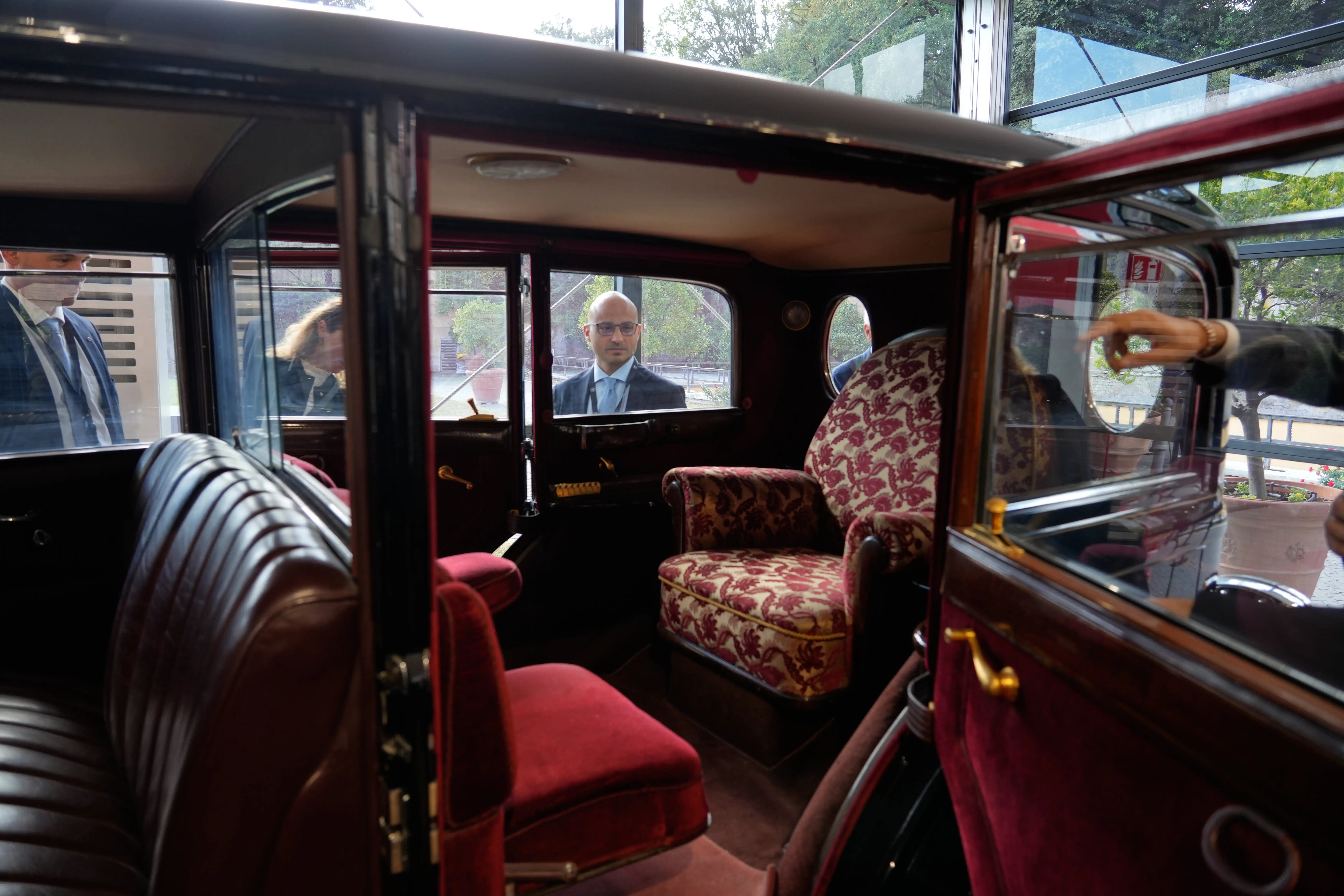
这些可真是些“圣车”。梵蒂冈正以一场新展览向教皇座驾致敬。“教皇座驾百年”展览展出了自1930年以来教皇们使用的八辆梅赛德斯-奔驰汽车,于本周开幕。
These are some holy rollers. The Vatican is paying homage to the popemobile with a new exhibition. “A Century of the Popemobile,” featuring eight Mercedes-Benz that popes have used since 1930, opened this week.
教皇利奥十四世在展览启动前介绍了教皇座驾的演变历程——展览设在梵蒂冈博物馆的方形花园(Giardino Quadrato)内的一座玻璃展馆中。
Pope Leo XIV explained the evolution of the popemobile ahead of the launch of the exhibit — housed in a glass pavilion in the Vatican Museums’ Giardino Quadrato.
据宗教新闻社报道,教皇利奥周三在梵蒂冈与展览组织者的一次私人会晤中表示:“几十年来,教皇座驾已从一种交通工具演变为一种相遇的工具,使教宗能够在牧灵访问和公开庆典中更贴近信众。”
“Over the decades, the popemobile has evolved from a means of transportation into an instrument of encounter, enabling the pontiff to draw closer to the faithful during pastoral visits and public celebrations,” Pope Leo told organizers of the exhibit during a private meeting at the Vatican on Wednesday, according to Religion News Service.
他补充道:“因此,你们的工作帮助促进了教会接触民众、向世界传递信仰、希望与仁爱信息的使命。”
“In this way, your work has helped facilitate the church’s mission of reaching out to people and bringing a message of faith, hope and charity to the world,” he added.
该展览将持续至明年1月,并非展示所有教皇座驾,而仅展出来自梅赛德斯的车款,因为该公司提供了其中大部分。
The exhibit, which will run until January, does not feature every popemobile, but only ones manufactured by Mercedes, which has supplied most of them.
梵蒂冈博物馆馆长芭芭拉·亚塔对该媒体表示:“一百多年来,每位教皇都从梅赛德斯-奔驰获得一辆教皇座驾,并将其作为对话、分享、祝福、见证民众和出行的载体。”
“Over 100 years, each pope has received a popemobile from Mercedes-Benz and used it as a vehicle of dialogue, as a vehicle of sharing and blessing and seeing the people and traveling,” Barbara Jatta, director of the Vatican Museums, told the outlet.
展出的最古老车款是第一辆正式教皇座驾——一辆黑色的纽堡460型豪华轿车——由德国汽车制造商于1930年赠予庇护十一世,后者任教皇时间为1922年至1939年。
The oldest car featured is the first official popemobile — a black Nürburg 460 limousine — gifted in 1930 to Pope Pius XI, who served from 1922 until 1939, by the German car manufacturer.
梵蒂冈博物馆历史收藏部策展人桑德罗·巴尔巴加洛对CNN表示:“它‘是专门为教皇使用而建造、设计和准备的,仅通过对比就能看出它是如何从量产车转变为独一无二的座驾’。”
It “was specifically built, designed, and prepared for papal use, so much so that just by comparing it, you can see how it transitions from the serial to the unique,” Sandro Barbagallo, curator of the Historical Collections Department at the Vatican Museums, told CNN.
“从这一点可以清楚地看出,此后所有的座驾都是专门制造的,目的是让教宗能被看见,但要在绝对安全、甚至可以说是舒适的条件下被看见并看见他人。”在教宗庇护十一世之前,教宗使用马车和手抬教座,后者由侍从抬在肩上。
“From this point, it is clear how all the cars were then made, precisely to allow the pope to be seen, but to be seen and to see in total safety and, I would even say, comfort.”Before Pope Pius XI, popes used horse-drawn carriages and gestatorial chairs, which were carried aloft on the shoulders of attendants.
“教宗座驾”这一术语是新闻界在教宗保禄六世1965年访问纽约期间创造的,当时他乘坐一辆定制的林肯大陆轿车。
The term popemobile was coined by the press during Pope Paul VI’s visit to New York in 1965, where he rode in a custom Lincoln Continental.
展出的另一辆车是教宗若望二十三世1960年的梅赛德斯-奔驰300 d Landaulet敞篷轿车,它配有可拆卸的后侧窗,标志着让教宗更贴近信众这一趋势的开端。
Another vehicle on display is Pope John XXIII’s Mercedes-Benz 300 d Landaulet from 1960, which featured removable rear side windows, marking the beginning of a trend toward allowing popes to get closer to the faithful.
1965年,梅赛德斯-奔驰向教宗保禄六世献上了600 Pullman Landaulet敞篷轿车,该车也在展出之列。它配备加高车顶和折叠篷顶,使教宗在敞篷车中能更清晰地被看见。
In 1965, Mercedes-Benz presented the 600 Pullman Landaulet to Pope Paul VI, which is also on display. It featured a raised roof and folding top, allowing the pontiff to be seen more clearly in the open car.
1980年,为教宗若望·保禄二世访问德国制造了一辆更现代的教宗座驾——梅赛德斯-奔驰230 G。它配备透明有机玻璃圆顶,使教宗既受到保护又能被人群看见。
In 1980, a more modern popemobile, the Mercedes-Benz 230 G, was built for John Paul II’s visit to Germany. It featured a transparent Plexiglas dome to keep him both protected and visible to the crowds.
教宗利奥还谈到了2024年献给教宗方济各的首辆电动教宗座驾——教宗方济各因环保倡导常被称为“绿色教宗”。
Pope Leo also spoke about the first electric popemobile — presented to Pope Francis, often called the “Green Pope” for his environmental advocacy — in 2024.
他说:“秉持这一精神,我鼓励你们继续将技术创新置于服务人类尊严、关怀受造物和共同利益之上。”
“In this spirit, I encourage you to continue placing technological innovation at the service of human dignity, care for creation and the common good,” he said.