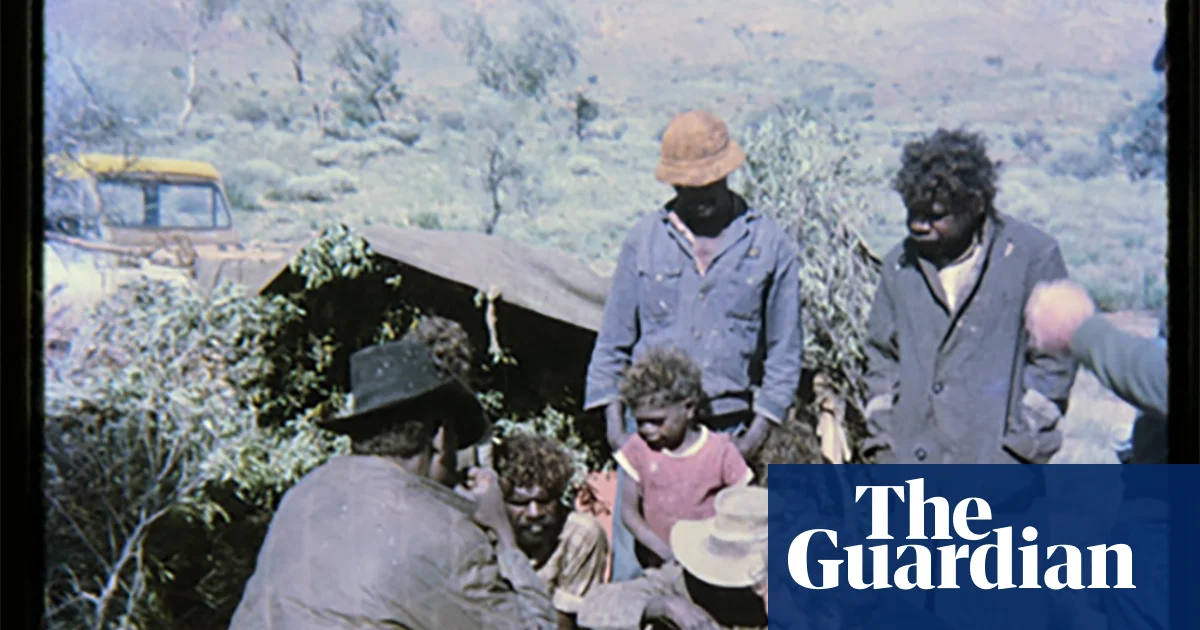
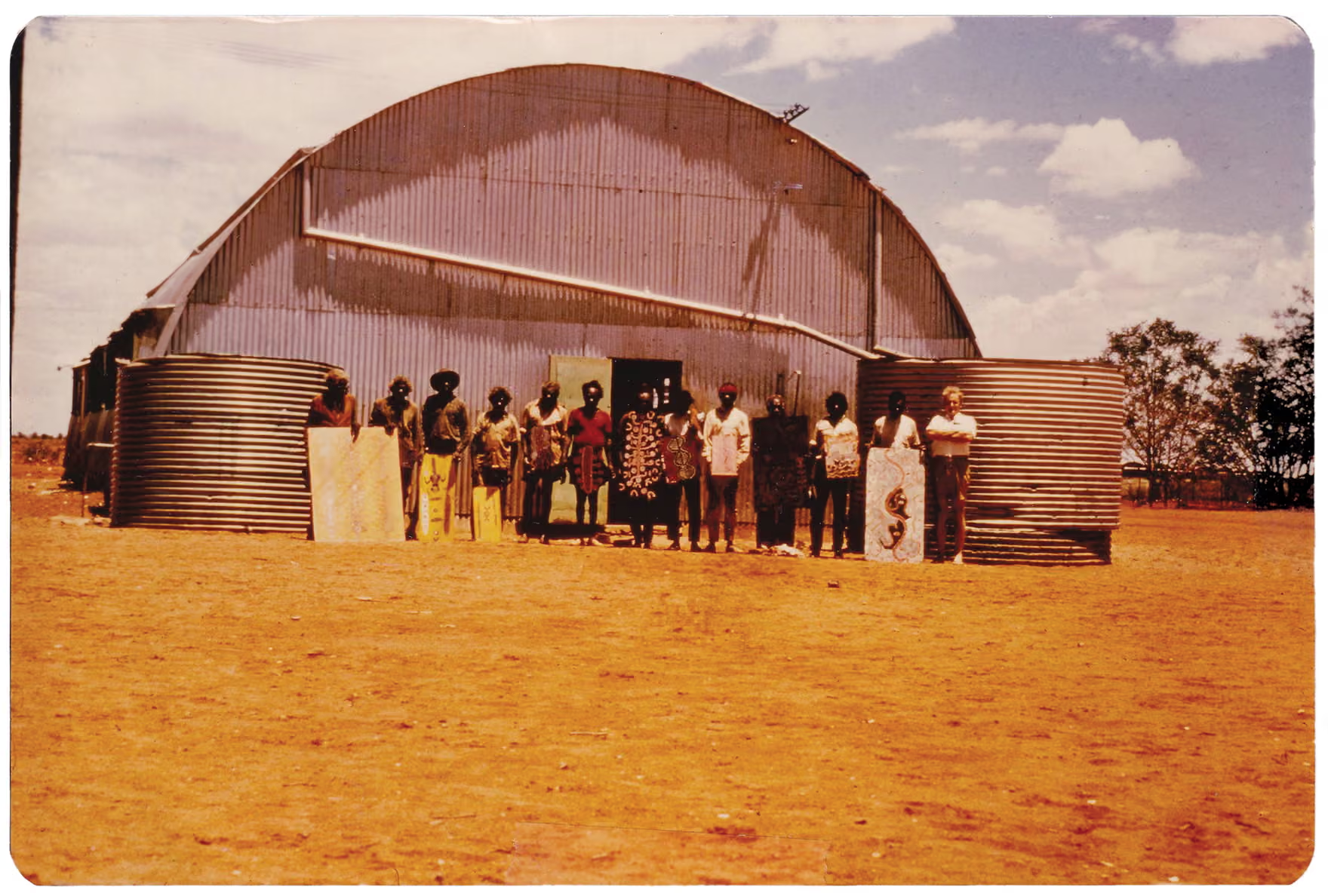
杰弗里·巴登与部分绘画者(及一名儿童)的合影,这张照片最初引起了基蒂·豪泽的注意。
The photo of Geoffrey Barden and some of the painting men (and child) that first caught Kitty Hauser's attention.
。在公众意识中,巴登在很大程度上仍作为艺术运动起源故事里那位同名的英雄与殉道者而存在。但一部新传记正在揭开这个故事背后的神话与疯狂。与许多奠基故事一样,关于享誉全球的西部沙漠原住民“点画”运动起源的白人澳大利亚叙事充满了神话色彩。
Photograph: courtesy of Dorn Bardon Bardon has largely remained in popular consciousness as the synonymous hero and martyr of the art movement’s origin story. But a new biography is unravelling the myth, and the madness, behind the tale Like many foundation stories, the white Australian narrative about the birth of the globally celebrated Western Desert Aboriginal “dot painting” movement is steeped in myth.
几十年来,故事一直是这样讲的。1971年,一位来自悉尼的年轻、古怪的中产阶级美术教师杰弗里·巴登来到偏远、推行同化政策的原住民定居点帕潘亚,该地位于爱丽斯泉以西250公里处。
For decades it has gone like this. In 1971 a young, eccentric middle-class art teacher from Sydney, Geoffrey Bardon, arrives in the remote assimilationist Aboriginal settlement of Papunya, 250km west of Alice Springs.
在这个由不同沙漠民族(瓦尔皮里人、平图皮人、卢里贾人、安马蒂尔人、阿伦特人和皮詹加加拉人)组成的定居点,巴登遇到了一群男子,其中包括克利福德·波瑟姆、查理·塔拉瓦、米克·纳马拉里·贾帕尔贾里、蒂姆·卢拉·贾帕尔贾里、卡帕·詹皮金帕和马克西·詹皮金帕。
At the settlement, made up of disparate desert peoples (Warlpiri, Pintupi, Luritja, Anmatyerr, Arrernte and Pitjantjatjara), Bardon meets a group of men including Clifford Possum, Charlie Tarawa, Mick Namarari Tjapaltjarri, Tim Leura Tjapaltjarri, Kaapa Tjampitjinpa and Maxie Tjampitjinpa.
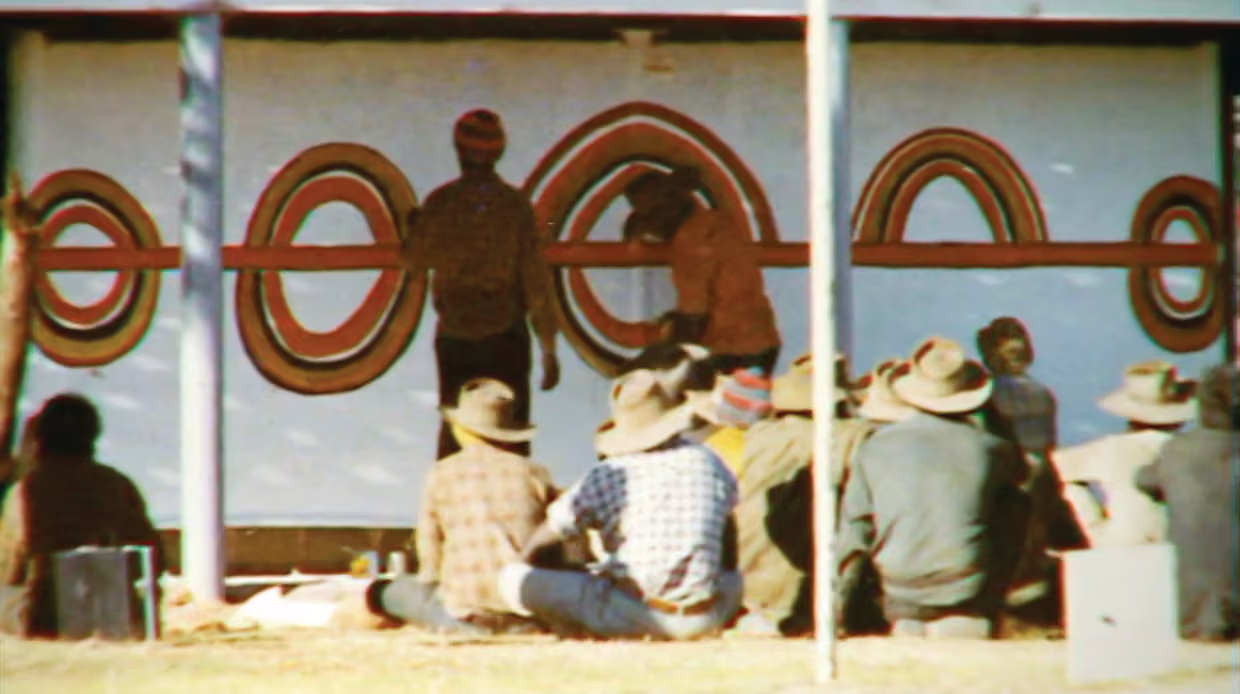
他说服这些男子在坚硬表面上绘制他们此前只用手指画在沙上、并在仪式中画在彼此身上的“梦幻”故事,最初是在学校外墙上一幅描绘蜜蚁的巨幅壁画。
He convinces the men to paint on hard surfaces the “dreaming’’ stories they had hitherto only committed with fingers to sand and ceremonially on to one another’s bodies, beginning with an expansive mural of honey ants on the external school wall.
1971年正在绘制的蜜蚁壁画,杰弗里·巴登拍摄的影像(出自《图案先生》)。
The honey ant mural being painted, 1971, footage by Geoffrey Bardon (from Mr Patterns).
巴登开始出售他们的作品。由此,他不仅构想出了西部沙漠画派,还催生了一个巨大的全球市场,用以容纳评论家罗伯特·休斯所称的“20世纪最后一场伟大的艺术运动”。这些男子后来被称为著名的帕潘亚“绘画者”。但巴登遭到白人同化主义当局的强烈反对,以至于他不得不逃离帕潘亚,身心俱疲。他此后再也没有工作过。
2003年,巴登62岁去世,但他在大众和互联网意识中(尽管不一定在21世纪艺术学界)长期被视为帕潘亚——以及更广泛的西部沙漠——艺术运动起源故事的同义英雄和殉道者。
Bardon starts to sell their works. In so doing he not only conceives the western desert painting school but also a voracious global market for what the critic Robert Hughes called “the last great art movement of the 20 century’’. The men will later become known as the celebrated Papunya “painting men’’ But Bardon meets impossible opposition from the white assimilationist authorities to the point where he must flee Papunya with his physical and mental health in tatters. He never works again. death at 62 in 2003 Bardon has largely remained in popular and internet consciousness (if not that of the 21 century art academy) as the synonymous hero and martyr of the Papunya– and, more broadly, Western Desert – art movement’s origin story.
但一本新传记——《艺术狂热:杰弗里·巴登与帕潘亚绘画者》,作者基蒂·豪瑟——对这位教师及其文化上有些寄生的年长大律师兄弟詹姆斯(“吉姆”)巴登带来了非凡的新认识。
But a new biography –Art Mania: Geoffrey Bardon and the Painting Men of Papunya by Kitty Hauser – brings extraordinary new understanding to the teacher and his somewhat culturally parasitic older barrister brother, James (“Jim’’) Bardon.
《艺术狂热》不仅仅是关于豪瑟所称的“杰夫”及其在西部沙漠绘画运动兴起中所起作用的传记。它也部分讲述了吉姆的故事,他利用弟弟1971年在帕潘亚度过的一年左右的时间,为自己两部小说(包括备受好评的1991年小说《夜之革命》,该书获得了维多利亚州总理文学奖新人奖)、电影纪录片以及他为杰夫撰写的大量文章和演讲提供了创作素材。作者基蒂·豪瑟在新南威尔士州厄尔伍德的家中。
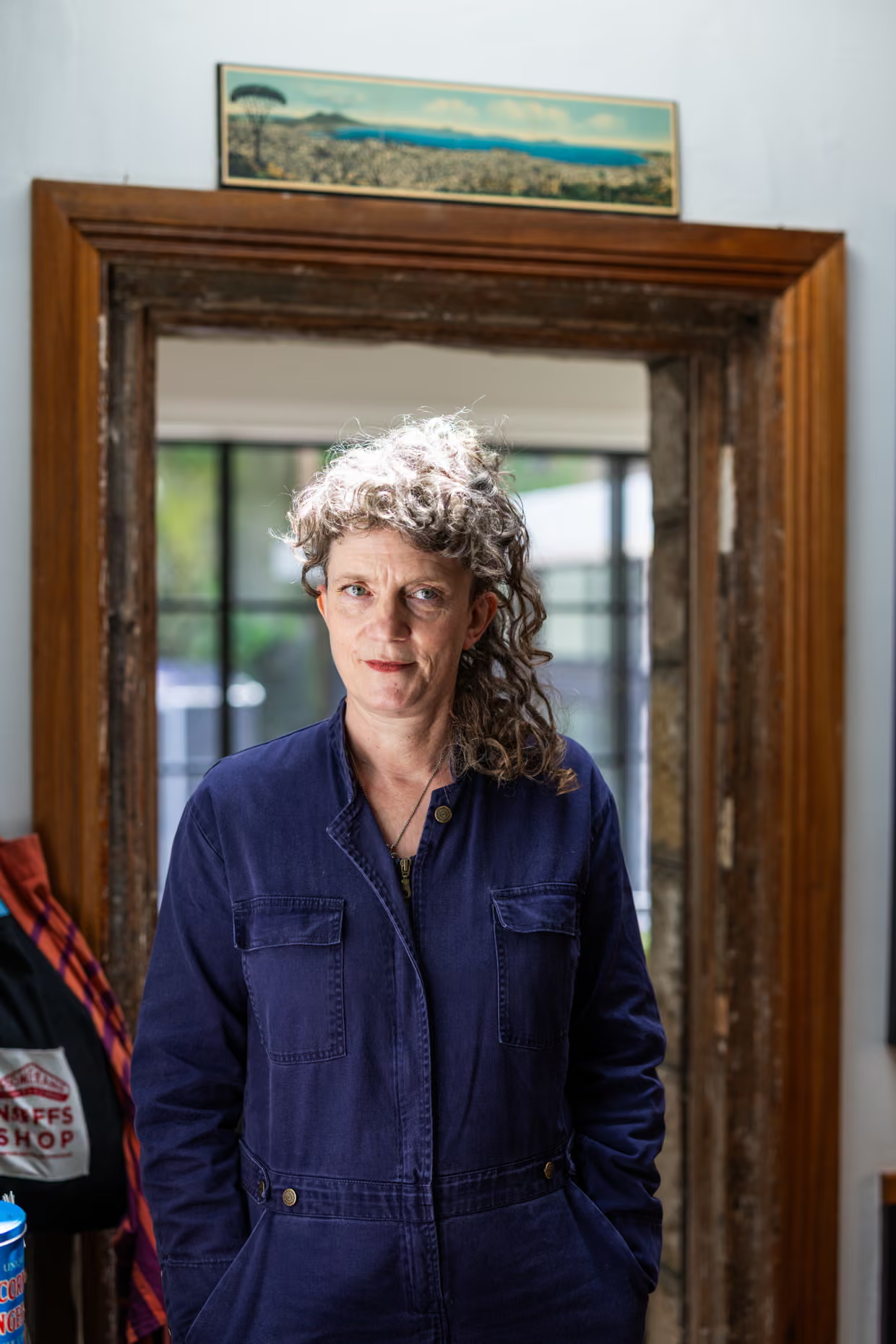
Art Mania is more than a biography of “Geoff’’, as Hauser calls him, and his role in the emergence of the Western Desert painting movement. It is also partly about Jim, who used his younger brother’s year or so at Papunya from 1971 as his own creative fodder for two novels (including the critically acclaimed 1991 novel, Revolution by Night, which won the Victorian premier’s literary award for new writing), film documentaries, and numerous articles and speeches he penned for Geoff. Author Kitty Hauser at her home in Earlwood, NSW.
在书中,豪瑟对这位年长的兄弟得出结论:“吉姆从绘画者们,或者说他对他们的想象中,获得了不少文学资本。几乎找不到比这更好的挪用例子了,即使它一直未被察觉(也许包括杰夫在内),因为吉姆的著作相对默默无闻。”豪瑟研究了杰夫遗孀多恩保存的大量巴登家族私人档案,创作出一本多层次的著作,探讨跨文化的主动性与窃取、谁有权讲述谁的故事,以及白人救世主/英雄神话模板长期以来如何在帕潘亚艺术故事上形成一种叙事不透明——一种殖民国家的白内障。
In the book, Hauser concludes of the elder brother: “Jim got a fair bit of literary mileage out of the painting men, or his idea of them. There could hardly be a better example of appropriation, even if it has gone under the radar (including, perhaps, Geoff’s) because of the obscurity of Jim’s writing.’’ Hauser has examined the extensive private Bardon archive held by Geoff’s widow, Dorn, to produce a multi-layered book about intercultural agency and theft, about who gets to tell whose stories and about how a template of white saviour/hero mythology has long formed a narrative opacity – a sort of settler state cataract – over the Papunya art story.
豪瑟表示她“无法知道当时绘画者们在想什么”。她写道,她的书是“一个白人的故事,一个白人神话的叙述”。
Hauser makes “no claim to know what was going on” for the painting men at the time. Hers is, she writes, “a white story, an account of a white myth”.
插图:Kitty-Hauser HR 这也是一本关于心理健康的书——书名中的“狂躁”——以及精神病学。因为巴登于1972年离开帕潘亚时,身心俱疲,随后被收治入悉尼的切尔姆斯福德医院,由精神科医生哈里·贝利治疗。在那里,他接受了深度睡眠疗法——一种野蛮的、与精神分析背道而驰的治疗方式,它将长期的大剂量镇静与电痉挛疗法相结合,以“重置”大脑和精神。该疗法在1990年的皇家调查中被揭露,导致24人死亡。
Illustration: Kitty-Hauser HR This is also a book about mental health – the mania of the title – and psychiatry. For after Bardon left Papunya in 1972, physically and mentally ragged, he was admitted to Sydney’s Chelmsford hospital under psychiatrist Harry Bailey There he was subjected to deep sleep therapy – a barbaric treatment, antithetic to psychoanalysis, that blended extended heavy sedation with electro-convulsion to “re-set” the brain and psyche. The treatment was exposed in a 1990 royal commission as responsible for 24 deaths.
关于帕潘亚——这个旨在同化人们融入“欧洲式工作和回报”的定居点——以及切尔姆斯福德,豪瑟写道:“难道这两个机构不都试图(不完美地)制造一种刻意的遗忘,一种对头脑的漂白,在一个案例中是这样,而在下一个案例中则是对整个文化的漂白吗?”抹除记忆。切尔姆斯福德早已在出生于英国的豪瑟的意识之中,当时,她于2003年定居澳大利亚后不久,看到一篇关于巴登和帕潘亚绘画男子的1970年代短篇杂志文章。
Of Papunya, the settlement for the assimilation into “European forms of work and rewards” and Chelmsford, Hauser writes: “Didn’t both institutions seek to instigate (imperfectly) a deliberate forgetfulness, a whitewashing of minds, in one case, and of entire cultures in the next?”Obliterating memories Chelmsford was already in British-born Hauser’s consciousness when, soon after settling in Australia in 2003, she saw a short 1970s magazine article about Bardon and the Papanya painting men.
这篇文章刊登了一张富有感染力的彩色照片,照片中,四肢粗壮的巴登坐在地上。他周围围着一些绘画男子(还有一个孩子),他们看着他膝上的打开的书或素描本。
The article featured an evocative colour photograph of the large-limbed Bardon sitting on the earth. He is surrounded by some of the painting men (and a child) who look upon the open book or sketchpad on his lap.
她说:“是这张照片,加上不太可能提到切尔姆斯福德医院,让我产生了兴趣——两个看似毫无关联的事物(原住民艺术和深度睡眠治疗)通过这个人联系在了一起。当然,这也是一个非凡的故事,带有——正如我现在意识到的——神话的元素。”与巴登一样,豪瑟的岳母诺琳在1970年代也是贝利在该医院的病人,她的“痛苦持续存在,对她本人和家庭都产生了影响”。对豪瑟来说,这两个看似毫无关联的机构的综合,构成了她这本书的萌芽。
She says: “It was the photograph, in combination with the unlikely mention of Chelmsford hospital, that got me interested – two apparently disconnected things (Aboriginal art and deep sleep treatment) connected through this man. Plus it was, of course, a remarkable story, with – as I now realise – elements of myth.”Like Bardon, Hauser’s mother-in-law, Noeleen, had been a patient of Bailey’s at the hospital in the 1970s and her “distress continued, with repercussions both for her and the family”. The synthesis, for Hauser, of these two otherwise seemingly disparate institutions formed the seed of her book.
“切尔姆斯福德与帕潘亚的并置超现实却暗示着主题:睡眠、遗忘、粉饰,”豪瑟说。“我想知道医院与定居点之间是否存在相似之处,因为在我看来,两者都以某种方式试图抹除记忆。”‘一个结局漫长的短篇故事’虽然巴登对人类学知之甚少,但他将自己置于西部沙漠艺术创作叙事中心的做法,与众多人类学家早期与原住民社区的文化接触相呼应。
“The juxtaposition of Chelmsford and Papunya was surreal but suggestive thematically: sleep, forgetfulness, whitewashing,” Hauser says. “I wondered if there were parallels between the hospital and the settlement, since both sought – so it seemed to me – to obliterate memories in one way or another.”‘A short story with a long ending’While Bardon had little knowledge of anthropology, his self-placement at the centre of the Western Desert art creation narrative echoes that of numerous anthropologists’ early cultural contact with First Nations communities.
“并非要贬低他及时且有影响力的干预,”原住民艺术策展人兼作家玛戈·纳瓦·尼尔说,但“历史往往会夸大巴登这类白人对黑人社区中已有绘画实践的影响力,而这些社区的主体性、声音和工作很容易被掩盖。”从唐纳德·汤姆森到诺曼·廷代尔对原住民部落的地理绘制及采集原住民毛发样本以制作其基因图谱,再到查尔斯·芒特福德对东北阿纳姆地树皮艺术的早期“发现”(如同巴登在帕潘亚一样,他认识到其审美价值,并是最早将其从社区输出的人之一),白人将自己英雄式地置于原住民文化知识前沿——作为发现者——并非新鲜事。
“Not to take anything away from his timely and impactful intervention,” says Margo Ngawa Neale, Indigenous art curator and writer, but “history tends to inflate the influence of white fellas like Bardon over the existing painting practices in Black communities where agency, voice and work is easily eclipsed.”From Donald Thomson to Norman Tindale’s geographic mapping of First Nations tribes and collecting of Aboriginal hair samples for his genetic map, to Charles Mountford’s early “discovery’’ of North East Arnhem land bark art (like Bardon at Papunya he recognised its aesthetic value and was among the first to export it from communities), white men placing themselves heroically at the vanguard of Indigenous cultural knowledge – as discoverers – is nothing new.
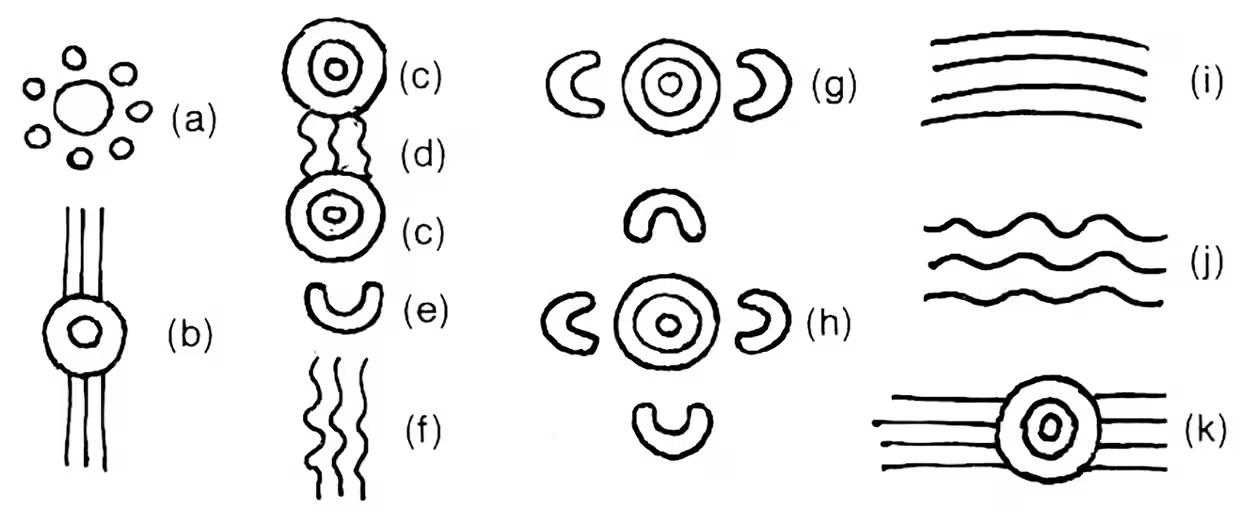
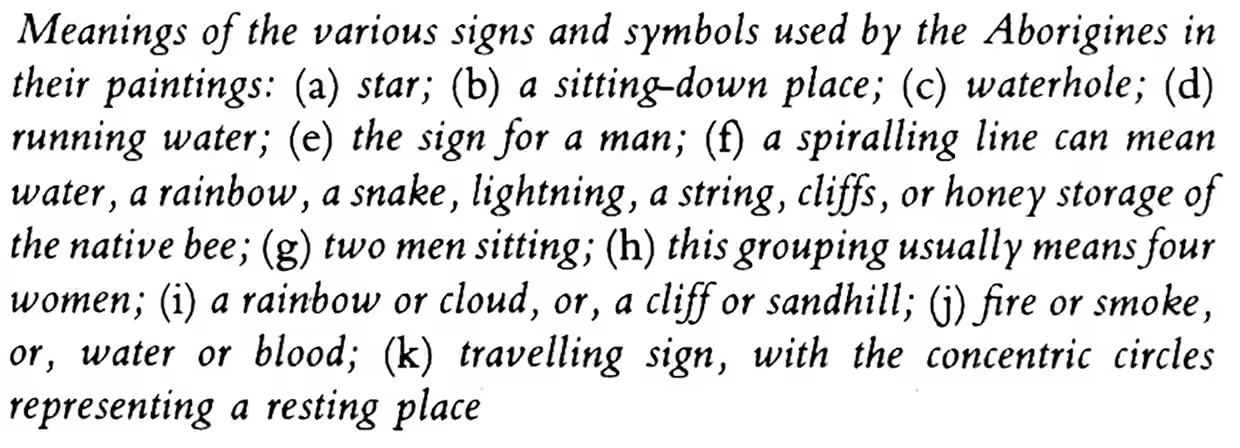
《符号与符号的含义》,出自杰弗里·巴登1979年著作《西部沙漠原住民艺术》尼尔,她是甘拜恩吉尔和瓦拉朱里血统,表示巴登与帕潘亚艺术的参与代表着“一个结局漫长的短篇故事”。
‘Meanings of the signs and symbols’, in Geoffrey Bardon’s 1979 book, Aboriginal Art of the Western Desert Neale, who is of Gumbaynggirr and Wiradjuri heritage, says Bardon’s involvement with Papunya art represents “a short story with a long ending”.
“他受过伤,却是个有才华的人,他将自己最好的一面奉献给了帕潘亚的绘画者们——在许多人眼中,他成了救世主,即便他自己未必如此。他是在正确的时间、正确的地点,遇到了正确的人。”巴登在帕潘亚的短暂时光充满热情与不知疲倦的投入。除了在帕潘亚小学任教(巴登本人也是一名画家,且具备美术教师资格),他还自掏腰包为这些人提供丙烯颜料和画板等材料。
“He was a damaged man but a talented one who gave the best of himself to the painting men of Papunya – he became a messiah in the eyes of many, if not himself. He was the right man in the right place at the right time.”Bardon’s short time at Papunya was a whirlwind of enthusiasm and tireless commitment. Besides teaching at Papunya elementary school (Bardon was himself a painter and qualified art teacher), he used his own resources to supply materials including acrylic paints and boards to the men.
巴登首先看中这些人作品的艺术价值,而非其人类学价值。周末,他把自己的康比货车装满这些人的作品,开往爱丽斯泉,将画作卖给一个初创的艺术中心,再带着钱回来给这些人,而这些人都必须为白人管理者在定居点里承担其他体力劳动任务。1971年12月,帕潘亚“绘画者”与杰夫合影。
Bardon recognised the men’s profoundly beautiful works for their artistic merit ahead of their anthropological value. On weekends he packed his Kombi van with the men’s works and drove to Alice Springs where he sold the paintings to a fledgling arts centre and returned with money for the men, who all had to perform other manual work duties around the settlement for the white administrators. Papunya ‘painting men’ with Geoff in December 1971.
摄影:弗雷德·弗里斯(GBP)一些掌权者认为绘画是对工作的干扰。巴登在帕潘亚生活和工作中那种混乱、凌乱的作风,再加上他单身汉的身份,招致了批评和嘲笑。
Photograph: Fred Friis (GBP) Some in authority viewed the painting as a distraction from work. Bardon’s chaotic, shambolic approach to his life and work in Papunya – together with his status as a single man – brought him criticism and derision.
“幕后有人质疑杰夫的品格和能力,尤其是在管理资金方面,”豪瑟写道。
“Behind the scenes questions were raised about Geoff’s character, and his capacities, especially in relation to managing money,’’ Hauser writes.
与此同时,他与在爱丽斯泉出售画作的女性帕特·霍根之间产生了紧张关系。随后,定居点的一名高级官员指控他“贩卖原住民绘画作品”。
Meanwhile tensions developed with Pat Hogan, the woman selling the artworks in Alice Springs. Then a senior official at the settlement accused him of “trafficking in Aboriginal paintings”.
虽然豪瑟发现巴登曾留下书面评论称“我总是想欺骗他们”,但她表示“没有证据表明”他真的这么做了。相反,他的记账工作,如同他许多方面的情况一样,只是混乱不堪,他在萌芽的原住民艺术市场中是“边做边摸索”。
While Hauser uncovered a written comment by Bardon that “I was always tempted to cheat them”, she says “no evidence has turned up” that he did. Rather, his record-keeping, like so much about him, was simply chaotic and he was “making it up as he went along” in the nascent Aboriginal art market.
在帕潘亚,巴登有时会无意中接触到秘密的神圣故事。该定居点中不同原住民社区的男性之间会出现相当大的紧张关系,因为其中一些男性正在分享那些对外来者——包括巴登——来说在文化上是禁忌的故事。
At Papunya, Bardon was sometimes unwittingly exposed to secret, sacred stories. Considerable tensions would emerge between the men of the disparate First Nations communities represented at the settlement because some of the men were sharing stories that were culturally taboo for outsiders – among them Bardon – to see.
插图:提供 巴登变得越来越偏执、孤立和抑郁。他觉得自己受到监视,有一次甚至被澳大利亚安全情报组织监视。
Illustration: Supplied Bardon became increasingly paranoid, isolated and depressed. He thought he was under surveillance including, once, by Asio.
豪泽引用他的遗孀多恩的话说:“他就是受不了批评。”最终,1972年的一个星期五,巴登“去爱丽丝泉酗酒了”,住进一家酒吧,并“在那里辱骂和虐待他能找到的任何人”,据其兄弟称。但那些绘画的男人,其中许多人爱他,也依赖他,带着他们准备出售的画作跟随他进了城,画作“裹得像受伤的动物”。星期天,他被送进了医院。
Hauser quotes his widow, Dorn: “He just couldn’t take criticism.”Finally, one Friday in 1972, Bardon went off “on a binge” to Alice Springs, stayed in a pub and “insulted and abused anyone he could find once there”, according to his brother. But the painting men, many of whom loved him but also relied on him, followed him into town with their works intended for sale “wrapped up like wounded animals”. On the Sunday he was hospitalised.
吉姆穿越大陆,将杰夫带回他父母位于悉尼绅士化的兰德威克的家中。
Jim crossed the continent to bring Geoff back to his parents’ home in Sydney’s gentrified Randwick.
“自大、妄想、偏执、愤怒、羞耻以及一种持续的辜负所有人的感觉——狂喜阶段之后不可避免的坠落阶段,”豪泽这样描述那段时期。“我们或许可以对此蒙上一层帷幕,就像杰夫本人所做的那样,至少在公众面前是这样;只不过与之相关的躁狂,正是那种适合带到跨文化聚会上的东西,或者至少不是错误的东西。”‘认知的局限’回到兰德威克后,巴登告诉家庭医生,他“在努力与原住民共同发展一种新艺术形式的过程中感到沮丧”。
“Grandiosity, delusion, paranoia, fury, shame and a lingering sense of having let everyone down – the inevitable earthward phase following the exuberant one,” Hauser writes of that time. “We might draw a curtain over it, as Geoff himself did, in public at least; except that the mania to which it was connected had been the right sort of thing to bring to the cross-cultural party, or at least not the wrong one.”‘The limits of knowing’Back in Randwick, Bardon told the family doctor he was “depressed in my struggle to evolve a new art form with the Aboriginals”.
他被转介给精神科医生哈里·贝利,并于1972年8月被收入切尔姆斯福德医院,接受深度睡眠疗法。
He was referred to psychiatrist Harry Bailey and admitted to Chelmsford for deep sleep therapy in August 1972.
他很幸运地活过了这种已经被证伪的精神疗法,该疗法旨在通过给患者用药使其昏迷数天或数周,从而在精神上“重置”患者,而这些患者正在接受从药物成瘾到抑郁症和情绪障碍等各种问题的治疗。
He was fortunate to survive the psychiatric therapy, already discredited, that aimed to psychiatrically reset patients who were being treated for everything from substance addiction to depression and mood disorders by drugging them to keep them unconscious for a period of days or weeks.
巴登在他生命最后一年拍摄的纪录片《图案先生》中说:“我确实康复了,但无法保住一份像样的工作,从那以后就一直是个病残之人。”
“I did recover but could not hold a proper job and have been an invalid ever since,” Bardon said in a documentary, Mr Patterns, filmed in the last year of his life.
在制作《米克与月亮》(1979年一部关于画家之一米克·纳马拉里·贾帕尔贾里的纪录片——为此他曾短暂回到帕潘亚)期间,杰夫开始与多恩·桑德斯交往,后者是巴登家的寄宿者。他们结了婚,搬到新南威尔士州北部的塔里。他们有两个儿子。他们一直住在塔里,直到他去世,主要靠他的养老金和写作的微薄收入维持生活。
While producing Mick and the Moon (a 1979 documentary about one of the painting men, Mick Namarari Tjapaltjarri – for which he returned briefly to Papunya) Geoff began a relationship with Dorn Saunders, a boarder at the Bardon home. They married and moved to Taree in northern New South Wales. They had two sons. They lived in Taree until his death, largely surviving on his pension and the meagre earnings from writing.
在帕潘亚,他获得了数十幅画作。富有的收藏家玛格丽特·卡内基在20世纪80年代买下了巴登的许多作品。随着全球对西部沙漠绘画市场的爆发式增长,这类作品后来价值大幅攀升。巴登曾对一名记者说:“当时我没有多少钱。所以,我不得不把它们卖掉。”杰夫·巴登在帮助和支持帕潘亚画家方面的真诚是毋庸置疑的。但正如豪泽所揭示的,除了他的利他主义之外,显然他也把帕潘亚视为个人的艺术机遇。
In Papunya he had acquired dozens of paintings. A wealthy collector, Margaret Carnegie, bought many of Bardon’s pieces in the 1980s. Such works would later profoundly multiply in value as the global market for Western Desert painting exploded. Bardon would tell a journalist, “At the time I didn’t have much money. So, I had to sell them.”There can be no doubting Geoff Bardon’s sincerity in helping and supporting the painting men of Papunya. But beyond his altruism, as Hauser reveals, it is clear that he also considered Papunya a personal artistic opportunity.
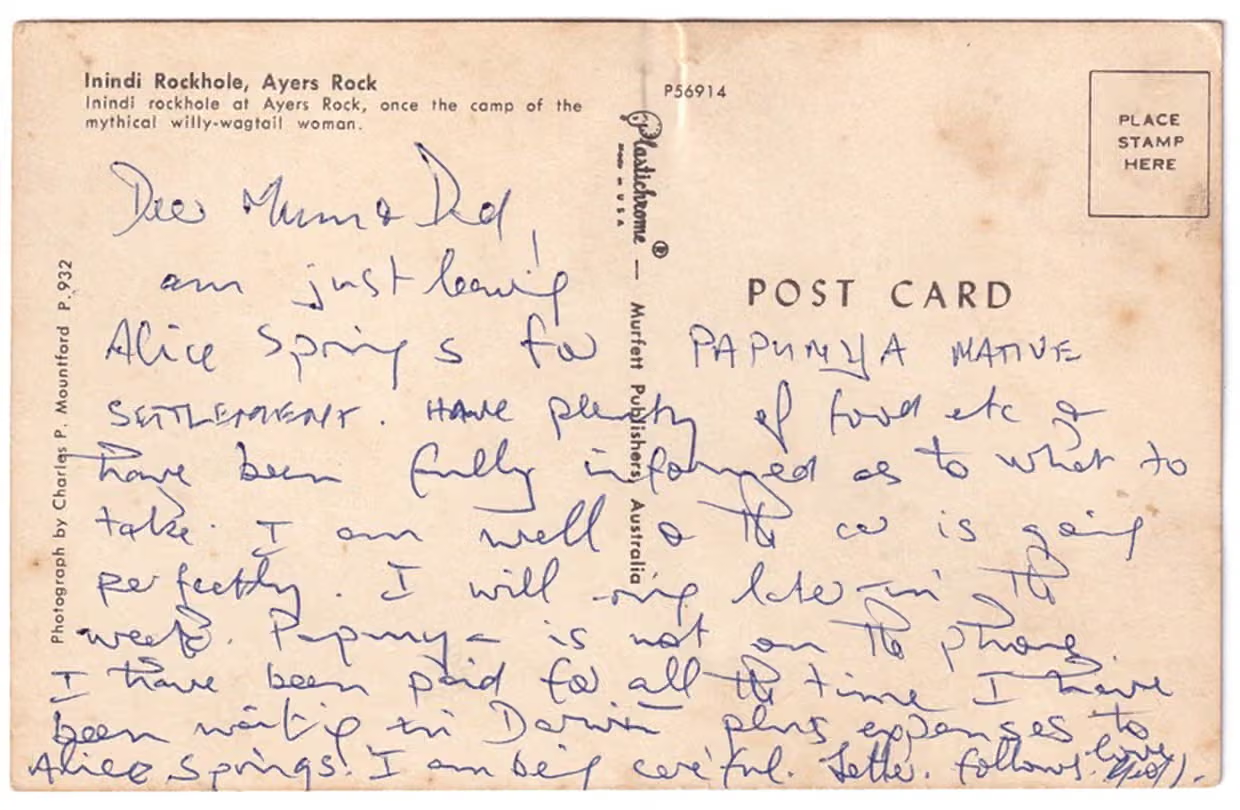
1971年杰夫寄给父母的一张明信片。豪泽写道:“在杰夫的许多文件中可以清楚地看出,几乎从一开始他就试图把在帕潘亚的经历整理成某种其他形式:一部小说、一个电影剧本、某种科幻作品。”
A postcard from Geoff to his parents in 1971“In places among Geoff’s papers it was clear that almost from the start he was trying to corral his experiences at Papunya into some other form: a novel, a film script, some kind of science fiction,’’ Hauser writes.
在巴登的档案中,豪泽偶然发现了一张图表和一段文字,其中巴登把自己的帕潘亚经历描绘得与美国通俗作家约瑟夫·坎贝尔的电影“单一神话”模板相一致——即追寻的英雄排除万难,带着集体的奖赏归来。
In Bardon’s archive, Hauser came across a diagram and writing in which he portrays his Papunya experience consistent with popular American writer Joseph Campbell’s cinematic monomyth template of the questing hero returning, against all odds, with a communal prize.
在拼凑巴登更完整的形象时,豪泽归功于其他人的出色研究,包括卢克·斯科尔斯、约翰·基恩和薇薇安·约翰逊,他们证实巴登抵达帕潘亚时绘画活动已经存在,而且他并不是第一个把作品带出定居点的人。
In assembling a more holistic picture of Bardon, Hauser credits the fine research of others, including Luke Scholes, John Keane and Vivien Johnson, who established that painting was already happening when Bardon arrived in Papunya and that he was not the first to take works out of the settlement.
其他人也强烈暗示,人们在其他西部沙漠原住民社区(包括尤恩德穆)也已经开始绘画。
Others have also strongly suggested that people were also already painting at other Western Desert Aboriginal communities including Yuendemu.
毕生中,巴登关于帕普尼亚的大量著作和演讲(包括他的三本书之一《西部沙漠原住民艺术》,书中详述了他与画家们的合作,并长期以来定义了绘画运动诞生的公认叙事)都清楚地表明,他感到被排斥,并实际上被社区的白人监管者逼离了那里。
For the rest of his life Bardon’s extensive writings and talks about Papunya (including one of three books, Aboriginal Art of the Western Desert in which his role with the painters is extensively canvased and came to define, for a long time, the accepted narrative of the painting movement’s birth) made it clear he felt ostracised and effectively forced out of the community by its white overseers.
但豪泽著作的核心——正如非原住民对原住民艺术本质上无法完全知晓——潜藏着一个谜团:巴登究竟为何离开。在帕普尼亚到底发生了什么。
But central to Hauser’s book – like the intrinsic unknowability of Aboriginal art for non-Indigenous people – simmers the mystery of precisely why Bardon left. Of what, exactly, happened at Papunya.
豪泽写道,也许“还有什么是杰弗里永远无法说出口的事[正如他后来告诉一位作家的]——或者……是什么让世界离他而去,使他无法留下”。
Perhaps, Hauser writes, there“something else that Geoff could never speak about [as he later told one writer] – or … something that tilted the world away from him and made it impossible to stay”.
豪泽说:“这本书整体上探讨的部分是认知的局限。我们不喜欢这一点。我们想知道,想看清一切!艺术也是如此。但有些事物无法直接显现;我感兴趣的是,这在绘画中如此,在一个人的一生中也是如此。”“我真的不想做这件事”《艺术狂热》酝酿已久。2008年,牛津大学历史学博士豪泽首次萌生撰写此书的念头。“很长一段时间我觉得这太沉重了,不想动笔。但事情接连发生,仿佛巧合般指引着你——这个点子属于你:我总遇到在切尔姆斯福德医院有过亲人的亲友,”她说。
“Part of what the book is about generally is the limits of knowing. We don’t like that. We want to know, want to see everything! That’s true of the art too,” Hauser says. “But there are some things that can’t show themselves directly; and it interested me that this is true both in the painting and in a person’s life.’’‘I really didn’t want to do it’Art Mania was a long time coming. It was 2008 when Oxford history PhD Hauser first contemplated writing it. “For a long time it felt as though it was too dark to do. I didn’t really want to do it. But things kept happening, as though coincidentally, in the way that they seem to do to tell you that an idea is yours: I kept meeting people who had relatives who had been at Chelmsford hospital, for instance,’’ she says.
总而言之,这本书花了18年才最终出版。“有几次我完全停止了[写这本传记],因为我觉得这与我无关,任何部分都无关,我本该守住自己的本分。”豪瑟的资料来源广泛(她对来源的注释和致谢长达53页)。其中包括多年来多次前往多恩在纽卡斯尔的家中,查阅杰夫·巴登的庞大档案,以及吉姆·巴登的未发表著作。
All up, it took 18 years before the book was finally published. “There were a couple of times when I stopped doing it [the biography] altogether because I felt it was none of my business, any of it, and that I should have stayed in my lane.’’ Hauser’s sources are expansive (her notes on them and acknowledgments run to 53 pages). They include extensive visits across years to Geoff Bardon’s vast archive at Dorn’s Newcastle house, and Jim Bardon’s unpublished writings.
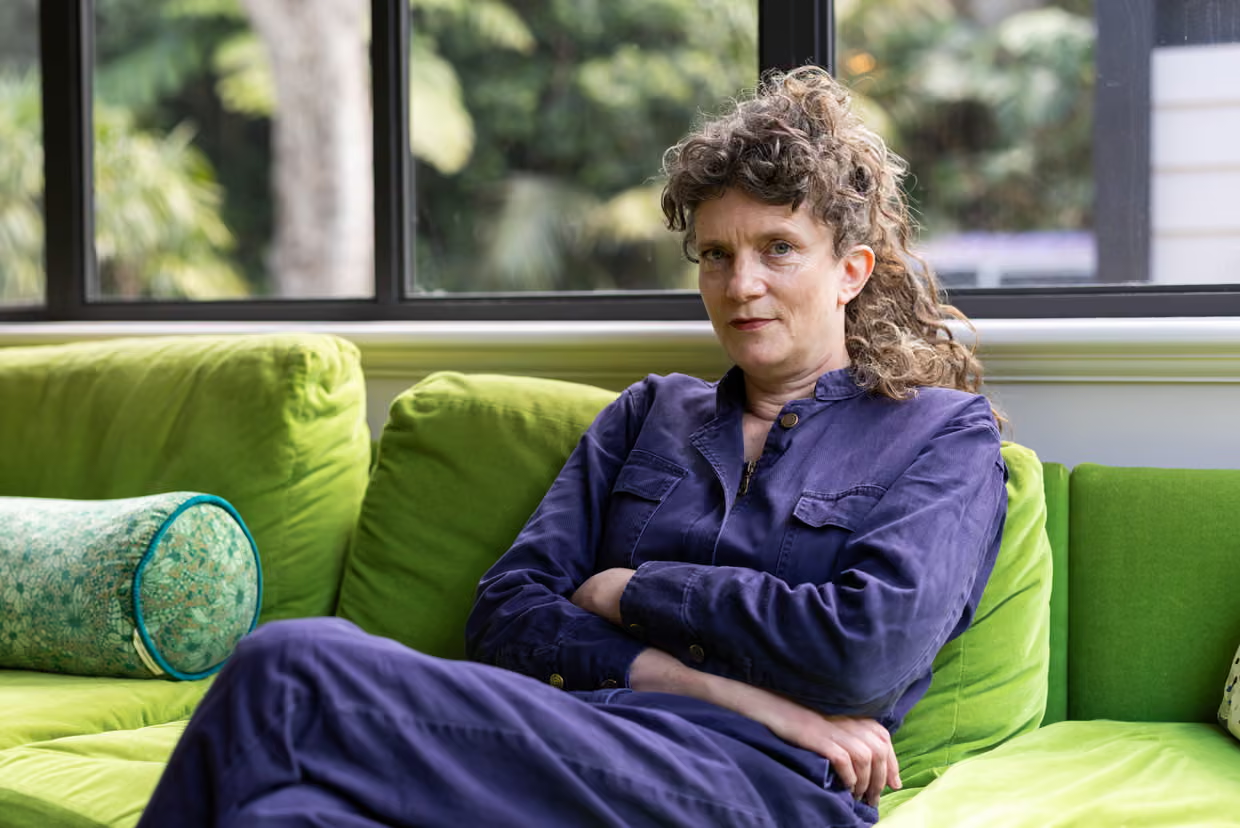
基蒂·豪瑟查阅了杰夫的遗孀多恩所保存的庞大私人巴登档案,撰写了这本关于跨文化主体性与窃取的多层次著作。
Kitty Hauser has examined the extensive private Bardon archive held by Geoff’s widow, Dorn, to produce a multi-layered book about intercultural agency and theft.
“我开始期待去拜访多恩;她对我很友善。我希望她对杰夫、对他的文稿,以及她对他工作的贡献能够被记录下来。我很感激她让我查阅了档案,”她说。
“I came to look forward to my visits to Dorn; she was kind to me. I wanted her care for Geoff, and for his papers, and her contribution to his work to go on record. I am very grateful that she gave me access to the archive,” she says.
这些写作和照片档案被装在箱子里,放在遗孀的客厅和厨房里,“还放在车道上和花园棚屋里”。
The archive of writing and photos were held in boxes around the widow’s living room and kitchen, “out on the driveway and in the garden shed as well”.
《艺术狂热》为杰弗里·巴登的生平带来了引人入胜的新视角和细腻之处,他最终呈现的既非罪人也非圣人,而是一个复杂而痛苦的人,无论在帕潘亚发生了什么。
Art Mania brings compelling new perspectives and nuance to the life of Geoffrey Bardon, who ultimately emerges as neither sinner nor saint, rather as complex and pained for whatever may have happened at Papunya.
可以肯定的是,巴登始终无法完全走出他在帕潘亚的短暂时光。他的传记作者说,他余生都在反复思量此事。
What is certain is that Bardon could never entirely move on from his brief time at Papunya. He would, his biographer says, mull over it for the rest of his life.
“对他来说,那是伟大的时光,是神圣的时光,他感到有什么东西发生了转变,”豪瑟写道。“他发现,那种时光对他再也无法回归,除非在自己重复的回响中短暂地出现。”
“It was for him the great time, the sacred time when he felt something shift,” writes Hauser. “It was something that could never return for him, he found, except momentarily in the echo of his own repetition of it.”
《艺术狂热:杰弗里·巴登与帕潘亚的绘画者们》,基蒂·豪瑟著,吉拉蒙多出版社出版(39.95美元)
Art Mania: Geoffrey Bardon and the Painting Men of Papunya by Kitty Hauser, published by Giramondo ($39.95)