“数学家是一台把咖啡变成定理的机器。”这是匈牙利数学家保罗·埃尔德什常挂在嘴边的一句话。他靠咖啡和安非他命维持精力,极少睡眠,几乎常年在外奔波,终身未婚、无子,一生发表了近1500篇论文,合作者达数百人之多。但在大多数方面,埃尔德什并不像机器。他把数学讲座称为“布道”,会在奇特的时间叫醒朋友,问:“你的大脑开放吗?”
A mathematician is a machine for turning coffee into theorems. This was a line often invoked by the Hungarian mathematician Paul Erdős, who was fuelled by coffee and amphetamines, slept little, travelled near-constantly, never married or had children, and published almost fifteen hundred papers in his lifetime, in collaboration with hundreds of other mathematicians. But Erdős was, in most ways, not machinelike. He called lecturing in mathematics “preaching,” woke friends at odd hours by asking, “Is your brain open?,” wore only silk underclothing on account of his sensitive skin, and claimed not to have learned how to butter toast until he was twenty-one.
因皮肤敏感,他只穿丝质贴身衣物,并声称直到21岁才学会如何在吐司上抹黄油。他把大部分钱捐给了慈善事业和急需资金完成学业的年轻数学家,并为自己提出的数学问题悬赏(有时10美元,有时1000美元)征求解答。数学是他的生命,数学家是他的家人。有人评价说,即便不论他对数学文献的杰出贡献,他对这门学科最深远的帮助,在于把一些本可能成为对冲基金经理、联邦调查局特工或迷失灵魂的人,变成了数学家。
He gave away most of his earnings to charitable causes and to young mathematicians in need of funds for their education, and he offered bounties (sometimes ten dollars, sometimes a thousand) for solutions to mathematical problems he’d proposed. Mathematics was his life. Mathematicians were his family. It has been said that, even above his remarkable contributions to the mathematical literature, he helped the discipline most profoundly by turning people who might otherwise have become hedge-fund managers or F.B.I. agents or lost souls into mathematicians.
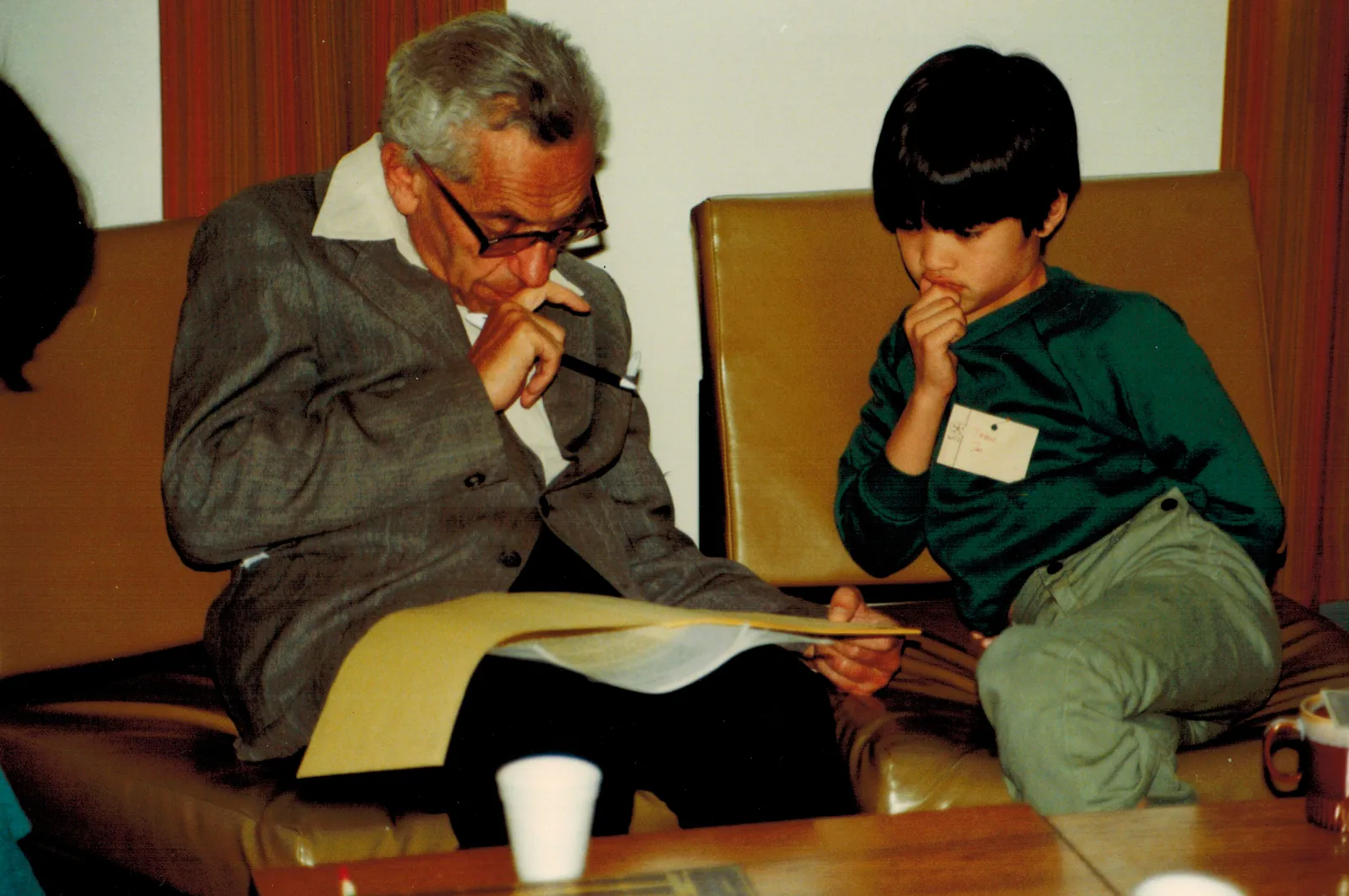
1996年,他去世时享年83岁,留下了约1000个未解问题。解出一个埃尔德什问题是莫大的荣誉,拥有一个低“埃尔德什数”也是如此——这个术语表示某人与他合作发表论文相隔几度。
When he died, in 1996, at the age of eighty-three, he left behind about a thousand problems. Solving an Erdős problem is a great honor, as is having a low “Erdős number,” a term that describes how many degrees of separation one is from having published work with him.
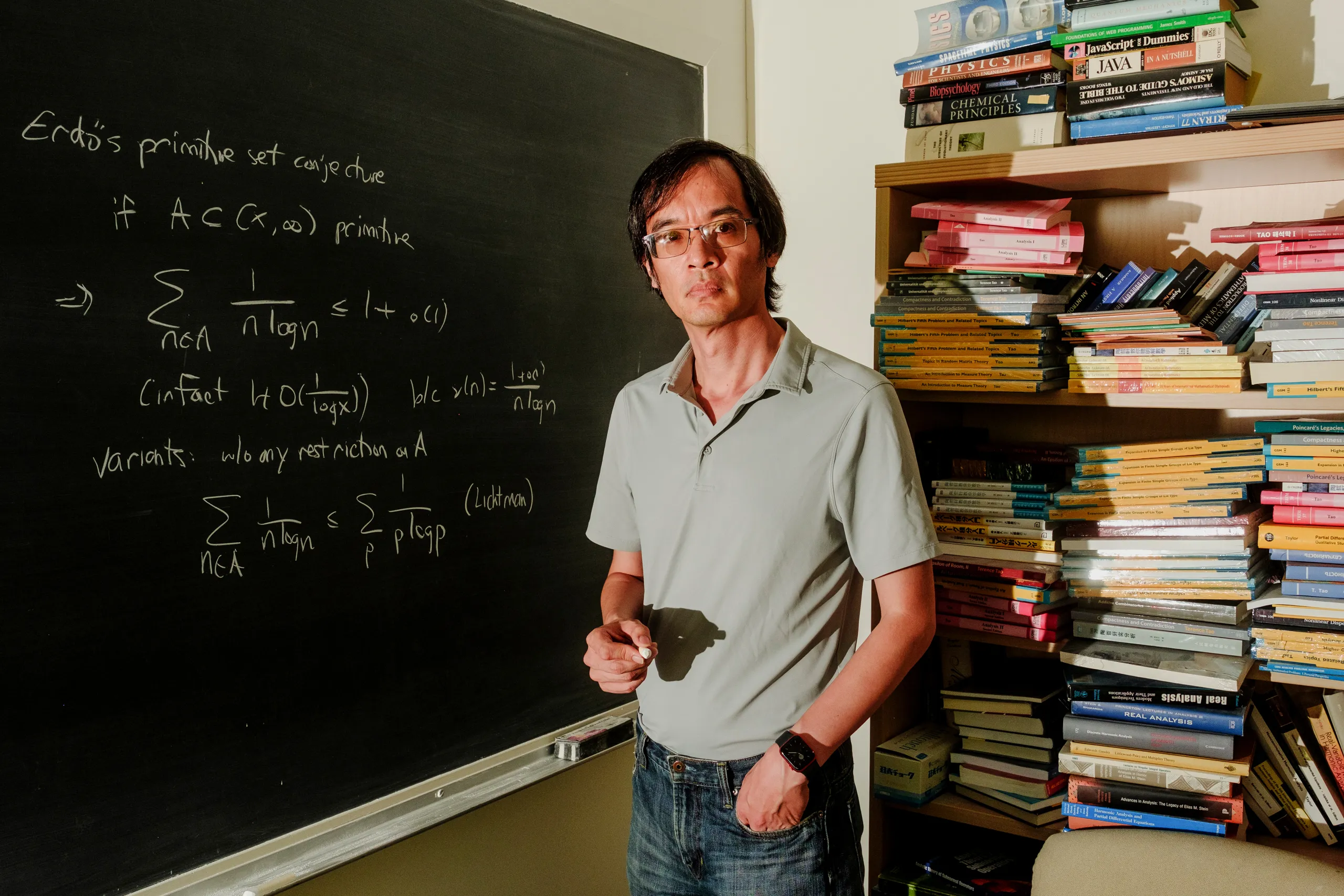
在数学界的另一个时代——也就是今年四月——我在位于加州大学洛杉矶分校数学科学大楼的陶哲轩办公室拜访了他。这座大楼通过一系列错综复杂的走廊和楼梯与博尔特楼相连,1969年,互联网的前身阿帕网(ARPANET)的第一条信息就是在那里发出的。其中一条走廊里还有一个电话亭。陶哲轩的办公室宽敞,装饰简朴,铺着米色地毯,摆着一张米色沙发,两面长墙上各安装了三块黑板,书架和书堆上摆放着几百本书,书名包括《分析学进展:埃利亚斯·M·斯坦的遗产》、《数论第一卷:工具与丢番图方程》和《椭圆曲线的算术》等。
In another era of mathematics, which is to say, in April, I visited Tao at his office in the Mathematical Sciences Building at U.C.L.A. The building was connected through a mazelike series of corridors and stairs to Boelter Hall, where, in 1969, the first message was sent on , the precursor to the internet. One of the hallways had a telephone booth. Tao’s office was spacious and mostly unadorned, with beige carpeting and a beige sofa, six blackboards mounted onto two long walls, and stacks and shelves with hundreds of books bearing titles such as “Advances in Analysis: The Legacy of Elias M. Stein,” “Number Theory Volume I: Tools and Diophantine Equations,” and “The Arithmetic of Elliptic Curves.”
在电灯开关旁边,贴着一幅画,画的是一只穿着黑西装、打着领带、长着獠牙的怪物,旁边还有一张纸,上写着一段密文(“LWKIRLCS”,其中一部分写着这几个字母)。这是他大孩子多年前给他画的。“我想我已经不记得怎么解码了,”陶哲轩说。办公室里没有摆放他获得的众多奖项和荣誉,但墙上挂着一幅由北达科他州立大学数学谱系计划制作的挂图,记录了一代又一代的师承关系。
Near the light switch, there was a drawing of a toothy monster in a black suit and tie, next to a message in code (“LWKIRLCS,” part of it read) written on a sheet of paper. His oldest child had made it for him years ago. “I don’t think I remember how to decode it,” Tao said. None of his many prizes and honors were on display, but there was a wall hanging—made by the Mathematics Genealogy Project, of North Dakota State University—recording generations upon generations of who had studied under whom.
我们小时候学的大部分数学都是机械性的,这可能就是为什么数学有时会被误解为一个缺乏想象力的领域。如果回想一下查尔斯·道奇森——也就是刘易斯·卡罗尔——是一位职业数学家,或许能对数学有更准确的认识。从某种意义上说,《爱丽丝梦游仙境》的创作过程类似于数学研究。在这个类比中,机械计算相当于写作的基础:拼写、主谓一致。
Much of the math we learn as kids is mechanical, which may be why mathematics is sometimes misperceived as an unimaginative field. A more accurate understanding might come from recalling that Charles Dodgson, better known as Lewis Carroll, was a professional mathematician. In some ways, the writing of “Alice’s Adventures in Wonderland” resembles mathematical research. Mechanical calculation, in this analogy, is the basics of composition: spelling, subject-verb agreement.
但为了探索逻辑、异想天开、惊奇与悖论,卡罗尔创造了白兔、柴郡猫、红心皇后等角色,以及疯狂茶会、核酸赛跑等场景。这些角色和场景,就如同数学家在探索数学思想时发明的对象和技巧。当安德鲁·怀尔斯证明费马大定理时,距离该猜想首次提出已过去三百五十多年,数学家们为此欢欣鼓舞,但并非因为答案本身——答案并不令人意外(没有正整数使得当 n > 2 时成立)。
But, in order to explore logic and whimsy and wonder and paradox, Carroll invented characters like the White Rabbit, the Cheshire Cat, and the Queen of Hearts, and situations like the Mad Tea Party and the Caucus Race. These characters and scenes are akin to the objects and techniques mathematicians invent as they explore mathematical ideas. When Andrew Wiles proved Fermat’s Last Theorem, more than three hundred and fifty years after its initial postulation, mathematicians were thrilled, but not because of the answer, which wasn’t surprising. (No, there are no positive whole numbers such that if > 2.)
怀尔斯证明中真正精彩的部分,是他在此过程中发展出的数学技巧。正是这些技巧推动了数学的发展。
What was wonderful about Wiles’s proof was the mathematical techniques he’d developed along the way. That was what advanced mathematics.
澳大利亚悉尼大学的数学家吉尔迪·威廉森向我形容,一个由人工智能辅助得出的解决方案“就像是整个数学界的美好事物”,另一个则“就像在花园里喷洒除草剂‘农达’”。这两项成果均由Anthropic的数学家莱文特·阿尔普盖发表。
The mathematician Geordie Williamson, of the University of Sydney, in Australia, described one A.I.-assisted solution to me as “like this beautiful thing for the whole math community” and another as “like the weed killer Roundup being sprayed on a garden.”Both results were published by Levent Alpöge, a mathematician at Anthropic.
那个“美好事物”关乎一个存在了八十七年的难题——雅可比猜想。我们可以把这个问题理解为:是否存在从一种形状到另一种形状的一一映射。7月19日,也就是西班牙对阵阿根廷的足球比赛当天,阿尔普盖在X上发帖:“大家好,雅可比猜想是错的,感谢我的好朋友阿基尔——一位人类——提出了这个问题,还有我的另一位好朋友法布尔——一个AI模型——在世界杯决赛期间辛苦工作了。”
The beautiful thing concerned an eighty-seven-year-old problem, the Jacobian conjecture. We can think of the problem as having to do with the possibility of a one-to-one mapping from one shape to another. On July 19th, the day of the Spain-Argentina soccer game, Alpöge posted on X, “hello there the jacobian conjecture is false thanx to my close friend akhil”—a human—“for asking about it and my other close friend fable”—an A.I. model—“for working during the world cup final.”
Claude Fable 5生成了一个猜想的反例,这就像鸵鸟是“所有鸟都会飞”这一猜想的反例一样。威廉森说:“在三十六小时内,数学家们就大致搞清了反例的来源,以及为什么它是很自然的。”包括陶哲轩在内的少数数学家研究了这个证明,弄懂了它——这一过程我反复听数学家们称为“消化证明”——并重构了其背后的代数几何。
Claude Fable 5 had produced a counterexample to the conjecture, much like how an ostrich is a counterexample to the conjecture that all birds can fly. Williamson said, “Within thirty-six hours, mathematicians had kind of understood where the counterexample comes from and why it’s natural.”A handful of mathematicians, including Tao, explored the proof, came to understand it—a process that I kept hearing mathematicians refer to as proof digestion—and reconstructed the algebraic geometry that underlay it.
7月21日,陶哲轩在他的博客上发布了这项工作,其中包括他深入细节时与ChatGPT对话的记录。到7月22日,巴纳德学院的谢蒙·雷兹奇科夫仅用高中水平的数学就制作出了该反例的可视化图示。这个证明开启了思考,而非扼杀了思考。
On July 21st, Tao posted the work on his blog, including the transcript of a conversation he’d had with ChatGPT as he looked into the details. By July 22nd, Semon Rezchikov, of Barnard College, had created a visualization of the counterexample using only high-school-level mathematics. The proof had opened up thinking, not decapitated it.
“我认为菲尔兹奖得主们的信很有价值,”麻省理工学院数学家约翰·厄舍尔告诉我。“虽然我理解,也许在数学界之外并不容易产生共鸣。我看到有人说:‘我们在癌症研究方面得到答案的速度太快了,为了学科发展必须放慢脚步!’” 厄舍尔和阿尔普盖是好朋友,他记得三四年前阿尔普盖曾说,人工智能将终结他们所熟知的数学。“我当时觉得他完全失去理智了,”厄舍尔说。
“I thought the Fields medallists’ letter was valuable,” John Urschel, a mathematician at M.I.T., told me. “Though I understand that maybe it doesn’t translate well outside of the mathematical community. I saw one person be, like, ‘We’re getting answers to cancer research too quickly, we must slow down for the sake of the field!’ ” Urschel is good friends with Alpöge, whom he remembers saying three or four years ago that A.I. was going to end math as they knew it. “I thought he had lost all sense,” Urschel said.