哈萨克斯坦正努力应对苏联独裁统治留下的历史遗产。约85年前,斯大林将数十万人流放:约40万居住在苏联的德裔被送往哈萨克斯坦。
Kazakhstan is struggling to deal with the legacy of the Soviet dictatorship. Some 85 years ago, Stalin deported hundreds of thousands of people: Some 400,000 ethnic Germans living in the USSR were sent to Kazakhstan.
谷歌搜索首选DW 苏联独裁者约瑟夫·斯大林在二战期间将全苏联的德裔驱逐至集中营 她希望让历史延续。22岁的尤娜·基涅赖什正在哈萨克斯坦现代首都阿斯塔纳学习公共关系。她自称是哈萨克德裔。
Prefer DW on Google Soviet dictator Josef Stalin deported ethnic Germans from across the USSR to camps during World War II She wants to keep history alive. Yunna Kinereish, 22, is studying public relations in Kazakhstan's modern capital, Astana. She describes herself as a Kazakh German.
“我在族裔上是德国人。但我也觉得自己是哈萨克人,因为我和家人一起保留传统,且拥有这种心态,”她告诉德国之声。
"I am German by ethnicity. But I also feel that I'm Kazakh, because I keep the traditions with my family, and I have this mentality," she told DW.
基涅赖什属于哈萨克斯坦德国人“复兴”协会,是目前生活在中亚共和国哈萨克斯坦的22.3万哈萨克德裔之一。
Kinereish, who belongs to the Wiedergeburt (Revival) Association of Germans in Kazakhstan, is one of 223,000 Kazakh Germans living in the Central Asian republic of Kazakhstan today.
基涅赖什最近在该协会青年剧院的一出戏剧中出演,讲述了她的俄裔德意志祖先的命运。
Kinereish recently acted in a play at the association's youth theater that told the fate of her Russian German forebears.
尤娜·基涅赖什是目前生活在哈萨克斯坦的22.3万哈萨克德裔之一 从18世纪起,德国人受到鼓励离开德国,在俄罗斯帝国定居,包括乌克兰黑海地区。
Yunna Kinereish is one of 223,000 Kazakh Germans living in Kazakhstan today From the 18th century onward, Germans were incentivized to leave Germany and settle in the Russian empire, including in Ukraine's Black Sea region.
但1941年希特勒纳粹德国军队入侵苏联后,苏联独裁者约瑟夫·斯大林开始将居住在俄罗斯和乌克兰的数十万德国人驱逐至西伯利亚和哈萨克斯坦。
But after the armies of Hitler's Nazi Germany invaded the Soviet Union in 1941, Soviet dictator Josef Stalin started deporting hundreds of thousands of Germans living in Russia and Ukraine to Siberia and Kazakhstan.
集体惩罚 与纳粹德国的入侵和暴行毫无关系的无辜者,被苏维埃政权集体追责,被诋毁为间谍和通敌者。
Collective punishment Innocent people who had nothing to do with Nazi Germany's invasion and atrocities were collectively held responsible by the Soviet power and denounced as spies and collaborators.
被驱逐者超过100万,其中至少20万人因驱逐、饥饿和强迫劳动而死亡。
There were more than a million deportees, of whom at least 200,000 died as a result of expulsion, hunger, and forced labor.
“我的家庭也是这段历史、这些可怕岁月的一部分。他们被驱逐出了乌克兰的克莱因韦尔特村,那是乌克兰的一个德裔聚居地。”尤娜·基涅赖什说,她和朋友们在友谊之家的舞台上讲述的个人故事深深打动了她,该协会的办公室就设在那里。“这对我来说并不容易,因为这一切触动了我内心最深处。我其实很想哭。但当我站在舞台上……我必须坚强。”
"My family is part of this history, these terrible times. They were driven out of the Ukrainian village Kleinwärter, a settlement of ethnic Germans in Ukraine Yunna Kinereish says she was very moved by the personal stories she and her friends had brought to the stage at the House of Friendship, where the association has its office. "It's not easy for me, because it all touches my heart very deeply. I actually feel like crying. But when I'm on stage ..., I have to be strong."
文化与记忆同在一屋檐下外观现代的友谊之家坐落于首都阿斯塔纳,是该市德裔文化的中心。主要由德国政府资助,它提供语言课程、开展社会工作,并致力于培育记忆文化,聚焦于苏联时期的驱逐与镇压主题。
Culture and remembrance under one roof The modern-looking House of Friendship in the capital Astana is the center for German culture in the city. Financed primarily by the German government, it offers language courses, engages in social work and fosters a culture of remembrance, focusing on the themes of deportation and repression under the Soviet regime.
尤娜·基涅赖什不仅在舞台上讲述她民族的历史,还在用影像记录这段历史。2025年,她拍摄了一部关于被关押在阿克莫林斯克“祖国叛徒妻子”劳改营(ALZhIR)的德裔女性的影片,该营是苏联古拉格体系中最臭名昭著的营区之一。
Yunna Kinereish doesn't only present the history of her people on stage: She is also documenting it on film. In 2025, she made a film about German women incarcerated in ALZhIR (Akmolinsk Camp for Wives of Traitors to the Motherland), among the most infamous in the Soviet Gulag system.
在20世纪30年代斯大林残酷的政治镇压和国家资助的恐怖统治时期,即被称为“大清洗”的时期,苏联在哈萨克斯坦建立了其最大的劳改营体系。仅阿克莫林斯克“祖国叛徒妻子”劳改营就关押过1.8万名女性。这些女性入狱的唯一原因是她们的丈夫被判定为叛徒或人民公敌。其中有167名德裔女性,她们的故事在影片中得以讲述。
During Stalin's brutal campaign of political repression and state-sponsored terror in the 1930s, a period known as the Great Terror, the Soviet Union established its biggest camp system in Kazakhstan. 18,000 women passed through the ALZhIR camp alone. These women were imprisoned there only because their husbands had been convicted of being traitors or enemies of the people. Among them were 167 ethnic German women, whose stories are told in the film.
阿克莫林斯克“祖国叛徒妻子”劳改营纪念馆位于阿斯塔纳城门之外,阿斯塔纳直到1997年才成为首都。
The memorial for the ALZhIR women's camp is located just outside the gates of Astana, which only became the capital in 1997.
阿斯塔纳的道路终年车辆拥堵。行人极少,骑行者更是绝迹。城市在不断扩张,新楼宇在城郊拔地而起。再往外便是荒凉的草原;阿克莫尔村距此约一小时车程。
Astana's roads are permanently clogged with traffic. There are almost no pedestrians, and no cyclists at all. The city is growing, with new buildings shooting up all along the outskirts of the city. Beyond them is the barren steppe; the village of Akmol is about an hour's drive away.
“悲伤拱门”是一座巨大的钢铁建筑,旨在纪念女性囚犯所遭受的苦难和强迫劳动。在进入阿克莫拉妇女劳改营受难者博物馆(ALZhIR)主馆之前,参观者会先经过这座“悲伤拱门”。博物馆内陈列着女囚犯的个人物品、简陋居住区的模型、原始文件和照片。
The Arch of Grief is a huge steel construction that commemorates the suffering and forced labor the women endured Before entering the actual ALZhIR museum, the visitor passes through the Arch of Grief, a huge steel construction that commemorates the suffering and forced labor the women endured. The museum itself contains personal items that belonged to the female prisoners, models of their primitive quarters, original documents and photographs.
代表性故事 其中一张照片的主人公是格特鲁德·普拉泰斯,一位有德国血统、在阿克莫拉妇女劳改营度过数年牢狱生涯的女性。普拉泰斯是下西里西亚(今属波兰)的一名印刷工人。她嫁给了卡尔·爱德华·普拉泰斯并成为苏联公民。1938年,在大清洗期间,她的丈夫被捕。格特鲁德也被定罪,罪名是“祖国叛徒的亲属”。
Representative stories One of the photos is of Gertrud Platais, a woman with German roots who spent years incarcerated in ALZhIR. Platais was a print worker from Lower Silesia, part of modern-day Poland. She married Karl Eduard Platais and became a Soviet citizen. In 1938, during the Great Terror, her husband was arrested. Gertrud was convicted, too as a "relative of a traitor to the homeland."
她被押送至阿克莫拉妇女劳改营,该地区夏季气温高达40摄氏度(104华氏度),冬季低至零下40摄氏度。在这里,她被迫从事刺绣劳动,直到1946年。此后,她被终身流放至规模巨大的卡拉干达劳改营(Karlag)。格特鲁德·普拉泰斯直到1956年才获得平反。她的故事只是记录苏联制度在哈萨克斯坦土地上制造恐怖的无数案例之一。
She was transferred to ALZhIR, in a region where temperatures hit 40 degrees Celsius (104 degrees Fahrenheit) in summer and minus 40 degreees Celsius in winter. Here, she was forced to work as an embroiderer until 1946. After this, she was banished for life to the huge Karaganda Corrective Labor Camp, known as Karlag. Gertrud Platais wasn't rehabilitated until 1956. Hers is just one story documenting the terror of the Soviet system on Kazakh soil.
卡拉干达劳改营是规模最大的劳改营系统,其占地面积约为纽约市的22倍。卡拉干达劳改营不仅是一个监狱营,更是一个巨大的经济和农业综合体。1931年至1959年间,近百万人曾被关押于此。
Karlag was by far the biggest camp system and its complex covered an area about 22 times the size of New York City. Karlag was not just a prison camp, but a huge economic and agricultural complex. Almost one million people passed through it between 1931 and 1959.
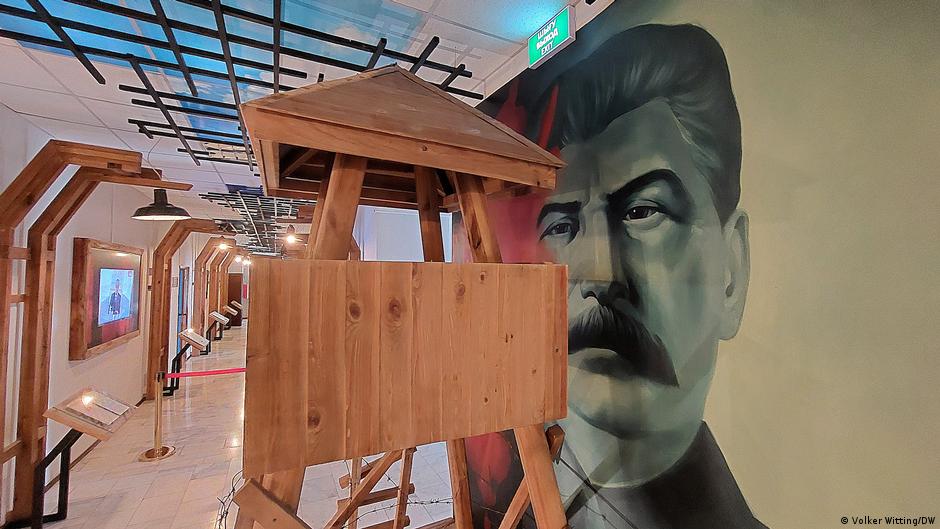
据信,仅在1940年至1950年间,就有约1万人死于此地:死于饥饿、严寒、疾病和强迫劳动的后果。格特鲁德·普拉泰作为“祖国叛徒的亲属”被定罪被布置过的纪念这座博物馆坐落在哈萨克草原中部,靠近卡拉干达市,位于阿斯塔纳以南约250公里处。它设在一栋曾用作营地系统管理机构的建筑里。前来参观的德国历史学家和专家略感困惑:人们并没有在这栋建筑里遭受酷刑或折磨,这里只是行政管理的地方。
Around 10,000 prisoners are believed to have died here between 1940 and 1950 alone: of starvation, cold, sickness, and the effects of forced labor. Gertrud Platai was convicted as a "relative of a traitor to the homeland" Staged remembrance The museum sits in the middle of the Kazakh steppe, near the city of Karaganda, about 250 kilometers south of Astana. It is located in the building that used to house the camp system administration. Visiting German historians and specialists are slightly puzzled: People were not tortured or tormented in this building, it was simply where the administration was done.
这里重建了审讯和酷刑牢房,无处不在的扬声器里倾泻出煽情的音乐,为一切渲染气氛。这给人的感觉是刻意布置的,而非真实原貌。与ALZhIR纪念馆一样,卡尔拉格博物馆的参观者寥寥无几。即便是受过良好教育的年轻哈萨克人,很可能也不知道它的存在。“哈萨克斯坦的许多人,以及某些政治领域,几乎毫无兴趣去正视这个国家往往十分残酷的历史,”凯瑟琳·M·埃尔德曼说。
Here, interrogation and torture cells have been reconstructed, and everything is underscored by melodramatic music pouring from ubiquitous loudspeakers. It comes across as staged rather than authentic. As at the ALZhIR memorial, the Karlag museum has few visitors. Even well-educated young Kazakhs probably don't know about it." Many people in Kazakhstan, and certain areas of politics, have almost no interest in coming to terms with the country's often brutal history," says Katherine M. Erdman.
她是阿斯塔纳纳扎尔巴耶夫大学的美国人类学家和考古学家,研究古拉格体系至今已有约十年。“这片地貌是被强制劳动塑造的”“我们想弄清楚这些营地究竟位于何处,以及今天还能如何辨认它们。”埃尔德曼和她的学生借助无人机飞行等现代技术,但实地采访和考察也是其中一部分。
An American anthropologist and archaeologist at the Nazarbayev University in Astana, she has been researching the Gulag system for about a decade now. "The landscape has been shaped by forced labor" "We wanted to find out where exactly the camps were, and how they can still be recognized today." Erdman and her students relied on modern technology such as drone flights, but conducting interviews and research on the ground was also a part of it.
“在许多地区,这片地貌是被强制劳动塑造的,”埃尔德曼说。工厂往往建在简陋的居住区旁边。房屋是用强制劳工制作的砖块建造的。
"In many regions, the landscape has been shaped by forced labor," Erdman says. Factories were often constructed alongside the primitive living quarters. Houses were built using bricks made by forced laborers.
研究人员将他们的发现直接告知附近的居民和地方行政部门。“我们常常只遇到冷漠,或者干脆被拒绝,”埃尔德曼说。在经济和社会进步的当下,许多人不愿被提醒过去的那些不光彩之处。
The researchers share their findings directly with neighbors and with local administrations. "Often we're just met with apathy, or flat-out rejection," says Erdman. At a time of economic and social advancement, many don't want to be reminded of the inglorious aspects of the past.
埃尔德曼表示,哈萨克斯坦希望向国际社会表明,本国正在正视其历史的阴暗面,但她常常感受到的是缺乏兴趣,甚至遭到排斥。这位学者已在哈萨克斯坦进行了十年的研究,但目前没有国家资金支持她继续开设讲座。
Erdman says there is a desire to demonstrate to the international community that the country is dealing with the dark side of its history, but that she often experiences lack of interest and even rejection. The academic has been conducting research in Kazakhstan for a decade, but there is no state funding for a further lectureship.
哈萨克斯坦的德裔居民尤娜·基内赖什是哈萨克斯坦希望确保过去不被遗忘的年轻人之一。她告诉德国之声:“我的祖先在哈萨克斯坦的古拉格体系中幸存下来。因此,对我来说重要的是,我们不能忘记自己的根,要把我们先辈所经历和遭受的一切传承下去。”本文最初以德文发表,是在德国联邦研究共产主义独裁统治基金会组织的一次考察旅行背景下撰写的。自1998年以来,该基金会由德国纳税人资助,致力于研究和重新审视德国、东德以及其他国家的前共产主义独裁统治。
The Kazakh German Yunna Kinereish is one of the young people in Kazakhstan who want to ensure that the past is not forgotten. "My ancestors survived the Gulag system in Kazakhstan," she tells DW. "So it's important to me that we don't forget our roots, and that what our forefathers experienced and suffered is passed on." This article, originally published in German, was written in the context of a study trip organized by the Federal Foundation for the Study of the Communist Dictatorship in Germany. Since 1998, the foundation, funded by the German taxpayer, has dedicated itself to studying and reappraising the former communist dictatorships in Germany, the GDR, and other countries.