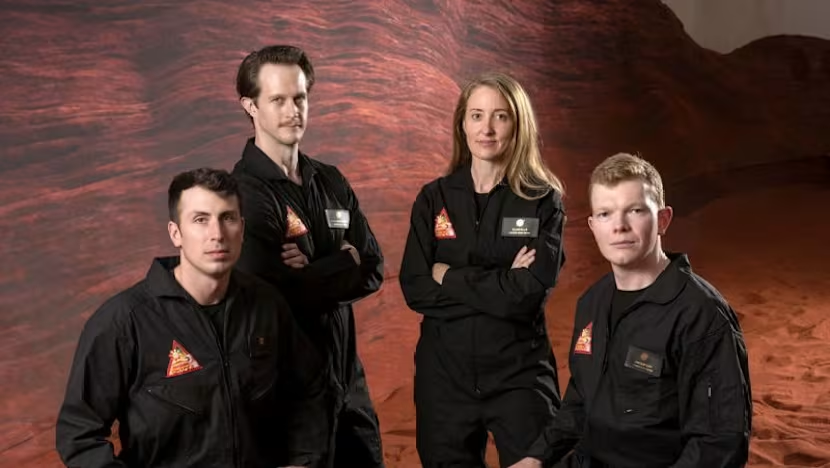
11月1日:在休斯敦美国国家航空航天局(NASA)约翰逊航天中心隔离生活378天后,参与模拟火星任务的四名机组成员已走出隔离舱,此项任务旨在帮助为NASA宇航员未来可能前往地球邻居火星的任务做准备。
Nov 1 : The four members of a crew who took part in a simulated mission to Mars have emerged after 378 days in isolation at the US space agency's Johnson Space Center in Houston, an endeavor designed to help prepare for a possible future excursion by NASA astronauts to Earth's planetary neighbor.
“这一年过得真不容易——类比宇航员自愿置身于‘囚禁’之中,”担任“机组健康与表现探索类比”(CHAPEA)任务医疗官的埃伦·埃利斯在周六与其他三名机组成员走出约翰逊航天中心时发表讲话说。
"It's been a hell of a year — analog astronauts living in captivity of our own free will," Ellen Ellis, the medical officer on the Crew Health and Performance Exploration Analog, or CHAPEA, mission, said in remarks at Johnson Space Center after emerging with her three crewmates on Saturday.
这四人于2025年10月19日进入这座占地1700平方英尺(约158平方米)的3D打印栖息舱,执行了诸如在模拟火星土壤中种植作物、并与NASA官员进行通信联络(重现星际通信固有的延迟)等任务。
The four entered the 1,700-square-foot (158-square-meter) 3D-printed habitat on October 19, 2025, and performed tasks such as growing crops in simulated Martian soil and interfacing with NASA officials with delays recreating those inherent in interplanetary communications.
NASA此前已利用机器人探测车和环绕飞船探索火星,其目标是最早于2030年代实现载人火星任务,在此之前计划让宇航员重返月球,这将是自1972年以来的首次。
NASA, which has explored Mars with robotic rovers and orbiting spacecraft, has ambitions for a human mission to Mars as early as the 2030s, with plans before that to return astronauts to the moon for the first time since 1972.
“我们拥有一个不断缩小的机遇窗口,以保持美国在太空领域的卓越地位,”埃利斯说。
"We have a narrowing window of opportunity to maintain US preeminence in space," Ellis said.
埃利斯提到了唐纳德·特朗普总统政府推动的面向太空相关行动的军事学院建设,以及月球基地计划。
Ellis mentioned the service academy for space-related operations pursued by President Donald Trump's administration and plans for a lunar base.
“让我们抓住主动权,以造福经济的科学引领方向,为我们的子孙后代确保我们在太空的遗产,”埃利斯说。
"Let's seize the initiative, lead with science that will benefit our economy and ensure our legacy in space for our children's children," Ellis said.
其他机组成员包括任务指挥官罗斯·埃尔德、科学官马修·蒙哥马利和飞行工程师詹姆斯·斯派瑟。
The other crew members were mission commander Ross Elder, science officer Matthew Montgomery and flight engineer James Spicer.
埃尔德在走出隔离环境后的发言中说:“对火星而言,风险巨大。但通过寻求理解、坚定的愿景和领导力、创造力、毅力、辛勤工作以及不可思议的基础,将人类送上火星的目标不仅是可以实现的,而且是不可避免的。” 机组成员将参加为期两周的任务后评估和总结,与美国国家航空航天局(NASA)科学家进行交流。NASA 表示,正在寻找关于宇航员如何适应长期任务中日常生活惯例和要求的见解,这些任务将超越地球,以保持宇航员的健康、高效和联系。
"For Mars, the risks are great," Elder said in remarks after emerging from isolation. "But through seeking understanding, strong vision and leadership, creativity, fortitude, hard work and incredible foundation, the goal of putting humans on Mars is not only achievable, but rather inevitable." The crew is set to participate in two weeks of post-mission evaluations and debriefing with NASA scientists. NASA has said it is looking for insight into what it takes for astronauts to adapt to the routines and demands of daily life on long-duration missions beyond Earth to keep them healthy, productive, and connected.
这是 NASA 的第二次 CHAPEA 任务,另一组四人机组曾在约翰逊航天中心隔离 378 天,跨越 2023 年和 2024 年。
This was NASA's second CHAPEA mission, with another four-person crew in isolation at Johnson Space Center for 378 days spanning 2023 and 2024.
约翰逊航天中心主任瓦内萨·怀奇在机组成员走出隔离环境时迎接了他们。怀奇表示,他们设法在有限资源条件下生活、维护栖息地,并执行了模拟火星行动。
Vanessa Wyche, director of the Johnson Space Center, greeted the crew members when they exited isolation. Wyche said they managed to live with limited resources, maintain their habitat, and carry out simulated Mars operations.
怀奇还指出机组如何应对模拟的星际通信,即发送信息和接收回复之间的延迟。
Wyche also noted how the crew dealt with the simulated interplanetary communications, with lag times between sending messages and receiving responses.
怀奇说:“这些延迟需要耐心、周密的计划和更大的独立性——这些品质对于未来前往数百万英里外的宇航员来说至关重要。”
"These delays require patience, careful planning and greater independence — qualities that will be essential for future astronauts traveling millions of miles from home," Wyche said.
怀奇表示,从 CHAPEA 机组及其经验中吸取的教训将有助于为首次登月任务,以及“总有一天,火星”任务铺平道路。
Wyche said the lessons learned from the CHAPEA crew and their experiences will help pave the way for the missions first to the moon and "one day, Mars."