中国研究人员绘制了海面风力能量如何涌入数千米深的海床的过程,揭示了他们称为“惯性烟囱”的巨大水下通道。
Chinese researchers have mapped how energy from surface wind surges thousands of metres into the seabed, revealing massive underwater conduits they called “inertial chimneys”.
该发现基于日本东海岸一座由美国资助的海洋传感器阵列收集的数据,结合未来的长期水下监测,可为海洋探测和通信提供水下声学环境支持,该团队表示。
The discovery, based on data collected by a US-funded ocean sensor array off the east coast of Japan, coupled with future long-term underwater monitoring, can provide underwater acoustic environmental support for marine detection and communication, the team said.
来自中国科学院海洋研究所的科学家们于10月在同行评议期刊《深海研究Ⅰ:海洋学研究论文》上发表了研究成果。
The scientists from the Institute of Oceanology of the Chinese Academy of Sciences published their findings in the peer‑reviewed journal Deep Sea Research Part I: Oceanographic Research Papers in October.
“结果表明,深海并非一潭死水,”科学家们在新闻稿中写道。“这项工作将海面风场、上层海洋和深海海底连接成一条连续的能量通道。”该研究分析了黑潮延伸区域一个600公里(323英里)乘600公里区域内分布的46个海底监测站网络收集的两年数据。
“The result shows that the deep sea is not a stagnant body of water,” the scientists wrote in a press release. “This work links the sea-surface wind field, the upper ocean and the deep-ocean sea floor into a continuous energy pathway.”The study analysed two years of data collected by a grid of 46 sea floor monitoring stations spread across a 600km (323 miles) by 600km area in the Kuroshio Extension region.
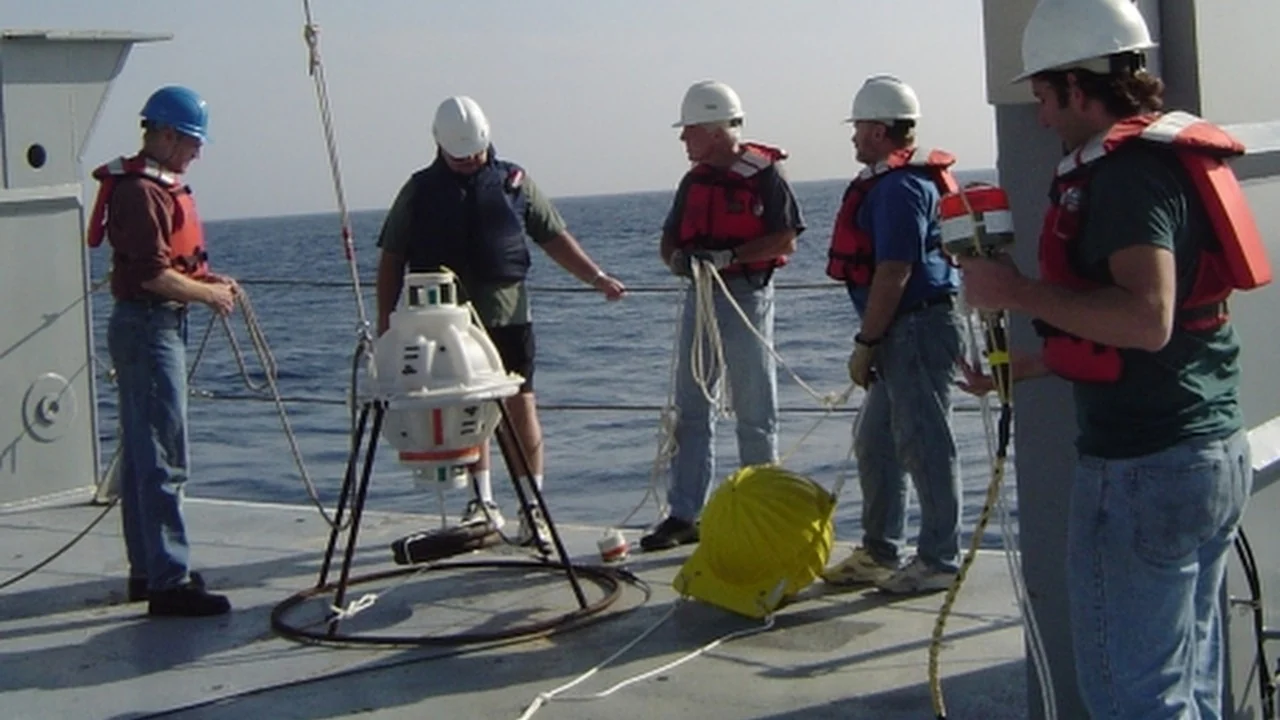
这些倒置回声测深仪配备了近底压力和流速传感器,系泊在海底,记录从海底到海面再返回的垂直声波往返行程时间、底部压力和近底洋流。
These inverted echo sounders, equipped with near-bottom pressure and current sensors, were moored to the ocean bottom to record vertical acoustic travel time of a round trip from the sea floor to the surface, bottom pressure and near-bottom currents.
该阵列于2004年至2006年部署,用于美国国家科学基金会资助的黑潮延伸系统研究。该阵列由罗德岛大学、伍兹霍尔海洋研究所和夏威夷大学的研究人员部署。
The array was deployed from 2004 to 2006 for the Kuroshio Extension System Study funded by the US National Science Foundation. It was deployed by researchers from the University of Rhode Island, the Woods Hole Oceanographic Institution and the University of Hawaii.
在最新研究中,中国科学家研究了近惯性内波,这种波长被认为是风能穿越数千米分层海水到达海底的关键载体。
In the latest study, the Chinese scientists looked into near-inertial internal waves, which have been considered a key vehicle for wind energy to travel through thousands of metres of stratified seawater to reach the sea floor.
当海面风吹过海面时,由于地球自转,上层水体会产生类似钟摆的运动,从而形成巨大的水下振荡。
They are massive underwater oscillations created when surface winds blow across the sea, setting upper water layers into pendulum-like motion due to Earth’s rotation.
虽然海洋分层为温暖的上层和寒冷的深层水体,这两层之间通常形成水交换屏障,但这些内波充当能量中继站,将能量传输至海洋深处。
Although the ocean is stratified into warm upper layers and cold deep waters that normally act as a barrier for water exchange between these layers, these internal waves act as energetic relays to transmit energy deep within the oceans.
该团队发现,当这些波穿过反气旋涡旋——北半球巨大的顺时针旋转的海洋涡旋时,涡旋的旋转会减弱地球自转对波的约束。
The team found that when these waves pass through anticyclonic eddies – massive, clockwise-rotating ocean whirlpools in the northern hemisphere – the eddy’s rotation reduces Earth’s rotational constraint on the wave.
这使波能量向内汇聚,并向下推进至深海,形成一个团队称为“惯性烟囱”的集中漏斗。
This draws the wave energy inward and propels it down into the deep sea, forming a concentrated funnel which they call an “inertial chimney”, according to the team.
该团队还发现,68%的底部近惯性波能量来自向下传播的上层海洋近惯性波,其余32%源自局部近底洋流。
The team also found that 68 per cent of bottom near-inertial wave energy stems from downward-propagating upper-ocean near-inertial waves, while the remaining 32 per cent originates from local near-bottom currents.
他们在论文中写道:“传输能量与局部产生能量之间的分配,为数值海洋模式中混合过程的参数化以及气候模拟中全球海洋能量预算闭合评估提供了宝贵的约束。”
“The partitioning between transmitted and locally generated energy provides valuable constraints for parameterising mixing processes in numerical ocean models and for evaluating global ocean energy budget closure within climate simulations,” they wrote in the paper.
该团队表示,通过长期观测获得的温度、盐度和声速剖面在海洋环境预报和深海工程方面具有广泛应用。
The team said temperature, salinity and sound-speed profiles obtained through long-term observations have wide applications in marine environmental forecasting and deep-sea engineering.
他们在该研究所的一份新闻稿中表示:“由于海面风暴的影响可以到达海底……深海温度和盐度结构在从数小时到季节的时间尺度上持续变化。”
“As the impact of storms at the sea surface can reach the ocean floor … deep-ocean temperature and salinity structures undergo continuous change across timescales ranging from hours to seasons,” they said in a press release from the institute.
他们表示:“这些变化难以通过零星的船载观测捕捉,这凸显了长期、连续、全原位原位观测的必要性,”并补充说,水下阵列可以与观测水面的卫星相连。
“These variations are difficult to capture through sporadic ship-based observations, pointing to the need for long-term, continuous, full-depth in situ observations,” they said, adding that underwater arrays can be linked to satellites which observe water surfaces.
他们表示,“温度和盐度结构的变化直接影响水下声波传播路径和传输损耗”。
They said “changes in temperature and salinity structure directly affect underwater sound propagation paths and transmission loss”.
将这些数据与声学传播模型相结合,可以支持对声道结构和传播条件的评估,以及水下声学环境预报,从而为水下探测和通信提供环境支撑。
“Integrating these data with acoustic propagation models can support assessments of sound-channel structure and propagation conditions, as well as underwater acoustic environment forecasting, helping to provide environmental support for underwater detection and communication.”