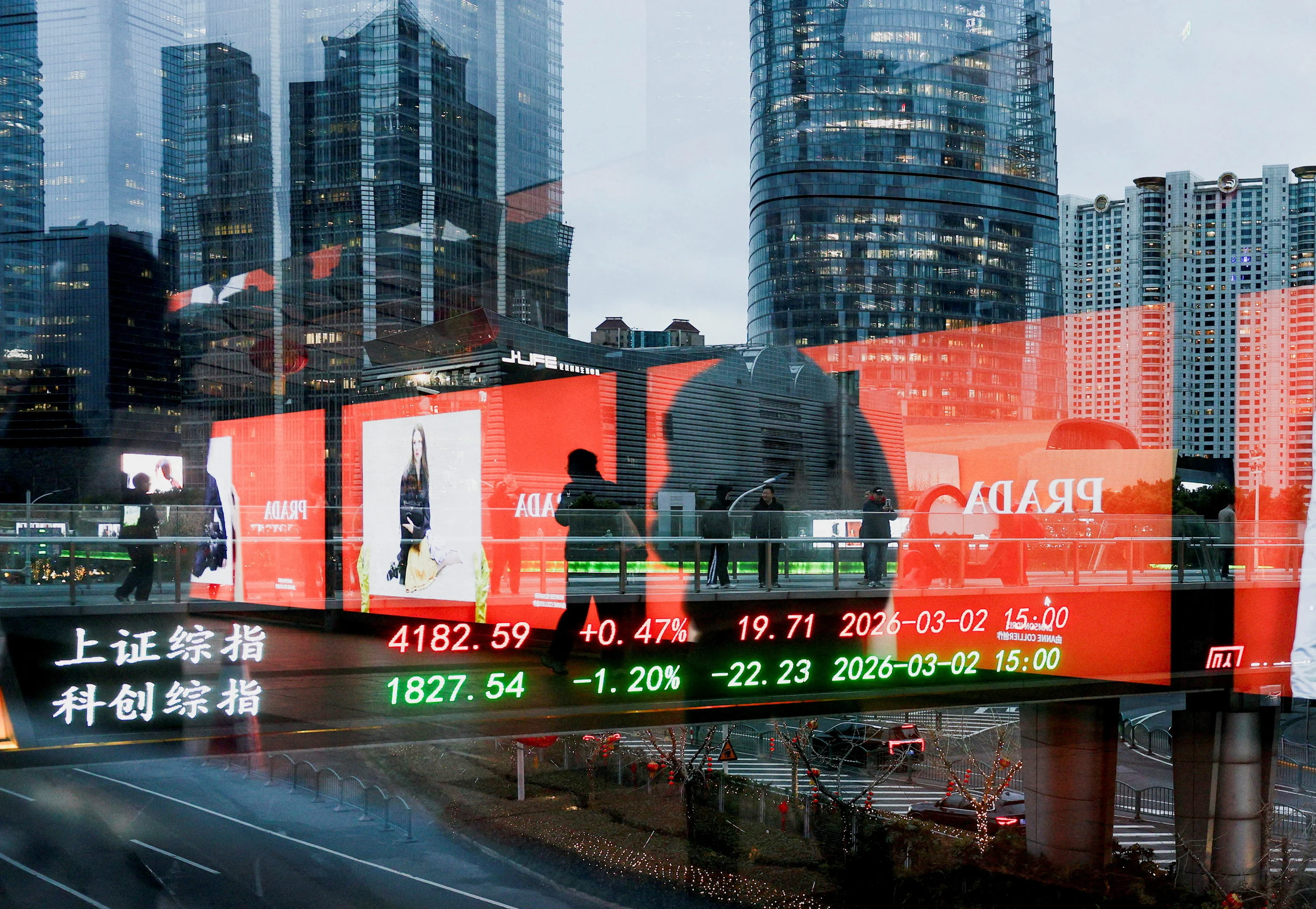
中国股市在一份报告推动下上涨,该报告称金融监管部门将与业内人士讨论支持措施,此前市场经历了创纪录的连续12周下跌。
Chinese stocks rose following a report that financial regulators were set to discuss support measures with industry participants following a record 12-week sell-off.
沪深300指数收盘上涨0.8%,上海科技股密集的科创50指数上涨3.1%,涨幅创9月中旬以来新高。券商股在全市场中表现突出,首创证券和太平洋证券均涨停,涨幅达10%。香港股市上涨0.4%。
The CSI 300 Index closed up 0.8 per cent, while Shanghai’s tech-heavy Star 50 rose 3.1 per cent, the most since mid-September. Securities companies were among notable gainers marketwide, with Sinolink Securities and Pacific Securities both climbing by the 10 per cent daily limit. Hong Kong stocks gained 0.4 per cent.
据《上海证券报》报道,中国人民银行、国家金融监督管理总局和中国证监会于周一召集主要银行开会,研究优化贷款工具以支持股票回购。这家国有报纸周日援引不具名业内人士消息称,多家券商和基金公司也收到通知,将于同日与央行和证监会开会。
The People’s Bank of China (PBOC), National Financial Regulatory Administration and China Securities Regulatory Commission called a meeting with major banks on Monday to study optimising lending facilities to support stock buy-backs, according to Shanghai Securities News. Several securities firms and fund managers also received notices for a meeting with the PBOC and CSRC the same day, the state-owned newspaper said on Sunday, citing unidentified industry sources.
在沪深300指数10月下跌8.5%、录得十多年来最差单月表现后,监管部门介入。人工智能乐观情绪降温,加剧了对经济增长、国内价格战和消费停滞的长期担忧。据高盛估算,国家队金融机构上月向市场注资约1700亿元人民币(约合255亿美元),试图遏制抛售潮。
Regulators stepped in after the CSI 300 lost 8.5 per cent in October, its worst monthly return in more than a decade, as waning artificial intelligence optimism compounded long-running concerns about economic growth, domestic price wars and stagnant consumption. State-backed “national team” financial institutions also injected an estimated 170 billion yuan (US$25.5 billion) into the market last month, according to Goldman Sachs, in an attempt to halt the sell-off.
中国人民银行(央行)周一启动每日隔夜逆回购操作,正式将主要政策利率从七天期转为隔夜期。央行已于周五正式宣布这一转变,此前已有迹象显示将进行调整。采用每日利率使央行与全球主要央行接轨,并让商业银行获得更灵活的融资渠道。央行周一开展5410亿元逆回购操作,利率为1.25%,而此前七天期逆回购利率为1.4%。在逆回购操作中,央行买入证券并承诺未来以固定价格卖回。
The PBOC switched its main policy rate on Monday with the start of daily overnight reverse repurchase operations, or repos. The central bank officially announced the move away from the seven-day rate on Friday, having trailed the shift previously. Moving to a daily rate brings the PBOC into line with global central banks and gives commercial lenders more flexible access to funding. The central bank conducted 541 billion yuan of reverse repos on Monday at 1.25 per cent. That compares with a seven-day rate of 1.4 per cent. Under a reverse repo, the central bank buys securities and then promises to sell them back at a fixed price in future.
中国10月工厂活动收缩幅度超预期,官方制造业采购经理指数(PMI)从9月的50.1降至49.3。彭博社调查的经济学家预期10月读数为49.9,略低于50这一荣枯分界线。据国家统计局数据,非制造业商务活动指数下滑至49.7。侧重中小型出口导向型企业的“评级狗”制造业PMI从52.1微降至52。
China’s factory activity contracted more than expected in October, with the official manufacturing purchasing managers’ index (PMI) falling to 49.3 from 50.1 in September. Economists polled by Bloomberg expected an October reading of 49.9, just below the 50 threshold between contraction and expansion. The non-manufacturing index slipped to 49.7, according to the National Bureau of Statistics. The RatingDog manufacturing PMI, which focuses on smaller, export-oriented companies, edged down to 52 from 52.1.
香港低迷的首次公开募股(IPO)市场面临考验,六家公司于周五开启簿记,寻求通过股票发行合计筹集最多60亿港元(约7.6亿美元)。10月仅有三宗交易完成,市场在今年前九个月创下3680亿港元融资纪录后降温。活动放缓源于全球科技股抛售、香港监管机构收紧IPO审批,以及年初大额发行后的市场消化不良。投资者也因回报不佳而望而却步,今年118宗交易中有86宗目前交易价低于发行价。
Hong Kong’s faltering initial public offering (IPO) market faces a test after six companies opened order books on Friday seeking to raise a combined total of as much as HK$6 billion (US$760 million) from share sales. Only three deals were completed in October as the market cooled after a record-breaking HK$368 billion of fundraising in the first nine months of the year. Activity slowed due to a global sell-off of technology stocks, a clampdown on IPOs by Hong Kong regulators and market indigestion following the blockbuster start to the year. Investors have also been put off by poor returns, with 86 of this year’s 118 deals now trading below the offer price.
更广泛的重新评估:始于强劲反弹后的获利回吐,已演变为对盈利能否支撑当前估值的更广泛重新评估。“我认为抛售最初主要是估值修正和部分获利回吐,但现在正在对盈利能否为人工智能热情提供正当理由进行关键性审视,”中国市场研究集团的Benjamin Cavender表示……“科技仍是经济亮点,但预期和估值已跑赢基本面,因此修正很可能在所难免。”
Broader reckoning: What started as profit-taking after a strong rally has turned into a broader reckoning over whether earnings can support current valuations. “I think the sell-off primarily started as a valuation correction and some profit taking, but now there is a critical look happening at whether earnings can justify the AI excitement,” said Benjamin Cavender of China Market Research Group … “Technology remains an economic bright spot, but expectations and valuations had run ahead of fundamentals so a correction was likely due.” (CNBC) High PEs: With the STAR50 index still at around 100 times trailing earnings, albeit down from a high of nearly 250, investors compare the Nasdaq 100’s multiple of 30 and worry the sell-off could get worse before it gets better.
(CNBC)高市盈率:科创50指数的滚动市盈率仍在100倍左右,虽已从近250倍的高位回落,投资者将其与纳斯达克100指数30倍的市盈率作比较,担心抛售在好转前可能进一步加剧。“正在发生的事情将让许多寻求上市的公司叫停脚步,”香港莲花资产管理管理合伙人兼首席投资官洪灏表示。
“What’s happening is now going to put a stop for many of the companies trying to get themselves listed,” said Hong Hao, managing partner and chief investment officer at Lotus Asset Management in Hong Kong.
力度不足:“如果没有解决根本关键问题的政策,任何旨在改善股市情绪的举措往往都是短暂的,”金融服务公司晨星的亚洲股票研究总监谭洛林说。“中国经济存在失衡,包括许多行业产能过剩,这些问题需要解决。今年财政支出不足也是一个拖累,”她补充道,需要采取措施提振国内消费。(CNN)热情消退:在中国,对人工智能的狂热可能已经来得快去得也快。
Limp support: “Any measure to address the stock market sentiment tends to be short-lived if there are no policies to address underlying key issues,” said Lorraine Tan, director of equity research in Asia at Morningstar, a financial services firm. “There are imbalances in China’s economy, including excess capacity in many sectors, that need to be addressed. The lack of fiscal spending this year has also been a drag,” she said, adding that measures are needed to boost domestic consumption. (CNN) Dampened enthusiasm: In China, AI exuberance may already have come and gone.
直到最近,中国的人工智能为投资者提供了美国人工智能所不具备的东西:纯粹接触前沿模型制造商的机会。……市场反应最初很热情。……但回调来得很快。……MSCI中国指数……在2026年下跌了30%。……一种解释认为,中国股市一直是韩国和台湾半导体题材的“资金来源交易”,高伟绮研究公司的路易-文森特·加夫表示,这“吸走了屋里所有的氧气”。
Until recently, Chinese AI offered investors something US AI did not: pure exposure to frontier model makers. … The market reaction was enthusiastic, initially. … But the correction came fast. … The MSCI China index … is down 30 per cent in 2026. … One theory for why is that Chinese equity markets have been the “funding trade” for the semiconductor play in Korea and Taiwan, which [Gavekal Research’s Louis-Vincent] Gave says has been “sucking all the oxygen out of the room”. (Financial Times, opinion) General anxiety: The lack of profits is one of several reasons for the sell-off.
(《金融时报》,观点文章)普遍焦虑:缺乏利润是抛售的几个原因之一。另一个原因是西方国家,特别是美国,有可能延长对中国技术的禁令。“今年利润率不如预期好。而且美国在加息。中国国内需求又这么疲软,”欧亚集团中国事务总监王丹说。她表示,科技公司普遍存在“焦虑”,担心在消费需求疲软的情况下,国家支持的模式是否行得通。
(《卫报》)中国监管部门为支持股市所做的努力,仅赢得了投资者半心半意的欢迎,因为投资者更关注长期拖累业绩的因素。
Another is the threat of Western countries, especially the US, extending bans on Chinese technology. “This year, the profit margin is not as good as expected. And the US is raising rates. And China’s domestic demand is so weak,” said Dan Wang, the China director for the Eurasia Group. She said that there was a “general anxiety” among technology companies about whether or not the state-backed model would work in the face of weak consumer demand. (The Guardian) Chinese regulators’ efforts to support stock markets won a half-hearted welcome from investors more focused on longer-term drags on performance.
自8月初以来,股市下跌,在今年早些时候由科技股推动的繁荣之后,出现了向更具防御性、或称“枯燥”板块的显著轮动。自全市场抛售开始以来,能源股领涨沪深300指数,上涨8.8%。公用事业、消费必需品和金融板块紧随其后,投资者寻求在提供稳定回报和股息、而非冒险的、火箭般飙升的价格涨幅的“稳健型”板块中避险。周五大型国有银行创纪录的盈利凸显了这种转向的优势。由于美以对伊朗战争导致油价上涨,能源板块也受益。
Stocks have fallen since early August and there has been a notable rotation into more defensive, or “boring”, sectors after a tech-fuelled boom earlier in the year. Energy stocks have led the CSI 300 Index since the marketwide sell-off began, rising by 8.8 per cent. Utilities, consumer staples and financials follow as investors seek shelter in steady-Eddie sectors that offer stable returns and dividends rather than risky, rocket-powered price gains. Record earnings for big state banks on Friday underscored the merits of the shift. The energy sector has also benefited from higher oil prices as a result of the US-Israeli war on Iran.
相比之下,电信和信息技术股已从“英雄”变为“反派”。这两个板块直到8月初仍是表现最好的板块,年初以来均上涨约30%。自市场反转以来,它们成为表现最差的板块,跌幅也约为30%。专注于科技的上证科创板50指数仅上个月就下跌了24%,跌幅远超韩国综合股价指数或美国纳斯达克指数等全球同行。
By contrast, telecoms and information technology stocks have turned from heroes to villains. These were the two best-performing sectors until early August, with both rising about 30 per cent from the beginning of the year. Since the market turnaround, they have been the worst performers, with declines also of about 30 per cent. The tech-focused Shanghai Star 50 Index lost 24 per cent last month alone, far worse than global peers such as South Korea’s Kospi or the Nasdaq in the United States.
随着人工智能(AI)乐观情绪在借贷成本上升、当地反对数据中心建设计划以及对巨额投资长期回报的担忧中动摇,科技股在全球范围内遭受重创。谷歌母公司Alphabet周四暴跌创纪录的12%,因搜索和广告销售在AI聊天机器人竞争下未达预期。该公司还披露了1万亿美元的采购承诺、未来租赁及其他义务。
Technology stocks have suffered worldwide as artificial intelligence (AI) optimism falters amid higher borrowing costs, local opposition to data-centre construction plans and concerns about long-term returns from massive investments. Google owner Alphabet plunged by a record 12 per cent on Thursday after search and advertising sales missed expectations amid competition from AI chatbots. The company also disclosed US$1 trillion in purchase commitments, future leases and other obligations.
在中国,AI 泡沫破裂已波及芯片制造公司,如 VeriSilicon、苏州东山和 Victory Giant。事实上,在过去 12 周里,沪深 300 指数的 53 只科技股中,仅有一只未出现下跌。电信板块受到数据中心供应商的抛售冲击,包括 Eoptolink Technology、锐捷网络和中际光电。该板块仍有表现突出的公司,尤其是网络运营商中国电信和中国移动,它们更像是公用事业而非 AI 题材。
In China, the bursting AI bubble has hit chipmaking companies such as VeriSilicon, Suzhou Dongshan and Victory Giant. Indeed, only one of 53 technology stocks in the CSI 300 avoided a decline over the last 12 weeks. The telecoms segment has been hit by routs for data-centre suppliers including Eoptolink Technology, Ruijie Networks and Zhongji Innolight. The sector has had some outperformers, notably network operators China Telecom and China Mobile, which are more like utilities than AI plays.
中国科技股长期表现不佳,即便政府致力于发展技术自主。彭博社报道,深圳以创业公司为主的创业板指数在过去五年跌幅为 25%,而大陆银行则上涨 70%。同期,美国纳斯达克指数上涨 76%。不过,创业板并非明显的低估——其市盈率为 27 倍,而纳斯达克为 29 倍。
Chinese tech stocks have also been long-term underperformers, even with the government’s efforts to develop technology independence. Shenzhen’s start-up-focused ChiNext Index has fallen by 25 per cent over the past five years compared with gains of 70 per cent for mainland banks, according to Bloomberg News. The Nasdaq has surged by 76 per cent in the US in the same period. Still, the ChiNext isn’t an obvious bargain – it trades at 27 times earnings versus 29 times for the Nasdaq.
整体来看,中国股票受到国内激烈的价格战、经济担忧以及极度谨慎的居民倾向于存款的拖累。要实现持续的市场反弹,可能需要对更广泛的经济进行根本性改革,包括采取措施刺激消费、建立更完善的社会保障体系,以引导居民投资股票。结束多年持续的房地产低迷也将是关键,以止住房产持有者的亏损并重建信心。
Chinese stocks in general have been weighed down by fierce domestic price wars, economic concerns and super-cautious households preferring savings accounts. A sustained market rally may therefore require fundamental reforms to the wider economy, including steps to boost consumption and the creation of a stronger social safety net in order to nudge households into investing in equities. Ending the years-long real-estate slump will also be vital in drawing a line under property owners’ losses and rebuilding confidence.
即便巨额贸易顺差为经济注入现金并提升人民币价值,国家对出口的依赖显然未能转化为股市收益。人民币兑美元在本周一实现第 13 天的在岸升值,已升至 2022 年以来的最高水平。
The nation’s reliance on exports is clearly failing to translate into stock gains even as a huge trade surplus floods the economy with cash and boosts the value of the yuan. The currency rose for a 13th day onshore versus the dollar on Monday. It’s at its strongest since 2022.
央行可能通过将主要货币政策工具从七天期利率改为隔夜回购利率,间接帮助股市。尽管隔夜利率为1.25%,低于七天期的1.4%,政策制定者仍避免将此表述为宽松的信号,而是将其描述为从中央计划的利率框架转向全球央行的常规做法。
The central bank may indirectly help stocks by switching its main monetary policy tool to the overnight repo rate instead of the seven-day rate. Policymakers have avoided presenting this as a sign of easing, even with the overnight rate being 1.25 per cent versus 1.4 per cent for the seven-day. Instead, it’s being described as a move away from a centrally planned framework for interest rates and towards global norms for central banks.
不过,理论上,较低的利率和更频繁获取央行资金的渠道应能提升借贷需求,并将现金推向实体经济。此举还可能放大官方支持股市的力度,包括周一据报的会议以及“国家队”主权财富基金的大规模买入。
Still, theoretically at least, a lower rate and more frequent access to central bank funds should boost borrowing demand and push cash into the real economy. The change could also magnify the impact of official efforts to support stock markets, including Monday’s reported meeting and huge purchases by “national team” sovereign wealth funds.
此类措施已表明监管部门能够为股市抛售设定底部。要点燃新一轮上涨则要困难得多。
Such measures have shown that regulators can put a floor under stock sell-offs. Stoking a new rally will be a much harder job.