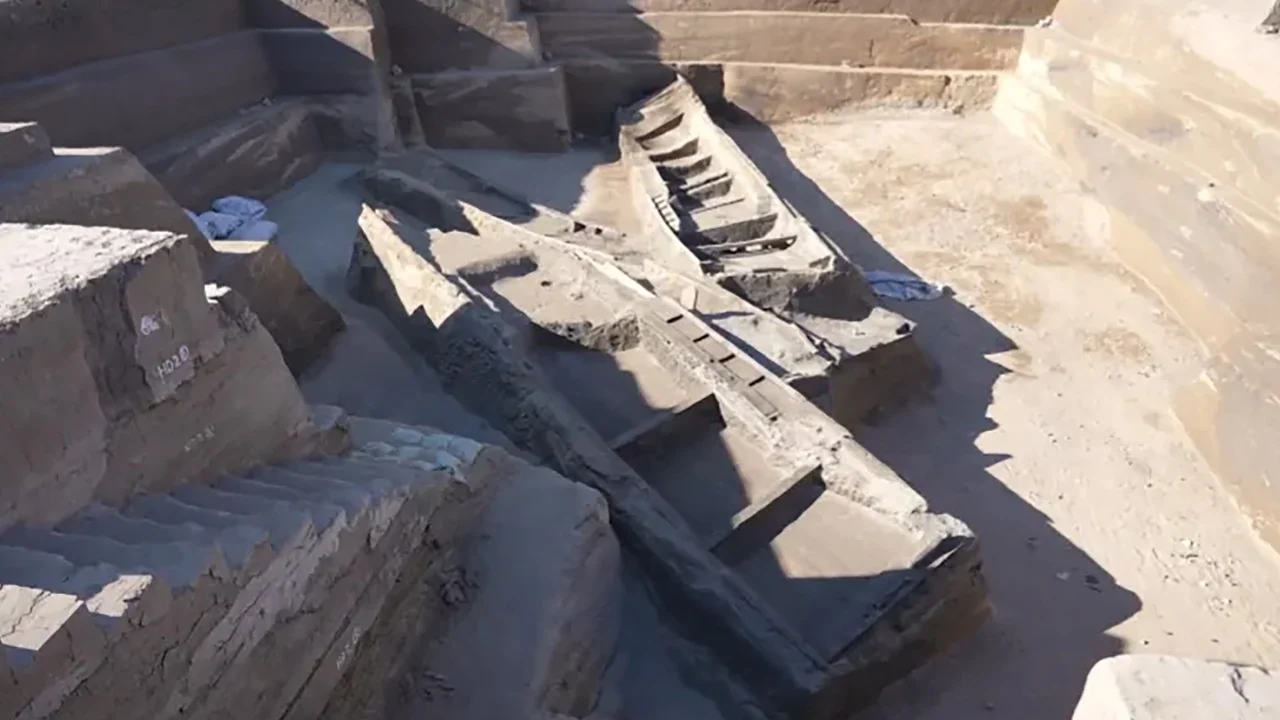
研究人员表示,在北京出土的三艘古代木船距今约1800年,为古代中国与世界其他地区之间的造船技术和文化交流提供了新证据。
Three ancient wooden boats unearthed in Beijing and dating back about 1,800 years offer new evidence of shipbuilding technology and cultural exchanges between ancient China and the rest of the world, according to researchers.
据北京市文物局官方社交媒体账号消息,周六,在2026北京公众考古季闭幕式上,研究人员公布了这一“北京古代内陆水上运输的首个实物证据”的详情。
The researchers unveiled details of “the first physical evidence of ancient inland water transport” in the Chinese capital at the closing ceremony of the 2026 Beijing Public Archaeology Season on Saturday, according to an official social media account of the Beijing Municipal Cultural Heritage Bureau.
据国家通讯社新华社报道,这三艘平底船可追溯至汉至魏晋时期(公元前206年—公元420年),是华北地区迄今发现的同期规模最大、结构最完整的内陆船只。
The three flat-bottomed boats, dating to the Han to Wei-Jin dynasties (206BC-AD420), were the largest and most structurally intact inland vessels of their period ever found in northern China, state news agency Xinhua reported.
这些船只于2025年底在北京市丰台区永定河故道的一处古河道中被发现。
The vessels were discovered in an ancient river channel along the former course of the Yongding River in Beijing’s Fengtai district in late 2025.
三艘船中最大的一艘长14米(46英尺)。考古人员在其木质构件上发现了意为“官”的汉字印记,表明这些船只用于国家管理的运输。
The largest of the three measures 14 metres (46 feet) long. Archaeologists found Chinese characters meaning “official” stamped on its wooden components, indicating state-managed transport.
据市委机关报《北京日报》报道,这些船只展现了当时先进的造船技术,其中一些可能与罗马时代地中海地区使用的做法有关。
The boats show sophisticated shipbuilding techniques for the period, some of which may be linked to practices used in the Mediterranean during the Roman era, according to the municipal Communist Party newspaper Beijing Daily.
船只的船体通过榫卯结构和木钉连接固定。建造者在构成船底的木板边缘切割出相互匹配的形状,将其拼合,并用木钉固定接头,使其牢固就位。
A combination of interlocking wooden joints and pegs held the boats’ hulls together. Builders cut matching shapes into the edges of the planks forming the bottom, fitted them together and secured the joints with wooden pegs to keep them firmly in place.
研究人员表示,这一技术在罗马时代地中海地区的造船中曾被广泛使用——大约从公元前1世纪到公元5世纪——但在其他地区鲜有记载。
The technique was widely used in Roman-era shipbuilding in the Mediterranean – roughly from the 1st century BC to the 5th century AD – but has rarely been documented elsewhere, according to the researchers.
据《北京日报》报道,新发现的这些船只为“东西方文化和技术交流提供了新证据”。
The newly discovered vessels offered “fresh evidence of cultural and technological exchanges between East and West”, Beijing Daily reported.
考古学家2014年首次在东亚发现类似结构,当时他们在位于中国西北部陕西省的古代都城西安发掘了一艘汉代木船,名为“丝路一号”。
Archaeologists first found a similar structure in East Asia in 2014, when they excavated a Han dynasty wooden boat, known as Silk Road No 1, in the ancient Chinese capital Xian in northwestern Shaanxi province.
“(丝路一号)为(汉朝都城)长安与罗马之间的文化交流提供了实物证据,”该船展览的策展人彭文在2024年接受新华社采访时表示。汉朝是中国与外部世界联系扩展的重要时期。
“[Silk Road No 1] provides physical evidence of cultural exchanges between [the] Han dynasty [capital] Changan and Rome,” Peng Wen, curator of the boat’s exhibition, told Xinhua in a 2024 interview. The Han dynasty marked an important period in the expansion of China’s contacts with the outside world.
公元前138年,汉武帝派遣使节张骞西行,寻求与大月氏结盟对抗匈奴。大月氏拒绝了结盟,但张骞带回了关于西域的宝贵信息,其范围延伸至中亚的广阔地区。
In 138BC, Han dynasty emperor Wu sent envoy Zhang Qian westward to seek an alliance with the Da Yuezhi people against the Xiongnu. The Da Yuezhi declined the alliance, but Zhang brought back valuable information about the western regions that extended to the vast area of Central Asia.
在接下来的几十年里,贸易路线不断扩展,将中国丝绸和其他货物运往西方,并带回马匹、葡萄和其他产品。
Over the following decades, the trade routes expanded, carrying Chinese silk and other goods westward, bringing back horses, grapes and other products.
这些网络还通过包括安息帝国在内的中间人将中国与罗马世界连接起来,安息帝国曾统治古代伊朗和美索不达米亚。
These networks also connected China with the Roman world through intermediaries including the Parthian Empire, which dominated ancient Iran and Mesopotamia.
公元97年,汉朝派遣使节甘英出使大秦——中国对罗马帝国的称呼——寻求建立直接联系。甘英抵达波斯湾,但未能完成旅程。
In AD97, the Han dynasty sent an envoy, Gan Ying, on a mission to Da Qin, the Chinese name for the Roman Empire, seeking to establish direct contact. Gan reached the Persian Gulf but did not complete the journey.
据记载,公元166年,自称罗马使节的人经海路经由今越南中部抵达汉朝宫廷,带来了象牙等货物。但历史学家质疑他们是官方使节还是商人。
In AD166, people claiming to be Roman envoys arrived at the Han court by sea via present-day central Vietnam, bringing goods including ivory, according to the . But historians have questioned whether they were official envoys or merchants.
尽管没有确凿证据表明中国与罗马之间存在直接外交关系,但地中海地区发现了汉代丝绸,而中国也出土了西方玻璃器皿。
And although there is no conclusive evidence of direct diplomatic ties between China and Rome, Han dynasty silk has been found in the Mediterranean region, while Western glassware has been unearthed in China.