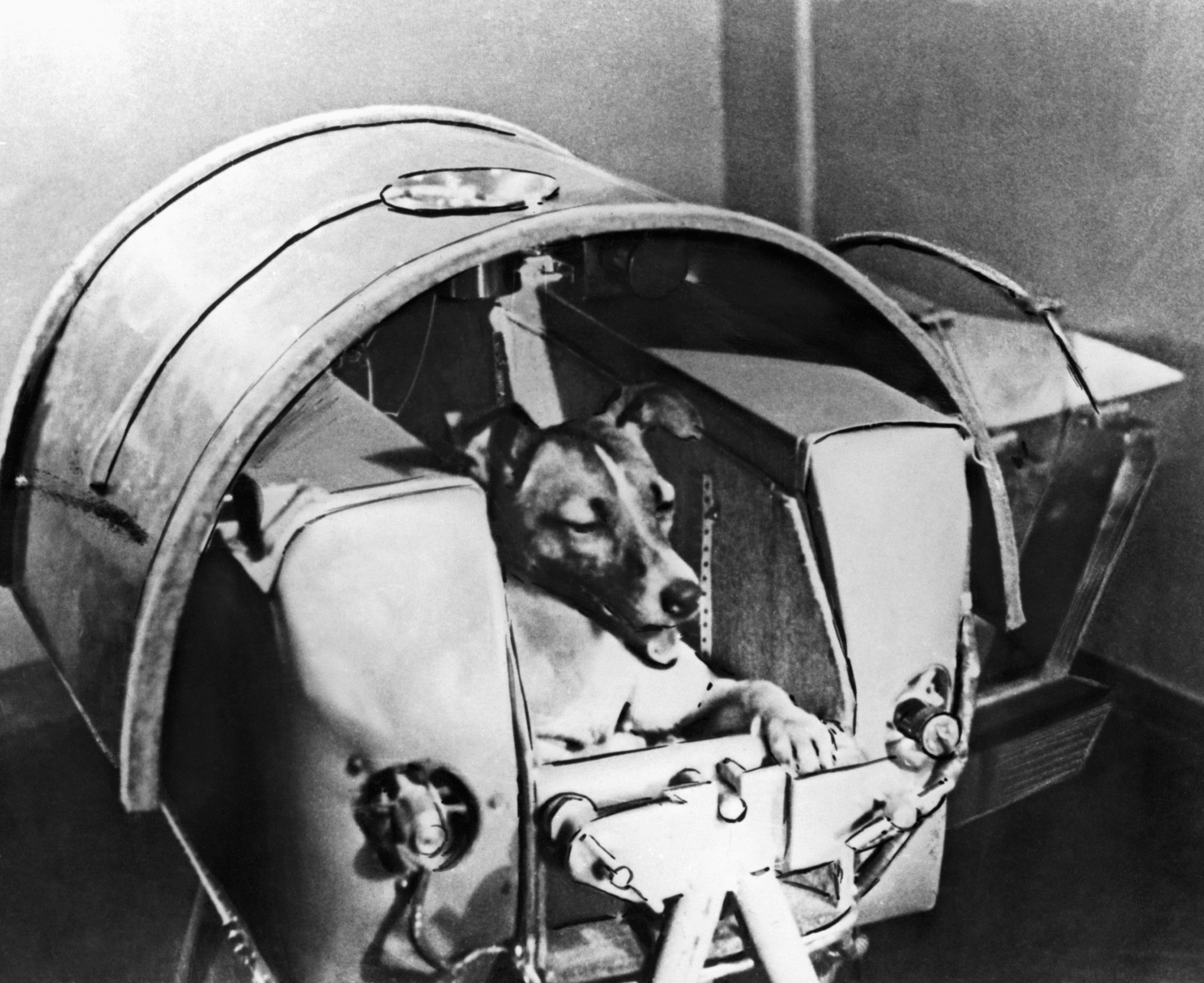
苏联官员隐瞒了莱卡悲惨命运的细节长达数十年。来自莫斯科的消息全是好消息。
Soviet officials hid the details of Laika’s sad fate for decades. The news from Moscow was all good.
当时距离苏联将第一只狗送入轨道并赢得全球喜爱已经过去了四天。冷战将世界一分为二,但各地的人们都在搜寻天空,希望能瞥一眼那道划过天际的白色亮光——那是搭载着可爱小莱卡飞越地球高空的“斯普特尼克2号”(Sputnik 2)。
It had been four days since the Soviet Union launched the first dog into orbit — and global adoration. The Cold War had split the world in two, but people everywhere were searching the sky for a glimpse of the streaking white blip that was Sputnik 2, carrying sweet little Laika high above the planet.
据美联社报道,当时俄罗斯首都正在流传消息称,这只3岁、重13磅的前流浪犬(据信是斯佩茨犬与梗犬的混血)即将回家。
Now, the Associated Press reported, word was circulating in the Russian capital that the 3-year-old, 13-pound former stray, believed to be a spitz-terrier mix, would soon be coming home.
美联社曾热情洋溢地报道:“这只狗的回归将为第二颗卫星的传奇画上圆满的句号:一次太空往返之旅。当然,降落伞空投将是史上最长的一次。”但当时,这只大眼睛、尖耳朵的小狗已经死了。它在1957年11月3日发射后数小时内便因过热和惊恐而死。当局从来没有任何计划将其活着带回。
“Return of the dog would complete a triumph in the saga of the second satellite: A roundtrip into space,” the AP enthused. “The parachute drop would be the longest ever, of course.”But by then, the big-eyed, pointy-eared pup was already dead. She had succumbed to overheating and panic within hours of the Nov. 3, 1957, launch. There had never been any plan to bring her back alive.
对苏联而言,前一个月发射的“斯普特尼克1号”(Sputnik 1)不仅是一场科学上的胜利,更是一场宣传政变。莫斯科掌握了将第一颗人造卫星送入轨道所需的技术,及其所暗示的军事优越感,在西方引发了一场信心危机,尼基塔·赫鲁晓夫对此感到十分欣喜。
For the Soviets, the launch the month before of Sputnik 1 had been not only a scientific triumph but a propaganda coup. Moscow’s mastery of the technology required to send the first man-made satellite into orbit, and the military superiority it implied, had provoked a crisis of confidence in the West, and Nikita Khrushchev was delighted.
为了扩大国家在太空竞赛中的领先地位,并加深对手的惊恐,这位苏联领导人只给了其太空计划几周时间来筹备下一次任务:将一只动物送入轨道。
Eager to expand his country’s lead in the Space Race — and to deepen its adversaries’ alarm — the Soviet premier gave his space program just weeks to ready the next mission: launching an animal into orbit.
这有足够的时间从莫斯科的一家收容所搜集流浪犬,挑选出一只听话、温顺的狗,通过手术植入监测其生命体征的设备,并试图让她习惯她将被封锁在其中的半平方米空间。但这并没有足够的时间来开发一个能将其送回地球的再入系统。
That was enough time to gather dogs from a Moscow shelter, pick one for her obedience and demeanor, surgically implant a device to monitor her vital signs, and try to get her accustomed to the half-square-meter space into which she would be sealed. It wasn’t enough time to develop a reentry system to deliver her back to Earth.
该任务将是一次有去无回的单程旅行,这一事实并未包含在公告中。尽管如此,动物福利组织——当时尚未出现如今这种有组织的动物权益运动——仍谴责其为残酷行径。狗主人及其宠物在华盛顿和伦敦的苏联大使馆以及纽约的联合国总部外举行了抗议活动。
That the mission would be a one-way trip wasn’t part of the announcement. Still, animal welfare groups — there wasn’t yet the organized animal rights movement of today — condemned it as cruel. Dog owners and their animals demonstrated outside Soviet embassies in Washington and London and U.N. headquarters in New York.
69年前的周二,莱卡在哈萨克斯坦第5科研试验场搭乘R-7火箭冲向太空。莱卡在俄语中意为“吠叫者”。当局为其提供了足够维持7到10天的营养和氧气。
Laika, Russian for “barker,” blasted off 69 years ago Tuesday from Scientific Research Test Range No. 5 in Kazakhstan atop an R-7 rocket. She was given enough nutrition and oxygen to survive seven to 10 days.
在接下来的一周里,苏联官员在每日公报中坚称这只狗活着并且状态良好。随后,他们声称在太空舱氧气耗尽之前对其实施了人道安乐死。直到1991年苏联解体后,真相才浮出水面。
For the next week, Soviet officials claimed in daily communiqués that the dog was alive and well. Then, they said, she was euthanized humanely, before her capsule ran out of oxygen. It wasn’t until after the Soviet Union collapsed in 1991 that the truth emerged.
莫斯科飞行控制中心传回的监测数据显示,在发射过程中,莱卡的心率增加了两倍,呼吸频率增加了四倍。在最大加速度下,她承受了5个G的过载。
During liftoff, monitor data sent back to Flight Control Center in Moscow showed, Laika’s heart rate tripled and her breath rate quadrupled. At maximum acceleration, she experienced 5 Gs.
当火箭进入轨道时,卫星未能与最后一级火箭分离。热控系统发生故障。隔热层撕裂。太空舱内的温度升至100度以上。
When the rocket entered orbit, the satellite failed to separate from the last rocket stage. The thermal control system malfunctioned. Heat insulation tore away. Inside the capsule, the temperature rose above 100 degrees.
据信莱卡在飞行5到7小时之间、即卫星第四次绕地球飞行时死亡。该飞行器又盘旋了161天,完成了约2570圈飞行后,才坠落出轨道并在重返大气层时烧毁。
Laika is believed to have died between five and seven hours into the flight, on the satellite’s fourth circuit of Earth. The craft circled for another 161 days, completing some 2,570 laps before falling from orbit and burning up in reentry.
对苏联来说,“斯普特尼克1号”是一场纯粹的胜利。但“斯普特尼克2号”的成就——重量增加到六倍,配备了遥测设备、科学设备以及供哺乳动物生存的生命维持系统——却因针对蓄意杀死这只俘获了全世界芳心的流浪狗的强烈抗议而黯然失色。
For the Soviets, Sputnik 1 had been an unalloyed victory. But the achievement of Sputnik 2, six times heavier, with telemetry equipment, scientific equipment and life support systems for a live mammal, was tempered by the outcry against the premeditated killing of the street dog who had captured hearts around the world.
自此之后,这只无畏的杂交犬一直存在于流行文化中,成为了数十首歌曲、书籍和电影的灵感来源。动物权益历史学家现在将她的死视为该运动的一个开创性时刻,权益倡导者在反对动物实验的辩论中也常常唤起对她的记忆。
The intrepid mutt has been a presence in popular culture ever since, the inspiration for dozens of songs, books and films. Historians of animal rights now see her death as a seminal moment in the movement, and rights advocates continue to invoke her memory in arguments against animal testing.
萨拉·奥利弗(Sara Oliver)2025年在善待动物组织(PETA)撰文写道:“莱卡令人心碎的故事,是人类将其他动物视为用完即弃的工具而非个体这一更大残酷模式的一部分。人类辜负了她——以及数百万其他动物——但我们正在从错误中吸取教训。”苏联人继续将狗送入太空,他们认为这些数据是载人飞行前期的关键准备。(美国宇航局使用的是猴子和黑猩猩。)但他们再也没有让狗成为自杀式任务的不知情的受害者。所有后续飞行都包括了动物安全回收的计划。
“Laika’s heartbreaking story is part of a larger pattern of cruelty where humans treat other animals as disposable tools instead of individuals,” Sara Oliver wrote for PETA in 2025. “Humanity failed her — and millions of other animals — but we are learning from our mistakes.”The Soviets continued to launch dogs into space, the data from which they viewed as critical preparation for manned missions. (NASA used monkeys and chimpanzees.) But never again would they make a dog the unwitting victim of a suicide mission. All subsequent flights included plans for the animals’ safe recovery.
20世纪90年代,随着莱卡苦难的细节开始浮出水面,苏联太空计划的老兵们表达了长期压抑的疑虑。
In the 1990s, as the details of Laika’s ordeal began to emerge, veterans of the Soviet space program expressed long-withheld misgivings.
据报道,训练莱卡的苏联前空军中将、科学家奥列格·加赞科(Oleg Gazenko)于1998年表示:“与动物一起工作是我们所有痛苦的根源。时间过去得越久,我对此就越感到抱歉。我们本不该这么做。我们从这次任务中学到的东西并不足以证明这只狗的死是值得的。”“照片年鉴”(Photo Almanac)是《华盛顿邮报》的一个不定期专栏,利用照片档案审视我们走过的路,以理解我们所处的当下。
“Work with animals is a source of suffering to all of us,” former Soviet Air Force Lt. Gen. Oleg Gazenko, the scientist who trained Laika, is reported to have said in 1998. “The more time passes, the more I’m sorry about it. We shouldn’t have done it. We did not learn enough from the mission to justify the death of the dog.”Photo Almanac is an occasional series from The Washington Post, using photo archives to examine where we’ve been to understand where we are.