这是一篇赞助内容,由东京都政府的东京更新网站专门创建和编辑。
This is a sponsored story, created and edited exclusively by Tokyo Metropolitan Government’s Tokyo Updates website.
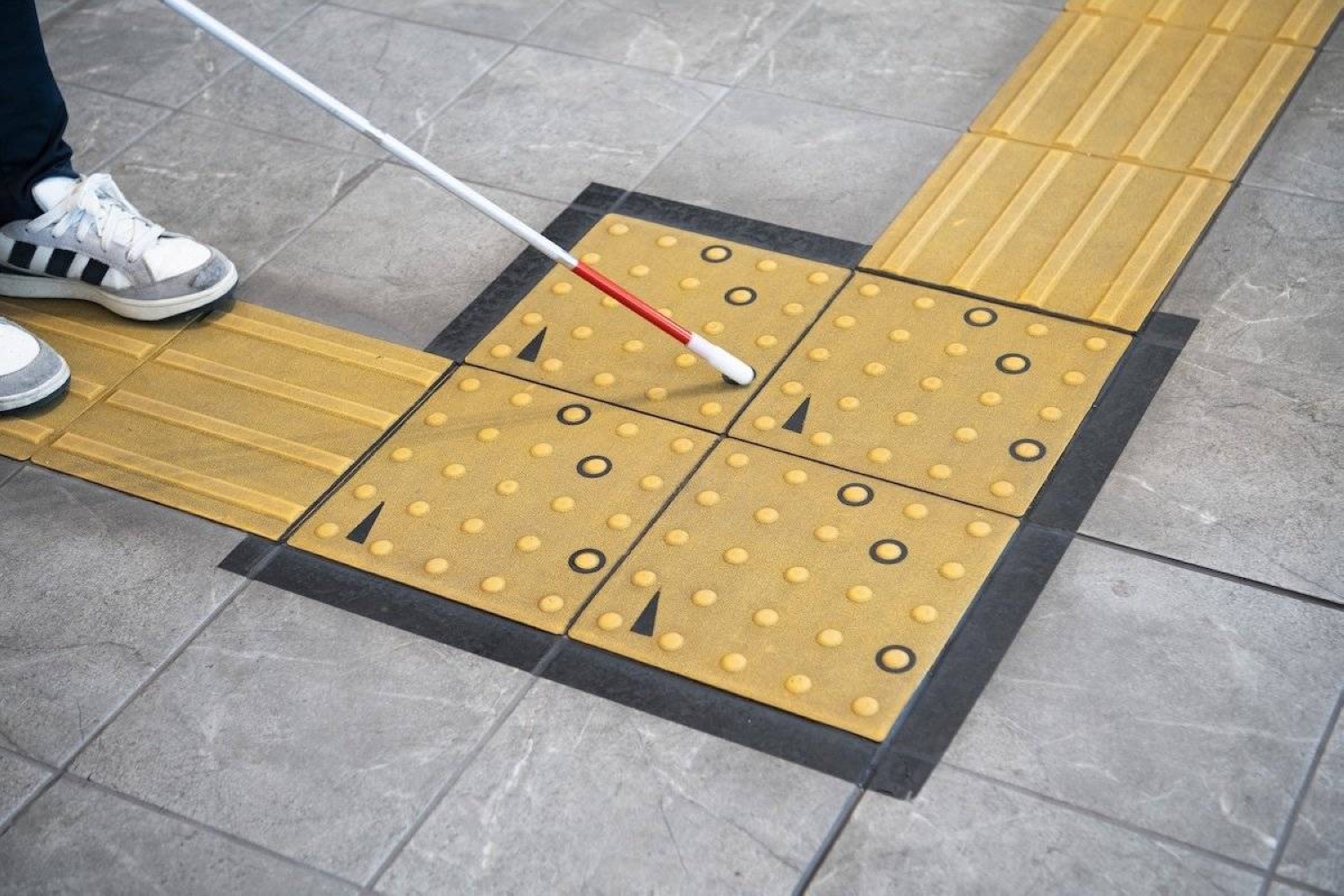
“直前是电梯和信息台。左侧是北出口。”把手机放在脚下的点字块上,即可获得周围环境的音频说明。该“编码点字块”系统正在日本21个地点推广,包括东京目黑区市政厅。本文将聚焦W&M Systems LLC的这一举措,该公司致力于打造一个人人可自由出行和探索的社会,包括视障人士。
“Straight ahead are the elevator and information desk. To your left is the north exit.”Hold your smartphone over the braille blocks at your feet, and get an audio explanation of your surroundings. This “coded braille block” system is being introduced at 21 locations across Japan, including the Setagaya City Hall in Tokyo. Here, we take a look at this initiative by W&M systems LLC, a company that aims to create a society where everyone, including those with visual impairments, can enjoy getting around and exploring freely.
点字块是一种无障碍基础设施,起源于1967年的日本西部冈山县。该系统将四条凸起线的导向点字块与凸起点的警示点字块相结合,帮助视障人士安全步行。W&M Systems的首席执行官高山宏康(Hiroyasu Takayama)看到了这一熟悉基础设施的新潜力。
Braille blocks are a form of barrier-free infrastructure that originated in Okayama Prefecture, located in western Japan, in 1967. The system combines guided braille blocks, with their four raised lines, and alert braille blocks, with their raised dots, to help people with visual impairments get around safely on foot. It was Hiroyasu Takayama, CEO of W&M systems, who saw the new potential in this familiar piece of infrastructure.
灵感来自首席工程师千叶和也(Kazuya Chiba)在为患有罕见疾病的母亲寻找沟通方式时开发的笔形传感器。当笔触碰印有特殊代码的纸张时,会播放录制的消息,例如“我热”或“我想喝水”。这一机制成为关键灵感来源。
The inspiration came from a pen-shaped sensor developed by lead engineer Kazuya Chiba while he was searching for ways to communicate with his mother, who was living with a rare disease. When the pen was touched to paper printed with special codes, it would play recorded messages such as “I’m hot” or “I’d like some water.”This mechanism proved to be a key source of inspiration.
回想起来,高山回忆道:“我想,也许我们可以把同样的机制——当传感器接触到某物时播放音频——应用于帮助视障人士步行出行。从那时起,我们开始了漫长的反复试验过程。”一条更智能的前行之路最初的想法是把视障人士使用的白手杖本身变成触控笔。在手杖尖端安装传感器,当使用者将其触碰盲文块时播放语音引导。虽然他们成功利用传感器读取了信息,但户外盲文块上积聚的灰尘和污垢使其在一天之内就无法使用。安装在手杖尖端的传感器也容易损坏或飞脱,使该系统不适合日常使用。
Looking back, Takayama recalls: “I thought maybe we could apply the same mechanism — playing audio when a sensor touches something — to help those with visual impairments get around on foot. From there, we began a long process of trial and error.”A smarter path forward The initial idea was to turn the white canes used by those with visual impairments into touch pens themselves. A sensor would be attached to the tip of the cane, and audio guidance would be played when the user touched it to the braille blocks. While they succeeded in using the sensor to read information, the dust and dirt that accumulated on outdoor braille blocks rendered it unusable within a day. The sensors attached to the tips of the canes were also prone to breaking or flying off, making the system impractical for everyday use.
“对视障人士来说,白手杖是身体的延伸。无论一个系统多么方便或具有突破性,如果不易于使用,就行不通。”他们接下来把注意力转向盲文块本身的凸点。通过在警示盲文块的25个凸点(按5×5网格排列)上添加标记,他们创造出一种可以像二维码一样读取的编码。通过改变哪些凸点被标为黑色,该系统可以生成超过3000万个唯一编码。
“For those with visual impairments, the white cane is an extension of the body. No matter how convenient or groundbreaking a system may be, it won’t work if it’s not easy to use.”They next turned their attention to the raised bumps on the braille blocks themselves. By adding markings to the 25 bumps (arranged in a 5x5 grid) on the alert braille blocks, they created a code that could be read in the same way as a QR code. By varying which bumps were marked in black, the system could generate over 30 million unique codes.
为将这一构想变为现实而开发的原型是一套笨重的装置,需要使用者将微型摄像头安装在白手杖上,通过线缆连接到随身佩戴的电脑和电池,并戴上耳机。虽然这一想法和技术具有创新性,但试验参与者指出,众多线缆使穿戴过程繁琐,而且会妨碍他们随时随意外出。
The prototype developed to bring the concept to life was a cumbersome setup that required users to attach a microcamera to their white cane, connect it by cable to a computer and battery worn on the body, and wear earphones. While the idea and the technology were innovative, participants in the trial noted that the many cords made it tedious to put on, and that it would prevent them from going out spontaneously.
重大突破出现在高山咨询其朋友、石川县金泽工业大学的松井邦夫教授时。根据松井的建议,利用智能手机——它已集摄像头、计算机和通信功能于一身——即可解决该问题,双方由此开始联合开发。2019年,他们的编码点字块识别系统作为智能手机应用程序“Walk and Mobile”发布。
A major breakthrough came when Takayama consulted his friend, Professor Kunio Matsui of the Kanazawa Institute of Technology in Ishikawa Prefecture, on Japan’s west coast. Acting on Matsui’s advice that the issue could be solved by using a smartphone — which already combines a camera, computer and telecommunication capabilities — they began joint development. And in 2019, their coded braille block recognition system was released as the smartphone app, Walk and Mobile.
自由漫行 这种编码点字块系统的显著特点在于,它会根据使用者行进的四个方向中的哪一个,提供不同的语音引导。依赖GPS的地图应用往往在室内或地下无法运行,即便在室外也可能偏离数米,导致导航时容易丧失方向感。通过将点字块作为固定的物理基准点,使用者能够在不丧失定向感的情况下,以厘米级精度确认自己的位置。
The freedom to wander The defining feature of this coded braille block system is that it provides different audio guidance depending on which of the four directions the user is traveling. Map apps that rely on GPS often do not function indoors or underground, and even outdoors can be off by several meters, making it easy to lose one’s sense of direction while navigating. By using the braille blocks as a fixed physical reference point, users are able to confirm their location at a centimeter-level accuracy without losing their orientation.
“对视障人士来说,最大的挑战是失去方向感,”高山解释道。“闭上眼睛转一圈,你就会失去自己正面朝向的位置。这是视障人士每天都会经历的事情。”
“The greatest challenge for people with visual impairments is when they lose their orientation,” Takayama explains. “Close your eyes and spin around a bit, and you lose track of where you’re facing. This is something that people with visual impairments experience on a daily basis.”
编码点字块在设计理念上与路线导航系统本质不同。许多无障碍系统旨在引导用户到达特定目的地,而W&M系统则设想“一个所有人都能自由漫步的社会”。“那边有一张长椅。” “那边有一个自动售货机。” “那边有一家新的和菓子店。” 语音导航融入了视力正常人行走时自然获取的信息,以及那些不方便向他人询问的事物,例如附近卫生间的位置。
The coded braille blocks also fundamentally differ from route-guidance systems in their design philosophy. While many barrier-free systems are designed to guide users to a specific destination, W&M systems envisions “a society where all people can enjoy the freedom to wander about freely.”“There’s a bench over there.”“There’s a vending machine.”“There’s a new wagashi (traditional Japanese confectionery) shop.”The audio guidance incorporates the kinds of information that sighted people naturally pick up on as they walk, as well as things that can be awkward to ask others about, such as the location of nearby restrooms.
公司收到了许多热情的用户反馈,包括“就像在脑海中出现了一张地图”“让我能自在地独自走动”等评论。在东京这样每一次步行都可能带来新发现的城市中实现这种漫步体验,可能会进一步推动这一愿景在日本的传播。
The company has received many enthusiastic responses from users, including comments like, “It’s like having a map appear in my head” and “It makes me comfortable walking around on my own.”Enabling this kind of wandering about in a city like Tokyo, where every walk can bring a new discovery, is likely to help further spread the vision across Japan.
截至2026年6月,编码点字块已在日本21个地点安装,主要集中在东京的设施,如目黑区市政府和品川区市政府,以及金泽市(石川县)、上条市(长野县)、鸟取市和广岛市等地。由于该系统在室内外环境中提供无缝覆盖,并包含即使离线也能运行的疏散模式,它能够在灾害期间提供音频导航,帮助用户前往附近的疏散避难所。
As of June 2026, coded braille blocks have been installed at 21 locations across Japan, mainly in facilities in Tokyo such as the Setagaya City Office and Shinagawa City Office in Tokyo, as well as sites in Kanazawa City, Ishikawa Prefecture; Shiojiri City, Nagano Prefecture; Tottori City; and Hiroshima City. Because the system provides seamless coverage across indoor and outdoor environments and includes an evacuation mode that functions even when offline, it can deliver audio guidance that helps users navigate to nearby evacuation shelters during disasters.
该公司还在探索通过多语言支持在旅游领域的应用。在金泽,计划于今年启动一项试点项目,测试提供当地观光景点信息的“观光模式”。该模式预计还将通过在金泽城公园周边的町屋(日本传统町屋)、和果子店及其他景点提供多语言语音导览,帮助缓解导游人手短缺的问题。
The company is also exploring applications in tourism through multilingual support. In Kanazawa, there is a pilot project planned for this year to test a “Tourism Mode” that provides information about local sightseeing destinations. This mode is also expected to help address labor shortages among tour guides by offering multilingual audio guidance on nearby machiya (traditional Japanese townhouses), wagashi shops, and other points of interest around Kanazawa Castle Park.
迈向无障碍社会 东京都政府正通过《福祉友好型城市建设条例》、《无障碍建筑条例》等,不仅在建筑物,还在道路和公共交通设施中推进无障碍措施。
Toward a barrier-free society The Tokyo Metropolitan Government is advancing barrier-free measures not only in buildings but also on roads and in public transportation facilities, through the Welfare-Friendly Town Development Ordinance, Barrier-Free Building Ordinance, and more.
然而,高山指出,仅完善基础设施是不够的。同样重要的是融入使用者自身的视角。
Takayama, however, points out that improving infrastructure alone is not enough. It is equally important to incorporate the perspectives of the users themselves.
“提到视觉障碍,人们往往会联想到全盲者。但实际上,全盲者仅占约10%。约90%属于所谓的弱视,他们可能能感知光线但只能看清模糊影像,或难以看清视野中心。他们的视力状况因人而异。”关于盲道砖,不仅要提供物理凸起,还要通过使用黄色等高可见度颜色,确保与周围路面有足够的对比度。据高山介绍,若为追求美观而安装与周围路面颜色相近的盲道砖,或设置过于复杂的分支盲道,反而会给视障者造成困扰。
“When people think of visual impairments, they tend to imagine someone who is completely blind. But in reality, only about 10% are totally blind. Around 90% have what’s called low vision, meaning they may be able to perceive light but see only blurred images, or have a hard time seeing in the center of their field of vision. The way they see varies greatly from person to person.”With braille blocks, it is important not only to provide physical raised bumps, but also to ensure sufficient contrast with the surrounding pavement by using highly visible colors like yellow. According to Takayama, prioritizing aesthetics and installing blocks in colors similar to the surrounding pavement, or creating overly complex branching routes of braille blocks, can actually cause confusion for those with visual impairments.
“真正无障碍与否的分水岭,在于基础设施是与使用者共同打造,还是从健全者视角出发建设,”高山表示。
“The dividing line between what’s truly barrier-free and what’s not lies in whether the infrastructure is created with the users themselves, rather than from the perspective of those who can see,” Takayama says.
国土交通省发布了关于建筑物和公共交通无障碍设施采用情况的数值数据。然而,W&M systems 公司与金泽工业大学合作,正致力于开发一项“无障碍达成指数”,旨在不仅衡量物理基础设施,还要衡量其可用性——诸如易用性和公众理解度等因素。
The Ministry of Land, Infrastructure, Transport and Tourism publishes numerical data on the adoption of barrier-free infrastructure in buildings and public transportation. However, W&M systems, in collaboration with the Kanazawa Institute of Technology, is working to develop a Barrier-Free Achievement Index that would measure not only the physical infrastructure, but also the usability of it — factors such as ease of use and public understanding.
“看不见或听不见的人、使用轮椅的人……我们的城市里有各种各样的人。我认为,采取一些小小的行动,比如留意周围的人,在有人看起来遇到困难时伸出援手,将是改变社会的第一步。”随着东京持续完善城市基础设施,也必须继续面对这样一个问题:这些基础设施是否对所有人都平等可及。给盲道赋予“声音”的举措,已开始缓慢地改变长久以来支撑日常生活的固有观念。
“People who have difficulty seeing or hearing, people who use wheelchairs... There are many different kinds of people in our cities. I think that taking small actions, such as paying attention to those around us and offering help when someone appears to be struggling, will be the first steps toward changing our society.”As Tokyo continues to enhance its urban infrastructure, it must also continue to address the question of whether that infrastructure is equally accessible to all. The act of giving braille blocks a “voice” has slowly begun to change the assumptions that have long supported everyday life.
随着盲道——这一最初在日本开发的设施——不断演进,人们期盼它能作为一种社会基础设施和无障碍新标准的体现,从东京传播到世界各地,构建一个人人都能随心所欲享受漫步的社会。
As braille blocks, originally developed in Japan, continue to evolve, the hope is that they will spread from Tokyo to the rest of the world as a form of social infrastructure and an embodiment of a new standard for barrier-free accessibility — a society where everyone can enjoy walking around as they please.