在关键矿产领域,情况要么是干旱,要么是洪水。多年来,试图开采或加工对电动汽车、无人机、医疗设备、LED、喷气发动机和计算机芯片性能至关重要的稀有元素的公司,必须为每一分钱而争夺。
In the world of critical minerals, it’s either a drought, or a flood. For years, companies trying to mine or process the rare elements vital to the performance of electric vehicles, drones, medical devices, LEDs, jet engines and computer chips had to fight for every cent.
资本密集型企业需要的债务和股权投资者几乎没有理由投入资金。运营成本通常不比铜、铝等更平凡的金属好,往往更差。小而缺乏流动性的市场使得长期现金流几乎无法以足够的信心预测,以便银行放贷大量资金。而这种谨慎是有充分理由的。任何行业平衡供需都很困难,但关键矿产尤为脆弱。如果最终用户开发出需要更少或根本不需要某种元素的新配方,几乎可以在一夜之间摧毁整个行业的投资案例。
The debt and equity investors that capital-intensive businesses need to get off the ground saw little reason to put money in. Operating costs are typically no better, and often far worse, than for more humdrum metals such as copper and aluminum. Small, illiquid markets make long-term cash flows nearly impossible to forecast with enough confidence for bankers to lend large sums. And there’s good reason for that caution. Balancing supply and demand is difficult in any industry, but critical minerals are unusually vulnerable. If end-users develop new formulations that require less of a particular element — or none at all — they can destroy the investment case for an entire sector almost overnight.
所有这一切的背后都是中国:低成本竞争者,拥有通过收紧出口管制来加速替代供应需求,或通过放宽管制来压低价格的力量。
And looming over everything is China: a low-cost competitor with the power to turbocharge demand for alternative supplies by tightening export controls, or crush prices by loosening them.
过去两年,情况迅速逆转。发达经济体去年对关键矿产作出650亿美元的公共承诺,超过2023年的四倍。理论上,这应该足以让行业在财务上更稳固。然而,政府承诺的资金尚未转化为投入使用的资金:实际投资令人担忧,去年下降了9%。矿业和加工企业正在发现,彩票中奖者有时会以艰难的方式学到的教训:突如其来的意外之财可能带来与解决问题同样多的问题。
The past two years have seen the situation rapidly reverse. Advanced economies made $65 billion in public commitments for critical minerals last year, more than four times the level in 2023. In theory, that should be more than enough to put the industry on a firmer financial footing. Yet the funds pledged by governments have yet to translate into money being put to work: actual investment, worryingly, fell 9% last year. Miners and processors are discovering what lottery winners sometimes learn the hard way: A sudden windfall can create as many problems as it solves.
以 Energy Fuels Inc. 的命运为例。这家公司创立之初是一家美国铀生产商,却在 2011 年福岛第一核电站事故引发核燃料价格崩盘时遭遇厄运。在首届特朗普政府的贸易战期间,它利用位于犹他州东南部的铀矿厂分离稀土元素,完成了自我重塑。
Consider the fate of Energy Fuels Inc. Founded as a US uranium producer, the company had the misfortune of running into the collapse in nuclear-fuel prices that followed the Fukushima Daiichi disaster in 2011. During the first Trump administration’s trade wars, it reinvented itself, using its uranium mill in southeastern Utah to separate rare-earth elements.
这一转型时机恰到好处。去年,该公司开始试验性分离最稀缺的稀土元素,如镝、铽和钐 —— 这些元素用于制造耐高温磁铁 —— 就在美国制造商因中国为报复唐纳德·特朗普总统的“解放日”关税而切断此类磁铁出口、陷入恐慌之际。
That was a well-timed shift. Trial separation of the most scarce rare earths such as dysprosium, terbium and samarium — needed for magnets that can withstand high temperatures — began last year, just as US manufacturers were starting to panic after China choked off exports of such magnets in retaliation for President Donald Trump’s Liberation Day tariffs.
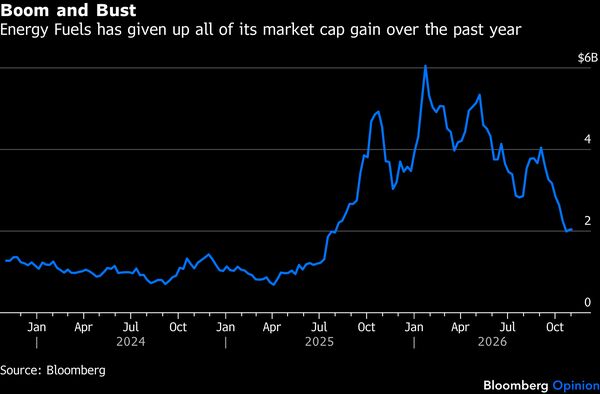
到今年 1 月底,Energy Fuels 的股价较七个月前上涨了五倍。管理层试图将公司打造成垂直整合的“从矿山到磁铁”稀土生产商,先后斥资 3 亿美元收购一家澳大利亚矿企,又于 6 月投入 19 亿美元收购磁铁制造商 VAC。
By late January this year, Energy Fuels’ stock was worth five times what it had been seven months earlier. Management was trying to turn the company into a vertically integrated “mine-to-magnets” rare-earth producer, spending $300 million on an Australian miner before laying out another $1.9 billion in June for magnet manufacturer VAC.
但这波好势头上个月遭遇重大挫折。据路透社报道,通用汽车公司作为 VAC 位于南卡罗来纳州萨姆特稀土磁铁工厂 90% 产量的客户,终止了协议。Energy Fuels 的市值从 1 月的约 65 亿美元缩水至不足三分之一。
But that good run hit a major obstacle last month. General Motors Co., the customer for 90% of the output from VAC’s rare-earth magnet plant in Sumter, South Carolina, terminated its agreement, Reuters reported. Energy Fuels’ market capitalization, about $6.5 billion in January, is now less than a third of that.
问题在于,无法靠情绪化的股价估值构建“从矿山到磁铁”的供应链。打破中国对关键矿产的垄断,需要在矿商、加工商和下游制造商等每个环节持续投资。但这一整个网络最终取决于政府无法单纯靠行政命令创造的东西:使用这些产品的企业能否提供稳定的需求。
The problem is that you can’t build a mine-to-magnets supply chain on excitable stock valuations. Breaking China’s stranglehold on critical minerals will require sustained investment at every stage — in miners, processors and downstream manufacturers. But that entire network ultimately rests on something governments can’t simply decree: steady demand from the companies that use their products.
2023年,通用汽车与VAC签署锚定协议时,首席执行官玛丽·巴拉曾表示,计划到2025年在北美每年生产100万辆电动汽车。然而,实际产量仅为17万辆,此后公司已计提超过110亿美元的费用,以缩减并重组其电动汽车项目。这家底特律车企已分别与MP Materials Corp.(MP材料公司)和Noveon Magnetics Inc.(诺威恩磁材公司)达成稀土磁体单独供货协议,因此VAC的产能如今看来已属于供过于求。
When GM signed its anchor deal with VAC in 2023, Chief Executive Officer Mary Barra was talking about producing 1 million electric vehicles a year in North America by 2025. Instead, it produced just 170,000, and has since taken more than $11 billion in charges to shrink and restructure its EV program. The Detroit-based carmaker already has separate rare-earth magnet deals with MP Materials Corp. and Noveon Magnetics Inc., so VAC’s output now looks surplus to requirements.
鉴于全球对稀土的紧张情绪,VAC的磁体本应有大量替代买家。但无法保证这些需求一定会落地。在这样一个规模小、抗风险能力弱的行业里,失去一个巨大终端用户可能引发连锁反应,波及整个供应链。这不仅会直接损害相关企业,还可能让投资者对关键矿产彻底失去信心,赶走该行业实现稳健发展所急需的私人资本。
Given the nervousness around rare earths worldwide, there should be plenty of alternative customers for VAC’s magnets. But there’s no guarantee they will materialize. The danger in such a small and fragile sector is that the loss of one giant end-user can cascade all the way down the supply chain. That wouldn’t just hurt the companies directly exposed. It could sour investors on critical minerals altogether, driving away precisely the private capital the industry needs to put itself on a stable footing.
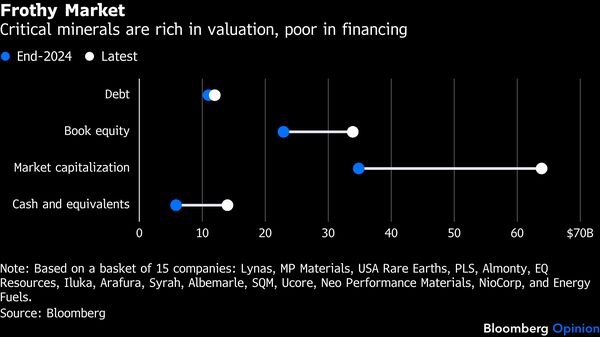
纵观构成上市关键矿产板块的十五家左右公司,同一模式反复出现。股价——企业金融中反应最快的部分——曾大幅飙升,在许多情况下随后又已崩盘。现金持有和账面权益也有所增加,因价格上涨和估值提升改善了利润率,并使企业能从股东处融资。但债务——任何寻求为大规模扩张融资的企业的“金标准”——仍然滞后。
Look across the 15 or so companies that make up the listed critical-minerals sector, and the same pattern emerges. Stock prices, the fastest-moving part of corporate finance, have soared and, in many cases, already crashed. Cash holdings and book equity have risen too, as higher prices and valuations have boosted margins and allowed companies to raise money from shareholders. But debt — the gold standard for any business seeking to finance serious expansion — is still lagging.
该行业拥有的有利条件比过去一代人中的任何时候都多:政府托底价格、公共贷款和股权投资、活跃的私人投资者,以及一个关于这些矿产为何在未来多年将保持至关重要的引人入胜的故事。但它在很大程度上仍缺乏将所有这些转化为持久业务所需的持续需求。检验标准不在于政府承诺多少资金,也不在于股价飙升多高,而在于当热情退去时,还能有多少企业屹立不倒。
The industry has more going for it than at any time in a generation: government-backed floor prices, public loans and equity investments, engaged private investors, and a compelling story about why these minerals will remain vital for years to come. What it still lacks, for the most part, is the sustained demand needed to turn all that into durable businesses. The test isn’t how much money governments pledge or how far shares rally. It’s how many businesses are still standing when the excitement drains away.