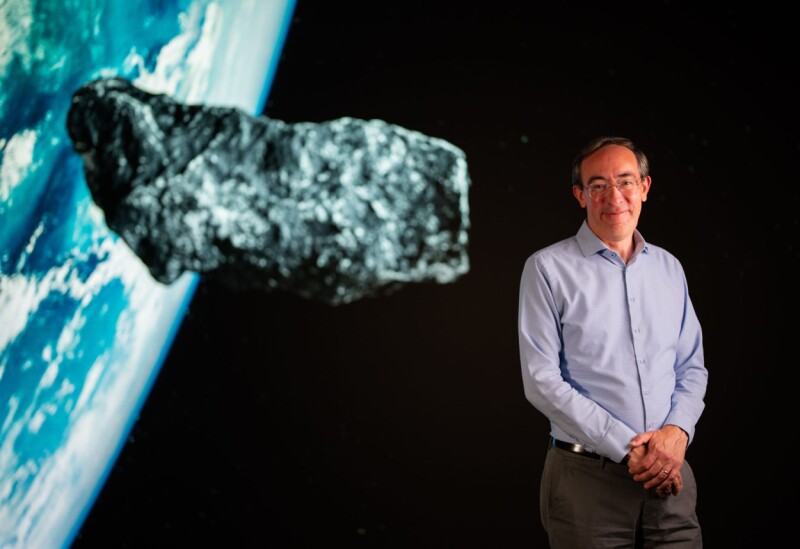
桑迪亚国家实验室的研究人员开发出一种方法,使小行星偏转建模更快、更详细。他们的模拟还展示了小行星的形状和朝向会在多大程度上增加偏转威胁性太空岩石的难度。由资深物理学家内森·摩尔带领的桑迪亚研究人员一直在寻找一种方法,以更好地模拟小行星附近核爆产生的X射线如何改变其轨道,这在一篇近期发表的研究论文中得到了解释。
Researchers at Sandia National Laboratories have developed a method to make asteroid deflection modeling faster and more detailed. Their simulations also demonstrated just how much asteroid shape and orientation can complicate efforts to deflect a threatening space rock. Sandia researchers, led by staff physicist Nathan Moore, were looking for a way to better model how X-rays from a nuclear detonation near an asteroid can change its trajectory, as explained in a recently published research paper.
“以前,计算太耗时,无法进行大量计算,”摩尔告诉《The》。“因此,很难探索不同的场景、不同的小行星或不同的任务概念。”这些计算的复杂性迫使早期研究人员做出妥协,往往将小行星建模为球体,或简化所涉及的物理过程。完美的球形小行星很少见,它们不规则的形状给那些密切关注天空以避免潜在小行星末日的人们带来了额外挑战。
“Before, the calculations were so time-consuming, one could not do very many of them,” Moore told The. “So it was very difficult to explore different scenarios, different asteroids, or different mission concepts.”The complexity of those calculations forced earlier researchers to make compromises, often modeling asteroids as spheres or simplifying the physics involved. Perfectly spherical asteroids are rare, and their irregular shapes present an additional challenge for those keeping an eye on the skies to avert a potential asteroid apocalypse.
为克服计算难题并实现对不规则小行星形状的更好建模,摩尔及其团队结合了桑迪亚已在使用的两个高保真模拟代码:ALEGRA(模拟辐射加热和高能材料动力学)和SPARTA(模拟低密度气体的行为)。正如摩尔在电子邮件中向我们解释的那样,这两个代码在小行星撞击建模的某一特定部分表现良好,但在另一部分表现不佳。
To overcome the computational problem and enable better modeling of irregular asteroid shapes, Moore and his team combined two high-fidelity simulation codes already in use at Sandia: ALEGRA, which models radiation heating and high-energy material dynamics, and SPARTA, which simulates the behavior of low-density gases. As Moore explained to us in an email, both codes are good at one particular part of asteroid impact modeling, but bad at the other.
“ALEGRA……能非常准确地模拟岩石表面的汽化,但对于低密度物质,计算效率会变低,”摩尔告诉我们。“这对小行星偏转模拟是个问题,因为随着气体在小行星周围膨胀,计算时间会增加。”早期使用ALEGRA的小行星模拟通常将小行星建模为球体,以缩短计算时间。“SPARTA在低气体密度下效率更高,”摩尔说。
“ALEGRA … can very accurately simulate the vaporization of the rocky surface, but the calculation becomes more inefficient for matter at low densities,” Moore told us. “This is a problem for asteroid deflection simulations, because as the gas expands around the asteroid, the calculation time goes up.”Earlier asteroid simulations using ALEGRA typically modeled asteroids as spheres to reduce calculation times. “SPARTA is more efficient at low gas densities,” Moore said.
“问题在于,相反地,SPARTA 在高气体密度下运行变得更加困难。因此关键在于同时使用这两个代码。”在摩尔的模型中,ALEGRA 处理高气体密度区域,而 SPARTA 处理形状不规则的稀薄区域。结果是两个代码各自处理最适合解决的问题部分,从而降低了总体计算负担。摩尔在桑迪亚国家实验室的新闻稿中表示,这种组合方法比早期方法快 1600 多倍,同时保留了足以预测形状不规则小行星偏转的精度。
“The problem is, conversely, SPARTA gets more difficult to run at high gas densities. So the key here was using both codes.”In Moore’s model, ALEGRA handles regions of high gas density, while SPARTA tackles the more dilute regions of an irregular shape. The result is two codes handling the parts of the problem they're best suited to solve, reducing the overall computational burden. The combined approach is more than 1,600 times faster than earlier methods, Moore said in a Sandia press release, while retaining sufficient accuracy to predict deflection in irregularly shaped asteroids.
摩尔的数据,更多的问题改进的模拟揭示了小行星的形状和朝向会在多大程度上使计算核偏转结果的尝试变得复杂。“我们预料到瞄准很重要,”摩尔说,“让我们惊讶的是它重要到这种程度。”利用三颗研究透彻的小行星——戈列夫卡、贝努和伊藤川——的详细模型进行偏转模拟发现,用近距离核爆产生的 X 射线照射同一颗小行星的不同侧面,产生的速度变化差异可达五倍。
Moore data, more problems The improved simulations reveal just how much asteroid shape and orientation can complicate attempts to calculate the outcome of a nuclear deflection. “We expected aim to matter,” Moore said. “What surprised us was how much.”
贝努是三者中最对称的,根据哪一面朝向爆炸,其偏转速度仍显示出近两倍的差异。换句话说,我们需要极其精确地确定在小行星附近引爆核装置的位置,否则我们冒着给它的推力远小于预期的风险。考虑到这一点,论文指出,我们可能对来袭小行星知之甚少,并且可能没有足够时间在尝试偏转它、防止我们所知的生命在全球性大火中终结之前,获得其清晰图像。
Deflection simulations using detailed models of three well-studied asteroids – Golevka, Bennu, and Itokawa – found that irradiating different sides of the same asteroid with X-rays from a nearby nuclear detonation could produce as much as a fivefold difference in the resulting velocity change. Bennu, the most symmetrical of the three, still showed nearly twofold differences in deflection velocity depending on which side faced the blast. In other words, we need to be incredibly precise about where we detonate a nuclear device near an asteroid, or we risk giving it a much smaller shove than intended.
我们也无法完全确定,当我们的偏转炸弹抵达时,小行星的朝向是否会配合。该团队还指出,如果不了解小行星的成分和内部结构,就很难得到准确的预测。
With that in mind, the paper points out that we might know little about an incoming asteroid, and might not have enough time to get a good picture of it before attempting to deflect it and prevent life as we know it from ending in a planet-wide conflagration. We also can’t be quite sure an asteroid’s orientation will cooperate once our deflecto-bomb arrives.
这可以说是小行星偏转迈出了一小步,却让人多了一大堆新担忧。但至少我们不再局限于把小行星当作完美球体的偏转模型了,尽管真正的威胁很可能形状坑坑洼洼得多。只希望我们能从足够远的地方发现小行星威胁,从而有机会先对其进行研究。®
The team also pointed out that it’s tricky to get an accurate prediction without knowing the composition and internal structure of an asteroid. One small step for asteroid deflection, one giant heap of new things to worry about, in other words. But hey – at least we’re no longer limited to deflection models that treat asteroids as perfect spheres, even though the real threats are likely to be considerably lumpier. Let’s just hope we spot an asteroid threat from far enough away that we get a chance to study it first. ®