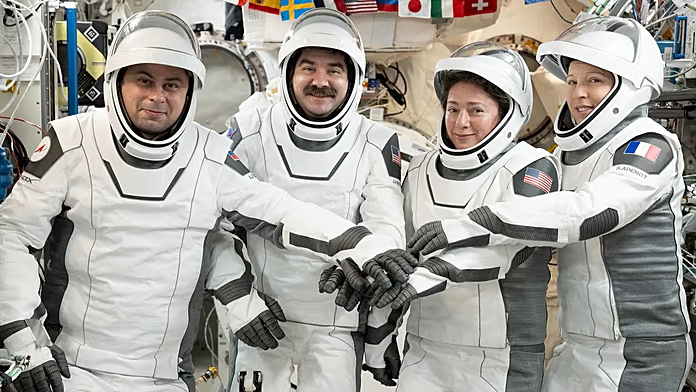
美国宇航员阿尼尔·梅农宣布,他和同事卢克·德莱尼、杰西卡·沃特金斯已在空间站完成投票,并强调投票通过安全的电子系统进行,确保选票送达选举官员。梅农在X平台上发文写道,从太空投票确实可行。他附上一段29秒的视频,视频中他展示了一张“我已投票”贴纸,并带人参观了他所说的自己的“投票站”——实际上是他在国际空间站上的私人舱室。
NASA astronaut Anil Menon announced that he and his colleagues Luke Delaney and Jessica Watkins had cast their votes from the space station, stressing that the process took place via a secure electronic system that ensures ballots reach election officials. In a post on X, Menon wrote that it is indeed possible to vote even from space. He attached a 29-second video in which he shows an “I voted” sticker and gives a tour of what he described as his own “polling station”, which in reality was his private cabin on the International Space Station.
他解释说,他在电脑上填写了表格并发送至得克萨斯州哈里斯县,他的选票在那里被正式登记。哈里斯县是美国宇航局宇航员通常的投票目的地,因为该县是休斯敦约翰逊航天中心的所在地,该中心是该机构管理载人航天任务的主要中心。选票如何传回地球?尽管距离遥远,投票过程依赖的是美国宇航局每天通过其太空通信与导航项目与空间站交换数据和信息所用的同一套基础设施。
He explained that he had filled out the form on his computer and sent it to Harris County in Texas, where his vote was officially recorded. Harris County is the usual electoral destination for NASA astronauts because it is home to the Johnson Space Center in Houston, the agency’s main centre for managing human spaceflight missions. How do votes travel back to Earth? Despite the distance, the voting process relies on the same infrastructure that NASA uses every day to exchange data and messages with the station through its space communications and navigation programme.
据该机构介绍,流程始于宇航员使用“联邦明信片申请表”申请缺席选票,这一表格同样供远离家乡服役的美国军人使用。选票在空间站上填写完毕后,通过美国宇航局的“跟踪与数据中继卫星系统”传输至该机构位于新墨西哥州拉斯克鲁塞斯的白沙设施的地面天线。随后,选票被转送至约翰逊航天中心的任务控制中心,再转发给相关县的选举官员进行登记和计票。
According to the agency, the procedure starts with the astronaut requesting an absentee ballot using the “Federal Post Card Application”, a form also used by US military personnel serving far from home. Once completed on board, the ballot is transmitted via NASA’s “Tracking and Data Relay Satellite System” to a ground antenna at the agency’s White Sands facility in Las Cruces, New Mexico. From there, it is transferred to Mission Control at the Johnson Space Center before being forwarded to the relevant county election official to be registered and counted.NASA stresses that the process is subject to strict security measures to protect the secrecy and integrity of the vote.
美国宇航局强调,该过程受到严格的安全措施保障,以保护投票的保密性和完整性。选票经过加密,只有宇航员和授权的选举官员能看到其内容。始于近三十年前的投票传统虽然从地球之外投票极为罕见,但这一做法本身并非新鲜事。它始于1997年,当时得克萨斯州立法机构通过了一项法律,允许美国宇航局宇航员在轨道上参加美国选举。
The ballot is encrypted, and only the astronaut and the authorised election official can see its contents.A voting tradition that began almost three decades agoAlthough voting from beyond planet Earth is highly unusual, the practice itself is not new. It began in 1997, when the Texas legislature passed a law allowing NASA astronauts to vote in US elections while in orbit.
美国宇航员大卫·沃尔夫是第一个这样做的人,他于同年从俄罗斯空间站“和平号”投下了选票,这比国际空间站于2000年11月迎来首批常驻乘组早了将近三年。
American astronaut David Wolf was the first to do so, casting his vote that same year from the Russian space station Mir, almost three years before the International Space Station welcomed its first permanent crew in November 2000.
今年投票的三名宇航员乘坐两次不同的任务抵达。德拉尼和沃特金斯于去年10月1日作为SpaceX“Crew-13”任务的一部分发射,而梅农则于7月中旬乘坐俄罗斯联盟号飞船抵达。
The three astronauts who voted this year arrived on two separate missions. Delaney and Watkins launched on 1 October last year as part of SpaceX’s “Crew-13” mission, while Menon arrived in mid-July aboard a Russian Soyuz spacecraft.
他们与另外四名机组成员一起生活:加拿大宇航员约书亚·库特里克和俄罗斯宇航员安娜·基基娜、彼得·杜布罗夫和谢尔盖·捷捷里亚特尼科夫。库特里克和捷捷里亚特尼科夫也是“Crew-13”的成员,而杜布罗夫和基基娜则与梅农一同乘坐联盟号抵达。
They are living alongside four other crew members: Canadian astronaut Joshua Kutryk and Russian cosmonauts Anna Kikina, Pyotr Dubrov and Sergei Teteriatnikov. Kutryk and Teteriatnikov are also part of “Crew-13”, while Dubrov and Kikina arrived with Menon on the Soyuz.